


When I started treating the Community of Madrid as more than just day-trip territory, the region opened up in surprising ways. I stopped chasing every UNESCO site in a single weekend and instead asked a more practical question: if I only had a handful of free days, where would I actually spend my time? The answer was a mix of royal landscapes, wine towns and tucked-away mountain villages that felt worlds away from the capital, yet still close enough to reach by train or bus.
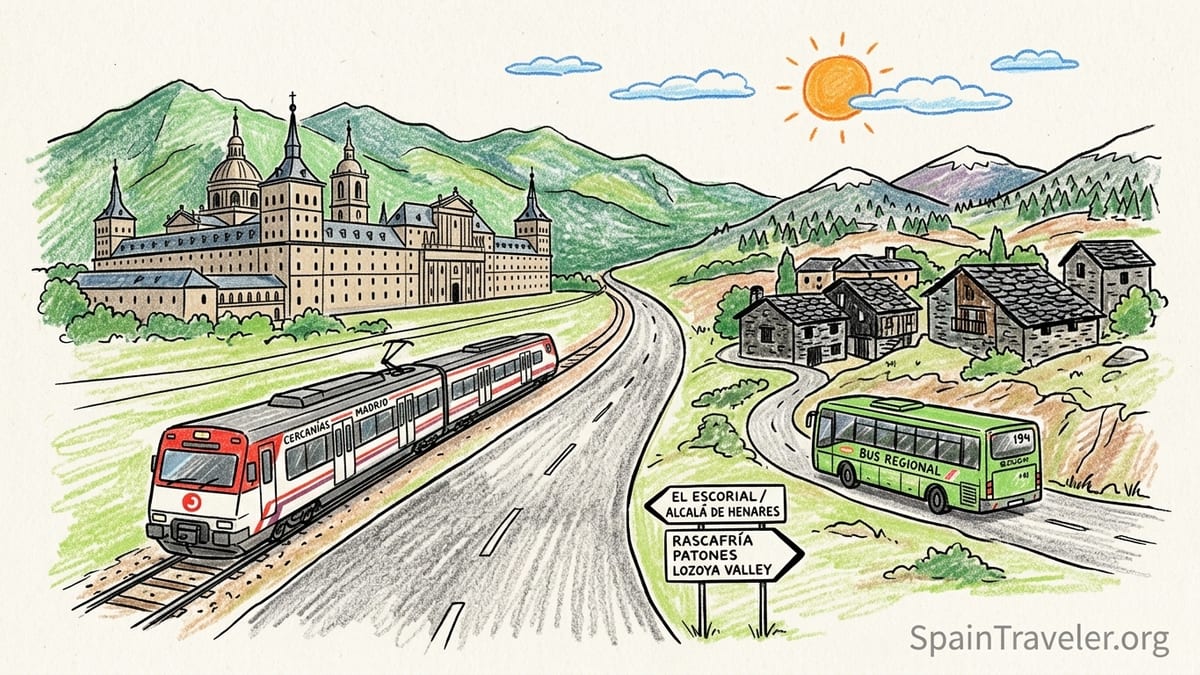
How I Actually Traveled Around the Community of Madrid
Over several years based in Madrid, I made a point of exploring the region slowly rather than ticking off every excursion in a single visit. I typically had one or two free days at a time, which meant choosing carefully: should I take the Cercanías train to a World Heritage town like Aranjuez or El Escorial, or spend that same day lingering in a smaller village like Patones or Buitrago del Lozoya? The result was a patchwork of trips that ranged from fast four-hour visits to full weekends, each giving me a clear sense of what felt rushed and what justified an overnight.
In practical terms, I relied heavily on Cercanías commuter trains for the big heritage hubs such as Alcalá de Henares, Aranjuez and El Escorial. All three are explicitly promoted by Madrid’s tourism authorities as easy day trips on the suburban rail network, with most trains funneling through Atocha and Chamartín stations. Services have been undergoing upgrades in recent years, and while there have been temporary disruptions around Atocha, the appeal of stepping on a commuter train and stepping off in a former royal residence or university city remains strong.
For smaller villages and nature escapes, I depended on the regional interurban buses that fan out from hubs like Plaza de Castilla and Conde de Casal. Rascafría and the Lozoya Valley are linked to Madrid by the 194 bus from Plaza de Castilla, while Patones de Arriba is reached by a combination of buses that climb into the northern hills. These services are affordable and integrated into the regional transport system, but they involve longer journey times and less frequent evening departures than the trains. That reality shaped how long I stayed in each place and whether I treated it as a day trip or committed to a night or two.
What follows is not an exhaustive catalogue of every town in the Community of Madrid, nor a marketing list of all eleven official Villas de Madrid. Instead, it is a personal short list of places where I have actually set foot, ordered coffee, watched the light change in the main square and, in several cases, dragged a suitcase over cobblestones to stay the night. I include both the headline destinations and a few quieter corners that competed surprisingly well with the UNESCO giants.
Alcalá de Henares: University City With True Evening Life
My first serious foray outside central Madrid was Alcalá de Henares, a university city east of the capital and one of Spain’s UNESCO World Heritage Sites. I have visited Alcalá three separate times, twice as long afternoons of about six hours and once as a one-night stay, which allowed me to see the city both as a day-tripper and as an overnight guest. All three visits confirmed Alcalá as the heritage town in the Madrid region where I would most happily linger without feeling like I should rush back for the last train.
Reaching Alcalá is straightforward on the Cercanías network. Trains on the C-2 and C-7 suburban lines connect Madrid with Alcalá in roughly 40 minutes from Atocha, with intermediate stops that make it feel like an everyday commuter run rather than a special excursion. Because it is on a busy corridor, frequencies are generally good throughout the day, although temporary timetable changes can occur when infrastructure work is underway. That easy rail link was part of the reason I felt comfortable staying into the evening on my first visit, knowing I could still get back to Madrid without too much stress.
As a university and heritage city, Alcalá delivers a very specific experience: arcaded streets filled with students, brick and stone colleges, and a compact historic center where you can walk from the Cervantes birth house to the old university courtyard in minutes. On my day trips I focused on the core sights around Plaza de Cervantes, the university buildings and the cathedral, and six hours felt enough to see the main monuments and sit down for a leisurely lunch. However, my overnight stay revealed a different side of the city. Once the bulk of day-trippers left on the early evening trains, the streets did not go quiet. Instead, the cafés and bars around Calle Mayor filled with local students, giving the evening a relaxed but lively energy that is rare in smaller towns tied mostly to tourism.
For most travelers, Alcalá works very well as a long day trip, especially if you catch a mid-morning train and plan to return after dinner. I did not feel rushed with six to eight hours, and the presence of frequent trains meant I could improvise a little. That said, if you want to feel the rhythm of a genuine university town, staying one night is worthwhile. The city is not primarily a nature escape or wine town; its appeal lies in architecture, history and an evening atmosphere that remains local after the UNESCO tour groups have left.
Aranjuez: Royal Landscape That Shines as a Long Day Trip
Aranjuez is where I first understood what people mean when they call the Community of Madrid a royal landscape. Set in the fertile plain of the Tagus River, this former spring residence of the Spanish monarchy is another UNESCO-listed cultural landscape and an easy train ride south from Madrid. I have made two full-day trips here, each running to about nine hours on the ground, and both times I returned to the city center feeling pleasantly tired but also convinced that a same-day return to Madrid was the right choice for me.
The town is linked to Madrid by the C-3 Cercanías line, which runs from Aranjuez to Chamartín via Atocha and several southern suburbs. Travel time from Atocha is usually around 45 minutes, though during recent works some services have terminated short of central Madrid, requiring a transfer. On my visits, I left Madrid mid-morning and arrived in time for a coffee near the station before walking to the Royal Palace and formal gardens. The walk itself, through tree-lined avenues and planned streets, is a good preview of Aranjuez’s identity as a designed royal town rather than a medieval tangle.
In terms of experience, Aranjuez offers monumental scale: a large palace, wide boulevards, and broad riverside gardens that can absorb crowds. On spring weekends the palace and its grounds are undeniably busy, with tour groups queuing for timed entry and local families picnicking by the Tagus. I found the central part of the day quite crowded, but there was ample room to retreat into the less formal gardens or wander further along the river paths where small rental boats and seasonal riverside bars add a modest resort feel. Prices for palace entry and guided visits are set by national heritage authorities and can change, so it is worth checking them shortly before travel rather than relying on old guidebooks.
Both of my visits ended with an early evening stroll through the historic grid of streets, where the atmosphere softened as day visitors drifted back to the station. Outdoor terraces remained active, particularly around the central squares, yet the town never felt as lively at night as Alcalá. That was part of why I never seriously considered staying over. For me, Aranjuez is at its best as a day trip that fills almost an entire day, combining palace visits, long garden walks and an unhurried lunch. It is grand and impressive, but the focus on monumental heritage over lived-in nightlife meant that, once the palace closed, I was content to head back to Madrid.
San Lorenzo de El Escorial: Monastery Powerhouse With Trade-Offs
San Lorenzo de El Escorial, often shortened simply to El Escorial, is another of the Community of Madrid’s showpiece excursions. Centered on the vast royal monastery and palace complex in the foothills of the Sierra de Guadarrama, it offers a mixture of royal history, religious architecture and mountain air just far enough from Madrid to feel like a change of climate. I have been twice, both times as day trips of around eight hours, using a mix of Cercanías rail and regional bus.
Traditionally, the C-3a and later C-8 lines linked Madrid with El Escorial on the suburban rail network, with trains taking roughly an hour from Atocha or Chamartín to reach the town. While services and line designations have changed over the years, the basic pattern remains: El Escorial is tied into the Cercanías system, and trains connect it to the capital alongside regular regional and long-distance services. On one visit I went by train and walked uphill from the station to the monastery, a steady climb that takes about 15 to 20 minutes. On another, I used a bus from Moncloa, which dropped me closer to the historic center but involved more time in road traffic.
The monastery itself is one of the most imposing buildings in the region, and that scale comes at a cost in terms of crowds. On my first trip, arriving late morning on a Saturday, the ticket lines and interior spaces were busy, with guided groups moving through the main cloisters and royal apartments. Audio guides and printed panels help you navigate, but there is no escaping the sense that you are sharing the building with hundreds of other visitors. The surrounding town, however, felt calmer, with cafés on sloping streets and small shops that still serve local residents rather than only souvenir hunters.
I found eight hours enough time to visit the complex, wander through the terraced gardens and enjoy a long lunch with views toward the mountains. The evening atmosphere in San Lorenzo de El Escorial was pleasant but not especially animated. Restaurants and bars stayed open, and locals were out for a paseo, yet by the time I caught a mid-evening train back to Madrid the streets were already thinning out. For many travelers, this makes El Escorial an ideal long day trip, especially combined with a short hike on the nearby trails. If you are particularly interested in monastic history or want to pair the monastery with mountain walks at higher altitude, an overnight could make sense, but the crowds and monument-centric focus meant I personally did not feel a strong pull to stay longer.
Rascafría and the Lozoya Valley: Nature Escape Worth a Night
Of all the official Villas de Madrid, Rascafría is the one that most surprised me and the place where I most clearly felt that a single day was not enough. Tucked into the Lozoya Valley in the Sierra de Guadarrama at roughly 100 kilometers north of Madrid and over 1,000 meters above sea level, it is promoted by both regional tourism and protected area authorities as a gateway to forests, rivers and high mountain trails rather than a purely monumental town. I have spent two weekends here, each time staying two nights, and on both occasions I left thinking I could easily have added a third.
Reaching Rascafría without a car requires committing to the bus. The 194 line runs from Plaza de Castilla in Madrid up the A-1 motorway and into the Lozoya Valley, connecting a series of villages before arriving in Rascafría itself. Regional information describes this as the main public transport link between the capital and the valley, and in my experience the journey takes around two hours, depending on traffic. Once in Rascafría, a local service links the village with the Monasterio de El Paular and the Puerto de Cotos in season, which opens up higher altitude walks and winter access. These bus schedules can be sparse outside weekends and holidays, which is one of the main reasons I prefer to stay at least one night.
Rascafría is not about a single blockbuster monument, although the El Paular monastery, the Puente del Perdón bridge and the nearby Bosque Finlandés create a strong historical and scenic core. On my visits, I spent long hours walking along the banks of the Lozoya River, following waymarked trails that lead through pine and oak woods, and taking on the popular route to the Cascadas del Purgatorio waterfalls. Local maps and visitor information emphasize the valley’s role as part of the Sierra de Guadarrama protected area, with trails that connect to high points like Peñalara, the highest peak in the region. Spending two full days, rather than one, allowed me to mix a serious hike with easier riverside walks and time simply sitting in the main square with coffee.
The evening atmosphere in Rascafría is quiet and distinctly serrano. On both weekends I stayed, restaurants around the main street and plaza were busy at Spanish dining hours, with families and groups of hikers lingering over set menus that often highlighted local game, mushrooms in season and grilled meats. After dinner the village calmed quickly, especially in colder months, and by midnight the streets were largely empty. This suited me perfectly after long days of walking, but anyone looking for nightlife beyond a final drink at a bar might feel restless. As a nature escape and mountain village experience, however, Rascafría rewards at least one night, preferably two, far more than a quick day trip that would spend almost as much time on the bus as on the trails.
Patones de Arriba and the Northern Hills: Small-Scale, High Reward
Where Rascafría offered forests and monastery architecture in a deep valley, Patones de Arriba provided a contrasting kind of escape: a compact mountain village of black slate houses perched above the Jarama basin, with steep lanes and dramatic views. Patones is not one of the official eleven Villas de Madrid, yet it has become one of the region’s emblematic villages thanks to its unique vernacular architecture and photogenic setting. I have visited Patones twice, both times as day trips of roughly seven hours door to door, and each visit reinforced my sense that it punches above its weight in terms of atmosphere.
Getting there involved more logistics than the direct trains to the bigger towns. From Madrid’s Plaza de Castilla interchange, I took an ALSA-operated interurban bus toward the northern villages, with services that stop at Patones or nearby Torrelaguna. In my case, this meant riding a mainline bus and then transferring to a smaller local service that climbs the final stretch to Patones de Arriba. Regional transport maps list routes such as the 913 or similar as serving this section, with timetables that require paying attention if you want to avoid long waits. Because of this, I treated Patones strictly as a daytime outing, making sure to plan my return bus before lingering too long over lunch.
Once in Patones de Arriba, the experience is all about scale and texture rather than big-ticket monuments: narrow stone alleys, terraced viewpoints, and a ring of short walking paths that loop into the surrounding hills. Compared with the UNESCO sites, the built heritage is modest, yet I found the village more rewarding in some ways because I could slow down without feeling guilty about skipping yet another chapel or museum. On both visits I spent about four hours in the village itself, splitting time between short walks, photography, and a leisurely meal on a terrace that looked across the valley. The limited number of streets means you can walk the entire village in less than an hour, but the setting encourages you to repeat routes at different times of day to watch the changing light.
Evenings in Patones de Arriba are reputedly atmospheric, with a few rural guesthouses and restaurants serving overnight guests, but I have not stayed the night. Late afternoon already had a distinctly peaceful feel once lunch crowds left, and by the time I boarded my return bus the village was settling into a quiet that felt more suited to a rural weekend stay than a late-night scene. For me, Patones is the classic example of a place where the lack of major monuments is more than offset by character. If you have a car or are comfortable with rural bus timetables, an overnight could deepen the experience, but for most travelers a well-planned day trip will capture the essence of this mountain village escape.
Chinchón and the Southern Wine Country: More Than a Famous Plaza
Chinchón occupies a unique place in the mental map of Madrid residents. It is both an official Villa de Madrid and one of the most instantly recognizable towns in the region, thanks to its asymmetric Plaza Mayor lined with wooden balconies that double as viewing stands when the square is used for bullfights and festivals. I have been to Chinchón three times so far, twice as classic day trips of about eight hours each and once as a one-night stay that let me experience the plaza after the last excursion bus left.
Without a car, the go-to way to reach Chinchón is by interurban bus from Madrid’s Conde de Casal transport hub. The 337 line connects the city with towns in the southeast, including Chinchón and Colmenar de Oreja, and operates with a mix of regular and semi-express services. On my visits, journey times from Madrid to Chinchón ranged around one hour, depending on traffic. Because the bus continues on to smaller towns, I always checked the destination board carefully and asked the driver to confirm the stop. Fares fall within the integrated regional tariff system, which keeps costs manageable compared with private tours that run similar routes.
Most visitors, including me on my first trip, come primarily for the square. During busy weekends and festival days, the Plaza Mayor can feel almost theatrical, with restaurant terraces filling most of the open space and visitors circling for photos of the green-painted balconies. On my longer stay, however, I discovered that Chinchón offers more than this one scene. The church and castle above town provide views over the surrounding countryside, and local tourism materials emphasize the area’s winemaking and production of anisette, along with connections by road and bike routes to nearby wine towns like Colmenar de Oreja. I spent part of one day visiting small bodegas just outside town, which grounded the visit in the wider agricultural landscape rather than just the iconic square.
Chinchón’s evening atmosphere changed dramatically depending on whether I stayed or left. On day trips, I tended to catch a late afternoon or early evening bus back to Madrid, which meant experiencing the plaza at its busiest, full of diners and excursion groups. During my overnight stay, by contrast, the square grew much quieter after 10 p.m., with mainly local families and overnight visitors lingering over dessert. Street lighting on the arcades and balconies gave the scene a soft, warm tone, and the absence of crowds made it feel like a completely different town. For travelers who value atmosphere as much as sightseeing, I would strongly recommend at least one night in Chinchón, ideally paired with a visit to nearby wine-producing villages if schedules permit.
Buitrago del Lozoya and Manzanares el Real: Two Sierra Gateways Compared
On the northern edge of the Community of Madrid, the official Villas de Madrid of Buitrago del Lozoya and Manzanares el Real both serve as gateways to the Sierra de Guadarrama and adjacent natural areas. I visited each of them on separate occasions, once spending about six hours in Buitrago and twice making five-to-seven-hour day trips to Manzanares el Real. Both towns gave me a clear sense of how smaller heritage centers can rival more famous sites in overall satisfaction, even when they lack global name recognition.
Buitrago del Lozoya, reached by interurban bus along the A-1 corridor, is a walled town perched above a river meander, with stone ramparts that enclose a compact historic quarter. On my visit, I arrived around late morning and spent the day walking the walls, exploring the churches and small museums, and watching local life in the main square. Compared to the queues and noise I had experienced in Aranjuez or El Escorial, Buitrago felt calm. The tourist presence was there, notably on weekends and during cultural events that the regional government highlights, but the overall scale was more human. The trade-off is that there are fewer formal attractions and limited evening options, which is why I treated it as a day trip rather than an overnight.
Manzanares el Real, also designated as a Villa de Madrid, offered a different profile. Reached from Madrid by bus along the northern axis, the town is dominated by a remarkably well-preserved castle and sits on the edge of the rocky landscape of La Pedriza, one of the most striking parts of the Sierra de Guadarrama. I visited twice, once focusing on the castle and the lakeside promenade, and another time using the town as a launching point for a hike into the granite formations. In terms of pure scenery, Manzanares delivered some of the best views I have found near Madrid, with massive boulders and cliffs visible directly from town.
In both places, the evening atmosphere felt limited compared to larger towns. Buitrago’s bars and restaurants clustered around the main square and lower streets, and on my visit things quieted noticeably by around 9 or 10 p.m. Manzanares had a bit more movement thanks to the weekend hikers and day-trippers from Madrid, but by the time I caught my evening bus back, most shops were closed. For this reason, I would recommend both Buitrago and Manzanares primarily as day trips, unless you are specifically looking for a very quiet overnight base to access mountain trails. The absence of large crowds, particularly in Buitrago, made them feel more rewarding in some ways than the monumental UNESCO sites, even though the number of individual attractions is smaller.
The Takeaway
Looking back at my time exploring the Community of Madrid, the places that stand out most are not only the biggest names, but the ones where my time on the ground matched the character of the destination. World Heritage towns like Alcalá de Henares, Aranjuez and San Lorenzo de El Escorial absolutely deserve their status, and with good use of Cercanías trains and regional buses they are straightforward to visit. Yet their scale and popularity also mean they are at their busiest in the middle of the day, and you share them with many other travelers. I rarely felt short of things to do, but I did sometimes feel short of personal space.
In contrast, smaller towns and villages such as Rascafría, Patones de Arriba, Buitrago del Lozoya, Manzanares el Real and Chinchón delivered experiences that were less about checklist sightseeing and more about place. In Rascafría, two-night stays allowed me to connect with the rhythms of a mountain village and explore the protected landscapes of the Lozoya Valley without rushing from bus to trailhead. In Patones, a few unhurried hours among slate houses felt as memorable as any palace facade. Buitrago and Manzanares gave me walled streets and castles in settings that never felt overwhelmed, while an overnight in Chinchón transformed a busy excursion town into a tranquil wine-country hub.
If I had to prioritize with only a few days available, I would recommend at least one serious nature escape with an overnight stay in Rascafría or the northern hills, one university or heritage town such as Alcalá where you can enjoy true evening street life, and one royal landscape like Aranjuez or El Escorial to understand Madrid’s historic reach. The transport network of Cercanías trains and interurban buses makes this mix realistic without a car, as long as you check current schedules and allow extra time for connections. Above all, I would resist the temptation to treat the Community of Madrid as only a checklist of day trips from the capital. Giving even one destination an extra night can turn a quick excursion into a real memory.
FAQ
Q1. Is it realistic to visit Alcalá, Aranjuez and El Escorial as separate day trips from Madrid?
Yes, all three are realistic day trips on Cercanías trains or regional buses, but trying to combine more than one of them in the same day usually feels rushed and undermines the experience.
Q2. Which place in the Community of Madrid is best for a quiet nature-focused weekend without a car?
Based on my own stays, Rascafría in the Lozoya Valley is the strongest choice, thanks to regular bus connections from Plaza de Castilla and direct access to forests, riverside trails and the El Paular area.
Q3. If I only have one spare day in Madrid, should I pick a UNESCO site or a smaller village like Patones?
If you value grand architecture and formal history, a UNESCO site such as Aranjuez or El Escorial is the safer choice. If you prefer atmosphere and short walks in a rural setting, Patones de Arriba can be more rewarding despite its smaller scale.
Q4. Does it make sense to stay overnight in Chinchón instead of returning to Madrid the same day?
Yes, staying one night changes the atmosphere completely. The Plaza Mayor becomes much quieter after day-trippers leave, and you can enjoy the square and nearby viewpoints without crowds.
Q5. Are public transport services to Rascafría and the northern mountains reliable enough for hiking trips?
The main bus routes operate regularly, but they are less frequent than suburban trains, especially early and late in the day, so hikers should check current timetables and plan returns conservatively.
Q6. Which town in the region offers the best combination of heritage sites and evening street life?
From my experience, Alcalá de Henares offers the best blend, with significant historic buildings, a UNESCO-designated center and a genuine student-driven evening scene that continues after visitors leave.
Q7. How crowded are the major royal sites like Aranjuez and El Escorial on weekends?
On spring and autumn weekends they can be quite crowded around late morning and early afternoon, especially in palace interiors and main gardens, so arriving earlier in the day generally makes the visit more comfortable.
Q8. Is Patones de Arriba suitable for travelers who are not comfortable driving in Spain?
Yes, it is possible to reach Patones de Arriba by a combination of interurban buses from Madrid, but the need to connect and the limited frequency mean that careful timetable planning is important if you are not driving.
Q9. For castle enthusiasts, is it better to prioritize Buitrago del Lozoya or Manzanares el Real?
Manzanares el Real offers a particularly striking castle in excellent condition and dramatic natural surroundings, while Buitrago combines its walls and smaller fortifications with a quieter riverside setting.
Q10. How many nights would you personally allocate to the Community of Madrid beyond time in the capital?
Given my experiences, I would allocate at least three extra nights: one in a university or heritage town, one or two in a nature-focused village like Rascafría, and several separate day trips from Madrid.