

I first came to Madrid thinking the real trip would happen inside the capital. On my most recent stay, I had ten days in total: six nights based near Atocha for museums, food and nightlife, and four nights deliberately set aside for the wider region. I split those four nights between a rental apartment in Alcalá de Henares, two nights in the Sierra de Guadarrama, and a final night in a wine town to the south-west. Across several visits I have zigzagged through the Community of Madrid by Cercanías commuter trains, interurban buses from Moncloa and Plaza de Castilla, and, on one trip, three slightly stressful days with a hire car. I arrived expecting an easy ring of half-day trips around Madrid. What I found instead was a patchwork of royal sites, medieval towns, high mountains, wine country and very quiet villages that reward slowing down and choosing carefully.
Leaving Madrid: When the Region Finally Clicks
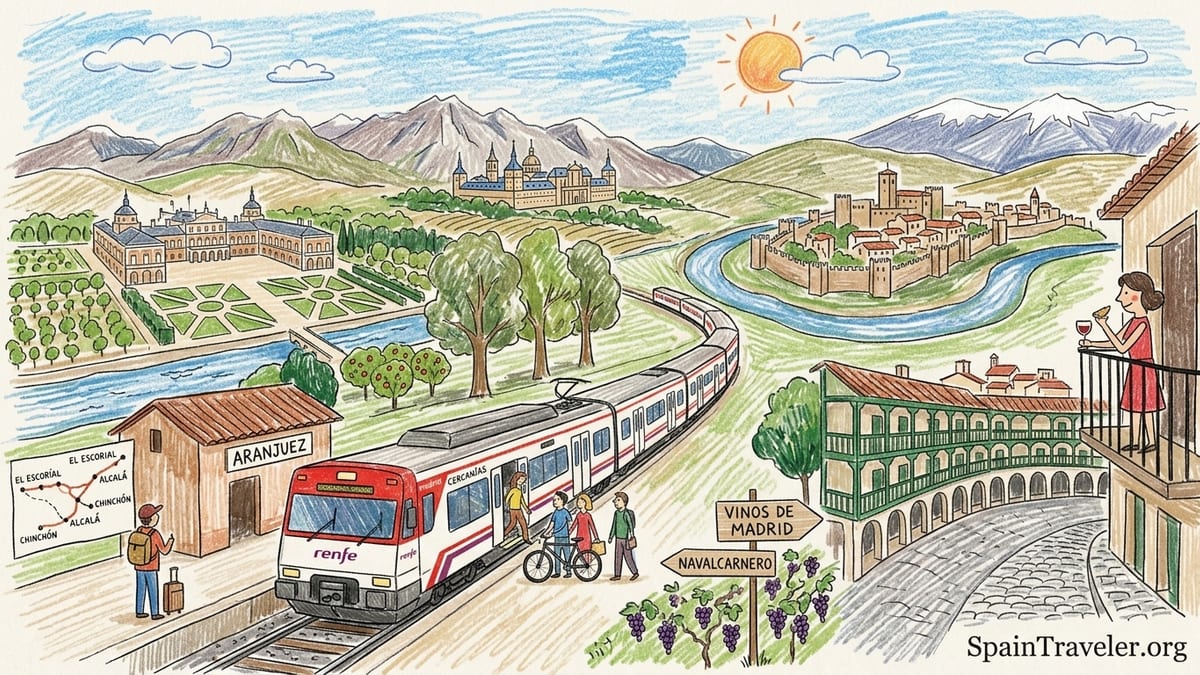
I only really understood the Community of Madrid the first time I left Atocha on a Cercanías train without plans to rush back for sunset drinks in Malasaña. That day I was heading to Aranjuez, about 50 minutes south on the C-3 line, lured by photos of the Royal Palace and gardens. The commuter train felt like any suburban journey at first, with office workers scrolling on their phones, but the landscape outside gradually shifted to flat fields, irrigation channels and the first hints of orchards along the Tagus basin. By the time I stepped out at Aranjuez station, my mental map of “Madrid” had stretched far beyond the Gran Vía skyline.
On later trips I followed the tracks in other directions: north-west to El Escorial and the granite foothills of the Sierra de Guadarrama, east to the university city of Alcalá de Henares, and by bus to Buitrago del Lozoya and Rascafría in the mountains. Each journey took between 40 and 90 minutes, and each felt like opening a new chapter: medieval walls, royal avenues lined with plane trees, ski slopes and pine forests, river valleys and eventually the vineyards near Navalcarnero and Chinchón. The distances are modest, but the contrast with the capital is dramatic.
What changed my perception most was not one single “wow” moment but the rhythm of daily life. In central Madrid at 22:30 on a Tuesday, restaurants are humming and people are still ordering their first round of tapas. In small towns like Navalcarnero or Chinchón, by that same hour on a weeknight in October, the main square often feels half asleep, with a handful of locals lingering over their last coffee or copa. That change of pace is exactly what many travelers are seeking, but it surprised me at first and forced me to plan evenings, transport and even grocery runs differently.
Over several visits, I also learned the limits of assuming that every place in the region can be treated as a quick detour. My attempts to combine Aranjuez and Chinchón in one day, or to rely entirely on buses for a rural hike in the Sierra Norte, turned into long days of clock-watching and tight connections. The Community of Madrid offers a lot that the city does not, but it rewards committing to fewer destinations and giving them time.
Royal Landscapes: Aranjuez and El Escorial
Aranjuez and San Lorenzo de El Escorial are the two royal pillars of the region, and they illustrate better than anywhere else how the Community of Madrid extends far beyond urban life. Aranjuez sits at the confluence of the Tagus and Jarama rivers. Its 18th century Royal Palace and geometric gardens form a cultural landscape that mixes grand architecture with orchards, riverside paths and historic irrigation systems. Walking from the station, I followed straight boulevards planted with plane trees toward the palace, then spent hours crossing bridges and shaded alleys that felt a world away from city traffic.
Practically, Aranjuez is one of the easiest day trips from Madrid without a car. Cercanías line C-3 connects Atocha and other central stations with Aranjuez in under an hour, and trains usually run two or three times per hour at peak periods. I used a standard commuter ticket loaded onto a reusable contactless card sold by Renfe, which for the outermost suburban zones is currently a little over 4 euros one way. On a Saturday in May, my morning train was busy but not uncomfortable, with families carrying picnic bags and cyclists heading for the river paths. Returning late afternoon, there was a brief crush on the platform as day trippers lined up for the same hourly departure, so arriving ten minutes early helped secure a seat.
San Lorenzo de El Escorial demands a slightly different approach. The enormous Escorial monastery and royal complex sits in the foothills north-west of Madrid, framed by scrubby hills and granite outcrops. To reach it, I took a Cercanías train toward El Escorial from Nuevos Ministerios. The journey took just under an hour, but a crucial detail is that the station is in the modern town of El Escorial. From there it is a 15 to 20 minute uphill walk or a short local bus ride to the historic center of San Lorenzo and the monastery entrance. On my first visit I underestimated this, arrived at midday in July, and trudged up in 35 degree heat with little shade.
Both royal sites suffer from weekend crowds, especially on free-entry days and during spring and autumn holidays. At El Escorial on a Sunday, queues to enter the basilica and royal pantheon snaked across the courtyard by late morning. If you want quieter conditions, midweek mornings are best, and winter visits can be atmospheric, though colder than Madrid city. Up in San Lorenzo, wind and sleet in January made the arcades a welcome refuge after exploring the grey stone courtyards. Even then, the view from the terraces back toward the snow-dusted peaks of Guadarrama underscored how much wilder the region becomes once you leave the ring road.
Medieval Towns and University Streets: Alcalá, Chinchón and Buitrago
For many travelers, the great discovery beyond Madrid is how much medieval and early modern heritage is packed into compact, walkable towns. Alcalá de Henares, east of the capital, was my base for two nights on one trip and quickly emerged as my favorite blend of history and daily life. This UNESCO listed university town, birthplace of Miguel de Cervantes, is linked to Madrid by Cercanías lines that run at least twice an hour from Atocha and Chamartín, with a journey time of around 40 minutes. I arrived on a weekday afternoon to find students spilling out of lecture halls onto arcaded streets and families strolling the main Calle Mayor.
Staying overnight in Alcalá rather than visiting as a rushed half-day changed everything. I was able to see the university’s historic courtyards in the quiet of the morning, visit the Cervantes Birthplace Museum without long waits, and still have time for a long lunch of roasted meats and local pastries. After sunset, the city emptied of many day trippers but bars near Plaza de los Santos Niños remained lively, a gentler, more local version of Madrid nightlife. Trains back to the capital run until late evening, but I appreciated not having to check a timetable every hour.
Chinchón, about 45 kilometers south-east of Madrid, offers a very different mood. The star is its Plaza Mayor, a sloping oval ringed with wooden balconies painted in green, where cafés, restaurants and occasional bullfighting events share the same historic stage. The town is surrounded by low hills, olive groves and vineyards. Official tourism information for the region highlights its anisette liqueur, garlic fair and theatre festival, but for a visitor the simple pleasure is sitting on the square with a coffee, watching locals cross from one arcade to another while the church towers over the rooftops.
Chinchón is technically reachable by interurban bus, with services from Conde de Casal in Madrid that usually take about an hour. However, frequencies can thin out in the middle of the day and on Sundays outside peak season. On one October weekday I misjudged the return and discovered a mid-afternoon gap of more than ninety minutes between buses. The plaza that felt charming at noon became almost deserted by 17:00, shutters half closed and terraces packing up. That experience convinced me that Chinchón rewards either renting a car for the day, so you can also explore nearby wine country, or staying overnight in one of the small guesthouses so you are not at the mercy of a limited timetable.
Further north, the walled town of Buitrago del Lozoya on the A-1 corridor offers another medieval layer. Its stone ramparts loop around a bend of the Lozoya River with the Sierra Norte rising behind. Here, there is no rail link, only buses from Plaza de Castilla in Madrid, operated under the regional transport authority. The ride can take roughly an hour on the direct lines and longer on stopping services. I visited on a December weekday and found a quiet old quarter of stone alleys, a small Picasso museum and broad views from the walls. By mid-afternoon, many small shops had closed and, outside summer or festival weekends, the town felt very tranquil. It was a revealing counterpoint to the energy of Madrid’s center and a reminder that rural tourism in the region still runs on local schedules.
Mountains, Snow and Summer Heat in the Sierra de Guadarrama
The most dramatic physical contrast with Madrid city comes in the Sierra de Guadarrama, the mountain range that forms the northern edge of the region. From the city’s rooftops the peaks look distant, but a Cercanías train or a bus from Moncloa gets you to proper high-country landscapes in under ninety minutes. On different trips I based myself in Cercedilla and Rascafría for hiking and fresh air, and both felt like entirely different climates compared with the city.
Cercedilla, reached by Cercanías from Atocha and Chamartín on lines heading toward the C-8 branch and beyond, sits around 1,200 meters above sea level. In July, when Madrid lingered above 35 degrees, Cercedilla’s afternoons were hot but tolerable, with nights cool enough for a light jacket. Trailheads into the Fuenfría valley and pine forests start near the station itself, and local buses connect to higher passes and ski areas in season. On a winter visit in February, light snow still clung to shaded slopes and trails above town, temperatures dropped below freezing at night, and many rural guesthouses took a midweek break. Planning around these seasonal closures becomes essential if you rely on restaurants rather than self-catering.
Rascafría, in the Lozoya Valley, is not on the rail network. I reached it by taking a commuter bus from Plaza de Castilla to Buitrago and then a regional connection, although there are also more direct services depending on the day and season. The journey climbed steadily into a landscape of meadows, rivers and conifer forests, the kind of scenery you might expect much farther from a major capital. Winter here brings real snow; on one January morning the road edges were piled with plowed drifts while the town streets were slushy underfoot. Hikers in the Sierra de Guadarrama National Park need to be ready for genuine mountain conditions: sudden wind, icy trails and early nightfall, even while Madrid down on the plateau enjoys clear blue skies and outdoor café culture.
In summer, the mountains act as a collective escape valve for city residents, especially at weekends. Buses from Moncloa toward Navacerrada and the high passes fill early, and many car parks for popular hiking areas reach capacity by late morning. On a Sunday in late June, arriving by car to a trailhead near Cotos just before 10:00, I found the main parking area already almost full and a queue building at the access road. The lesson was simple: arrive early, consider traveling midweek outside school holidays, and be prepared to walk a little farther from secondary parking areas if you value peace.
Wine Villages and Rural Quiet: Navalcarnero and Beyond
South-west of Madrid, the landscapes flatten into open fields, small valleys and low hills planted with vines. This is the heart of the Vinos de Madrid denomination’s Navalcarnero subzone, which includes nearly twenty municipalities and several recognized wineries. Here, the attraction is less about a single monument and more about the atmosphere of small plazas, cellars and countryside. Navalcarnero’s historic center, built around Plaza de Segovia, mixes painted façades, arcades and small chapels, while surrounding countryside holds vineyards that feed both local cooperatives and family-run wineries.
On one trip I rented a car for three days specifically to explore this wine country and a cluster of towns that are poorly linked by rail, including Navalcarnero, some smaller villages along the Guadarrama and Alberche rivers, and a stop in San Martín de Valdeiglesias near the border with Ávila. The first surprise came before I even left Madrid: navigating out of the city on the A-5 in morning commuter traffic was stressful, and construction works related to burying parts of the highway around Móstoles and Alcorcón created confusing diversions. Once beyond the suburbs, driving became easier, but parking in historic centers brought new challenges.
Navalcarnero’s core is a compact maze of one-way streets, pedestrianized segments and short-term parking zones. During a weekday morning in November I eventually found a legal space on the edge of the center and walked ten minutes into town, but on a Saturday afternoon in late spring, arriving just before 14:00, on-street spaces were packed with diners and winery visitors. Several small lots near the center filled quickly before lunch. My mistake was assuming I could simply “swing through” multiple wine villages in one day. In reality, each deserved a long lunch and unhurried stroll, and the logistics of moving between them, finding parking and adjusting to their quieter pace meant that two towns per day felt ambitious.
These rural areas also illustrated another contrast with the city: restaurant hours and evening life. In Madrid, kitchens often stay open through the afternoon, and you can find dinner almost any time after 20:30. In smaller wine towns, I discovered that many restaurants stop serving lunch orders by about 15:30, then close until around 21:00. On one weekday in a village near Navalcarnero, my plan for an early dinner at 19:30 failed entirely; the main square was empty, shutters down, and the only open establishment was a small bar serving drinks and cold tapas. Travelers without a car should also factor in that rural buses are typically infrequent at night, which makes staying overnight and embracing the slower rhythm more attractive than trying to commute back to the capital.
Transport Lessons: Trains, Buses and When a Car Helps
If there is one practical lesson from exploring the Community of Madrid, it is that transport decisions shape your entire experience. The Cercanías rail network is an efficient backbone for visiting larger satellite cities like Alcalá de Henares, Aranjuez, El Escorial and the foothills of the Sierra de Guadarrama. Trains are relatively frequent, fares within the region are modest for the distances covered, and stations often lie within walking distance of historic centers. For these rail-connected destinations, renting a car felt unnecessary in hindsight. On one trip I booked a vehicle simply out of habit, only to discover that I was paying extra to battle city traffic and search for parking in places that already had good train links.
Buses fill in the gaps, especially toward the northern mountains, the Sierra Norte and some rural valleys. From Moncloa, Plaza de Castilla and other major hubs, interurban lines run to Buitrago del Lozoya, Rascafría, Navacerrada and many small communities that would otherwise be difficult to reach. Prices are generally lower than equivalent train journeys, but journey times can be longer and subject to congestion at peak holiday times. During a peak August event in the mountains, regional authorities even reinforced certain lines from Plaza de Castilla to handle the surge of visitors heading to rural observation points, which shows how dependent these areas are on bus connections.
For deeply rural itineraries that involve multiple villages in a single day or irregular hiking trailheads, a car can still be worth the cost. My days exploring the wine routes south-west of Madrid and smaller hamlets in the Sierra Norte would have been extremely awkward with public transport alone, given services that might run only every two or three hours outside commuter peaks. Even then, I learned quickly that “having a car” does not mean instant mobility in historic centers. Narrow medieval streets, access restrictions, and limited parking mean that you often leave the vehicle on the outskirts and continue on foot.
I also made mistakes in assuming that combining certain destinations in one day would be easy. Attempting to visit both Aranjuez and Chinchón on the same Saturday, I took a morning Cercanías to Aranjuez, walked the palace gardens in the heat, then aimed to catch a mid-afternoon bus to Chinchón from a nearby town. A delayed connection meant I arrived in Chinchón just as many restaurants were finishing lunch service, then faced a long wait for the evening bus back to Madrid. Theoretically it was possible; in practice it turned into a day of watching timetables more than enjoying plazas. The lesson was to treat each major heritage town or landscape as a full day, or better yet, an overnight stay.
What the Region Offers That Madrid City Does Not
The Community of Madrid’s tourism campaigns often underline a mix of culture, nature, picturesque towns, family travel, gastronomy and sport. After spending time both in the capital and across the region, it becomes clear that these are not abstract marketing words but distinct experiences that Madrid city alone cannot fully deliver. The first and most obvious difference is landscape. Within an hour you can move from the dense, stone-and-tile city grid to irrigated orchards, river meadows, vineyards, oak scrubland and high granite peaks with snow. That physical variety shapes everything from climate to cuisine and outdoor activities.
Nature is the region’s trump card. While Madrid’s city parks are beautiful, hiking through the Sierra de Guadarrama or wandering river paths in Aranjuez and the Lozoya valley brings a sense of space and silence that is rare inside the M-30 ring road. Families can swap sidewalks for forest trails, simple picnic areas and even small ski areas in winter, all without needing a long-distance road trip. For visitors already spending several days in the city, a day or two in the mountains can rebalance the trip, especially during hot months when the temperature difference between downtown and higher elevations is striking.
Culturally, the region’s smaller towns bring Spanish history into sharper focus. In Alcalá de Henares you can literally walk through the courtyards where Spain’s early modern university tradition flourished, then step across to the house that celebrates Cervantes. In San Lorenzo de El Escorial, climbing the stone staircases of the monastery and looking out at the bare hills explains why the Habsburg court chose this austere setting. Chinchón’s sloping plaza, Buitrago’s riverside walls and Navalcarnero’s modest chapels all tell stories of rural life, religious festivals and centuries of adaptation that you rarely glimpse in Madrid’s grand boulevards alone.
Gastronomy also takes on a different character outside the capital. Madrid city offers cuisine from across Spain and the world, but in the region you start to notice specific local produce: wines bearing the Vinos de Madrid label from subzones such as Arganda, Navalcarnero, El Molar and San Martín de Valdeiglesias; hearty stews suited to cold mountain winters; roasts and grilled meats in town taverns; and small-batch sweets and liqueurs, like Chinchón’s aniseed spirit or pastries tied to local convents. Visiting wineries and small producers in person, tasting in their own cellars or simple courtyards, provides a grounded understanding of how landscape and climate shape what ends up on the plate in the city below.
The Takeaway
Exploring the Community of Madrid beyond the capital turned my understanding of “a city break in Madrid” into something far broader and more layered. My initial assumption that most of the important sights could be ticked off in half-day dashes from the center missed the real strength of the region: the way royal landscapes, university streets, medieval plazas, rugged mountains and quiet wine villages each have their own rhythm. The capital remains a magnetic base, but the moments that stay with me just as strongly are early winter sun over the orchards of Aranjuez, fog lifting from the Guadarrama slopes above Cercedilla, and the feeling of a rural plaza winding down hours earlier than any city terrace.
If you are planning a trip, the most useful mindset is to treat the Community of Madrid as a destination in its own right, not simply an afterthought to the city. Choose one or two directions that appeal most, check train and bus schedules with a bit of care, and build in enough time to adapt to local schedules and seasons. For royal history, give Aranjuez or El Escorial a full day. For culture and student life, consider sleeping in Alcalá de Henares. For mountain air, aim for Cercedilla, Rascafría or the high passes and allow for winter conditions. For gastronomy and wine, slow days in Navalcarnero, Chinchón or other vineyard towns will reward your patience.
In the end, what the wider Community of Madrid offers is a chance to see how landscapes, small towns and historic routes have long supported the capital, and how life continues there at a different speed. Those contrasts in climate, crowd levels, culinary focus and daily rhythm are exactly what make a longer stay in the region so rich. Leave the city for at least a couple of days, accept that not everything can fit into an afternoon, and the “Madrid trip” you remember will likely include a lot more than the city itself.
FAQ
Q1. Is it realistic to visit Aranjuez and El Escorial from Madrid without a car?
Yes, both are practical by public transport. Aranjuez is connected by Cercanías trains from Atocha in under an hour, while El Escorial is also on the Cercanías network with journeys of about an hour plus a short walk or local bus to the monastery town. For most travelers, trains are more straightforward than driving and parking at these popular royal sites.
Q2. Which regional town is best for an overnight stay instead of just a day trip?
Alcalá de Henares works very well. It has frequent train connections, a compact historic center, plenty of accommodation, university life that keeps evenings lively, and enough museums and monuments to fill at least a full day. Staying overnight lets you enjoy quieter mornings and a more local nightlife than in central Madrid.
Q3. Do I need a car to visit wine villages like Navalcarnero and Chinchón?
You can reach Chinchón by interurban bus and Navalcarnero by a mix of bus routes, but frequencies drop outside commuter times and it is hard to link several small towns in one day. A car is helpful if your focus is exploring multiple wineries or rural villages, but it becomes a burden for destinations already well served by Cercanías trains.
Q4. How early do smaller towns in the Community of Madrid quieten down at night?
On weeknights, many rural towns and wine villages become very quiet by around 22:30, with only a few bars or cafés still open. At weekends or during festivals they can be livelier, but in general you should not expect the late-night buzz of central Madrid. Plan dinners within typical local hours and do not rely on very late public transport back to the city.
Q5. What are winter conditions like in the Sierra de Guadarrama compared with Madrid city?
Winters in the Sierra de Guadarrama are significantly colder and snow is common at higher elevations. While Madrid may have clear, mild days, mountain towns like Cercedilla or Rascafría can see sub-zero nights, icy paths and snow on trails well into late winter. Proper clothing, footwear and attention to weather forecasts are important if you plan to hike or drive into the high passes.
Q6. Are weekend crowds a problem in popular destinations like El Escorial and Aranjuez?
Yes, weekends and public holidays draw many visitors from the capital. Expect lines to enter royal palaces and busy cafés at lunchtime, especially on free museum days or during spring and autumn. Visiting midweek, arriving early in the morning, or booking tickets where possible helps avoid the heaviest crowds.
Q7. Can I rely on public transport for hiking in rural areas of the Sierra Norte?
You can reach some trailheads and mountain towns by bus, but services may be limited outside peak seasons or commuting hours. For linear hikes or itineraries involving several remote villages in one day, low frequencies can become restrictive. A car or organized excursion offers more flexibility for complex rural routes.
Q8. How does summer heat affect travel in the Community of Madrid?
Summer heat is intense in the city and in low-lying agricultural areas. Activities in places like Aranjuez or the wine villages are more comfortable early in the morning and late in the evening. Mountain destinations such as the Sierra de Guadarrama offer cooler conditions and are popular escapes, but this also means fuller buses and crowded car parks on hot weekends.
Q9. Are restaurant hours outside Madrid city very different?
Yes. In many smaller towns, restaurants serve lunch from roughly 13:30 to 15:30 and then close until around 21:00 for dinner, if they open at night at all on weekdays. Arriving too early for dinner or too late for lunch can leave you with limited options. Checking local opening times or asking at your accommodation is wise.
Q10. If I only have two extra days beyond Madrid city, where should I go?
For a first visit, one strong combination is a full day in Aranjuez or El Escorial for royal history and landscaped gardens, and another day or overnight in Alcalá de Henares for university heritage and a smaller-city atmosphere. This pairing gives you a taste of both cultural and landscape diversity without overly complex logistics.