

Renting a car to explore the Community of Madrid sounds simple on paper: pick up keys, follow the GPS and hop between hilltop towns, vineyards and mountain valleys. What I actually learned, driving an imperfect route between several of the official Villas de Madrid and nearby wine and Sierra areas, was more nuanced. Some legs were unforgettable and clearly worth having a car for. Others would have been faster, cheaper and far less stressful by train or bus. I made classic mistakes, from arriving in Patones too late to find easy parking to nudging the car too far into medieval centers that really wanted me to stay out. This is the candid version of the trip: where I drove, what worked, what did not and how I would re-build the route if I did it again.
Picking Up the Car in Madrid and Understanding Restrictions
I started the trip exactly where most visitors will: at Adolfo Suárez Madrid Barajas Airport. I booked a compact petrol sedan with automatic transmission, picking up at Terminal 4 to avoid hauling luggage across the metro. In October 2026, comparison sites and brokers were showing compact cars in Madrid Airport from roughly 25 to 40 euros per day for a one-week rental, including basic collision damage waiver with a high excess. Desk prices with well-known brands were higher, closer to 60 to 90 euros per day when I checked directly, but they included better coverage and more flexible cancellation. I chose a compact specifically because I knew I would be parking in historic villages with narrow streets.
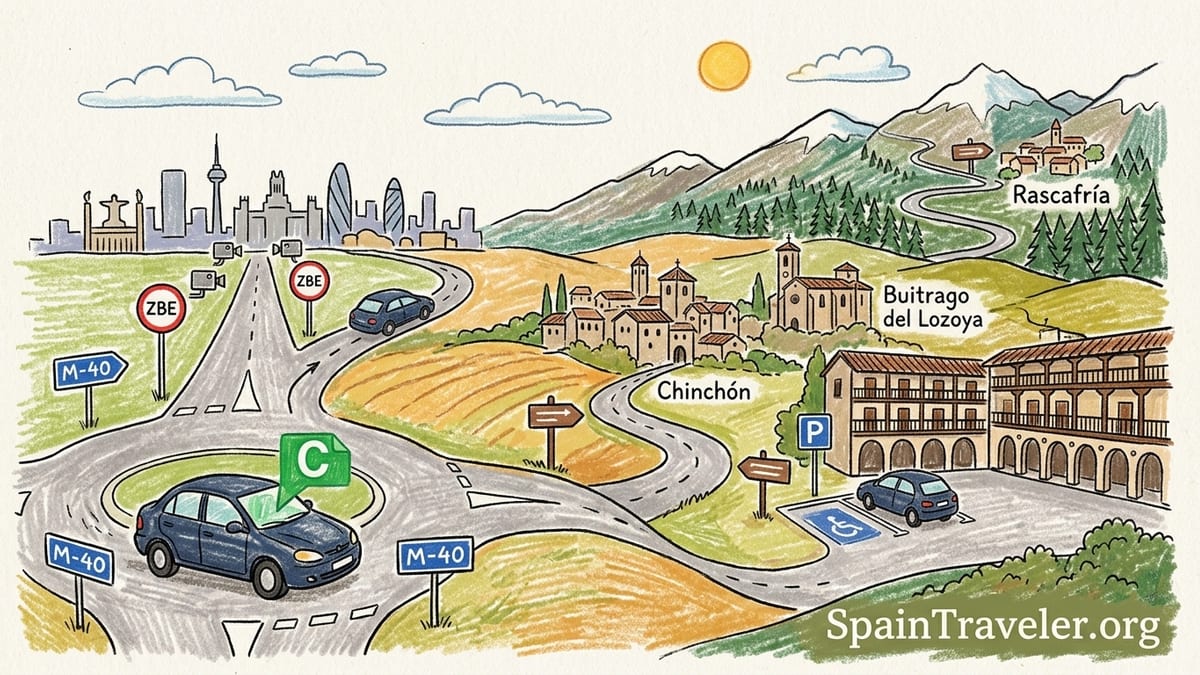
At the counter, the agent confirmed something important for driving into Madrid: rental cars are registered in Spain and carry an environmental sticker. Mine had the green "C" badge on the windshield. That matters because the entire municipality is now one large low emission zone, known locally as Madrid ZBE. Cars like mine with a C sticker can generally drive on ring roads and into much of the city, but access to the very historic center is tightly controlled and cameras read number plates as you enter. To keep things simple, I decided my car would not enter Madrid’s inner streets at all on this trip. I would collect it at the airport, drive outward to the towns, and return it at the airport before using metro and Cercanías trains inside the city.
For insurance, I rejected the expensive full coverage sold at the desk and used a standalone excess insurance policy bought before the trip, which covered the deductible if anything went wrong. It cost far less for a week than adding the rental company’s premium package. This did mean they blocked several hundred euros on my credit card as a security deposit. If you prefer not to have a deposit held, several brokers now offer packages where the daily price is higher but the deposit is minimal or zero and full insurance is bundled from the start.
Leaving Barajas, I followed signs to the M-40 ring road rather than the inner M-30. This was deliberate. The outer beltways keep you clear of the most confusing low emission signage and deliver you more directly to the regional highways that lead to the Villas de Madrid. Fuel was straightforward: service stations along the big autovías were selling petrol around the mid-1 euro per liter range when I drove, and the compact car’s efficiency meant that fuel never became a major cost compared with tolls, parking and the rental itself.
First Leg: Madrid to Chinchón and Colmenar de Oreja
The first real test of whether a car actually added value was the drive from the airport to Chinchón, one of the best-known Villas de Madrid. I joined the A-3 toward Valencia for a short stretch before turning south on smaller regional roads across the plains. Without traffic, the drive from Barajas to Chinchón took about 55 minutes of steady highway and secondary road driving. There are no tolls on this route, just a few roundabouts and some slow traffic through outer suburbs as you leave the capital.
In Chinchón, the car was immediately both an asset and a liability. The historic Plaza Mayor, framed by wooden balconies, is magnificent but surrounded by steep, tightly packed streets. I made the mistake of following the GPS directly toward the plaza instead of heading for the signed parking areas on the town’s edge. Within minutes I was facing a tight uphill lane barely wider than the mirrors, with delivery vans nosing down toward me. I managed to reverse into a tiny widening in the alley and backtrack, but it was an unnecessary stress. Once I followed the brown tourist signs to the public parking below the castle, everything became easy. From that lot it was a pleasant five to ten minute walk down into the main square.
After a long lunch and several hours wandering Chinchón’s streets and viewpoints, I drove the short hop to Colmenar de Oreja. This is where having a car really shone. Buses exist between Madrid and each of these towns, but linking them together in one day by public transport would have been awkward and time consuming, often involving backtracking to Madrid. By contrast, the drive between Chinchón and Colmenar de Oreja took less than 25 minutes on quiet country roads through an area of low hills and vineyards. In Colmenar I again chose a municipal parking area on the edge of the old center and walked the remaining distance to the Plaza Mayor and wine-focused shops. Here, unlike in Madrid itself, parking was free or very low-cost and unsigned residential streets were not yet heavily regulated.
Looking back, day one was where the car clearly justified itself: pairing two historic villas in a seamless loop, meandering through wine country between them, and stopping spontaneously at a roadside mirador to photograph the ochre fields in late afternoon light. Rail or bus would have carried me to either town, but not both in such a relaxed arc.
Wine Country and Over-Ambitious Planning
Flush with success after the first day, I over-planned the second. My idea was to leave Colmenar de Oreja, swing through nearby wine areas around Belmonte de Tajo and Villarejo de Salvanés, then reach the Sierra foothills by evening. The logic looked sound on the map. The reality of driving minor roads, navigating through small town traffic and adding vineyard stops made the schedule unrealistic.
From Colmenar I set off mid-morning, intending to visit at least one bodega for a tasting. In practice, dropping in unannounced at rural wineries often does not work, especially outside peak weekend times, and I quickly learned that pre-booking is close to essential. Several properties I passed were clearly working wineries but unmanned at the gate, or only open for pre-arranged tours. This meant extra driving along farm roads for little reward. The car allowed the detours, but it also made it tempting to chase too many possibilities.
I eventually reached Villarejo de Salvanés for a late morning coffee and a walk around its historic tower and square. Here again, the car was parked in a modest-sized lot on the edge of town. Then I forced the schedule further, trying to push as far as Manzanares el Real at the foot of the Sierra de Guadarrama on the same day. It was technically possible: about an hour and a half of driving northwest, almost crossing the entire region. But traffic thickened repeatedly near the outer ring roads and each small detour for fuel or photos extended the day. I reached the Manzanares area at dusk, tired, and with little time left to enjoy the landscape.
In hindsight, this day taught me that the map of the Community of Madrid is deceptive. The region looks compact, so it is easy to plan strings of four or five villages in a single day. However, once you factor real driving speeds on secondary roads, parking, walking into historic centers and the time you actually want to spend in each place, two main stops per day is a far better target. The car made this mistake possible by giving the illusion of total flexibility. A more disciplined plan, or even basing in Madrid and using rail for one or two of the more distant excursions, would have resulted in less time gripping the steering wheel and more time with a glass of local wine in hand.
Into the Sierra: Rascafría and Mountain Roads
The part of the trip that felt most like a classic mountain road adventure was the drive into the Sierra Norte and Sierra de Guadarrama, especially toward Rascafría. Leaving Manzanares el Real, the road climbs gradually past reservoirs and pine slopes, and before long you are on twisty two-lane mountain roads that feel a world away from central Madrid. In good weather, and with a modern car, these roads are not technically difficult, but they demand concentration and a moderate speed.
On my route, I skirted built-up Collado Villalba on the autovía and then followed regional roads that threaded between villages rather than taking the faster tolled AP-6, which branches north-west out of Madrid. The AP-6 toll road is an important detail for many itineraries heading toward Castile and León, with normal car tolls that can add up significantly on a return journey. On this trip I only joined a short section of the A-1 toward the north and stayed on toll-free roads for the rest. This kept costs down but added a little driving time.
The ascent toward Rascafría from the south involves several stretches where trucks slow the pace and overtaking is only possible on signed sections. I stopped at a mirador parking bay to let a storm cell pass and to take in views of the Sierra de Guadarrama ridge. Here, the car felt essential. Reaching Rascafría by public transport is possible via a combination of bus routes from Madrid’s Plaza de Castilla interchange, but the buses follow set timetables and stop running relatively early in the evening. The freedom to pull over for photos whenever the light broke through the clouds was something I would have missed entirely by bus.
Once in Rascafría, I parked in a marked lot on the edge of town and left the car completely unused for almost a full day. Walking around the village, visiting the Monastery of El Paular and strolling along the Lozoya River paths were all easily done on foot. Here the car had mainly been a delivery device to the valley. Had I been traveling in peak summer, I might have considered leaving the car in Madrid and using the bus instead, to avoid parking competition around popular picnic areas, but in shoulder season there was ample space in designated lots and no need to edge into narrow residential streets.
North to Buitrago and the Parking Lesson in Patones
From Rascafría I drove east and then south-east toward Buitrago del Lozoya, another of the Villas de Madrid. The direct road through the Lozoya valley is one of the most scenic drives of the whole trip, with the highway dipping and rising alongside the river and framed by rolling, forested hills. It took me about 45 minutes at an unhurried pace to reach Buitrago. There were no tolls on this leg, and fuel was available at standard service stations near the junctions with the A-1.
Buitrago’s walled old town and riverside walk are compact enough to explore in a few hours, and again, I left the car in a signed parking area just outside the walls. This was one of the clearest examples of a place where the regional bus from Madrid is absolutely viable, but the car genuinely improved the full day. I could arrive mid-morning, linger over lunch on a terrace and then continue in the afternoon to a much less public-transport-friendly destination: Patones de Arriba.
Patones is effectively two villages: Patones de Abajo on the main road and the older Patones de Arriba, a stone village perched on the hillside, now heavily visited on weekends. Driving from Buitrago to Patones took about an hour, partly on the A-1 and partly on smaller connector roads. I arrived late on a sunny Saturday afternoon, which was my mistake. By that time, the small parking area just below Patones de Arriba was full, and local regulations direct most drivers to leave their car lower down, at Patones de Abajo, when spaces above are saturated. There is a free dissuasive car park at the foot of the hill and a pleasant but steep 800-meter walk up a path known as the Barranco or ravine.
Because I had not researched the parking situation in detail and simply followed the GPS into the upper village access road, I ended up in a slow, slightly tense procession of cars queuing to turn around near the top as civil protection volunteers and signs indicated that spaces were full. Eventually, I retreated to Patones de Abajo and joined the rest of the cars in the main lot, but by then I had wasted close to 40 minutes. This is a textbook case of where arriving earlier in the day, or choosing a weekday, makes a huge difference for drivers. Buses from Madrid also serve Patones de Abajo, so a traveler who does not want to worry about parking can simply ride the bus and hike up. The car did allow me to pair Buitrago and Patones in one arc, but the price was some unnecessary parking stress.
Once parked, the walk up to Patones de Arriba was rewarding, and by early evening some cars began leaving the upper lot, validating the advice that arriving much earlier or staying later gives drivers more options. However, I left the car untouched during all my time in the village. The narrow slate streets and terraces are only accessible on foot, so in effect, the car’s job was just to reach the base of the hillside and wait.
When Rail Is Better: Skipping the Car for Madrid and Beyond
If my time in Patones and Buitrago highlighted situations where the car enabled village combinations that buses would have struggled with, my return toward Madrid highlighted the opposite: legs where having a car at all was more hindrance than help. From Patones I drove south into the metropolitan area, navigating successive beltways to reach my accommodation on the city’s outskirts. The closer I came to the center, the more time I spent peering at low emission signs and making sure I did not accidentally drift into camera-controlled inner zones.
The next morning, I deliberately left the car in a suburban hotel garage and spent the day in Madrid proper using metro and Cercanías trains. For key cultural visits like the Prado Museum, Reina Sofía and the Royal Palace, and for strolling neighborhoods such as La Latina or Malasaña, a car is useless or even dangerous to your budget because of potential fines for inadvertently crossing into restricted streets. Madrid’s central parking is expensive, on-street spaces are tightly regulated and underground garages fill fast. Moreover, rail connections from Madrid to other regional hubs such as Alcalá de Henares, Aranjuez and even Segovia are so frequent and quick that driving to these particular places offers no time advantage.
Comparing the experience, the best use of the car was in the rural and mountainous arcs between smaller towns. The worst use was trying to weave it back into the city’s fabric for urban sightseeing. In personal terms, the day I left the car unused and explored Madrid by rail and foot was the least stressful of the entire trip. If I had extended the journey to places like Toledo or Segovia, I would have chosen trains from Madrid Chamartín or Atocha and perhaps only rented a car again later for a separate countryside loop.
This contrast is important for planning. Many visitors default to picking up a car the moment they land and holding on to it for their entire stay. My experience suggests a different pattern: start or end with several car-free days in Madrid, use public transport for the major satellite cities and reserve car days for the specific periods when you will string together the more remote Villas de Madrid and rural landscapes that are difficult to stitch otherwise.
The Car When It Sat Still: Idle Days and Sunk Costs
Another lesson from this imperfect route was how often the car sat idle. In Rascafría, once I parked on arrival, the car did not move for about 24 hours. Walking trails started practically from my guesthouse door. In Chinchón and Buitrago, large parts of my time were spent on foot inside compact historic centers. On the day I devoted to Madrid itself, the car stayed in a garage while I commuted underground.
Financially, these idle periods matter. Every day you keep a rental car is another day of base charge, insurance and, often, paid parking. In one hotel near the outer beltway I paid around 12 euros for overnight underground parking, which was convenient but added to the overall cost. Multiplying such fees across a week or more, especially when the car is unused for long stretches, can make the road trip significantly more expensive than a hybrid approach combining rentals with rail days.
On the positive side, having the car waiting outside Rascafría meant that when unexpected rain rolled in the following morning, I could change plans quickly and drive out earlier than planned, heading to sunnier areas in the plains. This kind of flexibility is difficult with fixed bus timetables. However, I also realized that if I had scheduled Rascafría as an out-and-back day trip from Madrid by bus, with no overnight, I would have saved a rental day and a hotel parking charge. The point is not that one approach is always better but that every idle day with a rental car should be a deliberate choice, not just a byproduct of hanging onto the keys by habit.
In total, across a six-day period, the car likely sat unused for the equivalent of two full days. Rebuilding the route with that in mind would easily shave costs without sacrificing access to the very places that justified driving in the first place.
The Route I Would Actually Drive Again
Having now driven a somewhat tangled route that touched several Villas de Madrid, wine areas and Sierra villages, I can clearly describe the version I would repeat. It starts and ends with the idea that the car is a tool for rural and village connections, not a general-purpose solution for all movement around Madrid.
I would still pick up a compact petrol car at Barajas, confirm the environmental sticker at the desk and drive outward on the M-40 to avoid low emission confusion. Day one would focus solely on Chinchón and Colmenar de Oreja, with an early arrival in Chinchón to secure easy parking below the castle and a relaxed afternoon in Colmenar’s arcaded plaza, then a night in one of the two towns. The car would genuinely work hard this day, shuttling between villas and allowing a short detour into surrounding vineyards.
Day two would drop the over-ambitious zigzags through multiple wine hamlets. Instead, I would drive at a measured pace toward the Sierra, stopping perhaps once in a single additional town such as Villarejo de Salvanés rather than several. The priority would be reaching Rascafría by mid-afternoon along scenic mountain roads, parking once and leaving the car untouched until departure the next day. Rascafría would again serve as a walking base, not a driving playground.
Day three would be the Lozoya valley arc to Buitrago del Lozoya, then onward to Patones, with one crucial change: I would visit Patones on a weekday and aim to arrive late morning, not late afternoon. That would increase the chances of finding a space in the upper car park and reduce time spent queuing on the access road. If upper spaces were still full, I would resign myself early to the free lot in Patones de Abajo, enjoy the walk up and celebrate the fact that the car had at least linked Buitrago and Patones into one satisfying rural day.
After Patones, instead of fighting my way into Madrid’s outskirts for an urban stay with a car, I would drive directly back to the airport that evening or the next morning, return the vehicle and switch entirely to public transport for the city and any rail-accessible side trips such as Alcalá de Henares or Aranjuez. This would sharply separate the road trip into a true countryside loop, sandwiched between car-free cultural days. It would also mean fewer hours squinting at low emission signs and fewer nights paying for parking garages where the car merely gathered dust.
FAQ
Q1. Do I really need a car to visit the Villas de Madrid like Chinchón or Buitrago?
For one or two villas, no. Chinchón, Buitrago del Lozoya and several others have direct buses from Madrid and make easy day trips. A car becomes truly useful when you want to connect multiple small towns such as Chinchón and Colmenar de Oreja in one day, or combine Buitrago with Patones or Rascafría in a single rural loop.
Q2. Where is the best place to pick up a rental car for this kind of route?
Madrid Barajas Airport is the simplest option. Companies have clear access to the ring roads, offices keep long opening hours and cars carry Spanish environmental stickers suitable for driving in most of the municipality. Picking up and dropping off at the airport avoids navigating the tightest low emission zones in central Madrid.
Q3. What type of car is best for historic towns and mountain roads around Madrid?
A compact petrol sedan or hatchback is ideal. It is small enough for narrow village streets and easier to park in crowded lots like those at Patones de Arriba, yet powerful enough to handle climbs into the Sierra. Larger SUVs can feel unnecessarily bulky in older centers and may make tight parking more stressful.
Q4. How expensive are tolls and fuel on a Community of Madrid road trip?
Within the Community of Madrid, you can plan routes that avoid tolls entirely by using the main autovías and regional roads. If you venture onto toll motorways such as the AP-6 toward Castile and León, costs rise and a return trip can add several tens of euros to your budget. Fuel prices fluctuate, but compact cars keep consumption low enough that rental fees and parking tend to dominate overall costs.
Q5. Is driving into central Madrid a good idea with a rental car?
For most visitors, no. Central Madrid is covered by strict low emission zones, on-street parking is tightly regulated and underground garages can be expensive. It is usually better to park the car on the outskirts or at the airport and rely on metro, buses and suburban trains for city sightseeing. This also reduces the risk of fines for entering restricted streets.
Q6. How should I handle parking in popular villages like Patones de Arriba?
Arrive early in the day or visit on a weekday. When upper parking areas are full, drivers are directed to use the free car park in Patones de Abajo and walk up an 800-meter path to the village. Following local signage from the start, rather than pushing all the way to the upper access road by habit, saves time and reduces frustration.
Q7. Are the mountain roads to places like Rascafría difficult or dangerous?
In normal weather they are well-maintained two-lane roads with moderate gradients. The main challenge is staying patient behind slower vehicles and taking curves at sensible speeds. In winter, snow and ice can complicate driving, so checking forecasts and local advisories before setting out is important, and in bad conditions postponing the drive or using public transport may be wiser.
Q8. How many towns should I realistically plan to visit in one driving day?
Two main stops per day is a comfortable target. That allows time for parking, walking into historic centers, lingering over meals and making short scenic stops. Trying to cram four or five villages, plus winery visits, into a single day turns the trip into a rushed checklist and leaves you driving more than exploring.
Q9. When does it make more sense to use trains or buses instead of the car?
For Madrid’s core attractions and for major satellite cities like Alcalá de Henares, Aranjuez or Segovia, rail and bus connections are frequent, fast and inexpensive. In these cases driving offers little advantage and may actually slow you down. Reserve the car for rural connectors between smaller Villas de Madrid and Sierra villages where public transport is sparse.
Q10. What is the single biggest mistake to avoid on a Community of Madrid road trip?
Over-committing your itinerary to the car. Keeping a vehicle for days when it sits unused in hotel garages, or pushing it into restricted historic centers and busy weekend villages at peak times, adds cost and stress. Designing a route where the car is used purposefully on just a few key countryside days, and returned before you dive into Madrid’s urban core, leads to a far more enjoyable trip.