


Exploring the Community of Madrid without a car is not only possible, it is often the most pleasant way to see the region. The Cercanías suburban rail network, mid-distance trains and a dense web of interurban buses give you easy access to royal palaces, UNESCO-listed old towns and national park scenery. This guide focuses on practical details for day-trippers based in central Madrid, explaining when trains work best, where buses or taxis are helpful, and in which corners of the region renting a car starts to make more sense.
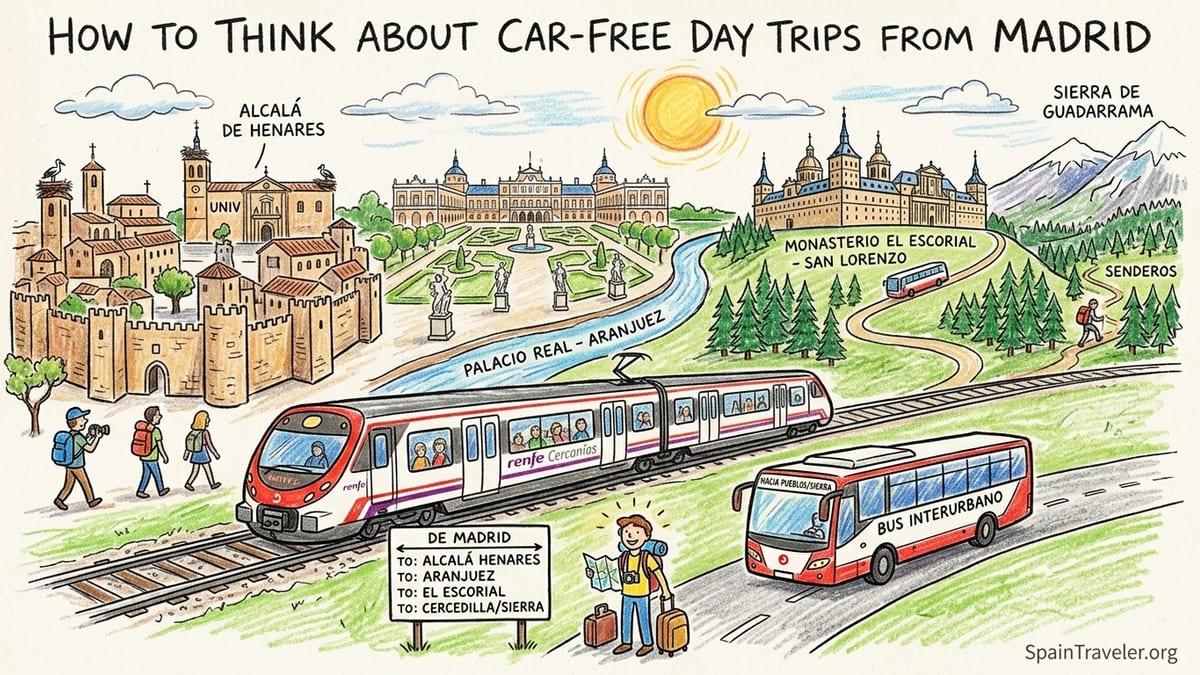
How to Think About Car-Free Day Trips from Madrid
Madrid’s main suburban rail stations for day trips are Atocha Cercanías, Chamartín, Sol and Príncipe Pío. Most visitors will start from Atocha or Sol, which are well connected by Metro and on multiple Cercanías lines. Typical journey times to regional highlights range from about 30 minutes to Alcalá de Henares to roughly one hour to Aranjuez, El Escorial or Cercedilla. Trains usually run at least every 30 minutes on weekends on these core routes, with denser service at peak times.
The regional rail network is branded as Cercanías Madrid and operated by Renfe. For most popular day-trip destinations such as Alcalá de Henares, Aranjuez and El Escorial you use standard Cercanías tickets or zone-based public transport passes. One-way fares within the Community of Madrid are usually in the range of just a few euros per person, and holders of integrated transport cards often benefit from capped or discounted prices. For visitors staying several days, it is worth considering a tourist travel pass that covers both Cercanías and Metro inside the region.
Interurban buses fill in the gaps where rail coverage is weaker, especially in smaller Sierra villages, rural reservoirs and wine or castle towns away from the main railway corridors. These buses typically depart from large hubs like Moncloa, Plaza Elíptica or Avenida de América. They can be comfortable and inexpensive, but routes are less intuitive than the rail lines and some run only once an hour, or a few times per day on weekends. This is where careful timetable checks and conservative planning for your return become important.
For each of the main destinations below, this guide explains how to reach the town by regular public transport and how the proposed tourist trains fit into that picture. It also highlights last-mile considerations such as the walk from the station to the main sights, the availability of local buses or taxis, and the risks of getting stranded late in the evening if you miss the last train back to Madrid.
Alcalá de Henares: UNESCO Old Town on the Henares Corridor
Alcalá de Henares is one of the easiest and most rewarding rail day trips from Madrid. It lies about 30 kilometers east of the capital, on the busy Henares Corridor. Renfe Cercanías lines C2 and C7 connect central Madrid with Alcalá’s main station in around 35 to 40 minutes, with trains roughly every 15 minutes on weekdays and generally every 20 to 30 minutes per direction on weekends. Services start early in the morning and run until late evening, giving day-trippers a wide choice of departure and return times.
From Madrid, you can board direct Cercanías trains to Alcalá de Henares at Atocha Cercanías, Recoletos, Nuevos Ministerios or Chamartín. Many visitors find Atocha simplest, as signs for Cercanías are clear and there are staffed ticket counters as well as machines. On arrival at Alcalá de Henares station, it is about a 10 to 15 minute flat walk to the historic center along wide streets. If you prefer, local urban buses stop outside the station and connect with the university area and old town, but most visitors walk.
Once in the historic center, compact streets mean you can do all your sightseeing on foot. The University of Alcalá courtyards, Calle Mayor, Cervantes’s birthplace museum and the cathedral can all be comfortably covered in a few hours, with plenty of time for lunch and an afternoon stroll. A common pattern is to arrive mid-morning, have a leisurely menu del día in the early afternoon and catch a late afternoon or early evening Cercanías back to Madrid. With frequent trains, you rarely need to worry about getting stranded, but if you are out late on a Sunday it pays to confirm the last two departures back to the capital at the station or on the Renfe Cercanías app.
Alcalá also occasionally features in themed tourist-rail promotions and cultural campaigns, but these add-ons are not necessary for a straightforward day trip. For most travelers, the regular Cercanías service remains the best option, because it is flexible, inexpensive and fully integrated with Madrid’s public transport system. This makes Alcalá one of the top recommendations for visitors who want a history-rich day out without dealing with buses or car rentals.
Aranjuez: Royal Palace and Gardens by the Tagus
Aranjuez lies south of Madrid on the railway corridor toward Castilla-La Mancha. It is known for its royal palace, formal gardens and historic river setting. The town is served by Cercanías line C3, which connects Aranjuez with Madrid Atocha and Chamartín. Travel time from Atocha is generally in the range of 45 to 55 minutes, depending on the stopping pattern. On most weekends there are at least two trains per hour in each direction during the central part of the day, though there can be longer gaps early in the morning or late at night, so checking the current timetable remains important.
From Aranjuez station the walk to the palace district takes about 15 to 20 minutes along relatively flat streets. The route is straightforward and signposted, but in summer heat it can feel exposed, so carrying water and sun protection is advisable. Taxis sometimes wait outside the station, especially around the arrival of certain trains, and there is a local bus network for those who prefer not to walk. However, service frequencies on local buses are modest, especially on Sundays, so you cannot rely on simply turning up without checking a timetable.
Tourism authorities and Renfe have long promoted the historic Strawberry Train, a vintage-style excursion that typically runs on selected weekends in spring and autumn between Madrid and Aranjuez. This train often includes tastings of local strawberries in season and a guided visit, and it departs from the old Madrid-Delicias or modern stations depending on the current program. It can be an enjoyable experience for families or railway enthusiasts, but tickets are limited and sold separately from standard Cercanías fares. Many travelers prefer to keep full flexibility by using regular C3 trains, combining independent visits to the palace, Casa del Labrador, the gardens and perhaps a riverside meal.
Because the rail connection is direct and reasonably frequent, Aranjuez is comfortable as a full-day or long half-day trip without a car. A common worry is the last return train, particularly on weekend evenings when visitors stay for dinner. Station information boards and the Cercanías mobile tools show the final departures, and as a rule it is wise to plan to be back at the station at least one train earlier than the very last advertised service. That small buffer greatly reduces stress if there are minor delays or a crowd at the ticket machines.
San Lorenzo de El Escorial: Monastery in the Foothills
San Lorenzo de El Escorial, dominated by its immense royal monastery and palace, is another pillar of the region’s car-free tourism promotion. The standard rail route from Madrid is Cercanías line C3a or C8 to El Escorial station, which sits in the lower, more modern town of El Escorial rather than directly in the historic hilltop center of San Lorenzo. From Madrid, travel time is usually around 55 to 65 minutes. Trains typically leave Atocha and Chamartín at least once per hour on weekends, sometimes more often, but with some irregular gaps in the timetable that merit a quick check when planning your day.
On arrival at El Escorial station, you face the main last-mile decision of this trip. The monastery in San Lorenzo is about 2 kilometers uphill from the station. Many visitors choose to walk, taking around 25 to 30 minutes at a moderate pace. The route is on surfaced streets and pavements, but it is noticeably uphill and may feel strenuous in hot weather or for less mobile travelers. For a more relaxed arrival, taxis usually wait outside the station, and there is a local bus line that climbs from the rail station to the San Lorenzo center and sometimes onward toward nearby residential areas.
In parallel with regular trains, regional tourism bodies have supported the Tren de Felipe II, a privately operated heritage-style tourist train marketed by a major bus and coach company. This service usually runs on selected weekends and holidays from Madrid Príncipe Pío directly to El Escorial, often bundling rail travel with guided visits, bus shuttles and entrance tickets. The experience uses historic rolling stock and is promoted as a themed excursion through the foothills of the Sierra de Guadarrama. It appeals to visitors who like packaged experiences, but because departures are limited and reservations are required, it is less flexible than normal Cercanías trains.
For purely practical travelers, the standard Cercanías option remains the best balance of cost and freedom. You can choose your own timetable, linger longer in the monastery complex, or combine San Lorenzo with a coffee stop in the lower town without worrying about a fixed excursion schedule. The main risks to consider are the uphill walk from the station and the occasional clustering of return trains, so a quick review of the evening timetable before you head up to the monastery can help you plan your descent and avoid a long wait back at the platform.
Sierra de Guadarrama: Mountain Air Without a Car
The Sierra de Guadarrama north of Madrid offers cool forests, high passes and alpine meadows, and regional authorities are keen to make it accessible by public transport. The key rail gateway is Cercedilla, on the Cercanías network. Cercanías lines C8 and some regional services connect Madrid with Cercedilla in roughly 1 hour to 1 hour 15 minutes from Chamartín or Atocha, with around one or two trains per hour on typical weekends. From Cercedilla you can walk directly into the village, connect with local hiking trails or continue toward higher elevations.
Historically, the narrow-gauge C9 mountain line ran from Cercedilla to Puerto de Navacerrada and Cotos, giving direct car-free access to the national park environment. Extensive works on this line have kept it closed for an extended period, and as of mid-2026 a full reopening date had not yet been confirmed. To maintain connectivity, Renfe and regional authorities have been operating replacement bus services from Cercedilla up to Navacerrada and Cotos, scheduled to roughly mirror a traditional daytime excursion pattern, often with several departures in each direction between morning and early evening. Because these arrangements can change as rail works progress, anyone planning a Sierra day trip should verify the current situation shortly before travel, especially in autumn and winter when weather-related adjustments are possible.
Assuming the replacement buses or future restored trains are running, the last-mile question in the Sierra is less about towns and more about trailheads. Stops at Puerto de Navacerrada and Cotos place you very close to signed hiking routes into the Guadarrama National Park. For example, from Cotos many walkers follow marked tracks toward the Peñalara area, while from Navacerrada there are routes along ridges and into pine forests. Surfaces are mostly unpaved mountain paths, so sturdy footwear and appropriate clothing are more important than in urban excursions. There are usually simple refreshments or mountain refuges near these high stops, but their schedules vary by season and weather.
The main car-free risks in the Sierra involve capacity and last return times. On sunny winter weekends and in high summer, replacement buses or future mountain trains toward Cotos and Navacerrada can be very busy in the morning. Seats into the mountains are generally less of an issue than returning down to Cercedilla in late afternoon, when many hikers converge on the same few services. Authorities sometimes respond by requiring advance reservations or by capping park access on peak days, so visitors should monitor official information channels and consider travelling slightly earlier or later than the crowd to avoid being left behind. As always, aim to finish your hike in time to catch a bus or train earlier than the final departure of the day, and build in a safety margin for slower-than-expected walking.
Tourist Trains vs Everyday Services
Current regional tourism promotion places strong emphasis on thematic or historic trains to San Lorenzo de El Escorial, Aranjuez and the Sierra de Guadarrama. These experiences can be memorable, combining vintage rolling stock, on-board commentary and guided tours at the destination. For example, excursions toward Aranjuez often include tastings of local produce, while mountain-focused promotions into Guadarrama highlight the environmental values of the national park and may integrate ranger-led walks or interpretation activities.
However, tourist trains usually run on fixed dates, mainly weekends and certain holidays, and occupy just one or two time slots per day. Tickets are sold through dedicated channels and may include entrance fees or activities whose value depends on your interests. Families with young children or rail enthusiasts may enjoy the added structure and the novelty of historic carriages. Independent travelers, especially those with limited time in Madrid, often prioritize flexibility and prefer to move on their own schedule using regular Cercanías and bus services.
From a practical standpoint, everyday trains almost always give you more options for both outward and return journeys. If the weather looks poor on the morning of a planned Guadarrama trip, you can simply postpone it by a few hours or switch to another destination such as Alcalá de Henares without forfeiting a prepaid excursion ticket. Similarly, if you fall in love with Aranjuez’s gardens and want to stay longer, regular C3 services make it easy to extend your day into the evening without asking a guide or group leader.
The best way to integrate tourist trains into a car-free itinerary is to treat them as optional highlights rather than the backbone of your transport plan. Check dates and inclusions carefully, compare with the cost and frequency of standard services, and decide whether the themed experience adds enough value for you. If in doubt, base your planning on the reliable grid of Cercanías and interurban buses and consider tourist trains as a pleasant bonus if the timing and price suit your trip.
Beyond the Classics: Possible but Slower Car-Free Day Trips
Outside the flagship destinations, several smaller towns and landscapes in the Community of Madrid can be reached without a car, but they usually require longer journeys, less frequent buses or tricky connections. Examples include reservoirs and hill villages on the northern side of the Sierra, such as Rascafría, Buitrago del Lozoya or Manzanares el Real. Reaching these places from central Madrid commonly involves an interurban bus from Moncloa or Plaza de Castilla, with typical travel times of 1.5 to 2 hours each way, and weekend frequencies sometimes as low as one bus per hour or less.
In these cases, the main constraint is not difficulty in finding a route, but the risk of feeling tied to a thin timetable. If you miss a mid-afternoon bus back from a rural village, the next departure might be late in the day, drastically shortening your evening in Madrid. In shoulder seasons, there can also be gaps during siesta hours. To manage this, travelers should note down at least two potential return options when they arrive and perhaps set a quiet alarm on their phone as a reminder to start walking toward the stop in time.
Another practical challenge outside the main rail corridors is the last-mile segment from bus stop to attraction. For instance, in some reservoir areas, the stop is on a main road a significant walk from lakeside picnic spots or trailheads. Surfaces might be uneven, with limited shade or lighting, and there may not be taxis waiting on demand. This does not make such trips impossible without a car, but it does require more preparation, including checking local maps, assessing your walking comfort and possibly adjusting expectations about how many sites you will realistically see in a single day.
For repeat visitors or long stays, these slower car-free trips can be rewarding precisely because they attract fewer day-trippers. The key is to choose one area per day and fully commit to it, instead of trying to string several smaller villages together. If you are only in Madrid for a short city break, however, it generally makes sense to prioritize the better-connected destinations described earlier, where the combination of transport frequency and compact sightseeing makes last-minute decisions easier.
The Takeaway
For travelers staying in central Madrid, the Community of Madrid offers a rich set of car-free day trips. Alcalá de Henares, Aranjuez and San Lorenzo de El Escorial stand out as straightforward choices linked to the capital by reasonably frequent Cercanías trains and supported by active tourism promotion. Their stations are close enough to the main sights to make walking or short taxi rides practical, and return trains run late enough to permit relaxed dinners before heading back to your hotel.
The Sierra de Guadarrama is also accessible without a car, especially via Cercedilla and, subject to current works and replacement services, up toward Navacerrada and Cotos. Here, the focus shifts from palaces and historic squares to high-mountain scenery and hiking. Because services into the national park areas are fewer and more sensitive to weather and capacity limits, planning and schedule checks are more important, and you should give yourself generous buffers around the last return of the day.
Beyond these headline destinations, many lesser-known villages, reservoirs and natural areas can be reached through combinations of Cercanías and interurban buses. These trips are “possible but slower” in the sense that journey times are longer, weekend frequencies lower and last-mile walks more significant. They can deliver a strong sense of rural Madrid, but are best suited to travelers who enjoy navigating timetables and do not mind building their day around a handful of fixed departure times.
Finally, there are parts of the wider region where renting a car becomes much more practical, particularly if you want to link several small villages in one day, carry sports equipment or explore at night when public transport options taper off. As a rule of thumb, the easiest car-free day trips from Madrid are Alcalá de Henares, Aranjuez and San Lorenzo de El Escorial, plus Cercedilla for a taste of the Sierra. Possible but slower outings include single-village or single-reservoir excursions deeper into the mountains or plains by interurban bus. When your plans involve scattered rural sites, late returns or complex detours, a short-term car rental or private transfer can convert a stressful day of tight connections into a relaxed regional road trip.
FAQ
Q1. Do I need to book Cercanías train tickets in advance for day trips?
For most Cercanías routes in the Community of Madrid, including Alcalá de Henares, Aranjuez, El Escorial and Cercedilla, advance booking is not required. You buy standard suburban tickets or use a compatible transport pass on the day of travel and simply board any train on your chosen line within the validity period of your ticket.
Q2. Which is the easiest car-free day trip from Madrid for a first-time visitor?
Alcalá de Henares is often the easiest option because it has very frequent Cercanías trains from central Madrid, a short walking connection from the station to the historic center and compact sights that can be comfortably explored in half a day or a full day without needing buses or taxis.
Q3. How late do trains run back to Madrid from Aranjuez and El Escorial on weekends?
Evening Cercanías services from Aranjuez and El Escorial generally run until late evening on Fridays and Saturdays, with slightly earlier last departures on Sundays. Exact times vary by timetable period, so you should check the current schedule at the station or in official journey-planning tools on the day you travel.
Q4. Is the mountain train between Cercedilla, Navacerrada and Cotos currently running?
The historic C9 mountain railway has been undergoing long-term works, and at times its service has been suspended and replaced by buses. Because reopening dates and replacement arrangements can change, anyone planning a Sierra de Guadarrama hike should verify the latest information shortly before their trip.
Q5. Are tourist trains like the Tren de Felipe II included in regular public transport passes?
No. Heritage and tourist trains such as the Tren de Felipe II or themed excursions to Aranjuez and the Sierra are marketed as special experiences. They use separate ticketing, often include guided visits or tastings, and are not covered by standard public transport passes or ordinary Cercanías fares.
Q6. How challenging is the walk from El Escorial station up to the monastery in San Lorenzo?
The walk is around 2 kilometers and steadily uphill. Most reasonably fit visitors manage it in about 25 to 30 minutes, but in hot weather or for those with mobility issues it can feel demanding. Taxis and a local bus service from the station provide alternatives to walking.
Q7. Can I combine two towns, such as Alcalá de Henares and Aranjuez, in a single car-free day?
It is technically possible but not usually recommended for a relaxed day, as the towns lie on different rail corridors and you must route back through Madrid to switch lines. Most travelers find it more enjoyable to devote one full or long half-day to each destination rather than rush between multiple towns.
Q8. What should I consider when planning a bus-based day trip to smaller Sierra villages?
You should look carefully at weekend timetables, note at least two possible return departures, and check how far the bus stop is from your main goal, such as a reservoir shore or trailhead. Also factor in reduced services during midday hours and the possibility that there may be no taxis waiting at remote stops.
Q9. When does renting a car become more practical for exploring the Community of Madrid?
Renting a car is most practical when you want to visit several small villages in one day, stay out late in rural areas, carry bulky equipment such as bikes or skis, or explore places that are far from any rail line and only lightly served by buses.
Q10. Is it safe to return to Madrid late at night on Cercanías trains after a day trip?
Cercanías trains are widely used by commuters and travelers and are generally considered safe, including in the evening. As in any big city, it is sensible to keep an eye on your belongings, avoid very empty carriages if possible, and plan your route from the arrival station back to your accommodation in advance.