


After several extended trips around the Community of Madrid over the last few years, I stopped thinking of the region as “the countryside around the capital” and started treating it as its own, very varied destination. In 2026 I went back with a clear mission: to revisit the experiences I genuinely loved, test some of the much-promoted heritage trains, and see which day trips and outdoor adventures I would honestly recommend to a friend. This guide focuses on those real, on-the-ground experiences, including the mixed ones, and keeps Madrid city itself largely in the background so the rest of the region can finally take center stage.
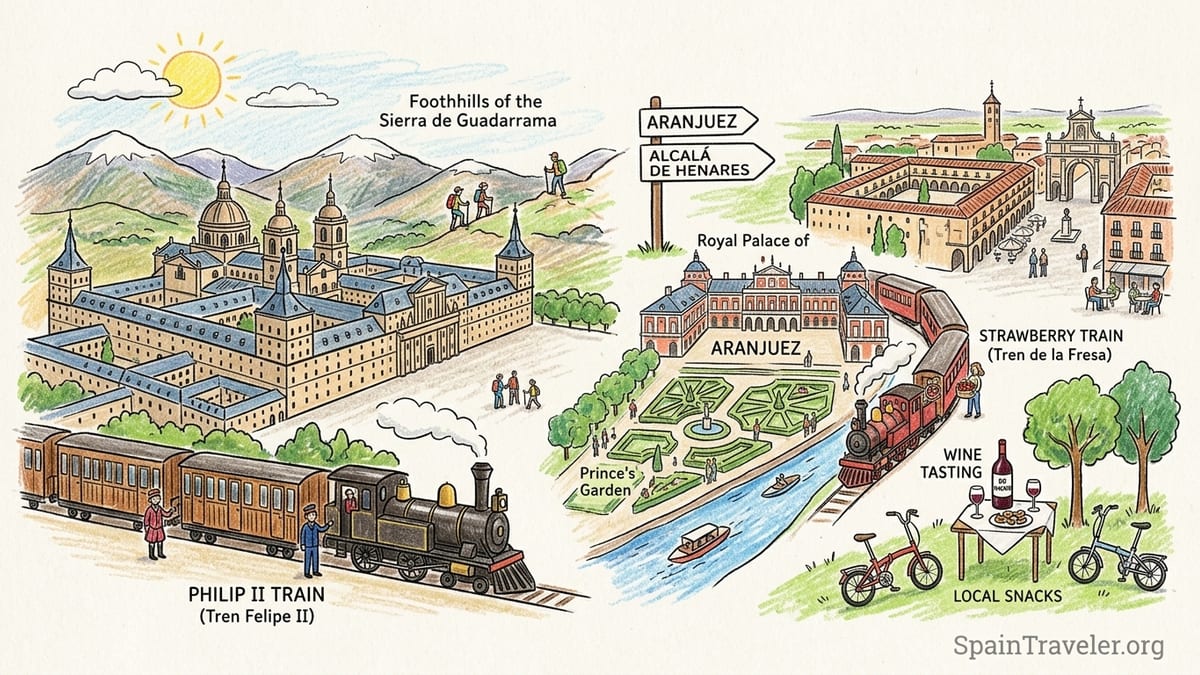
UNESCO Heritage in San Lorenzo de El Escorial by Historic Train
San Lorenzo de El Escorial is the experience I recommend most often to first-time visitors who want to understand both the landscape and the history of the Community of Madrid. On my latest visit in summer 2026 I chose the Philip II Train, a vintage train service running from Madrid Príncipe Pío to El Escorial, combined with a guided tour of the Royal Monastery and time to wander the royal town. The monastery and historic ensemble are part of a UNESCO World Heritage Site and, with the surrounding foothills of the Sierra de Guadarrama, they feel very different from the urban intensity of central Madrid.
I booked the “Travesía” package directly through the Philip II Train operator’s official site about two weeks in advance, which was enough lead time in July outside the busiest local holiday weekends. The package included the return train, a guided tour of the Royal Site and Monastery and some free time in town. I paid just under 50 euros per adult in mid-2026. The full excursion, from departure at around 10:20 from Príncipe Pío to arrival back in Madrid in the early evening, took roughly eight hours. Crowds inside the monastery were moderate on a weekday, busy around the royal pantheon and basilica but never overwhelming.
Physically, this is a low to medium effort day. The main strain comes from walking the long corridors of the monastery, climbing a few staircases and managing some gentle uphill streets in San Lorenzo itself. I wore comfortable shoes and was happy to have a light layer for the cooler temperatures compared to Madrid. The vintage carriages of the train are atmospheric, with wooden interiors and costumed staff who give a short introduction to the history of the route. The comfort level is perfectly fine for the one-hour ride but noticeably more basic than regular Cercanías commuter trains, with no modern power outlets or air conditioning as effective as newer rolling stock.
Would I repeat it? Yes, particularly now that parts of the art collections in El Escorial have been refreshed and reopened after long renovations, which made this 2026 visit feel much richer than my previous trip several years earlier. The combination of rail journey, UNESCO-listed architecture and mountain-edge scenery makes it one of the most balanced day trips in the region. The only drawback is cost compared with doing the journey independently on a regular Cercanías train and booking monastery tickets on your own, but for first-time visitors who value a structured day, I still consider the Philip II Train worth the money.
Aranjuez by the Strawberry Train: Iconic but Not Essential
South of Madrid, Aranjuez is another UNESCO World Heritage landscape, famous for its royal palace, gardens and historical orchards along the Tagus River. In spring 2026 I returned to Aranjuez using the Tren de la Fresa, the historic “Strawberry Train” that runs on selected weekends. It is heavily promoted as a heritage experience and, while it is fun, my verdict after riding it again is more mixed than enthusiastic.
I booked directly through the official Strawberry Train site about a month in advance for a Saturday in May. I chose one of the classic packages that included the return journey from Madrid Chamartín to Aranjuez, a short local transfer and a guided visit to the Royal Palace and one of the historic gardens, plus a tasting of local strawberries served on board. The adult price for my 2026 date was in the range of the higher combined tickets, around 50 to 60 euros per person depending on the exact route and inclusions, noticeably more than a standard commuter rail ticket and separately purchased palace entry.
The total duration was similar to the Escorial trip, roughly eight hours door to door, but the crowd level felt higher. My train was almost full, and many passengers were visiting as families or large groups. The on-board strawberry tasting is a charming touch, and the vintage coaches are photogenic, but there was a lot of waiting time at intermediate transfers and a somewhat rushed feeling once we were in Aranjuez, especially around the palace. Physically, the day is easy, with mostly flat walking in and around the palace and gardens, though the midday heat in May already made the open areas feel exposed.
Would I repeat the Strawberry Train itself? Probably not, unless traveling with children or train enthusiasts. Aranjuez is absolutely worth visiting for its palace interiors and especially its riverside gardens, but on balance I preferred my earlier independent trip by Cercanías train which cost much less and allowed me to control my timing. For independent travelers on a budget, I would suggest taking the regular commuter train from Madrid and buying palace tickets online in advance, then spending unhurried time in the Island Garden and Prince’s Garden. The heritage train is a pleasant, nostalgic extra, but not essential to appreciating Aranjuez.
Walking Medieval Alcalá de Henares with and without the Cervantes Train
Alcalá de Henares, birthplace of Miguel de Cervantes and home to one of Spain’s oldest universities, is the third major UNESCO World Heritage city in the Community of Madrid. I have visited several times, including one recent trip in 2026 for the autumn Cervantine festivities. Over the years I have done both the themed Cervantes Train excursion and completely independent day trips on standard Cercanías services, and the comparison is instructive.
The Cervantes Train, which typically operates on selected Saturdays from Madrid Atocha to Alcalá, includes actors in Golden Age costumes on board and a guided walk through the historic center on arrival. When I used it, I booked through Renfe’s official channels, paying a combined fare that was noticeably higher than a commuter return ticket but included the guided visit and discounts at some local museums and restaurants. The outing lasted roughly seven to eight hours, including free time for lunch. Crowd levels were medium, with a mix of domestic day trippers and some international visitors drawn by the Cervantes theme.
Physically, the day is light to moderate effort. The chief activity is walking: along the arcaded Calle Mayor, through Plaza de Cervantes, into the university courtyards and down to the cathedral and Archbishop’s Palace area. Surfaces are mostly flat and paved, but the distances add up over a full day, so comfortable shoes are important. My favorite part of the experience has always been wandering under the long colonnades of Calle Mayor, ducking into the Cervantes Birthplace Museum and stopping for traditional snacks like local “costrada” pastries and a simple menu del día in one of the older taverns just off the main square.
Would I repeat the Cervantes Train specifically? I would recommend it once if you are particularly fond of Cervantes or traveling with children who might enjoy the costumed guides. However, my most satisfying visit in 2026 was actually an independent autumn Sunday. I went by regular Cercanías from Madrid Chamartín, paying only a few euros for the return trip with my transport card, and timed the arrival to coincide with the Cervantine week events and the popular medieval-style street market. That allowed long, quiet wanderings through the historic university quarter and less structured time in museums and churches. So my strong recommendation is Alcalá itself, rather than the themed train, which I now see as an optional extra rather than a must-do.
Hiking and High Country Excursions in the Sierra de Guadarrama
One of the revelations of spending real time in the Community of Madrid is how quickly you can swap city pavements for high mountain trails. The Sierra de Guadarrama National Park, stretching along the northern edge of the region, offers some of the most rewarding hiking near any European capital. My most memorable day here combined a commuter-rail approach with a mid-level hike around the Cercedilla area, followed by a late lunch in a mountain village.
I based myself in Madrid and took a morning Cercanías train from Atocha to Cercedilla, paying only a few euros with my transport card. From the station it is about a 20 to 30 minute uphill walk to the Fuenfría valley trailheads, where multiple marked routes begin. I opted for a circular walk of roughly three to four hours, with forest paths, moderate elevation gain and viewpoints back toward the plains around Madrid. Crowds were light on a weekday in late spring, with mostly local hikers and a few school groups closer to the picnic areas. The physical effort here is definitely moderate, with sustained uphills, rocky sections and altitude noticeably higher than the city.
On a previous trip, before renovation works closed the historic C-9 line, I had taken the mountain railway up from Cercedilla to Cotos for access to higher trails near Peñalara. That journey is currently affected by infrastructure works and occasional service interruptions, and in 2026 it remains something travelers need to check carefully before planning around it. On my latest visit I therefore stayed around Cercedilla and the lower Fuenfría valley, which still gave a good taste of the Sierra without relying on any special seasonal train.
Would I repeat hiking in the Sierra de Guadarrama? Absolutely, although I would be more selective about weekends. When I tested a sunny Saturday earlier in the year, the parking areas and lower trails around Navacerrada and Cotos felt much busier, and the queues for return trains could be frustrating in the late afternoon. For readers, I would recommend a simple plan: choose a weekday if possible, use Cercanías to Cercedilla or another village on the northern lines, start hiking early with plenty of water and sun protection, and finish with a late lunch at a local bar near the station. It is one of the most satisfying, relatively low-cost ways to discover the wild side of the Community of Madrid.
Wine Tasting and Country Landscapes by Rail
The Community of Madrid has its own Designation of Origin wines, and over several visits I have tried both organized wine-by-rail experiences and more improvised tastings arranged directly with wineries reachable by train. Not all have been equally memorable, but the combination of rail travel, vineyard countryside and local food has made this category one I am happy to recommend, with some caveats.
On one of the region’s promoted wine trains, which departed from central Madrid for a day of vineyard visits and tastings, I booked through a tour operator that packaged Renfe tickets, bus transfers from the destination station and guided visits to two bodegas with lunch. The price per person in 2026 was in the low triple digits in euros, including several tastings and a three-course meal. The total duration was a full day, from around 9:00 in the morning until after 19:00 back in Madrid. Crowds were moderate, with the group capped at about 25 participants, a mixture of domestic weekenders and a handful of foreign visitors.
Physically, these days are easy, involving little more than standing and gentle strolling through vineyards and cellars. The effort lies more in pacing the tastings if you are not used to Spanish pours and generous hospitality. My honest verdict is that while the day was enjoyable and well organized, the cost felt high compared with arranging a simpler outing on my own. On a later trip I used Cercanías to reach a smaller town within the Madrid wine area, arranged a tasting directly with a local winery by email and paid significantly less overall, even including a good lunch of local lamb and vegetables in the village.
Would I repeat a wine-by-rail day? Yes, but I would choose more targeted experiences rather than the most heavily marketed packages. For readers interested in wine who are comfortable with a bit of Spanish and planning, I suggest using the regional wine route associations and tourist offices to identify one or two bodegas that welcome independent visitors. Combine that with commuter rail or regional buses, leave plenty of time between tastings and trains, and you can build a very personal and reasonably priced day in the countryside without needing a large group tour. The region’s reds and young whites are not yet as famous as those from Rioja or Ribera del Duero, but tasting them in situ adds an unexpected layer to any stay in Madrid.
Royal Gardens and Seasonal Surprises
When people think of gardens around Madrid, they often picture the urban Retiro Park, but some of the most interesting historic landscapes lie at the royal sites in Aranjuez and El Escorial, and in smaller palace complexes scattered through the region. My experiences here have taught me that timing and season matter more than any brochure suggests.
In Aranjuez, the Island Garden and the larger Prince’s Garden along the Tagus are enchanting in late spring and early autumn, when the trees are green and the river levels are reasonably high. My May 2026 visit, however, revealed the downside of coming at midday in a warm year. Shade was patchy in some of the more formal sections, and the combination of heat and weekend crowds left parts of the main walks feeling less romantic than expected. Entrance to the gardens themselves was inexpensive or included with palace tickets, but food and drink options inside the grounds were limited, so I was glad I had brought water from town.
At El Escorial, the monastery’s own formal gardens and the surrounding slopes have a more austere charm. On my latest summer trip, the geometric beds were neat but not especially lush, and the stronger impression came from the elevated views back across the plains. A previous spring visit, with cooler light and fresher growth, had felt almost like an entirely different place. What remained constant was the physical effort: moderate amounts of walking with some short staircases and slopes but nothing too strenuous.
Would I repeat the royal gardens? Yes, though with two explicit pieces of advice drawn from experience. First, aim for spring or early autumn, and avoid the high midday hours in the hottest months if you can. Second, treat the gardens as part of a broader day that also includes interiors, town walks or nearby countryside, rather than as standalone attractions. On their own, they risk feeling like long, sunny strolls. Framed as one chapter in a day that mixes architecture, history and food, they become much more rewarding.
Traditional Food, Small Towns and Cycling Escapes
Beyond the big-name UNESCO sites, some of my favorite days in the Community of Madrid have taken place in ordinary small towns where tourism is more of a weekend extra than an industry. Here, the experiences are less about headline attractions and more about the rhythm of local life, traditional food and, in some cases, simple cycling routes that start almost at the station doors.
On one spring Sunday I took a Cercanías train toward the southeast, getting off in a modest town that sits on one of the region’s signed cycling corridors. I brought a folding bike, which is allowed on these trains without special restrictions, and spent the day following a converted rail trail through fields and low hills. The cost was minimal, limited to the standard train fare and a few euros for coffee and a menu del día in a family-run bar. Crowds were almost non-existent once I left town. Physically, the effort was moderate over several hours, but the gradients were gentle and the surfaces mostly smooth.
On another occasion, in a village north of Madrid that I reached again by Cercanías, I skipped any formal activity and simply followed the main street from station to plaza, stopping where older locals were eating weekend stews and roasted meats. Ordering the daily menu, which usually ran between 12 and 18 euros for three courses with bread and a drink in 2026, I found that some of the most satisfying food experiences in the region were also the most unpretentious. Dishes like cocido madrileño, rustic lamb and homemade desserts tasted better in these small-town dining rooms than in many trendier restaurants in the capital.
Would I repeat these quieter, food-and-cycling days? Definitely. They require a bit more initiative and comfort with Spanish, since English is less widely used, but they show a side of the Community of Madrid that nearly all day trippers miss. The only caveat is transport reliability. In 2026, commuter services around Madrid have periodically suffered delays and disruptions, so I now always build extra time into any return journey and check same-day service notices before setting out, particularly if I have evening plans back in the city.
The Takeaway
After multiple trips and quite a few experiments with how to explore the Community of Madrid, a clear pattern emerges. The strongest experiences are not those that simply tick off the most advertised attractions, but those that combine a sense of place, manageable logistics and enough flexibility to let the day unfold at its own pace. San Lorenzo de El Escorial by historic train, hiking in the Sierra de Guadarrama, and unhurried walks through Alcalá de Henares all meet that test and are outings I would happily repeat.
Some of the heavily promoted heritage trains, like the Strawberry Train to Aranjuez or the more elaborate wine excursions, can be enjoyable but do not always justify their higher prices and tighter schedules when good commuter rail services and independent bookings offer more freedom. That does not mean you should avoid them outright, especially if you value the convenience of a packaged day, but it does suggest looking beyond the marketing to see whether the structure fits your travel style.
Above all, what my 2026 journeys confirmed is how varied the Community of Madrid really is. Within an hour of the capital you can move from granite monasteries and royal gardens to mountain forests, vineyards and small towns where lunch is the day’s main event. With a bit of planning and a realistic view of costs, crowds and transport reliability, you can build a stay here that feels rich and grounded rather than rushed and repetitive. If you treat the region as a destination in its own right, not just a ring around Madrid city, it will reward you with far more than a checklist of excursions.
FAQ
Q1. Is it worth paying extra for the Philip II Train to El Escorial instead of using regular Cercanías trains?
For first-time visitors who want a structured, all-in-one day with guided tour and a sense of occasion, the Philip II Train is worth the extra cost. If you are on a tighter budget and comfortable organizing your own tickets and timings, regular Cercanías plus independently booked monastery entry will be cheaper and more flexible.
Q2. How far in advance should I book heritage trains like the Strawberry Train or Cervantes Train in 2026?
For popular spring and autumn weekends, booking at least three to four weeks ahead is sensible, especially for the Strawberry Train. For less busy dates outside local holidays, one to two weeks has been enough in my experience, but seats can still sell out close to departure, so earlier is always safer.
Q3. Can I visit Aranjuez and Alcalá de Henares without joining any tour or themed train?
Yes. Both towns are easy to reach on standard Cercanías commuter services from Madrid, with frequent departures and low fares. Once there, you can explore on foot, buy tickets at the main monuments and, if you like, join locally run walking tours from the tourist offices.
Q4. What level of fitness do I need for hiking in the Sierra de Guadarrama?
For the lower valley walks around places like Cercedilla, a reasonable level of general fitness is enough. Expect a few hours of walking on uneven paths with some uphill sections. If you plan to tackle higher routes near passes and peaks, you should be comfortable with steeper climbs, altitude and changing weather conditions.
Q5. Are wine-by-rail excursions in the Community of Madrid good value?
They can be enjoyable and convenient, but they are not always the best value if you are willing to organize your own tastings. Group packages tend to cost significantly more per person than a self-planned day using commuter rail or regional buses plus direct bookings with one or two wineries.
Q6. When is the best season to enjoy the royal gardens of Aranjuez and El Escorial?
Spring and early autumn offer the best combination of greenery, comfortable temperatures and pleasant light. High summer can be very hot and exposed in some sections, while parts of winter may feel stark and less atmospheric, although quieter.
Q7. How crowded are the main UNESCO sites around Madrid during 2026?
Crowding varies by site and season. El Escorial and Aranjuez can be busy on weekends and holidays, especially in spring, while weekdays tend to be calmer. Alcalá de Henares sees spikes during major events like Cervantine celebrations, but normally feels more relaxed than the royal sites.
Q8. Is it easy to bring a bicycle on trains in the Community of Madrid?
On standard Cercanías trains, bringing a bicycle is generally straightforward and free, with some restrictions on certain lines and busy times. Folding bikes are the simplest option. It is always wise to check current rules and any temporary limitations before travel, as regulations can change.
Q9. Do I need to speak Spanish to enjoy small towns and independent excursions in the region?
In major tourist sites and hotels, some English is usually spoken, but in smaller towns and local bars you will encounter much more Spanish. Knowing basic phrases and carrying key information written down helps a lot. With patience and a translation app, independent travel is still very feasible.
Q10. How reliable is public transport for day trips around the Community of Madrid in 2026?
Public transport coverage is excellent, but there have been periodic delays and disruptions on commuter rail lines due to maintenance and incidents. I now plan extra time for connections and always check same-day service updates before setting out, especially if I have evening tickets or reservations back in Madrid.