


Leave the tapas bars of central Madrid behind and you discover a very different side of the Spanish capital. The surrounding countryside of the Community of Madrid is a mosaic of vineyards, hill towns, grazing land and orchards, where wine cellars are dug into clay slopes and lamb roasts slowly in wood-fired ovens. This is the territory of the Denominación de Origen (DO) Vinos de Madrid and of small-scale gastronomy that has evolved separately from the restaurants of the city. Within an hour of Puerta del Sol, you can be tasting Garnacha among granite peaks, exploring century-old wine caves, or lunching in a village plaza with a plate of roast suckling lamb and a bottle from the nearest bodega.
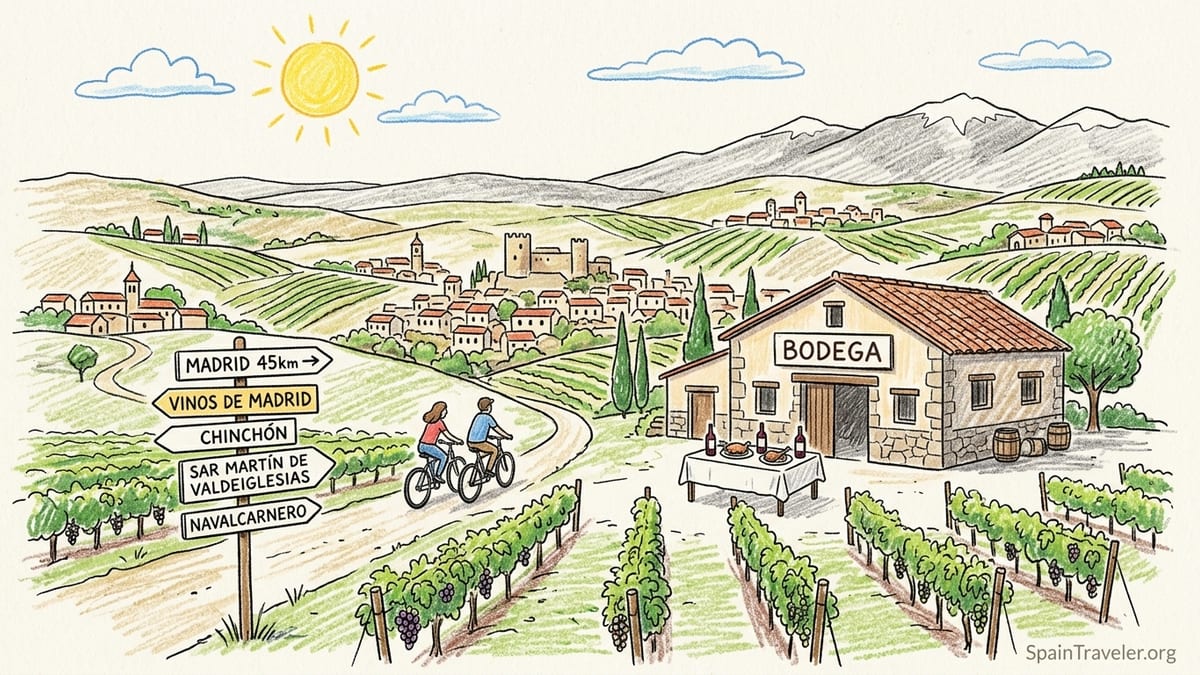
Vinos de Madrid: A Wine Region at the Capital’s Doorstep
The DO Vinos de Madrid was officially recognised in the 1990s as the wine region of the Community of Madrid. Today it brings together more than forty registered wineries, around fifty in some broader counts, spread across roughly fifty municipalities and close to nine thousand hectares of vineyards. What makes this region unique is how closely it hugs the capital: its four official subzones Arganda, Navalcarnero, San Martín de Valdeiglesias and El Molar form a ring around Madrid, with most wineries reachable by car in under an hour from the city centre according to regional tourism authorities. This proximity has helped fuel a rise in wine tourism, yet the vineyards retain a distinctly rural, small-scale character.
The subzones each have their own personality. Arganda, southeast of the city along the Tajuña and Jarama valleys, is the largest, with dozens of bodegas and a landscape of gently rolling cereal fields and vines on limestone and clay soils. To the southwest, Navalcarnero lies on poorer, sandier soils that historically favoured fresh, easy-drinking reds. Further west, San Martín de Valdeiglesias climbs toward the Sierra de Gredos, where old-vine Garnacha and the white grape Albillo Real grow on decomposed granite near reservoirs and pine forests. The youngest subzone, El Molar, to the north of Madrid, represents a cooler, higher-altitude frontier of the designation, with smaller vineyard surface but strong potential.
Visiting these subzones is a reminder that Madrid’s food and wine identity is not limited to the city. You might start a day biking between vineyards in Arganda, continue with a tasting of mountain Garnacha near San Martín’s Castle of Coracera, then finish with dinner at a rural asador serving meat from the nearby Sierra de Guadarrama. The DO Vinos de Madrid acts as a common quality umbrella, but the experiences, landscapes and flavours are decidedly local, and often very different from one valley to the next.
Because the region is compact, it is easy to weave wine visits into broader itineraries. A morning in the historic town of Colmenar de Oreja or Navalcarnero, both recognised by the regional “Villas de Madrid” tourism programme, combines well with tasting in traditional underground cellars. Alternatively, you can link wine with nature in the Sierra Oeste, pairing a hike around the San Juan reservoir with an afternoon among the vines of San Martín de Valdeiglesias. In all cases, you are moving through agricultural countryside, not commuter suburbs, and the local table reflects that.
Flavours of the Countryside: Regional Products and Dishes
The Community of Madrid has quietly built a reputation for quality regional produce that rarely appears by name in the capital’s trendiest restaurants. In the countryside, however, these labels matter. The region is home to the DO Vinos de Madrid for wine, the protected geographical indication (PGI) Carne de la Sierra de Guadarrama for beef and veal, quality designations for Campo Real olives, the protected designation for Anís de Chinchón, and a guarantee mark for Aceite de Madrid olive oil. Visit a rural restaurant and these names often appear printed on menus, chalked on blackboards or proudly mentioned by owners as they explain where their ingredients come from.
Hearty meat dishes dominate many village tables. In the sierras north and west of Madrid, PGI Sierra de Guadarrama beef appears as chuletón (large bone-in steak), entrecot or slow-cooked stews. Around the southern and eastern countryside, lamb and kid goat take centre stage, especially in asadores where whole or half animals are roasted in wood-fired ovens. Pork from central Spain, including local embutidos and dishes like cochinillo asado (roast suckling pig), provides an alternative for those who prefer richer flavours. These are not refined city plates but generous, rustic servings meant to be shared with family and washed down with local red wine.
Vegetable gardens and orchards add freshness to the regional profile. The fertile vegas, or river plains, of the Tajuña and Jarama south and east of Madrid supply tomatoes, artichokes, peppers and lettuce that reach local markets and restaurant kitchens during the growing season. Some towns, such as Villa del Prado, even host annual fairs dedicated to their huerta produce and local wine. Spring menus may feature revueltos of wild asparagus, while autumn brings mushrooms from the Guadarrama forests and game dishes based on venison or wild boar in the higher sierras. Ordering the “plato del día” in a village bar at lunchtime is often the easiest way to discover what is in season.
Desserts and bakery traditions also mark the difference between city and countryside. In various rural towns you will find rosquillas (rings of fried dough), mantecados, and seasonal sweets tied to local festivals. In Chinchón, pastries with names such as pelotas de fraile or tetas de novicia have long histories and are still made in small obradores around the Plaza Mayor. Madroño liqueur and honey from the Sierra Norte of Madrid round out the picture, along with the region’s signature anise liqueurs. For wine travellers, these are essential companions to bottles brought back from the day’s tastings.
Rural Asadores and Village Dining Rooms
A defining pleasure of leaving Madrid city is sitting down in a rural asador or family-run dining room where recipes have changed little in decades. Asadores typically specialise in meats roasted in traditional wood-fired ovens, sometimes visible from the dining room, sometimes hidden in the back near the kitchen. In the Community of Madrid’s countryside they are commonly found in towns such as Colmenar de Oreja, Navalcarnero, San Martín de Valdeiglesias, and in the villages of the Sierra de Guadarrama. Many open mainly at lunchtime and fill quickly on weekends with Madrileños who drive out for the day.
Prices for a full meal at a rural asador are often more approachable than in central Madrid, though they have risen in recent years. As an illustrative range, a generous plate of roast lamb or suckling pig with salad might sit around 20 to 30 euros per person, depending on the cut and the restaurant, while fixed-price weekday menus del día in simpler village bars can still be found in the 12 to 18 euro range, usually including starter, main course, dessert, bread and wine. Because there can be significant variation between establishments, it is wise to confirm prices when you book or check the blackboard menu outside.
Wine lists in these establishments increasingly highlight bottles from the nearest Vinos de Madrid subzone. In a Navalcarnero dining room, that might mean young, fruity Garnacha from surrounding sandy soils, while in Arganda you could encounter structured Tempranillo-based reds or fresh Malvar whites from the local cooperative. In San Martín de Valdeiglesias and the Sierra Oeste, some asadores now pour high-altitude, single-vineyard Garnacha and mineral-driven Albillo Real from small estates, often at prices far lower than you would pay for similar wines from more famous regions.
Service style tends to be informal and family-oriented. It is common to see multi-generational groups sharing platters rather than ordering individually. Reservations for Sunday lunch are strongly recommended in well-known villages within easy reach of Madrid, especially during autumn and spring when rural tourism peaks. If you are combining a winery visit with lunch, allow generous travel time between venues, as rural roads can be slow and picturesque detours are tempting.
Chinchón: Anís, Wine Cellars and Traditional Food
Chinchón, about 45 kilometres southeast of Madrid, is one of the clearest examples of how rural gastronomy in the Community of Madrid has developed its own identity. Officially recognised as one of the “Villas de Madrid,” it is best known for its oval Plaza Mayor lined with wooden balconies and for Anís de Chinchón, a protected spirit distilled from aniseed. Yet the town is also part of the DO Vinos de Madrid area, with vineyards in its municipal limits and historic wine cellars carved beneath houses and streets.
The local tourism office promotes wine and food experiences that go well beyond a simple stroll around the square. Visitors can book guided tours of centuries-old bodegas, including one that is considered among the oldest in the region, and take part in private tastings led by enologists. Some wineries around Chinchón focus on traditional grape varieties such as Tempranillo, Tinto Fino, Airén and Malvar, with an emphasis on manual, sustainable viticulture. Cellar tours often showcase underground galleries where wine once fermented in concrete or clay vessels, offering a glimpse of how central viticulture was to rural life.
On the gastronomy side, Chinchón’s restaurants and inns serve dishes that blend Castilian and local influences. In and around the Plaza Mayor you will find cocido madrileño, hearty stews, grilled meats and roasts, along with seasonal game. Many establishments offer a menu that pairs a starter based on local vegetables or soups with a main meat dish and dessert, which might be a slice of homemade flan or one of the town’s distinctive pastries. Local sweets with colourful names, along with anisettes and other liqueurs, are a popular souvenir and a way to support small family businesses.
Chinchón also serves as a practical base for exploring nearby wine country in the Arganda subzone. Within a short drive, you can reach towns such as Colmenar de Oreja and Villarejo de Salvanés, where underground cellars stretch beneath streets and squares and where events like wine fairs and cultural festivals take place during the year. By structuring your itinerary around Chinchón, you combine a visually striking historic centre, a well-developed hospitality offer, and easy access to both wine and food experiences in the surrounding countryside.
Inside the DO: Landscapes and Wine Styles Across the Subzones
Travelling through the Vinos de Madrid subzones helps explain why local wine can taste so different from one village to the next. In Arganda, vineyards extend over terrace-like slopes and plateaus between river valleys. Soils mix limestone and clay, summers are hot and dry, and the main grapes are Tempranillo for reds and Malvar and Airén for whites. Wineries here produce everything from joven reds intended for early drinking to oak-aged crianzas and reservas, as well as increasingly expressive whites that pair well with vegetable dishes and fish. Many bodegas are medium-sized cooperatives or family firms, often located on the edge of towns such as Arganda del Rey, Colmenar de Oreja or Valdilecha.
Navalcarnero, southwest of Madrid, has a wine history dating back to at least the thirteenth century. Its soils are generally lighter and sandier, which historically produced softer reds based on Garnacha and some Tempranillo, as well as simple claretes. The town maintains a strong wine identity, with a small wine museum and events throughout the year that link local culture to the vineyards around it. Several bodegas in this subzone still use underground cellars and traditional winemaking methods, while others have shifted towards more modern facilities and styles. For travellers, Navalcarnero offers a compact historic centre, easy vehicle access from the A-5 highway and the sensation of being in a distinct wine town, not just a suburb.
San Martín de Valdeiglesias, at the western edge of the region, is often seen as the most dramatically scenic wine area. Here vineyards climb hillsides framed by pine forests and granite outcrops, near reservoirs such as San Juan and Picadas that attract hikers and water-sports enthusiasts. Old-vine Garnacha planted at higher elevations can give wines with surprising freshness and minerality, while Albillo Real, an old Castilian white variety, yields textured, characterful whites. Several small and medium-sized wineries have gained recognition for low-yield, quality-focused production, and the town’s restored medieval castle now houses a wine shop and tasting space that showcases subzone wines.
The youngest and smallest subzone, El Molar, lies to the north of Madrid along the foothills of the Sierra Norte. Its inclusion within DO Vinos de Madrid reflects both historic plantings and a newer wave of viticulture that takes advantage of altitude and cooler night-time temperatures. Vineyards are often scattered among holm oaks and scrubland, and while the number of wineries and hectares is modest compared to Arganda, the area is of growing interest to winemakers seeking fresh, expressive reds and whites. For visitors, El Molar can be combined with nature excursions in the nearby Sierra or with rural stays in the northern part of the region.
How to Explore: Independent Visits, Guided Routes and Wine Trains
Travellers interested in Vinos de Madrid face a practical question: how best to organise their visits. One option is independent touring by car, booking directly with individual wineries. This gives maximum flexibility to choose subzones, times and styles of wine, and it works particularly well in Arganda, Navalcarnero and the wider Sierra Oeste. Many bodegas request advance reservations for tastings and tours, and some only open on specific days or mornings, so contacting them ahead of time by phone or email is essential. Driving distances are short, but secondary roads can be winding; having a designated driver who spits during tastings or abstains from drinking is an important safety consideration.
For those without a car or who prefer not to drive, guided wine routes departing from Madrid city provide an attractive alternative. Several tour operators, often in collaboration with the regional tourism authorities and the DO, offer half-day or full-day excursions that include transport, guided winery visits and sometimes lunch in a village restaurant. Itineraries frequently focus on one subzone, such as Arganda or San Martín, and might combine a visit to a historic town like Chinchón or Colmenar de Oreja with one or two bodegas. Prices vary by operator and group size, but as a broad indication many such tours fall somewhere between 60 and 150 euros per person, depending on inclusions like meals or premium tastings. Checking what is covered before booking matters, particularly for independent-minded travellers who prefer time to explore on their own.
A third option promoted by regional tourism authorities in recent years is rail-based wine experiences, sometimes branded as wine trains. These combine a train journey from Madrid to a wine town with guided visits to local wineries, meals featuring regional products and, in some cases, cultural activities such as theatre or historical reenactments. Availability can be seasonal and is often tied to specific events or weekends. Schedules and prices tend to change from year to year, so the most reliable way to plan is to consult up-to-date information from the Community of Madrid’s official tourism channels or local councils in towns like Navalcarnero, Aranjuez or San Martín de Valdeiglesias before your trip.
Each approach has its own strengths. Independent car-based travel suits visitors who like to move at their own pace, explore back roads and perhaps connect more deeply with individual producers. Guided routes reduce logistical stress and are particularly convenient if you are short on time or unfamiliar with Spanish. Train-based experiences appeal to travellers who prioritise sustainability, prefer not to drive after tastings and enjoy themed days out that integrate wine, heritage and gastronomy into a single package. When deciding, consider not only budget and language ability but also how comfortable you feel navigating rural areas and arranging reservations in advance.
When a Car Helps and Where Public Transport Works
Despite marketing claims that many wineries are less than an hour from Madrid by car or public transport, the ground reality is that a private vehicle still makes some areas much easier to explore. The Arganda subzone, for example, includes towns connected by regional buses from Madrid, such as Arganda del Rey or Morata de Tajuña, but vineyards and bodegas often sit outside the town centres along rural tracks. Reaching more than one winery and then continuing to another village for lunch is far more straightforward if you are driving, especially on weekends when public transport frequencies can be reduced.
In Navalcarnero, buses from Madrid’s Príncipe Pío or other stations bring you to the historic centre in roughly forty minutes under normal traffic conditions. From there, you can visit cellars within walking distance and explore the town’s squares and museums on foot. However, if your goal is to reach multiple wineries scattered across the subzone or combine Navalcarnero with nearby countryside restaurants, a car becomes very useful. The same holds true in San Martín de Valdeiglesias: interurban buses from Madrid connect you to the town itself in about an hour, but many vineyards, viewpoints and rural accommodation options lie several kilometres away, making driving or pre-arranged transfers the practical choice.
El Molar and the northern parts of the region benefit from a mix of bus and, in some corridors, commuter rail services, which can be paired with short taxi rides to specific wineries or rural lodgings. However, taxis may not be abundant at small-town stations, and ride-hailing platforms have patchy coverage in sparsely populated areas. If you plan to rely on public transport, it is worth contacting wineries in advance to ask about local taxi numbers or transfer services they may use, and to confirm opening hours that fit with bus or train timetables.
For travellers who prefer to avoid both driving and complex public transport planning, organised tours and wine trains effectively act as substitutes for having your own car. They are particularly sensible if you want to taste freely without worrying about blood-alcohol limits or navigation. The trade-off is less flexibility: you will visit the bodegas chosen by the organiser and have limited time in each village. A hybrid approach can also work well, for instance using a guided tour for a first overview of the Vinos de Madrid landscape and then returning on another day with a rental car to dive deeper into a subzone or village that caught your attention.
The Takeaway
Exploring the Community of Madrid’s food and wine scene beyond the capital reveals a region with its own strong rural identity. The DO Vinos de Madrid, with its four subzones encircling the city, is not an abstract label but a living landscape of vineyards, small towns and family wineries. In Arganda, Navalcarnero, San Martín de Valdeiglesias and El Molar, the wines reflect different soils and climates, from limestone plains to granite hillsides, while at the table you find meat from the Sierra de Guadarrama, vegetables from riverbank gardens, olives from Campo Real and anisette distilled in Chinchón.
Wine tourism here is best understood as a combination of landscape, heritage and gastronomy rather than as a succession of cellar-door tastings. Historic plazas like Chinchón’s, underground cellars in Colmenar de Oreja or Navalcarnero, medieval castles and reservoirs framed by pine forests all form part of the experience. Whether you choose independent driving, guided routes or wine trains, the key is to slow down, plan ahead and allow time for long lunches in rural asadores and conversations with winemakers who are helping to redefine what Madrid wine and countryside cuisine mean.
For travellers used to thinking of Madrid purely as an urban destination, this nearby rural world can come as a surprise. Yet within an hour of leaving the city, you can be standing among vines, tasting Garnacha grown on granite at altitude, or dipping bread into the juices of a wood-roasted lamb while a local Tempranillo fills your glass. It is in these moments, far from the bustle of the Gran Vía, that the Community of Madrid’s own gastronomic and wine identity reveals itself, distinct from but deeply connected to the capital whose name it shares.
FAQ
Q1. How far are the Vinos de Madrid wineries from central Madrid?
Most of the main wine towns in the DO, such as Arganda del Rey, Navalcarnero and San Martín de Valdeiglesias, are roughly 30 to 70 kilometres from central Madrid, usually under an hour by car in normal traffic.
Q2. Do I need a car to visit wineries in the Community of Madrid?
A car is not strictly necessary, but it makes visiting multiple wineries in one day much easier. Some towns are reachable by bus or train, and guided tours or wine trains can substitute for driving if you prefer to rely on organised transport.
Q3. Can I visit wineries in Chinchón itself?
Chinchón has historic wine cellars and is part of the Vinos de Madrid production area. Several bodegas in and around the town offer visits and tastings by prior reservation, often combined with tours of underground cellars and the historic centre.
Q4. What typical dishes should I try in rural restaurants outside Madrid city?
Look for roast lamb or suckling pig from wood-fired ovens, beef from the Sierra de Guadarrama, hearty stews like cocido, seasonal vegetables from local huertas, and traditional pastries or anisettes for dessert.
Q5. Are winery visits and tastings expensive in the Vinos de Madrid region?
Prices vary, but many standard visits with a short tour and tasting of several wines are moderately priced compared with more famous Spanish regions. Some wineries may waive or reduce the fee if you purchase bottles, while premium or private experiences cost more.
Q6. When is the best time of year to explore the wine country around Madrid?
Spring and autumn are generally the most pleasant, with milder temperatures and colourful landscapes. Harvest time around September and early October can be particularly interesting, although wineries may be busy with production and require careful advance booking.
Q7. Is English widely spoken at rural wineries and restaurants?
In many wineries that work regularly with visitors, staff have at least basic English, and some offer full tours in English. In small village bars and asadores, Spanish is more common, so a few key phrases and a willingness to gesture and smile are very helpful.
Q8. Can I visit vineyards and combine wine tourism with outdoor activities?
Yes. Areas such as San Martín de Valdeiglesias near the San Juan reservoir and the Sierra Oeste allow you to combine tastings with hiking, swimming, cycling or simply walking through vineyard landscapes before or after your winery visits.
Q9. Are there child-friendly options on wine routes in the Community of Madrid?
Many wineries welcome families and offer juice or grape must tastings for children, and the surrounding countryside provides space for walks and picnics. However, experiences are primarily designed for adults, so it is worth confirming in advance that younger visitors are accommodated.
Q10. How should I buy and transport wine from the region if I am flying home?
Most wineries sell bottles on-site and can advise on packing. Travellers typically carry wines in checked luggage using padded sleeves or travel wine cases, and it is important to check airline baggage rules and customs allowances for your destination before purchasing large quantities.