


Deciding where to sleep in the Community of Madrid shapes how you experience the region. Madrid city is an obvious base, but the surrounding World Heritage towns, official "Villas de Madrid" and Sierra de Guadarrama villages offer very different evenings, easier starts for certain excursions and a slower, more local rhythm once the day-trippers go home. This guide compares those options so you can decide whether to stay put in the capital, split your time between bases, or skip Madrid altogether for a few nights.
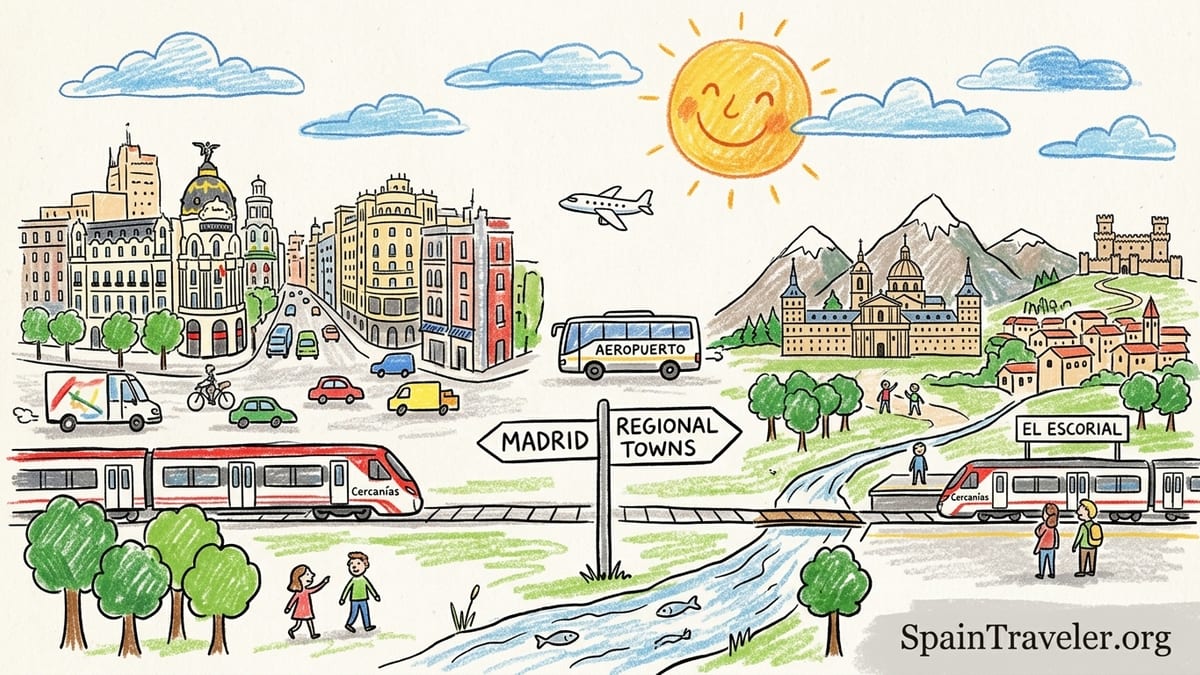
Madrid vs the Region: How Your Base Changes the Trip
Staying in central Madrid puts you at the heart of a major European capital, with dense public transport, late-night dining and accommodation in every price band. From a hotel near Puerta del Sol or Gran Vía you can reach the Prado, Reina Sofía and Palacio Real on foot, while three main hubs Atocha, Chamartín and Príncipe Pío connect you to the Cercanías commuter rail network for day trips across the region. For many first-time visitors, this convenience and choice outweigh the appeal of quieter bases.
Outside the city, the Community of Madrid actively promotes its World Heritage cities Alcalá de Henares, Aranjuez and San Lorenzo de El Escorial, along with eleven designated "Villas de Madrid" such as Chinchón, Buitrago del Lozoya and Manzanares el Real, as destinations in their own right, not just side trips from Madrid. Regional campaigns group these towns under brands like "World Heritage in Madrid" and "Villas de Madrid," highlighting them as places to stay, with their own cultural calendars and walking-scale historic centers.
This shift in emphasis matters for trip planning. If you sleep in Alcalá or San Lorenzo, you are not just commuting in for a single monument; you wake up to local markets, neighborhood bars that never see a tour bus and quieter streets once the day-trippers have left. In Aranjuez, for example, many visitors see only the Royal Palace and gardens in a rushed half day, then head back to Madrid. Staying overnight lets you walk the Tagus riverbank at dusk, dine in a terrace on the Calle de la Reina and see the palace facade lit up in the evening calm.
The decision broadly breaks into two strategies. One is to base in Madrid and day trip out, using fast Cercanías trains that often reach Alcalá, Aranjuez or El Escorial in 45 to 60 minutes. The other is to combine a Madrid stay with one or two nights in a heritage town or Sierra village, trading some big-city convenience for deeper immersion and easier access to nearby countryside. The right choice depends on your priorities, mobility, budget and how many days you have in the region.
Airport Access and Arriving Smart
Almost all international visitors arrive at Adolfo Suárez Madrid-Barajas Airport, about 12 kilometers northeast of the city. Public information published in 2026 confirms that four main options link the airport to the center: Metro line 8, the yellow Exprés Aeropuerto bus, Cercanías commuter trains from Terminal 4 and metered taxis. Metro journeys typically take 30 to 40 minutes to central stations, while the Exprés bus reaches Cibeles or Atocha in roughly a similar time window, usually for around 5 euros including the airport supplement. A fixed taxi fare of 33 euros applies between any terminal and any address inside the M-30 ring road, which covers most central districts.
If you intend to base outside Madrid city for part of your stay, it remains practical to spend the first night in the capital. After a long flight, the last thing many travelers want is to master regional bus timetables. By staying near Atocha or Chamartín after landing, you can sleep off jet lag, then board a Cercanías train the next morning to Alcalá de Henares, Aranjuez or El Escorial. For example, a morning Cercanías service from Atocha to Alcalá usually takes about 40 minutes and runs frequently at peak hours, making for a gentle transition into a university town atmosphere.
Direct airport access to secondary bases is limited. There is no regular rail service from Barajas to Aranjuez or El Escorial without passing through the city network. Reaching a Sierra village such as Cercedilla, Navacerrada or Rascafría normally requires at least one change inside Madrid to either a train or a regional bus at Moncloa or Plaza de Castilla. For this reason, using Madrid city as an arrival and departure base is often the simplest solution, even if you plan to sleep elsewhere for a few intermediate nights.
One practical example: a couple arriving in Terminal 4 with light luggage might tap contactless cards into the Cercanías station under the terminal, ride to Chamartín in around 15 minutes, then continue by Cercanías to El Escorial in about an hour. Another traveler landing late in the evening might prefer the flat-rate taxi into a hotel near Nuevos Ministerios or Sol, then take a mid-morning train to a heritage town once rested. Your arrival time, luggage and comfort with transfers will guide whether you move bases immediately or phase into the region.
Madrid City as a Base: Who It Suits Best
Using Madrid city as your only base makes sense for many first-time visitors, short stays and trips where nightlife, museums and restaurant choice are top priorities. Central neighborhoods such as Sol, Huertas, Malasaña, La Latina, Chueca and Salamanca offer an enormous spread of accommodation, from simple pensiones around 80 to 120 euros per night in shoulder seasons to high-end design hotels and classic grand hotels that may run several hundred euros per night. You can walk to major museums, wander tapas streets after dark and still reach the regional towns in under an hour for day trips.
Public transport density in the city is hard to beat. Lines C-2, C-3, C-7 and C-8 of Cercanías link Atocha and Chamartín with Alcalá de Henares, Aranjuez and El Escorial, while interurban buses fan out from Moncloa and Conde de Casal to Sierra villages and official Villas de Madrid. For example, buses to Chinchón leave from Conde de Casal and typically take around 50 to 60 minutes, while trains from Atocha to Aranjuez often run at least twice an hour during busy times and take roughly 45 minutes.
Staying in Madrid is especially suitable if you are visiting in winter when mountain weather can be unpredictable or if you rely entirely on public transport. You have far more back-up options if a train line suffers temporary disruptions, which has occurred intermittently during upgrade works on the Cercanías network. If a C-3 service to Aranjuez terminates early due to engineering works, you can usually re-route via another line or choose a different destination that day, without feeling stranded in a small town with limited alternatives.
Parking and driving into central Madrid, by contrast, is complicated by low-emission regulations and scarce, expensive parking. Visitors planning to rent a car for rural excursions often do better to wait until they are ready to leave the city, pick up the vehicle from a location outside the inner ring road, and then head straight to a regional base. For purely urban stays without a car, Madrid is unbeatable, but for road-tripping through the Sierra or visiting winery villages, keeping a car in the center is rarely worth the stress or cost.
San Lorenzo de El Escorial: Monastery Mornings and Sierra Air
San Lorenzo de El Escorial sits on the lower slopes of the Sierra de Guadarrama, dominated by the vast granite complex of the Monastery and Royal Seat of San Lorenzo de El Escorial. Recognized as a UNESCO World Heritage site, the monastery, royal pantheon and palace form one of Spain’s most important historical ensembles. The town itself has steep, cobbled streets, traditional inns and viewpoints over the surrounding mountains, giving a very different feel to Madrid’s flat boulevards.
From Madrid, Cercanías line C-8 connects Atocha and Chamartín with El Escorial, usually in about one hour. Recent service information indicates trains between El Escorial and Atocha can run as frequently as every 30 minutes during peak periods, with reduced frequencies in off-peak hours. There is also road access via the A-6 motorway and M-600, making it straightforward for drivers who want to combine El Escorial with mountain hikes or a circular route through the Sierra. Parking in San Lorenzo is easier than in central Madrid, though on busy weekends it can still require patience near the monastery.
Staying overnight in San Lorenzo gives two clear advantages over a Madrid day trip. First, you can start at the monastery as the doors open, before the bulk of tour buses arrive from Madrid mid-morning. This makes the long galleries, basilica and royal apartments feel far more contemplative. Second, once the last coaches depart in late afternoon, the town quiets significantly. Locals reclaim the arcaded plazas, and you can linger over dinner in a traditional asador or modern bistro with views toward the illuminated monastery. In high season, that evening atmosphere is often the highlight of a stay.
This base works particularly well for travelers who want to mix culture and nature. San Lorenzo is within easy reach of hiking routes in the Sierra de Guadarrama, and some local hotels and casas rurales cater specifically to walkers and cyclists. A typical itinerary might see you tour the monastery in the early morning, enjoy a long lunch in town, then hike a signed trail in the late afternoon. For a multi-night stay, you might add a day trip to the nearby Valle de los Caídos or continue by car to mountain villages such as Cercedilla or Navacerrada.
Alcalá de Henares and Aranjuez: World Heritage as a Sleep Base
Alcalá de Henares and Aranjuez share UNESCO World Heritage status, but their characters are distinct. Alcalá, birthplace of Miguel de Cervantes, functions as a lively university city with Renaissance courtyards, the Cervantes Birthplace Museum and a compact historic quarter lined with arcades. Aranjuez spreads along the Tagus River, with a Bourbon palace, extensive formal gardens and historic irrigation systems that underpin its cultural landscape designation.
Alcalá benefits from high rail connectivity. Transport data show that lines C-2, C-7 and C-8 of Cercanías link Alcalá with Madrid’s main stations, providing regular services that often take around 35 to 45 minutes between Atocha and Alcalá. This frequency makes it practical both as a day trip and as a base for travelers who still want quick access to central Madrid for one or two evenings. Hotels and guesthouses here often price slightly below comparable central Madrid properties, especially outside major university events, which can make Alcalá attractive for budget-conscious visitors who do not mind a daily commute.
Aranjuez sits to the south of Madrid, linked by Cercanías line C-3. Journey times between Atocha and Aranjuez are typically around 45 minutes, though schedules can be affected by ongoing infrastructure works on some stretches of the Cercanías network. The town’s accommodation cluster includes small hotels and family-run hostales within walking distance of both the station and the palace. Many visitors choose to stay here in spring, when the palace gardens and riverside parks are particularly attractive and local events celebrate the town’s horticultural traditions.
Sleeping in either Alcalá or Aranjuez changes how you see them. In Alcalá, student bars and tapas crawls take over once the excursion groups have left, and the main plaza feels like a local meeting point rather than a tourist stage set. In Aranjuez, early mornings in the Prince’s Garden or along the Tagus are almost empty, and summer evenings bring open-air concerts, regional festivals and nightly strolls under tree-lined avenues. Both towns give a sense of everyday Spanish life that can be harder to find in Madrid’s most central, visitor-heavy districts.
These bases suit travelers who prefer mid-size towns where everything is walkable and who plan one or two excursions into Madrid rather than daily museum visits. They are also practical for road trips heading toward La Mancha or Castile-La Mancha, since you can pick up a rental car in Madrid, drive south, park more easily than in the capital and explore nearby countryside without navigating Madrid’s inner low-emission zones each day.
Chinchón and the Official “Villas de Madrid”
Chinchón, one of the designated "Villas de Madrid," offers an archetypal Castilian small-town experience within an hour of the capital. Its central Plaza Mayor, lined with green-painted wooden balconies, hosts festivals, bull-related events and open-air performances, while the town climbs in tiers up the hillside to a church and castle ruins. Official regional tourism materials describe Chinchón as a place where time seems to have paused, and its use as a film set for historical productions underlines that impression.
Reaching Chinchón from Madrid usually involves an interurban bus from the Conde de Casal transport hub on the eastern side of the city. Typical journey times hover around 50 to 60 minutes, depending on traffic. There is no train station, so travelers without a car need to plan around bus timetables, which may thin out in the late evening. Drivers can reach the town via regional roads and find public parking areas on the outskirts of the historic center, walking the last few minutes uphill.
Chinchón’s character changes dramatically once the day-trippers and touring coaches have gone. At midday on a weekend, terraces around the Plaza Mayor will be full of visitors eating cocido or grilled meats, and souvenir shops spill onto the arcades. By night, especially outside summer, the square can be almost hushed, lit by warm streetlamps and dotted with just a few tables of locals. Staying the night lets you enjoy this quieter side, along with early morning walks when shopkeepers open shutters and bread vans crisscross the alleys.
This makes Chinchón an excellent base for travelers who value atmosphere and scenery over transport convenience. There are fewer hotel beds than in the World Heritage towns, and options skew toward small inns, casas rurales and a few characterful boutique properties set in old houses with interior courtyards. It is not an ideal base if you plan to commute into Madrid daily, but it works beautifully as a two-night pause between city time and wider touring, or as a base for exploring nearby wine country and other Villas de Madrid such as Colmenar de Oreja or Villarejo de Salvanés.
Sierra de Guadarrama Villages: Nature at Your Doorstep
For travelers whose priority is mountain air, hiking and a break from urban life, villages in the Sierra de Guadarrama offer a compelling alternative to both Madrid and the heritage towns. Places like Cercedilla, Navacerrada, Rascafría, Manzanares el Real or Buitrago del Lozoya place you within minutes of trailheads, lakes and viewpoints, while still keeping Madrid within reach for a culture day if needed. Some of these, notably Manzanares el Real and Buitrago, are themselves part of the official "Villas de Madrid" network due to their castle architecture and historic centers.
Access varies by village. Cercedilla, for example, is reachable by Cercanías services from Madrid that continue beyond Collado Villalba into the high valleys, though frequencies can drop to every 30 or 60 minutes at quieter times. Navacerrada and Rascafría typically rely on regional buses from Moncloa or Plaza de Castilla, with more limited late-night services. Drivers reach these villages via the A-6, M-601 or A-1 corridors, often within 60 to 90 minutes of central Madrid, but winter snow or holiday traffic can significantly lengthen travel times.
Staying in a Sierra village is primarily about rhythm. Mornings begin with local bakeries and cafés serving mountain-style breakfasts before hikers head for routes in the Peñalara Natural Park, La Pedriza or along high ridges. Afternoons might include a menu del día in a family restaurant and a siesta, followed by an evening paseo under clear, cooler skies than in the city. After the last day-trippers drive back toward Madrid, villages fall quiet, and starlit nights can be strikingly dark compared to the capital.
Accommodation here is more seasonal and often family-run. In summer and on sunny winter weekends, demand for casas rurales and small hotels spikes as madrileños escape the heat or seek snow. Prices can approach central Madrid levels for quality lodges near ski areas or popular trailheads, although midweek outside peak school holidays often brings better value. Travelers who do not plan to drive should pay close attention to bus and train timetables, especially the timing of the last return services, and consider staying in a village with at least basic evening services and a taxi company based nearby in case of missed buses.
Who Should Move Bases – And Who Should Not
Changing bases inside the Community of Madrid involves trade-offs. Travelers staying three or fewer nights in total, or those with large amounts of luggage or mobility constraints, often benefit from minimizing hotel changes. For them, using Madrid as a single base and taking one or two day trips by Cercanías keeps logistics simple while still showcasing the range of landscapes and history. A typical three-night first visit might combine one day in central Madrid, one day trip to a World Heritage town and one flexible day for museums or a second excursion.
On the other hand, travelers with five or more regional days can gain a lot by adding an overnight base in a smaller town or the Sierra. For example, a family spending a week in the area might split time between four nights in Madrid and three nights in San Lorenzo de El Escorial or a Sierra village, giving children both city playgrounds and mountain hikes. Couples interested in food and wine might choose Madrid for tapas and high-end dining at the start, then two nights in Chinchón or Aranjuez to slow down and enjoy long, local meals without watching the clock for the last train.
There are also timing advantages to moving bases. Early entry to major monuments such as the Monastery of San Lorenzo or the Royal Palace of Aranjuez is more practical when you are already in town. Instead of catching a 7:00 train from Madrid to beat the crowds, you can enjoy breakfast near your accommodation and stroll over before opening. Likewise, evenings in plaza-lined towns often reach their most atmospheric around 9:00 or 10:00 at night, when many day-trippers staying in Madrid are already on the train home or finishing dinner back in the capital.
That said, some travelers may find the reduced restaurant choice and quieter nightlife in smaller towns less appealing, especially on Sunday or Monday evenings when local venues may close. Digital nomads or visitors needing consistent co-working spaces will generally be better served in Madrid proper. When in doubt, it can help to frame your decision around one question: do you want to treat the heritage towns and Sierra as outings from Madrid, or as places where you live, however briefly? Your base strategy should answer that honestly.
Base Strategies for 3, 5 and 7 Regional Days
For a three-day regional stay, the most efficient option for most travelers is to sleep all nights in Madrid city. Day one can focus on the historic center and a museum or two. Day two might be a rail day trip to either Alcalá de Henares or Aranjuez, depending on whether you prefer a university ambiance or palace gardens. Day three can then remain flexible, perhaps adding a half-day visit to San Lorenzo de El Escorial if you move quickly, or simply exploring additional neighborhoods such as La Latina or Chamberí. With so little time, the cost in time and effort of changing bases outweighs the benefits for most visitors.
With five regional days, splitting your stay becomes more attractive. One practical structure is three nights in Madrid followed by two nights in a heritage town or Sierra village. For example, arrive and spend three nights in Madrid, using one day for core sights and another for a day trip to the town you plan to move to later. This lets you test both transport and atmosphere in daylight. You could day trip to San Lorenzo de El Escorial, then decide to return for two nights at the end of your stay if it resonates. Alternatively, you might fall for Alcalá’s colonnaded squares and opt to finish your trip with quiet evenings in its historic quarter.
For seven regional days or more, a multi-base strategy can unlock very different facets of the Community of Madrid. One possible pattern is four nights in Madrid, two in a World Heritage town and one in a Sierra village, using a rental car for the final segment if you are comfortable driving. Another is three nights in Madrid followed by four nights split between Aranjuez and Chinchón, focusing on gardens, seasonal festivals and rural gastronomy. Because distances are relatively short, you are unlikely to spend more than an hour or two moving between these bases on any single day.
Whatever the length of stay, keep departure logistics in mind. Many travelers find it easiest to end back in Madrid the night before a flight, returning a rental car that afternoon and sleeping near a good airport transport link such as Nuevos Ministerios, Chamartín or Atocha. Others prefer to end in a town with straightforward morning connections, such as Alcalá or Aranjuez, and travel in to the airport by train and Metro. In every case, checking current rail schedules a few weeks before travel, especially in summer when infrastructure works are common, helps ensure that your planned base strategy aligns with the reality on the ground.
The Takeaway
Choosing where to stay in the Community of Madrid is less about finding a single "best" base and more about matching place to purpose. Madrid city excels as a first-timers’ hub, with direct airport links, dense transport, endless dining and easy day trips. The World Heritage towns of San Lorenzo de El Escorial, Alcalá de Henares and Aranjuez, along with official Villas de Madrid like Chinchón, offer a slower pace, powerful historic settings and evenings that belong mostly to residents once excursion crowds thin out. Sierra villages take you a step further into nature, trading some convenience for trails and starry skies on your doorstep.
The region’s tourism strategy increasingly invites visitors to think of these places as destinations in their own right, not just dots on a map connected to Madrid. By considering your time frame, mobility, need for nightlife or quiet, and interest in early monument access or mountain walks, you can decide whether to remain anchored in the capital or move bases once or twice. When chosen thoughtfully, where you sleep in the Community of Madrid becomes an integral part of the story you tell yourself about the trip, not just a logistical detail.
FAQ
Q1. Is it practical to stay in Alcalá de Henares and visit Madrid for a day?
Yes, regular Cercanías trains typically connect Alcalá with Madrid’s Atocha and Chamartín stations in about 35 to 45 minutes, so a day in the capital is realistic as long as you are comfortable with a commuter-style journey at the start and end of the day.
Q2. If I stay in San Lorenzo de El Escorial, can I still reach the airport easily on departure day?
It is possible but involves at least one, and usually two, transfers by train and Metro, so many travelers prefer to spend their final night back in Madrid or allow generous time cushions if traveling to the airport directly from El Escorial.
Q3. Do Sierra villages like Cercedilla work as bases without a rental car?
Cercedilla and a few other villages served by Cercanías trains can work without a car if you plan hikes that depart from the village itself, but relying on regional buses for more remote trailheads or evening returns requires careful timetable checks and flexibility.
Q4. Is parking easier in Aranjuez and Alcalá de Henares than in central Madrid?
Generally yes, especially in areas just outside the historic cores, where you will find surface parking or municipal lots that are less constrained and less expensive than the regulated, low-emission zones and underground garages inside central Madrid.
Q5. Which base is best for travelers focused mainly on museums and nightlife?
Central Madrid suits museum and nightlife-focused trips best, since you can walk or take short Metro rides between major museums, theaters and late-opening tapas districts without worrying about last trains back to another town.
Q6. Is Chinchón a good base for repeated day trips into Madrid?
Chinchón is better suited to one or two nights focused on local atmosphere and nearby countryside, because its bus-based connection to Madrid is slower and less frequent than train-linked towns, making daily commuting less convenient.
Q7. When is it worth splitting a week between Madrid and the Sierra?
If you have seven or more regional days and want a mix of culture and nature, spending roughly half your time in Madrid and half in a Sierra village or San Lorenzo de El Escorial can deliver both experiences without excessive moving.
Q8. Are there enough restaurant options in smaller bases outside Madrid?
Most heritage towns and larger Sierra villages have a solid core of restaurants and bars, but choice shrinks compared with Madrid, and some venues close early or shut one night a week, so it is wise to check local opening days in advance.
Q9. Should I rent a car for visiting Aranjuez, Alcalá or El Escorial?
For those three towns, most travelers do not need a car because Cercanías trains offer direct links, but a rental car becomes more useful if you want to combine them with smaller villages or rural attractions that lack rail access.
Q10. How far ahead should I check train and bus timetables when planning bases?
It is sensible to confirm timetables a few weeks before travel and again shortly before each move, since seasonal engineering works on the Cercanías network and regional buses can temporarily alter frequencies or routes.