


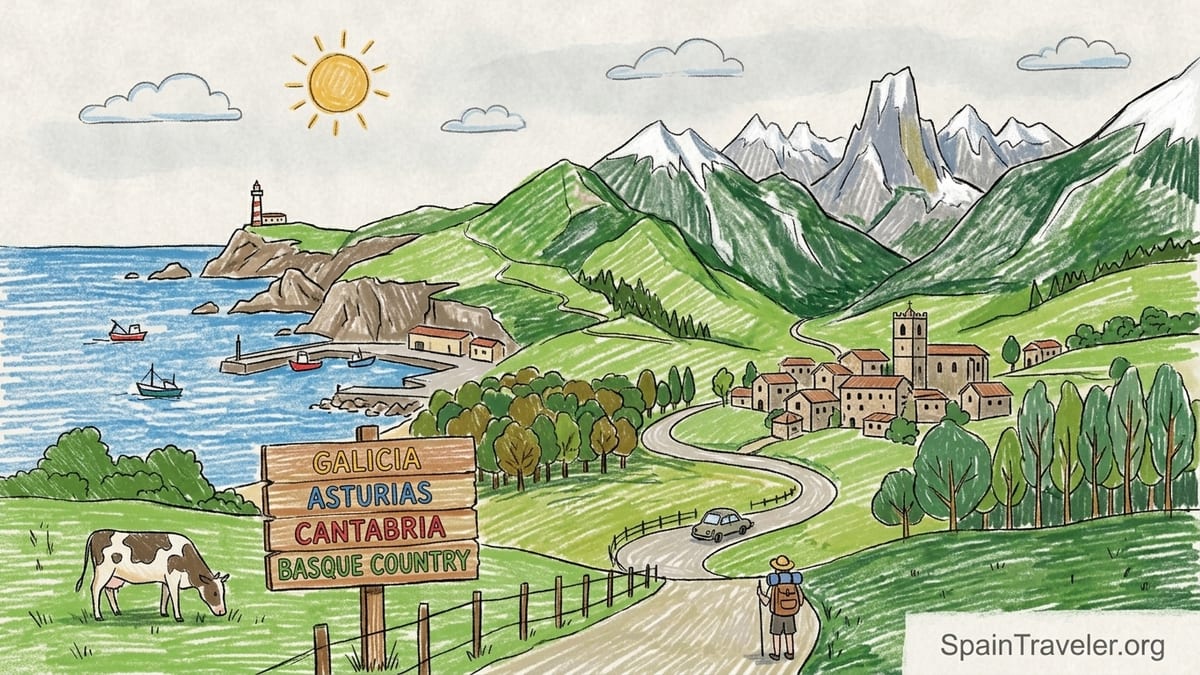
Green Spain is the name Spain’s tourism authorities use for the lush Atlantic strip of the north: Galicia, Asturias, Cantabria and the Basque Country. This is not the Spain of sunburnt beaches and white villages, but of emerald hills, wild ocean, stone fishing ports and compact, walkable cities. If you are planning a first trip and trying to decide where to focus, this guide explains what unites these four regions, what makes each distinct, and how to move between their cities, villages and national parks.
What Green Spain Is and Why It Feels So Different
Green Spain runs for roughly 800 kilometers along the Bay of Biscay, from the border with Portugal up to the French frontier. Officially, it includes four autonomous communities: Galicia in the far west, Asturias and Cantabria in the middle, and the Basque Country to the east. The brand is actively promoted by Spain’s national and regional tourism boards as a single Atlantic destination, but on the ground each region has its own language, cuisine and character.
The common thread is the climate. Moist Atlantic air from the Cantabrian Sea keeps the landscape intensely green for most of the year. Instead of olive groves and arid plains, you see pastures, chestnut and eucalyptus forests, and steep valleys where cows and horses graze. Many first-time visitors compare the scenery to a mix of Ireland or Brittany with Spanish villages and food.
Travel here feels different to the Mediterranean coast. Many towns are compact, everyday working places rather than resort strips. In August, you will still see Spanish families on the beach, but you are just as likely to share a café terrace with students or local office workers on their lunch break. Prices reflect that mix. A coffee in a neighborhood bar in Oviedo or Vigo might be around 1.50 euros, and an excellent three-course weekday lunch menu with wine in a small town can still appear around 15 to 20 euros, which is noticeably lower than in Barcelona or San Sebastián’s most touristy streets.
For a first visit, you do not need to see all four regions. Many travelers choose one main base plus one or two nearby cities, for a trip of 7 to 12 days. The following sections break down what each region offers, along with practical notes on climate, access and travel times so you can decide which part of Green Spain matches your style.
Climate and When to Go
Green Spain has a temperate oceanic climate, with mild temperatures year-round and frequent rain. Cities like San Sebastián are known within Spain for their cloudy, wet weather and even hold some of the country’s highest annual rainfall totals. Summers are generally warm rather than hot, with typical daytime highs in the low to mid 70s Fahrenheit from June to early September, and cooler evenings that often call for a light jacket.
Rain is distributed relatively evenly throughout the year, so you should expect showers in any month. In practice, July and August tend to be the driest and sunniest, but even then you may get two or three grey days in a week. Winter, from November to February, is cool, damp and often windy on the coast, but snow at sea level is rare. Snow is more common in the interior mountains such as the Picos de Europa, where conditions can change rapidly and some high passes remain snow-covered well into spring.
If your priority is beaches and long evenings outdoors, late June through early September is the safest window. In late July and August, popular coastal towns like Sanxenxo in Galicia, Llanes in Asturias, Comillas in Cantabria and Zarautz in the Basque Country can feel busy, with higher hotel prices and more limited availability, especially on weekends. Shoulder months like May, early June, late September and early October are ideal for hiking, city sightseeing and food, with cooler temperatures and fewer crowds, but you will need a good waterproof jacket and shoes.
First-time visitors are often surprised by how quickly the weather can change. It is common to start the day under low cloud in Santander, drive an hour inland to the Picos de Europa and find bright sunshine, or the reverse. Pack layers, a compact umbrella, and shoes that can handle wet pavements and muddy paths, particularly if you plan to walk sections of the Camino de Santiago or coastal trails.
Galicia: Santiago, the Camino and the Atlantic Edge
Galicia forms the western end of Green Spain and feels like a world of its own. Its language, Galician, sounds closer to Portuguese than to Castilian Spanish, and the region has a strong Celtic identity visible in music, bagpipes and festivals. For first-time visitors, the main entry point is usually Santiago de Compostela, whose cathedral marks the end of the Camino de Santiago pilgrimage routes. Even if you are not walking the Camino, spending one or two nights in Santiago allows you to experience the medieval old town, granite arcades and seafood-focused bars.
Beyond Santiago, the Galician coastline is rugged and deeply indented, with rías, or flooded river valleys, creating sheltered estuaries. The Rías Baixas in the southwest are known for Albariño white wine and shellfish. A practical example: you might visit the town of Cambados, taste Albariño at a small family winery, and then lunch on steamed mussels and clams in a simple port-side restaurant, with a bottle of wine often priced similarly to two or three glasses in a major city elsewhere in Europe.
Further north and west, Galicia becomes wilder. The Costa da Morte and the area around Fisterra offer cliffs, lighthouses and long Atlantic beaches where even in high summer you can find plenty of space. These areas are best explored by car, as public transport between small villages is limited and infrequent. Driving from Santiago to Fisterra typically takes around 1.5 to 2 hours, but you will want to stop at viewpoints and fishing ports along the way.
Galicia is also well placed for arrivals from abroad. Santiago-Rosalía de Castro Airport handles flights from major Spanish cities like Madrid and Barcelona and a rotating set of European destinations, while A Coruña and Vigo airports offer additional domestic and some international connections. For a one-region trip of 7 days, it is realistic to fly into Santiago, spend three nights in Santiago and the nearby coast, then move south to the Rías Baixas or inland to Ribeira Sacra for river canyons, monasteries and vineyard terraces before flying out.
Asturias: Mountains, Oviedo, Gijón and Picos de Europa
Asturias sits between Galicia and Cantabria and markets itself as Spain’s “natural paradise.” The region offers a dramatic mix of sea and mountains in a compact area. Within an hour’s drive from many coastal towns you can be deep in the Picos de Europa, a jagged limestone range that spans Asturias, Cantabria and Castile and León. The national park is one of Spain’s top hiking areas, but still feels relatively low-key compared with the Pyrenees or Alps.
Most first-time visitors base themselves in one of three places. Oviedo, the inland capital, is an elegant city with pre-Romanesque churches on its green hillsides and a polished old town packed with cider bars. Gijón, half an hour away by train or bus, is the largest city, with an urban beach, a headland promenade and a working port. Llanes, further east, is a small coastal town ringed by beaches and green headlands, ideal if you want sea air and easy road access to the Picos.
Asturias Airport, located near Avilés, connects the region with Madrid, Barcelona and other Spanish and occasional European cities, making it a straightforward gateway to Green Spain. Buses operated by companies like ALSA link the airport with Oviedo and Gijón in around 45 to 60 minutes. Once in the region, a hire car gives the most flexibility for exploring villages like Cangas de Onís, the Covadonga Lakes and small surfer beaches such as Playa de Rodiles, but there is also a narrow-gauge coastal railway that trundles between many smaller towns at a leisurely pace.
Asturian food leans hearty: fabada, a rich bean stew, grilled or cider-braised chorizo, and simple grilled fish on the coast. One real-world detail many visitors notice is the price of natural cider. In traditional sidrerías in Oviedo or Gijón, a 70-centiliter bottle often costs less than a glass of wine in northern Europe, and is poured in the distinctive Asturian style from above head height. For a first trip of 5 to 7 days focusing on Asturias, a common pattern is three nights in Oviedo or Gijón, two nights in or near the Picos de Europa for hiking or cable car rides, and one or two nights on the coast.
Cantabria: Santander, Picos Access and Coastal Villages
Cantabria is a relatively small region squeezed between Asturias and the Basque Country, but it holds a dense mix of attractions. Its capital, Santander, curves around a wide bay with sandy beaches, a yacht harbor and a waterfront park that includes the Magdalena Peninsula. Visitors often use Santander as a soft landing point: you can stroll the seafront promenade within hours of arrival and find informal tapas bars a short walk from the ferry terminal and city-center hotels.
For many travelers, Cantabria’s real appeal lies just beyond the capital. The region includes the eastern side of the Picos de Europa, accessible via mountain roads towards Potes and the Fuente Dé cable car, which whisks you up to high viewpoints in a few minutes. That makes Cantabria a strong choice if you want to mix one or two days of easy hiking with time in historic villages and on the coast. A realistic example itinerary might be two nights in Santander, two in Potes for mountain walks and visits to viewpoints, and one in a coastal village such as Comillas or San Vicente de la Barquera.
Cantabria’s coast is dotted with small fishing towns that retain a local feel. Comillas has Modernista architecture and a beach at the edge of town; Castro Urdiales near the Basque border features a medieval church and castle overlooking its harbor. Inland, Cantabria is known for cave art sites and for family attractions like the Cabárceno Nature Park, a large open-space zoo set in a former mining landscape just outside Santander. These sites are easiest to reach by car, though local buses and organized excursions are an option in summer.
Seve Ballesteros-Santander Airport provides domestic flights and some international routes, particularly in summer, and there are also long-distance buses and trains linking Santander with Madrid and other Spanish cities. For a broader Green Spain trip, Santander often acts as a hinge: it sits about 2.5 to 3 hours by road from Oviedo to the west and around 2 hours from Bilbao to the east, making it a natural midpoint on a coastal drive.
Basque Country: Bilbao, San Sebastián and Coastal Character
The Basque Country, or Euskadi, forms the eastern end of Green Spain and has a distinct language, culture and cuisine. It is also the most urbanized part of the four, anchored by the cities of Bilbao and San Sebastián and a string of industrial towns along the estuaries. Visitors often notice the visual contrast between the green hills and the bold modern architecture in cities like Bilbao, where the titanium curves of the Guggenheim Museum sit beside old port warehouses and bridges.
Bilbao is the main air gateway to Green Spain. Bilbao Airport has steadily increased its passenger numbers and routes in recent years, with Spanish carriers and low-cost airlines adding capacity and new connections, including additional flights to major European hubs. That means more options for first-time visitors to arrive directly without transiting through Madrid or Barcelona. From the airport, a frequent bus runs into the city center in about 20 to 25 minutes, and once downtown most key sights are easily walkable or a short metro ride away.
San Sebastián, known locally as Donostia, sits east of Bilbao near the French border and is famous for its wide shell-shaped bay, La Concha, and its dense concentration of pintxo bars. Its oceanic climate leads to many cloudy and rainy days, yet in summer the waterfront still fills with swimmers and paddle-boarders. Food is a major draw. In the old town, you can spend an evening grazing from bar to bar, ordering single bite-sized creations for a few euros each, while in the modern Gros neighborhood you will find more experimental offerings and surfing culture near Zurriola Beach.
Between and beyond these cities, the Basque coast is a patchwork of small resorts and fishing villages worth building into a first-time itinerary. Getaria, with its hilltop church and anchovy industry, and Zarautz, with one of the longest urban beaches in the region, can both be reached by a small regional train from San Sebastián in under an hour. Inland, the countryside is deeply green, dotted with farmhouses and cider houses where locals gather for seasonal cider tastings and traditional dishes. Given the density of public transport and the narrow roads into some coastal towns, many first-time visitors choose to skip the car here and rely on buses and trains instead.
Getting In, Getting Around and How Long to Stay
One of the practical advantages of Green Spain is the number of regional airports spread along the coast. From west to east, you have Vigo, Santiago, A Coruña, Asturias, Santander, Bilbao, Vitoria-Gasteiz and San Sebastián, each offering various domestic and some international flights. In recent seasons, airlines have been increasing capacity at Bilbao in particular, making it a strong candidate for open-jaw trips where you arrive in Bilbao and depart from another airport such as Santiago or vice versa.
For most first-time visitors aiming to see more than one region, renting a car is the most flexible option. The coastal highway connects the four communities, with typical driving times of around 1.5 to 2 hours from Santiago to Oviedo, 2.5 to 3 hours from Oviedo to Santander, and around 1.5 to 2 hours from Santander to Bilbao, depending on traffic and stops. A compact car often proves more comfortable on narrow village streets and mountain roads than a large SUV, and parking in old-town centers can be tight. Many travelers pick up a car after a day or two in a city, which avoids city-center driving and can reduce rental days and cost.
That said, you can cover a lot of Green Spain without driving. Long-distance buses operated by national companies link major cities such as Santiago, Oviedo, Santander and Bilbao several times a day, and coastal narrow-gauge trains connect smaller towns in Galicia, Asturias and Cantabria, though they are slower than the highway. Inside regional capitals like Bilbao, Oviedo and Santander, local buses, trams and metros are efficient and inexpensive, with single fares often under a few euros.
In terms of trip length, a focused visit to just one region works well with 5 to 7 days. For example, you might fly into Santiago and spend a week between Santiago and the Rías Baixas, or base yourself in Bilbao with side trips to San Sebastián and the Rioja Alavesa wine region. If you want a multi-region overview of Green Spain, 10 to 14 days allows you to sample at least three of the four communities without rushing. A practical two-week route for a first-timer could be Bilbao, San Sebastián and the Basque coast for four nights, then Santander and Cantabrian villages for three, followed by five nights split between Asturias mountains and coast, finishing in Santiago for two nights before flying out.
Food, Culture and Choosing the Right Region for You
Food is a major reason many travelers gravitate to Green Spain. While each region has its specialties, a few broad patterns help first-timers. Galicia is seafood-first, with dishes like pulpo a la gallega (octopus with paprika and olive oil) and grilled turbot appearing frequently on menus in coastal towns. Asturias leans toward hearty mountain fare, from bean stews to Cabrales cheese, alongside a strong cider culture. Cantabria mixes coastal and rural influences, with anchovies from Santoña, sobaos pastries from the Pas valleys and mountain cheeses. The Basque Country is known internationally for its pintxos culture and high-end restaurants, but also for simple grilled fish and txuleta steak in traditional grill houses.
Cultural identity also varies. In Galicia and the Basque Country you are likely to hear local languages alongside Spanish in everyday life, and see bilingual signage. Regional festivals can be a highlight, whether that is a summer fiesta in a fishing village with fireworks over the harbor, or a cider or wine festival inland. For a first trip, it is wise to check festival dates in advance, as they can affect accommodation availability and prices, particularly in smaller towns where bed capacity is limited.
When choosing where to focus, consider what you want most from the trip. If you are drawn to pilgrimage history, stone villages and wild Atlantic headlands, Galicia and Santiago make a strong base. If you want a tight mix of mountains and easily accessed beaches, Asturias and Cantabria, combined with the Picos de Europa, provide that in a compact area. If food and urban culture are priorities, and you prefer to rely on public transport, the Basque Country, with Bilbao and San Sebastián, is often the best starting point.
Budget is another factor. In general, accommodation and dining in Galicia, Asturias and parts of Cantabria can be slightly more affordable than in the most in-demand districts of San Sebastián or central Bilbao, where boutique hotels and tasting-menu restaurants command higher prices. A mid-range hotel room in a smaller coastal town like Ribadeo or Luarca might be significantly less per night than a similar standard room near San Sebastián’s La Concha. For many visitors, the solution is to mix: perhaps two nights in a high-end city hotel, balanced with several nights in rural guesthouses or simple seaside hotels.
FAQ
Q1. How many days do I need for a first trip to Green Spain?
Most first-time visitors are comfortable with 7 to 10 days if they focus on one or two regions, or 10 to 14 days if they want to sample three or four.
Q2. Is it worth renting a car, or can I rely on public transport?
You can travel between major cities by bus and train, but a car makes it much easier to reach rural villages, coastal viewpoints and the Picos de Europa.
Q3. Which airport is best to fly into for Green Spain?
Bilbao is usually the most convenient gateway thanks to its growing number of flights, but Santiago, Asturias, Santander and Vigo can be better for region-focused trips.
Q4. What is the weather like in summer along the Green Spain coast?
Summers are generally mild, with warm days, cooler evenings and a mix of sun and cloud, and you should still expect occasional showers even in July and August.
Q5. Can I visit the Picos de Europa without serious hiking experience?
Yes. Many viewpoints, such as those reached by the Covadonga Lakes road or the Fuente Dé cable car, offer short, easy walks with big scenery suitable for casual visitors.
Q6. Are Galicia, Asturias, Cantabria and the Basque Country expensive compared with the rest of Spain?
Overall prices are moderate, with everyday food and drink often cheaper than in major Mediterranean resorts, though top restaurants and prime city hotels can be costly.
Q7. Is English widely spoken in Green Spain?
In main cities and tourist areas you will usually find some English, especially among younger people and hospitality staff, but in villages basic Spanish phrases are very helpful.
Q8. When is the best time to visit if I want fewer crowds?
Late May, June, late September and early October balance milder weather with fewer visitors and more availability than the peak summer weeks of late July and August.
Q9. Can I combine Green Spain with another part of Spain on one trip?
Yes. Fast trains and domestic flights link cities like Bilbao, Santiago and Santander with Madrid and Barcelona, making two-center trips very feasible in 10 to 14 days.
Q10. Do I need to book accommodation far in advance?
In high summer and during festivals, coastal towns and cities can sell out, so booking several months ahead is wise, while in shoulder seasons you often have more flexibility.