


Green Spain stretches in a lush arc along the Atlantic from the Basque Country through Cantabria and Asturias to Galicia, where ocean, mountains and fishing villages create some of Europe’s finest walking. In recent years specialist operators have turned this quietly spectacular corner of Spain into a serious walking-holiday destination, offering self-guided and guided itineraries with luggage transfers, handpicked hotels and airport shuttles. This guide compares the key areas and routes, and looks at what you actually get when you book a walking holiday package in Green Spain today.
What Makes Green Spain Ideal For Walking Holidays
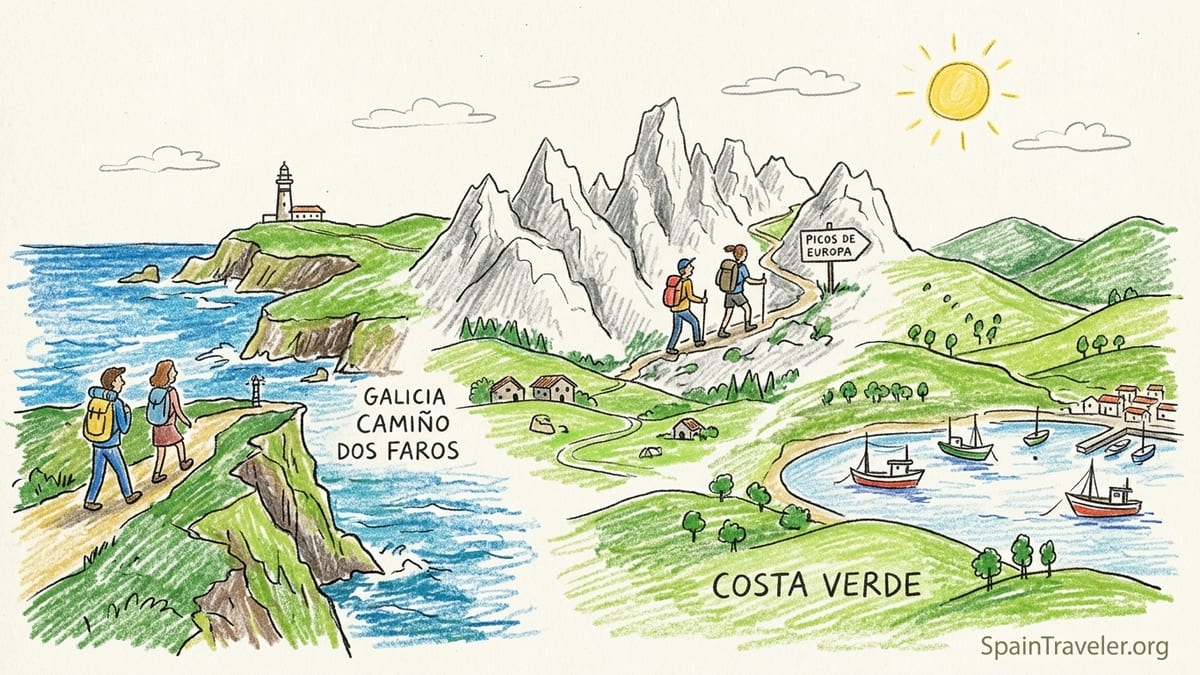
When travel companies talk about Green Spain, they usually mean the northern Atlantic strip that includes Galicia, Asturias, Cantabria and the Basque Country. High rainfall keeps the hills emerald, while Atlantic fronts carve dramatic cliffs and deep estuaries. For walkers the headline attraction is variety. In a single week you might hike limestone gorges in the Picos de Europa, follow the clifftop Camiño dos Faros in Galicia, or thread fishing villages along the Costa Verde and Basque Coast.
Specialist operators now package this landscape into trips for different experience levels. Entry-level guests might choose a 6 or 7 night self-guided coastal holiday with daily distances of 10 to 18 kilometres and modest ascents, with luggage transferred between small hotels. More experienced hikers can opt for multi-day traverses of the Picos or longer Camino del Norte stages, where 20 to 25 kilometre days and uneven terrain are common. Many companies market Green Spain specifically as a cooler, greener alternative to southern European hiking, especially attractive from May to October.
For international travellers, access is easier than it looks on the map. Bilbao and Santander serve the Basque and Cantabrian coasts, Asturias Airport works well for the eastern Costa Verde and Picos, and Santiago de Compostela and A Coruña are the main gateways for Galicia. A typical package includes private or taxi transfers from one of these airports to your first hotel, so you are not trying to decode rural bus timetables straight off a flight.
Picos de Europa: High Drama In A Compact Mountain Range
The Picos de Europa sit just inland from the Cantabrian coast, with sheer limestone massifs rising abruptly from pastoral valleys. Walking-holiday operators specialising in the region, such as local outfits based in arenas like Potes, Arenas de Cabrales or Cangas de Onís, now offer supported self-guided trips that include bag transfers, route notes and emergency backup. A typical week might combine classic routes such as the Cares Gorge path, balcony trails above the Fuente Dé cable car, and quieter shepherd tracks between high pastures and hamlets.
Difficulty in the Picos is usually described as moderate to challenging. Daily distances may only be 10 to 16 kilometres, but ascents and descents can exceed 800 or 1,000 metres on rough, rocky paths. Some itineraries are centre based, with 7 nights in one or two guesthouses and daily walks out and back, which suits travellers who prefer not to change hotels every night. Others are point-to-point treks that cross from one valley to another, with luggage transferred to your next inn while you carry only a daypack.
Accommodation standards in Picos packages are typically small rural hotels, mountain inns and casas rurales, often rated around simple 2 or 3 star level but chosen for character and location rather than formality. Rooms almost always have private bathrooms in packaged holidays. For example, a one-week self-guided Picos trip might cost in the region of 900 to 1,200 euros per person in high season, including breakfasts, luggage transfer, airport pickup from Santander or Asturias and detailed mapping. Guided group weeks, with a professional mountain leader and smaller daily group sizes, usually sit above that price band.
Guided versus self-guided is an important decision in the Picos. Guided trips suit less experienced mountain walkers who value route-finding support, dynamic decision making in changeable weather and the security of a qualified leader. Self-guided walkers confident on alpine-style terrain can enjoy more flexibility and privacy, with local operator support if a storm closes in or a transfer needs adjusting. Either way, most packages in the Picos offer 5 or 6 walking days within a 7 night stay.
Asturias Coastal Walks: Gentle Green Cliffs And Fishing Villages
Asturias markets itself as Spain’s Natural Paradise, and its Costa Verde is increasingly offered as a softer coastal alternative to the high mountains. Companies such as S-Cape Travel sell 7 or 8 day self-guided holidays that link fishing towns like Llanes, Ribadesella and Villaviciosa using a mix of Camino del Norte paths and quieter local trails. One of their popular itineraries follows the E-9 coastal route east of Llanes, with optional taxi drops that let you choose your daily distance before walking back along cliffs, blowholes and sandy coves to your hotel.
Daily distances on these Asturias coastal trips typically range from 12 to 22 kilometres, with modest elevation changes and well-worn paths. Terrain includes clifftop grass tracks, country lanes and beach sections, occasionally with short, steep descents to coves. This makes the Costa Verde well suited to reasonably fit first-timers, mixed-ability couples and travellers who prefer scenery and culture over physical challenge. Operators often flag that Asturias’ green landscapes come from regular rain, so two pairs of shoes and reliable waterproofs are strongly recommended.
Luggage transfer is now standard on commercial Asturias coastal holidays. Your main bag is moved between hotels each day, usually with a 15 to 20 kilogram limit, leaving you to walk with a rain jacket, water, snacks and camera. Accommodation is generally in small 2 or 3 star hotels, coastal inns and renovated manor houses, with occasional nights in historic buildings such as converted convents or Indianos villas. Asturias Airport or Santander tend to be the key arrival points, with a taxi or private transfer into the first overnight town included or available as an extra.
Compared with the Picos, guided group walking on the Asturias coast is less common, as navigation is simpler and risk lower. Most visitors opt for self-guided packages that include GPX tracks, printed route notes and a 24 hour helpline. Those on a tighter budget sometimes replicate operator itineraries independently by booking the same hotels and using public buses or taxis to fill gaps, but that requires more Spanish and more planning than a turn key holiday.
Galicia’s Camiño dos Faros: The Wild Lighthouse Coast
The Camiño dos Faros, or Lighthouse Way, runs for roughly 200 kilometres along Galicia’s Costa da Morte between Malpica and Finisterre. It is one of Green Spain’s most spectacular but also most demanding coastal trails, with frequent ascents and descents between beaches, headlands and fishing coves. The route is usually divided into eight stages, but commercial holidays often stretch this to a 9 or 10 day itinerary with an extra day to travel in and out.
Several operators now offer self-guided Camiño dos Faros holidays pitched clearly at experienced walkers. A typical package will include 9 nights of bed and breakfast in small hotels or rural guesthouses, luggage transfers between each stage end, GPX tracks, detailed daily notes and phone support. Transfers from Santiago de Compostela to Malpica at the start and from Finisterre back to Santiago at the end are often bundled into the price. Expect a per person cost in the broad region of 1,000 to 1,300 euros in high season based on two people sharing, with single room supplements adding significantly to that figure.
Difficulty on the Camiño dos Faros is not to be underestimated. Some stages approach or exceed 25 kilometres with repeated climbs and descents, loose rocky paths, exposed clifftops and long remote stretches without services. Official descriptions often rate stages on a 1 to 5 scale, and several sections reach 4 or 5. Operators frequently emphasise that this is not a Camino de Santiago with dense infrastructure and spontaneous luggage transport; outside packages, walkers must negotiate bag transfers independently with accommodations or local taxi firms. For strong, confident hikers who want an elemental Atlantic coastal experience with the safety net of organised logistics, however, the Lighthouse Way is a standout option in Green Spain.
Guided walking on the Camiño dos Faros exists but is much rarer than self-guided packages. When offered, it tends to target small groups who value a local guide’s knowledge of history, lighthouses, shipwreck lore and seafood restaurants as much as navigation. Outside organised holidays, most long-distance walkers on this trail are still independent, planning their own stages and using small coastal pensions. If you prefer to minimise uncertainty, booking through a specialist that explicitly mentions luggage transfer and private transfers at both ends is advisable.
Basque Coastal Hiking: Cliffs, Geoparks And City Gateways
The Basque Coast combines rugged cliffs, geological drama and refined food culture. Tourism offices for towns like Zumaia actively promote walking routes through the Basque Coast UNESCO Global Geopark between Zumaia and Deba, where layered flysch cliffs plunge into the Bay of Biscay. Day hikes here often use waymarked paths that can be walked independently with basic maps, but several international operators market multi day self-guided trips along the Basque shoreline that end near Bilbao’s bay and its easy airport connections.
Commercial Basque Coast itineraries generally run for 5 to 7 nights with 4 to 6 walking days. One example is a self-guided “Basque Coast to the Bay of Bilbao” holiday that links coastal villages and beaches with 12 to 22 kilometre days, rated as easy to moderate. Another is a Spanish Basque Coast package in the foothills of the Pyrenees, with 5 or 6 walking days classed around level 2 on a 1 to 5 difficulty scale, mixing cliff paths with inland ridges and traditional villages. These trips typically balance hiking with time in cultural hubs like San Sebastián or Bilbao.
Luggage transfer is again built into most Basque Coast packages, with bags shuttled between small seaside hotels and guesthouses. Accommodation ranges from simple pensions in fishing harbours to mid range city hotels in San Sebastián or Bilbao on the final nights. Because public transport along the Basque coast is fairly good, some itineraries incorporate short train or bus hops, for example riding the narrow gauge Euskotren between Deba and Zumaia one way and walking back along the cliffs the other.
Guided hiking on the Basque Coast tends to revolve around shorter themed day walks, sometimes combined with food and wine experiences. Operators offering full week guided tours often mix coastal stages with inland Basque cultural visits and cross into the French Basque Country as well. For walkers who want full flexibility on start dates, self-guided remains the dominant model, usually with airport transfers to or from Bilbao included or available as pre booked extras.
Camino del Norte And Camino Primitivo: Pilgrim Routes As Walking Holidays
The Camino del Norte follows the Bay of Biscay coast from Irún on the French border through San Sebastián, Bilbao, Santander and Gijón into Galicia before turning inland to Santiago de Compostela. The total distance is in the region of 800 to 900 kilometres depending on variants, but walking-holiday companies carve this into 6 to 9 day segments, each focused on a particular stretch, such as Santander to Oviedo or Ribadeo to Santiago. A typical self-guided segment might include 7 nights, 5 or 6 walking days of 18 to 25 kilometres and luggage transfers between pre booked hotels and guesthouses.
The Camino Primitivo branches inland from Oviedo through the Asturian hills and into Galicia, meeting the French Way near Melide. Operators often present it as the most physically demanding of the major Camino routes in Spain, with sustained climbs and descents on mountain paths. Commercial packages for the Primitivo commonly run 11 to 13 nights to cover the full route, or 6 to 7 nights for half itineraries, again with daily distances around 20 to 27 kilometres and mixed accommodation in rural hotels, guesthouses and occasionally private rooms in pilgrim albergues.
Both the Norte and Primitivo are heavily supported by independent infrastructure. Even without a package, pilgrims can use mobile apps to book beds night by night and luggage transfer services that move backpacks between albergues and small hotels for a modest daily fee. However, travellers who want a holiday-style experience increasingly choose to book with Camino specialists that pre arrange private rooms with en suite bathrooms, breakfasts, bag transfers and sometimes airport or train-station pickups in places like Bilbao, Santander, Oviedo or Santiago.
Guided Camino trips, whether along the Norte or Primitivo, usually operate as fixed-date group departures with a support vehicle, tour leader and shared dinners. They are significantly more expensive than going self-guided, but appeal to walkers who prefer a social group, curated cultural stops en route and not having to manage any logistics. Self-guided Camino holidays sit between fully independent pilgrimages and guided groups, providing daily route notes, emergency support and structured accommodation while still allowing you to walk at your own pace.
Self-Guided vs Guided: Which Model Suits You In Green Spain
Across Green Spain, self-guided walking holidays now dominate, especially on coastal routes and Camino sections where paths are well waymarked. In practical terms, a self-guided package usually includes nightly accommodation with breakfast, daily luggage transfers between hotels, GPX tracks and printed route descriptions, plus a local contact number for emergencies or last-minute adjustments. Start dates are often flexible, so you can begin any day within the operating season, and trips can be shortened or extended with extra nights on request.
Guided walking holidays have a different feel. A professional guide leads the route, manages safety decisions and often introduces local culture and food. Groups are typically 6 to 14 people, with fixed departure dates and a fixed itinerary. In the Picos de Europa and on the Camino Primitivo, guided options are valuable for less experienced hikers uncomfortable with mountain navigation or steep, remote sections. On easier Asturias and Basque coastal routes, guided departures exist but are less common; many walkers find the paths intuitive enough to manage alone with maps and GPS notes.
Cost is another consideration. Self-guided packages in Green Spain often run from around 800 euros per person for a week of walking with simple hotels and luggage transfer, to 1,300 euros or more for higher-standard accommodation or longer itineraries such as the full Camiño dos Faros. Guided trips, with leader wages and often some group transfers or dinners included, generally start higher and can be 20 to 40 percent more expensive than equivalent self-guided weeks. Independent walking without any package can be cheaper still, but requires much more work to book accommodation, understand seasonal closures and organise luggage transport.
Ultimately, the choice between self-guided and guided comes down to your confidence and priorities. If you are happy using GPS apps, can cope with some Spanish and like the idea of setting your own pace and lunch stops, self-guided gives maximum freedom. If you prefer to switch your brain off, meet new people and hand decisions about weather, timing and route tweaks to someone else, guided group holidays or privately guided trips will feel more like a classic escorted tour on foot.
Practical Comparison: Luggage, Hotels, Walking Days And Transfers
For travellers comparing options across Green Spain, it helps to look at the practical elements side by side. In Picos de Europa mountain itineraries, luggage transfer is typically limited to one bag around 15 to 20 kilograms per person, collected each morning at your inn and delivered to the next village by late afternoon. Routes feature 5 or 6 walking days within a week, with at least one rest or flexible day often built in for bad weather or optional excursions. Airport transfers most commonly use Santander or Asturias, taking 1.5 to 2.5 hours by private vehicle to reach trailhead villages.
On Asturias coastal walking holidays, similar luggage limits apply, but transfers are usually shorter and easier along the main coastal highway. A common 7 night trip may include 5 walking days plus one rest day in a town like Llanes or Ribadesella. Hotel standards are generally mid range, focusing on small family-run 2 or 3 star properties close to the sea. In Galicia on the Camiño dos Faros, the number of walking days often rises to 8 within a 9 or 10 night itinerary, with luggage moves each day and less margin for rest days unless you book extra nights. Hotels can be slightly simpler in remote villages but are still usually en suite, with breakfast included.
Basque Coast packages commonly blend 4 to 6 walking days with one or two city nights in San Sebastián or Bilbao. Luggage transfer operates between coastal guesthouses and city hotels, often combined with short local train or taxi rides to avoid industrial sections. Accommodation standards range from characterful seaside pensions to comfortable 3 or 4 star hotels in Bilbao’s centre, reflecting the more urban edges of the route. On the Camino del Norte and Primitivo, commercial holidays frequently string together 6 to 12 consecutive walking days, particularly for pilgrims aiming to earn the Compostela certificate, which requires at least 100 kilometres on foot into Santiago.
In all these regions, airport access is a big part of route design. Camiño dos Faros packages nearly always anchor their transfers around Santiago de Compostela airport, with some also using A Coruña. Basque itineraries lean on Bilbao. Asturias coast and Picos de Europa trips often give a choice of Asturias, Santander or occasionally Bilbao, priced according to transfer length. If you are planning multi-region walking, such as combining a Basque Coast segment with Picos trekking, it can be worth asking an operator to arrange a custom link transfer between the two instead of trying to handle regional buses and trains yourself.
The Takeaway
Green Spain’s rise as a walking-holiday destination means you can now choose between a surprisingly wide range of experiences within one corner of the Iberian Peninsula. The Picos de Europa provide serious mountain drama for strong hikers who want alpine-style days without travelling to the Alps. Asturias and the Basque Coast offer softer, village-to-village seaside walking with dependable luggage transfers and easy access to cities like Bilbao or Oviedo. Galicia’s Camiño dos Faros stands out as a wild Atlantic adventure for seasoned walkers, while the Camino del Norte and Camino Primitivo turn historic pilgrimage routes into structured holidays with private rooms and bag transport.
Deciding between self-guided and guided options, and comparing details such as hotel standards, number of walking days and airport transfers, is now as important as choosing the region itself. Travellers who value independence and flexibility will gravitate to self-guided packages in Asturias, the Basque Country or along Camino segments, while those eyeing tougher mountain or lighthouse routes may appreciate the reassurance of a local guide or at least a well established specialist operator managing logistics in the background. Whatever combination you choose, Green Spain rewards those who slow down to walking pace, with landscapes, food and culture that make the extra planning worthwhile.
FAQ
Q1. Is a walking holiday in Green Spain suitable for first-time hikers?
For reasonably fit beginners, coastal routes in Asturias and the Basque Country, or shorter segments of the Camino del Norte, are usually the best starting point. These offer well-marked paths, moderate daily distances and easy logistics, especially on self-guided packages with luggage transfers and pre booked hotels.
Q2. How difficult is the Camiño dos Faros in Galicia compared with the Camino del Norte?
The Camiño dos Faros is generally tougher, with steeper, more frequent ascents and descents, rougher paths and more remote stretches. The Camino del Norte still involves 20 to 25 kilometre days, but infrastructure is denser and terrain more forgiving overall.
Q3. Do I need a guided tour for the Picos de Europa?
You do not have to, but a guided tour is sensible if you have limited mountain experience or are unsure about navigating in changeable weather. Confident hikers familiar with rocky, alpine-style terrain can choose self-guided packages that still include local backup and transfers.
Q4. What kind of accommodation can I expect on Green Spain walking holidays?
Most commercial trips use small hotels, rural inns and guesthouses, typically in the simple but comfortable 2 to 3 star range, almost always with private bathrooms. Some itineraries include occasional nights in historic buildings or higher-standard city hotels at the start or end.
Q5. Are luggage transfers reliable on Camino routes and coastal trails?
On the Camino del Norte and Primitivo, as well as on packaged coastal holidays in Asturias, Galicia and the Basque Country, luggage transfers are now well established and generally reliable. Bags are usually moved once a day between named accommodations within a weight limit.
Q6. Which airports work best for accessing Green Spain walking holidays?
Bilbao and Santander are the main gateways for the Basque Coast and eastern Cantabria, Asturias Airport serves the Costa Verde and parts of the Picos, and Santiago de Compostela and A Coruña are the main hubs for Galicia, including the Camiño dos Faros and final Camino stages.
Q7. When is the best time of year to walk in Green Spain?
The main walking season runs from late April to October. May, June, September and early October often offer the best balance of mild temperatures and fewer crowds, though rain is possible year-round along this Atlantic coast.
Q8. How many days should I plan for a first Green Spain walking trip?
A week is a good starting point, typically 7 nights with 5 or 6 walking days. That is enough for a representative stretch of Asturias or Basque coast, a segment of the Camino del Norte, or an introductory Picos de Europa or Camiño dos Faros itinerary.
Q9. Can non-Spanish speakers manage self-guided holidays easily?
Yes, most specialist operators provide route notes in English, and hotel staff along established routes are used to international walkers. Learning a few basic Spanish phrases helps, but you can usually manage with English and written materials.
Q10. How far in advance should I book a Green Spain walking holiday?
For peak months such as June, September and early October, booking 4 to 6 months ahead is advisable, especially for popular Camino sections and coastal routes where small hotels can fill quickly. Outside peak weeks, 2 to 3 months often suffices.