


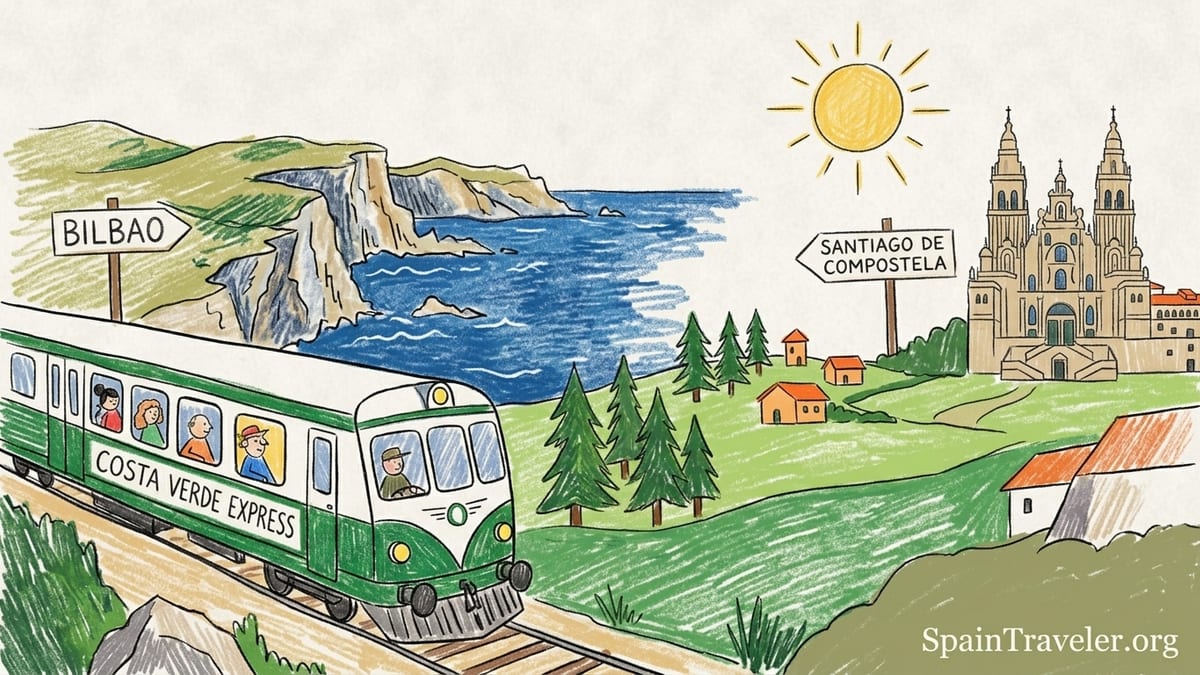
The Costa Verde Express is one of Europe’s most atmospheric luxury trains, tracing the lush Green Spain coastline between Bilbao and Santiago de Compostela in six days and five nights. For 2026, fares for this rail-only grand tour start at around €5,000 per person in a double Gran Clase Suite and include accommodation, full board, drinks, excursions and onboard entertainment. This guide explains exactly what you get for that price, how the itinerary works in both directions, how much independent time you can expect in each stop, and how the experience compares with driving the same route by rental car.
Costa Verde Express in 2026: Key Facts, Dates and Pricing
The Costa Verde Express is a luxury tourist train operated under Renfe’s upscale “Trenes Turísticos de Lujo” program, running along Spain’s northern coast between Bilbao and Santiago de Compostela. The classic Green Spain route is scheduled as a six-day, five-night journey, marketed as “Ruta España Verde,” with departures in both directions on selected dates from spring to autumn. For 2026 and 2027, dedicated tour operators list the Bilbao to Santiago itinerary as a 6 days / 5 nights program, with official pricing tables confirming this structure.
For 2026 departures on the Bilbao to Santiago route, published tariffs for a Gran Clase double suite start at approximately €5,000 per person for the full six-day journey. Single travelers face a significant solo supplement: current tables show single-use supplements running close to 80 percent of the base fare, bringing solo occupancy of a suite to around €9,000 for the full itinerary. Agencies and Renfe emphasize that prices are “subject to reconfirmation,” so travelers should treat these as guide figures and expect small adjustments when booking is finalized.
Departures on the Bilbao to Santiago direction in 2026 are currently concentrated in the shoulder season, notably in September and October, with dates such as 12 and 26 September and 24 October frequently cited on specialist booking sites. The same trainset also runs in reverse from Santiago to Bilbao on select dates, so flexible travelers can often choose direction based on their wider trip plan and flight availability into Bilbao and out of Santiago, or vice versa.
Tickets can be purchased through Renfe’s luxury trains portal, through dedicated Costa Verde Express specialist agencies, or via high-end tour operators that package the train with pre and post nights, transfers and sometimes city tours. In practice, most international travelers book through an agency or tour specialist because cabins are limited and English-language support for complex questions is easier to obtain through intermediaries experienced with Spain’s tourist trains.
Itinerary Bilbao to Santiago: Day-by-Day Overview
The standard Green Spain itinerary between Bilbao and Santiago runs for six days / five nights and follows a broadly westward path along the Cantabrian coast. Current outlines show the main stages as Bilbao, Santander, Llanes, Oviedo, Luarca, Viveiro and Santiago de Compostela. Many of the actual excursions are by luxury coach that travels alongside the train, giving access to historic centers and coastal viewpoints the rails do not reach directly.
On Day 1, passengers typically check in at a designated hotel or station lounge in Bilbao, with baggage transferred to the train. There is usually time for a guided tour of the city’s core sights, such as the Guggenheim Museum exterior, the Nervión riverfront and the Casco Viejo, before boarding the Costa Verde Express. The train then rolls west towards Cantabria, where it is often stabled overnight after a welcome dinner in the dining car.
Day 2 is usually devoted to Cantabria, with sightseeing in Santander and historic Santillana del Mar or the Altamira area. A luxury coach meets the train and carries guests into the old quarter of Santander, to sea promenades, and on to stone-paved Santillana, returning to the train for lunch or dinner. Overnight is commonly on board in northern Cantabria or eastern Asturias, depending on the exact schedule for that departure.
Days 3 and 4 shift further west into Asturias, with stops pointed out in advance such as Llanes, Oviedo and the coastal village of Luarca. Passengers might spend the morning exploring Llanes’ harbor and old town before continuing to Oviedo for a guided visit of its pre-Romanesque churches and atmospheric old streets. Onboard nights after these stages are generally near Oviedo and Luarca. Day 5 moves into Galicia, often focusing on the fishing town of Viveiro and nearby coastal viewpoints, before the final Day 6 ride towards Santiago de Compostela for a guided visit of the historic center and cathedral precinct.
Because exact schedules can vary slightly by departure, travelers should always check the detailed daily program at booking time. Nonetheless, the core promise of the Costa Verde Express across the Bilbao to Santiago route remains consistent: six calendar days, five nights aboard a historic-style luxury train, and a curated sequence of visits to Green Spain’s hallmark coastal cities, villages and landscapes.
Cabins, Suites and Onboard Experience
All guest accommodation on the Costa Verde Express is in Gran Clase suites. These cabins are compact but fully self-contained, reflecting the train’s heritage design. Each suite typically includes two lower beds that convert from a daytime sofa and an adjacent single, or a double-style configuration, plus a private en suite bathroom with shower. Trains refurbished in recent years generally feature modern fixtures such as hydromassage showers, toiletries, individual climate control, wardrobe space, reading lights and a small safe.
During the day, attendants transform the cabin into a sitting room, adding cushions and adjusting bedding so that guests can use the suite as a private lounge between excursions. At night, the cabin reverts to a bedroom. Compared with luxury river cruises, cabin sizes remain modest, but they are notably more generous than standard European sleepers and designed to be comfortable for five consecutive nights. Large windows allow passengers to watch the green mountains, cliffs and villages of the Cantabrian coast slide by without leaving their cabin.
Beyond the suites, the heart of the onboard experience lies in the lounge and dining cars. The Costa Verde Express typically carries one or two observation-style salons, furnished with armchairs, tables and a bar. This is where passengers gravitate after dinner for live music, informal talks, or simply to enjoy a digestif while watching hamlets and headlands pass in the twilight. During the afternoon, it often serves as a reading room, with coffee and pastries laid out as the train traverses rural stretches.
Dress codes on board are generally smart casual, leaning slightly more formal at dinner. Travelers often pack light, with one medium suitcase per person stowed in their suite and a smaller day bag for buses and city walks. The train’s general rhythm blends relaxed moments on board with busy sightseeing blocks ashore, and the physical comfort of the suites and lounges becomes crucial to how restorative the journey feels between excursions.
What Your Fare Includes: Meals, Drinks and Excursions
The Costa Verde Express is sold on a broadly all-inclusive basis. For the standard Bilbao–Santiago journey, the fare covers accommodation in a Gran Clase suite for five nights, all onboard meals, drinks with meals, a selection of open-bar drinks in the lounge, guided excursions, museum entrances specified in the program and onboard entertainment. Tipping policies can differ by operator, but gratuities for coach drivers and local guides may or may not be included, so it is worth confirming at booking time.
Breakfast is normally served on board, with a buffet or à la carte selection that might include pastries, fresh fruit, cured meats, cheeses, yogurt and hot dishes. Many days see the train moving during breakfast, so guests eat while rolling past dairy farms, surf beaches and wooded hills. Lunches and dinners vary between meals on board and in local restaurants along the route. On some days guests dine in renowned regional restaurants in cities such as Santander, Oviedo or Santiago, sampling specialties like Asturian fabada, Cantabrian seafood or Galician octopus, all paired with local wines.
Drinks policies are generous but not limitless. House wines, beer, soft drinks and coffee are typically included at lunch and dinner, and many departures now include an open bar in the lounge car for standard brands during set hours. Premium labels or very high-end wines, if stocked, are normally charged separately. A typical example from recent seasons would be a couple from the United States who enjoy cava and white wine with dinner each night, coffee after dessert and a gin and tonic in the bar car; none of that appears as a separate line item on their final bill unless they opt for top-shelf spirits.
The excursion program is central to the all-inclusive concept. Guided city tours, entrance to selected museums or monuments and transfers by a dedicated luxury coach are all part of the fare. A day in Oviedo, for instance, might include a walking tour of the cathedral area and pre-Romanesque churches, while a stop in Santillana del Mar might combine a guided stroll through the medieval lanes with a visit to the Altamira interpretation center or neo-cave. Guests can always opt out of a visit and stay on or near the train, but there is no refund for missed excursions.
How Structured Is the Trip and How Much Free Time Do You Get?
The Costa Verde Express is designed as a highly curated experience, and the daily schedule reflects that. Mornings often begin with breakfast on board, followed by departure for a guided excursion around 9:30 or 10:00. Guests are transferred by coach to the day’s main town or sights, led on a walking tour by a local guide, and then either given some free time or moved on to another venue. Lunch is either in a local restaurant or back on the train. Afternoons see another excursion or scenic ride, followed by time to refresh in the cabin before a multi-course dinner. Evenings often end with live music, a cocktail or informal talk in the lounge.
Independent time varies by stop but is not the primary focus. In a place such as Santillana del Mar, travelers commonly report having 45 to 90 minutes of unstructured time to wander, take photographs or sit at a café after the group walking tour. In larger cities such as Santander or Oviedo, there might be a similar pocket of free time, but it is usually framed within the group transfer schedule. Bilbao and Santiago, as major gateways, offer more scope to extend your stay by adding hotel nights before or after the train, rather than relying on independent time during the rail journey itself.
For travelers who enjoy depth and flexibility, this structure has pros and cons. On the plus side, logistics are effortless: there is no need to plan routes, book museum slots or worry about parking. The guides handle navigation, and the coach meets the train at each stage. On the downside, spontaneous detours are limited. You cannot easily decide to spend an extra half-day hiking in the Picos de Europa or lingering in a particular village, because the train and its schedule will move on regardless.
A practical way to approach this is to treat the Costa Verde Express as an immersive overview of Green Spain rather than a deep-dive into specific locations. If you already know you want extended time in, say, Oviedo, the Basque coast or the Galician Rías Altas, you could plan additional nights after the train, perhaps renting a car in Santiago to loop back along the Galician coast, or flying into Bilbao several days earlier to explore the Basque hinterland independently before boarding.
Departure Direction, Seasonality and How to Choose Your Dates
The Costa Verde Express routinely operates in both directions between Bilbao and Santiago. The six-day program marketed as “Bilbao–Santiago” simply reverses as “Santiago–Bilbao” on other dates, sharing the same intermediate stops in a different order. Functionally, the onboard experience is nearly identical: you still spend five nights on the train, still visit Cantabrian and Asturian highlights, and still end in a major city with an international airport and good domestic rail and air connections.
Choosing direction is therefore mostly a question of broader trip planning. Many international travelers prefer to start in Bilbao, a city with strong connections via Madrid, Barcelona and several European hubs, and end in Santiago de Compostela, then continue into Portugal or fly back home. Others begin their Iberian trip on the Camino de Santiago, spending a few nights in Santiago, and then board the train in the city to travel east, ending in Bilbao for onward flights or a separate Basque Country stay. Flight schedules and one-way rental car prices at either end of the trip often tip the balance when travelers are deciding which direction to book.
Seasonality is a more consequential factor. The 2026 schedule for the six days / five nights Costa Verde Express Green Spain route clusters departures in September and October, with at least three dates already public. These months typically bring mild temperatures, fewer domestic holiday crowds than July and August, and a good chance of mixed sun and cloud along the often-rainy northern coast. Earlier-season departures in May and June appear more frequently in the 2027 program, which can be attractive for travelers seeking spring greenery and slightly cooler days.
Because departure dates are limited and cabins few, the train often sells out months in advance, especially for peak holiday periods or groups chartering multiple suites. Prospective guests looking at a September 2026 departure from Bilbao, for instance, should aim to secure a provisional booking as soon as their international flights are fixed. Waitlists are common, and agencies sometimes hold small blocks of cabins that can be released if asked about specifically.
Costa Verde Express vs Driving Bilbao to Santiago by Rental Car
Covering the same corridor by rental car is the obvious independent alternative to the Costa Verde Express. The core distance between Bilbao and Santiago de Compostela via the faster A-8 and AP-9 motorways is roughly 550 to 600 kilometers, which can be driven in about six to seven hours without stops. However, most road-trip travelers stretch this over eight to twelve days, building in nights in Santander or Santillana del Mar, Llanes or Ribadesella, Oviedo or Gijón, a fishing village such as Cudillero or Luarca, and a Galician town like Ribadeo or Viveiro before finishing in Santiago.
Costs for a self-drive are much lower on paper but depend heavily on travel style. A compact one-way rental from Bilbao to Santiago in late September might average €45 to €70 per day before insurance, with a one-way drop fee anywhere between €100 and €250 depending on the company and season. Mid-range hotels along the coast can range from around €80 to €180 per night for a double room, while charming rural guesthouses may go for €90 to €140 including breakfast. Factor in fuel on the A-8, occasional tolls, paid parking in historic centers and daily restaurant meals, and a comfortable ten-night road trip for two might land in the €3,000 to €4,500 range for everything excluding flights.
In terms of experience, the trade-offs are clear. The train offers a curated, social, low-effort journey: you unpack once, sleep in the same bed for five nights, and let professional staff handle navigation, luggage and sightseeing logistics. You also enjoy the romance of vintage rail travel, formal dinners in a rolling dining car and the sense of belonging to a small, traveling house-party of a few dozen fellow passengers. In contrast, driving gives you the freedom to choose every stop and linger as long as you like, whether that means three nights in the Picos de Europa for hiking, detours into the Costa da Morte west of Santiago, or lazy days on lesser-known beaches around Llanes or Laredo.
However, road trips carry their own friction. Parking a rental car in central Bilbao, Oviedo or Santiago can be costly and stressful, especially for drivers unused to narrow one-way streets and underground garages. Summer traffic along the coast can be heavy, and drivers must limit wine tasting at lunch. A traveler who values a glass of txakoli in a Basque fishing village, cider in an Asturian sidrería and Albariño in coastal Galicia may find being behind the wheel constraining. With the Costa Verde Express, those tastings are folded safely into the inclusive dining experience, and nobody in the party needs to abstain from enjoying local wines with dinner.
For many travelers, the decision comes down to priorities. If you dream of classic rail journeys, prefer not to drive in foreign countries, and appreciate having most decisions handled for you, the Costa Verde Express justifies its premium price as a rare, slow-travel experience. If, instead, you want extended hiking time, flexible beach days, or the option to mix in remote inland villages and last-minute detours, a rental car will feel more rewarding and can be tailored to match or undercut the cost of the train, depending on the level of accommodation and dining you choose.
The Takeaway
By 2026, the Costa Verde Express has firmly established itself as one of the signature luxury rail experiences in Spain, offering a six-day, five-night journey through the heart of Green Spain between Bilbao and Santiago de Compostela. With Gran Clase suites, nearly all-inclusive pricing, carefully curated excursions and limited departure dates, it caters to travelers who value comfort, service and the romance of classic train travel over complete independence.
Understanding exactly what is included in the roughly €5,000 per person starting fare is key to deciding whether it suits your style. The ticket buys you five nights in a private suite, all onboard meals and most drinks, guided visits in every major stop, and seamless logistics from the moment you check in. What it does not provide is extended free time in each place: independent exploration exists, but within set windows of an hour or two, rather than entire afternoons.
If you are weighing the Costa Verde Express against a self-drive along the Cantabrian coast, think of the train as a concentrated, elegant overview and the car as a flexible, slower-burning exploration. Many seasoned travelers ultimately combine both: using the train to experience the historic rail route in one direction, and later returning to northern Spain by car to dive deeper into favorite stretches. Either way, the Bilbao–Santiago corridor remains one of Europe’s most rewarding journeys, blending ocean, mountains, food, wine and history in a compact but endlessly varied slice of Spain.
FAQ
Q1. How long is the Costa Verde Express journey from Bilbao to Santiago?
The regular Costa Verde Express Green Spain route operates as a six-day, five-night itinerary between Bilbao and Santiago de Compostela.
Q2. What is included in the Costa Verde Express fare?
The fare typically includes accommodation in a Gran Clase suite, all onboard meals, drinks with meals, selected open-bar options, guided excursions, museum entries in the program and onboard entertainment.
Q3. How much does the Costa Verde Express cost in 2026?
For 2026, published prices for the Bilbao–Santiago route start around €5,000 per person in a double Gran Clase Suite, with higher per-person costs for solo travelers due to the single supplement.
Q4. How much independent time will I have in each destination?
You usually get short windows of free time, often 45 to 90 minutes in towns like Santillana del Mar or Oviedo, within a largely guided schedule. Longer independent exploration is best added before or after the train journey.
Q5. Does the Costa Verde Express run in both directions?
Yes. The Costa Verde Express operates in both directions between Bilbao and Santiago, with separate departure dates for Bilbao–Santiago and Santiago–Bilbao itineraries using the same core route.
Q6. What are the cabins like on the Costa Verde Express?
All guest accommodation is in Gran Clase suites, compact but comfortable cabins with twin or double bedding, a private en suite bathroom with shower, climate control and storage space.
Q7. Are drinks and tips included in the price?
House wines, beer, soft drinks and coffee are usually included with meals and many departures offer an open bar for standard brands. Gratuities policies vary by operator, so it is important to confirm whether tips are included when booking.
Q8. Is the Costa Verde Express suitable for travelers who do not want a rigid schedule?
The journey is quite structured, with set excursion times and group activities. Travelers seeking maximum flexibility may prefer to complement or replace it with a self-drive itinerary along the same route.
Q9. How does the train compare cost-wise with renting a car for the same route?
A comfortable ten-night self-drive from Bilbao to Santiago for two people, with mid-range hotels and restaurant meals, can often cost less overall than the train, but it lacks the inclusive luxury rail experience and requires more hands-on planning.
Q10. When is the best time of year to take the Costa Verde Express?
For the six-day Bilbao–Santiago route, 2026 departures cluster in September and October, when northern Spain’s weather is usually mild and the main summer crowds have thinned, making these months an excellent choice.