


Driving the north coast of Spain from Bilbao or San Sebastián to Santiago de Compostela is one of Europe’s great slow‑travel journeys. Known collectively as Green Spain, the four regions of the Basque Country, Cantabria, Asturias and Galicia offer an Atlantic coastline of cliffs and surf beaches backed by dairy pastures, fishing harbours and the jagged limestone walls of the Picos de Europa. Spain’s official Green Spain route connects Bilbao and Santiago in a week, but with a car and a little planning you can stretch that into a richer 10 to 12 day road trip without turning it into a logistical marathon.
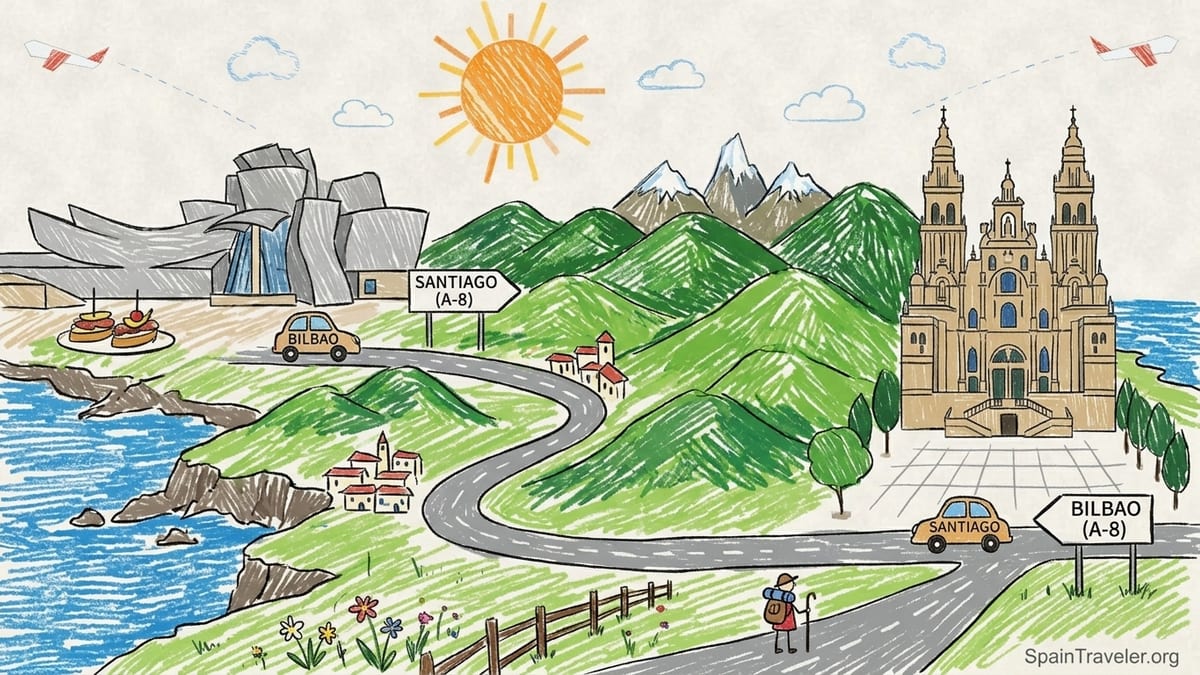
Bilbao or Santiago: Choosing Your Direction and Flights
The official Green Spain route runs east to west from Bilbao to Santiago de Compostela in about seven days, using the A‑8 Autovía del Cantábrico and the older N‑634 coast road to stitch together the four regions. Many UK and European visitors fly into Bilbao and out of Santiago, but the route works equally well in reverse. From North America, it can be just as convenient to connect via Madrid or Barcelona and fly into Santiago first, then work back to Bilbao, especially in summer when rental car one‑way fees are easier to absorb as part of a longer trip.
There are practical differences between starting at each end. Beginning in Bilbao lets you settle into Spanish driving on a mix of motorway and short urban hops before you reach the tighter coast roads of Asturias and the Picos de Europa. You can spend your first evening walking between the Guggenheim, the riverside promenade and the pintxos bars of the Old Town, then head west the next morning. Starting in Santiago, by contrast, front‑loads the historic pilgrimage atmosphere and cathedral plazas, and works well if you want to add a few days hiking on the Camino at the end without needing the car.
Rental fleets at both airports are comparable, with most major companies offering compact manual hatchbacks from around 35 to 50 euros per day in shoulder season, rising in August. When comparing, check the one‑way surcharge between Bilbao and Santiago, as this can range from around 50 to 150 euros depending on the company and dates. If the fee looks steep for your travel window, you can consider a loop that returns to your arrival airport, but that means repeating some of the route and skipping the satisfying east‑west traverse.
Whichever way you drive it, the basic logic remains the same: two nights in or near Bilbao or San Sebastián, two to three nights across Cantabria and eastern Asturias, two to three nights in western Asturias and the Galician Rías Altas, and one to two nights in Santiago. From that seven‑day core, you layer on extra days for inland routes and Picos de Europa detours rather than attempting a sprawling month‑long itinerary.
The Core Seven‑Day East‑to‑West Route
The shortest version that still feels like a complete Green Spain journey runs over seven days between Bilbao and Santiago, following the coastline and dipping only lightly inland. From Bilbao or San Sebastián you head into Cantabria, cross Asturias, then roll into Galicia and finally Santiago without backtracking. For most drivers, the A‑8 motorway will be the default corridor, with chosen segments of the older N‑634 or N‑632 for scenic diversions.
On a typical one‑week layout starting in Bilbao, Day 1 is Bilbao itself, exploring the Guggenheim, the Azkuna Zentroa cultural centre and the Old Town bars. Day 2 takes you west along the coast towards Cantabria, making short stops in Castro Urdiales or Laredo for a harbourfront lunch before overnighting near Santander or in a smaller town such as Santillana del Mar. Day 3 carries you into Asturias, perhaps via San Vicente de la Barquera for its estuary views, with a night around Llanes or Ribadesella. Days 4 and 5 shift to central or western Asturias, with Gijón or Oviedo as comfortable bases for beaches, cider houses and short inland drives. Day 6 cuts into Galicia, where you can sleep near Lugo’s historic centre or along the Rías Altas around Viveiro or Ribadeo. Day 7 finishes in Santiago, with at least one evening reserved to see the cathedral squares glow after dark.
Distances on this core route are manageable. Bilbao to Santander is roughly 100 kilometres, often under an hour and a half even with a coffee stop. Santander to Llanes is similar again. A longer day from Asturias into central Galicia, for example from Gijón to Lugo or Ribadeo to Santiago, can sit in the three to four hour range including petrol and lunch breaks. These legs let you spend more time walking harbourfronts and pintxos streets rather than sitting behind the wheel.
For drivers who prefer fewer hotel changes, you can still follow the seven‑day pattern but lengthen stays: two nights Bilbao, two around eastern Asturias, two around western Asturias or Galicia’s north coast, one in Santiago. That slight adjustment makes it easier to unpack, settle into a neighbourhood supermarket for snacks and wine, and plan day trips when the weather looks especially good for a particular stretch of coast.
Where to Park and When to Change Hotels
Northern Spanish cities are markedly easier to drive into than some southern counterparts, but it still pays to be strategic about parking and base towns. In Bilbao, short‑stay on‑street parking operates under the OTA system, with ticket machines and coloured zones, which can be fiddly and time‑limited for visitors. Most travellers opt for a 24‑hour underground garage near the centre instead, where typical daily rates run from about 18 to 25 euros. For example, car parks around the Guggenheim and Plaza Moyúa allow you to leave the car and explore the city entirely on foot, which is often less stressful than navigating narrow one‑way streets every time you go out for dinner.
Smaller bases along the route are usually kinder to drivers. In Santillana del Mar, many guesthouses include a small private car park or street‑edge spaces right outside. In fishing towns such as Llanes or Ribadesella, you will find signed public car parks on the edge of the old town, where you can park for a few euros and walk in. In Asturias and Galicia, blue‑zone street parking is generally cheap, though high summer weekends can still fill coastal lots by late morning, particularly near popular beaches.
As a rule of thumb, it is worth changing hotels every two or three nights rather than every day. A two‑night stay in eastern Cantabria or western Basque Country lets you explore Santander, Santillana del Mar and Comillas without packing every morning. A two‑night stop in eastern Asturias works well for day trips into the Picos de Europa or to cliff‑backed beaches like Playa de Torimbia. In western Asturias or Galicia, basing in Gijón, Oviedo or a coastal town such as Cudillero or Luarca keeps daily drives short while still moving you steadily west.
If you plan more serious mountain detours in the Picos de Europa, consider an extra hub specifically for that, such as Potes in Cantabria or Cangas de Onís in Asturias. Both towns have multiple small hotels and guesthouses with private parking included or available for a small daily charge, which is far more practical than trying to reach the high‑mountain viewpoints in a single long day from the coast.
Mountain Detours: Picos de Europa and Inland Routes
The Picos de Europa straddle Cantabria, Asturias and Castilla y León, rising sharply from dairy pastures into limestone peaks. For many drivers this is the highlight of a Green Spain road trip, but it does add time and winding roads. The most straightforward detour from the core coastal route is from the Cantabrian side: leaving the A‑8 near Unquera, then following the N‑621 up the Hermida Gorge into Potes. From there, a well‑paved mountain road leads to Fuente Dé, where a cable car climbs almost 1000 metres in minutes to a viewpoint plateau when conditions allow. Parking at Potes is in a mix of pay‑and‑display and guesthouse lots, while Fuente Dé has a large surface car park that fills on summer weekends.
From the Asturian side, the classic inland loop runs from the coastal A‑8 near Ribadesella or Llanes to Cangas de Onís, and then up towards the Sanctuary of Covadonga and the Lagos de Covadonga. On summer and holiday dates, private cars are often restricted on the final section up to the lakes, with a shuttle bus system operating from car parks lower down. This type of traffic management means you need to allow extra time and check local guidance the evening before, especially if you want to catch early‑morning light on the water rather than arrive at midday.
In practical terms, you can integrate the Picos over two or three nights without derailing a one‑week route. One option is to spend one night less on the Cantabrian coast and instead sleep in Potes or Cangas de Onís, driving in from the sea in the afternoon and out the following day towards Asturias. Another is to add two extra days to create a nine‑day itinerary, slotting them between Cantabria and Asturias. That gives you a full day to drive the mountain roads in unhurried fashion and to adapt to Green Spain’s often changeable weather, which can bring low cloud to the summits even in July.
Beyond the Picos, several inland routes tempt slow drivers. From Asturias, the A‑66 Autovía de la Plata and older mountain passes lead towards León and the Meseta, opening up Roman and medieval towns for a night away from the sea. In Galicia, the Miño and Sil river valleys form the Ribeira Sacra, where terraced vineyards look down on the water. A common pattern for wine lovers is to detour one day south from the A‑8 for a long lunch and viewpoint stop in Ribeira Sacra, then return to the coast or continue towards Santiago the next morning.
Driving, Weather and Road Conditions along the Green Coast
One of the strengths of this route is that you can travel almost the entire length on modern motorways if you choose. The A‑8 Autovía del Cantábrico tracks the coast from the Basque Country through Cantabria and Asturias into Galicia, forming the spine of most Green Spain road trips. It is toll‑free across this northern stretch, with frequent service areas and clear signage, which makes it suitable even for drivers new to Spain. For more local flavour and views, you can leave the A‑8 for segments of the N‑634 or N‑632, which thread through villages and headlands closer to the sea.
Coastal weather is milder and wetter than in southern Spain, which is a blessing in mid‑summer but can bring mist and sudden showers in shoulder seasons. In June and September, you might drive one morning in drizzle past Gijón’s San Lorenzo beach and by afternoon be walking the harbourfront in Ribadeo in sunshine and 22 degrees. This variability is part of the region’s character. It is wise to keep one or two “flex days” in your plan so that you can adjust which day you dedicate to a longer coastal hike or a Picos viewpoint, based on a two or three day local forecast.
Driving style in the north is generally relaxed, with speeds on the autovía matching the signed limits and patient overtaking on the smaller coast roads. The main hazards are not aggressive drivers but the combination of rain, fog and livestock near mountain villages. On routes into the Picos and towards Covadonga, for instance, it is common to encounter cattle or sheep on the tarmac and to pass through very narrow village streets. Renting a compact car rather than a large SUV can make these sections significantly more comfortable and reduces stress when parking in old town centres.
Fuel and toll costs are manageable on a Bilbao to Santiago journey. Diesel and petrol prices fluctuate, but for a compact car covering roughly 1000 to 1300 kilometres over 7 to 10 days, many travellers find they spend a few hundred euros on fuel in total, less if they stick mainly to the motorway and avoid unnecessary detours. With most of the A‑8 toll‑free on this stretch, you are paying primarily for fuel and parking, not for the road itself. Service stations on the A‑8 often include simple cafeterias where you can order a menú del día for lunch, a practical way to experience local stews and grilled fish without hunting down a restaurant in every small town.
Food, Culture and Coastal Highlights by Region
Although the route is a continuous coastal journey, the four regions feel distinct. In the Basque Country, Bilbao and San Sebastián have become shorthand for contemporary architecture and inventive pintxos. A typical evening in Bilbao might involve a casual crawl along Calle Ledesma or the streets of the Casco Viejo, ordering a couple of skewers of anchovy and olive here, a slice of bacalao there, each paired with a small glass of txakoli white wine or cider. Drive half an hour to the coast and you are walking the cliffs around Getxo or Mundaka, where Atlantic surf breaks under green headlands.
Crossing into Cantabria, the scale softens. Santander has elegant bayfront promenades and beaches such as El Sardinero within city limits, but many drivers choose nearby Santillana del Mar for an overnight, drawn by its cobbled lanes and stone mansions. From here you can visit the Altamira cave museum or detour to Comillas, where the modernist “Capricho” by Gaudí sits a short walk from the sea. Farther west, San Vicente de la Barquera offers one of the best postcard combinations in the region: a medieval bridge, saltmarshes and, on clear days, the snow‑tipped Picos de Europa behind.
Asturias is defined as much by its food and drink as by its landscapes. Oviedo and Gijón provide contrasting urban bases: Oviedo with its historic core and cider houses lined along Calle Gascona, where waiters pour cider from held‑high bottles into glasses at arm’s length; Gijón with its working‑port character, beach promenade and seafood bars in Cimavilla. Along the Asturian coast, small ports like Lastres or Cudillero cling to hillsides, and grassy headlands hide beaches such as Playa de Torimbia or Playa del Silencio, reached by short walks from car parks above the cliffs.
Entering Galicia, the light and coastline shift again. The Rías Altas around Ribadeo, Viveiro and Ortigueira feel wilder, with long sandy bays and surf spots that remain quiet even in July compared with the Mediterranean. Seafood becomes still more central to daily menus: plates of pulpo a feira, percebes barnacles in season and grilled sardines appear alongside Albariño whites and Mencía reds. Approaching Santiago, many drivers choose a final coastal night in the Rías Baixas or a full day’s drive inland, then return the car and explore the old town on foot, following arcaded streets that finish in the broad squares around the cathedral.
The Takeaway
A Green Spain road trip from Bilbao or San Sebastián to Santiago is best thought of as a flexible spine rather than a rigid checklist. The official one‑week route linking the Basque Country, Cantabria, Asturias and Galicia gives you a proven framework, but the real art lies in tuning hotel changes, mountain detours and slow food stops to your own pace. For some travellers, that means concentrating on coast and cities, using the A‑8 to keep driving days short and evenings long. For others, it means trading a night on the beach for a high‑valley inn where cowbells are louder than traffic.
Wherever you sit on that spectrum, a few principles hold. Start or finish in the city that works best with your flights, not the other way around. Keep a compact rental car and use city garages instead of hunting for the last blue‑zone space. Limit hotel changes to every two or three nights, and if the mountains call, add a dedicated Picos de Europa base instead of trying to squeeze the peaks into a rushed day trip. Treat the weather as part of the story, leaning into misty mornings in fishing harbours and saving the brightest days for balcony viewpoints and coastal hikes.
By thinking in terms of a seven‑day core with optional inland extensions, you get the best of both worlds: a journey that feels achievable within a week of holiday, but that can easily expand into a ten or twelve day adventure. The end result is the same in either direction. One morning you are watching Atlantic waves at some quiet Cantabrian cove, that evening you are stepping into a cider bar or cathedral square, and by the time you hand back the keys in Bilbao or Santiago, Green Spain has started to feel less like a line on the map and more like a landscape you know by the curve of its roads.
FAQ
Q1. Is it better to start the Green Spain road trip in Bilbao or Santiago?
Both directions work well. Many travellers start in Bilbao to see the Guggenheim and ease into driving before tackling mountain detours, then finish with quieter days in Galicia and Santiago. If your flights or connections are better into Santiago, starting there and ending in Bilbao is equally practical.
Q2. How many days do I really need for a Bilbao to Santiago drive?
The official Green Spain route can be done in seven days, which is the minimum to see each region without feeling rushed. If you want to include a full Picos de Europa detour or extra time in cities like San Sebastián, Oviedo or Santiago, 10 to 12 days is more comfortable.
Q3. Do I need a car in Bilbao and Santiago themselves?
No. Both cities are walkable, and central parking can be expensive and stressful to manage. A common strategy is to pick up the car the morning you leave Bilbao, and return it on arrival in Santiago, then explore each city on foot or by taxi and public transport.
Q4. What type of rental car is best for this route?
A compact or mid‑size hatchback, often in the “economy” or “compact” category, is ideal. It is easier to manoeuvre in old towns, cheaper to fuel, and more comfortable on narrow mountain roads in the Picos de Europa than a large SUV or van.
Q5. Are the roads in the Picos de Europa difficult or dangerous to drive?
The main mountain roads are paved and well maintained, but they are narrow, winding and sometimes shared with livestock. Drivers comfortable with curves and occasional steep drops usually find them enjoyable. If you are nervous about heights or tight bends, plan shorter days and avoid driving the highest routes in poor weather.
Q6. When is the best time of year to do the Green Spain road trip?
Late spring and early autumn, roughly May to June and September to early October, offer a good balance of mild temperatures, open mountain roads and fewer crowds at popular beaches and viewpoints. July and August are busier and warmer but still far cooler than much of southern Spain.
Q7. How expensive is parking along the route?
City centre garages in Bilbao, Santander, Oviedo or Santiago typically cost around 18 to 25 euros per day. In smaller coastal towns and village car parks, parking is often a few euros or occasionally free, especially outside high summer weekends.
Q8. Can I do this trip using only motorways and avoid narrow roads?
Yes for most of the distance. The A‑8 motorway runs along the north coast through the Basque Country, Cantabria, Asturias and into Galicia. Using it for longer hops and only dropping to local roads near your overnight stops keeps driving simpler, though you will miss some of the most scenic coastal and mountain stretches.
Q9. Is it easy to find fuel and food stops along the way?
Fuel stations are frequent along the A‑8 and near larger towns, and most have a simple cafeteria or restaurant where you can eat a menú del día at lunchtime. In more remote coastal or mountain areas, it is wise to fill up before long detours and check opening hours outside summer.
Q10. Do I need to speak Spanish to manage this road trip?
Basic Spanish phrases are very useful, especially in small villages and rural guesthouses, but you can manage with English in most hotels and larger restaurants. Road signs follow standard European conventions, and using an offline navigation app or in‑car GPS makes it straightforward to follow the route.