


Northern Spain’s emerald fringe, known as Green Spain, runs from Galicia to the Basque Country and hides some of the country’s most characterful places to sleep. Instead of generic chain hotels, you will find granite manor houses facing Atlantic rías, mountain lodges beneath the Picos de Europa, palatial Paradores with walled gardens, and country inns that double as serious restaurants. For road trippers and slow travelers, choosing the right overnight stop can shape the whole journey. This guide focuses on the most rewarding rural hotels and Paradores in Galicia, Asturias, Cantabria and the Basque Country, with practical detail on scenery, historic character, restaurants, parking, hiking access and how well each works as a one-night stop on a longer route.
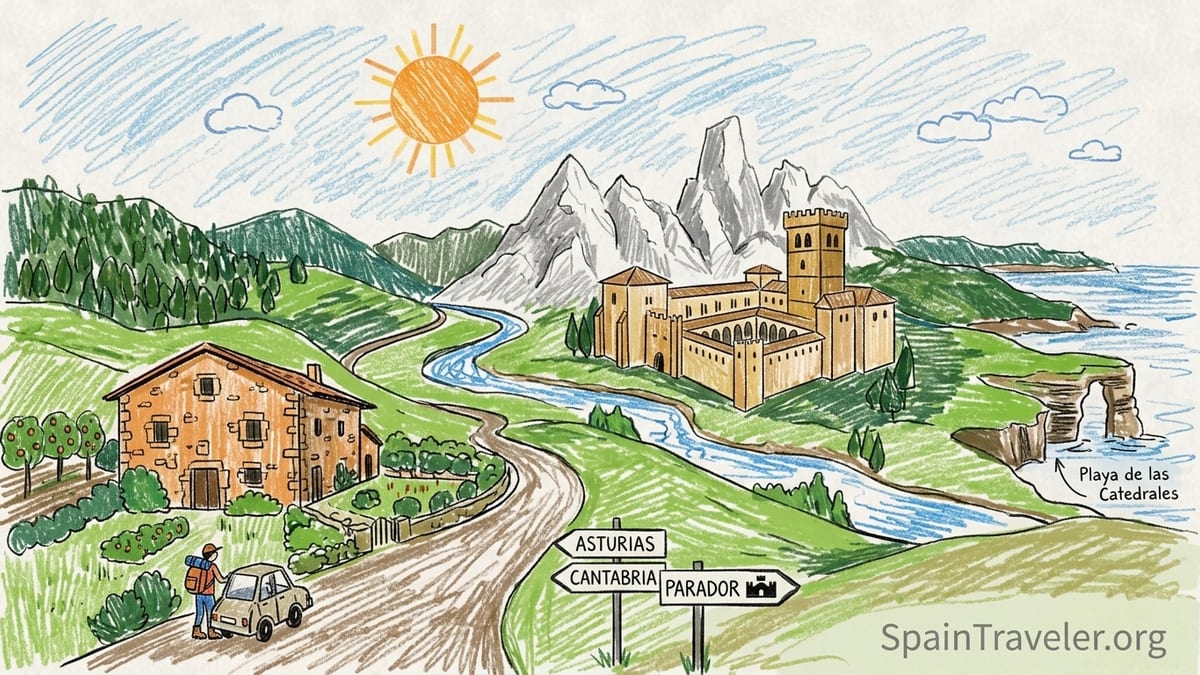
Understanding Rural Stays and Paradores in Green Spain
Green Spain covers the Atlantic side of the Iberian Peninsula, where moist ocean winds create lush hills, deep valleys and some of Europe’s most dramatic sea cliffs. Here, rural accommodation tends to fall into a few clear categories. Traditional stone farmhouses converted into small hotels are often labeled casa rural, while manor houses or pazos in Galicia and palacios in Cantabria mix aristocratic history with modern comforts. Layered on top is the state-run Paradores network, which restores and operates historic buildings, from monasteries to medieval towers, as full-service hotels. This mix means travelers can sleep in centuries-old properties without sacrificing reliable heating, good beds and breakfast.
In practice, rural hotels usually have 6 to 20 rooms, generous gardens, on-site parking and some sort of evening meal, although options range from simple home cooking to destination restaurants with tasting menus. Prices in the 2026 season typically run from around 80 to 150 euros per double room with breakfast in independent rural hotels, and from roughly 120 to 220 euros per night in many Paradores, depending on location and season. While big coastal cities like Bilbao or A Coruña offer stylish urban hotels, basing yourself in the countryside gets you closer to trailheads, quieter beaches and traditional villages, which is why rural properties work particularly well for hikers, drivers and food-focused travelers.
The Paradores chain integrates strongly into this landscape. In Green Spain, stand-out properties include Parador de Argómaniz in the Basque Country, Parador de Limpias and Parador de Fuente Dé in Cantabria, Parador de Cangas de Onís in Asturias, and Parador de Ribadeo and Parador de Vilalba in Galicia. These six Paradores are bundled into a dedicated España Verde Route, a seven-night itinerary offered for the 2026 season from around 590 euros per person for bed and breakfast, which represents a competitive per-night rate when compared with booking peak summer dates individually. That route effectively sketches one of the most efficient road-trip circuits in the region.
Beyond Paradores, Green Spain has a dense network of independent hotels. In Asturias, for example, clusters of rural hotels surround the Picos de Europa and the fishing villages of the Costa Verde, with properties like small stone guesthouses near Covadonga and the Sierra del Sueve combining mountain views and quick access to beaches. In the Basque Country, restored caseríos, or traditional Basque farmhouses, have become intimate inns surrounded by apple orchards and vineyards, while in Cantabria the local casa montañesa style is visible in many rural hotels, with deep balconies, carved wooden eaves and stone façades. Understanding these regional differences helps you decide whether you want sea views, monasteries, vineyards or jagged peaks outside your window.
The España Verde Paradores Route: A Ready-Made Road Trip
For travelers who prefer a structured itinerary, Paradores currently sells a specific España Verde Route for seven nights that strings together six rural and small-town Paradores: Argómaniz in the Basque Country, Limpias and Fuente Dé in Cantabria, Cangas de Onís in Asturias, and Ribadeo and Vilalba in Galicia. The package is marketed for the 2026 season from around 590 euros per person in double occupancy, with breakfast included. That works out at roughly 84 euros per person per night, which is competitive in high season for full-service historic hotels in northern Spain and gives a useful cost benchmark when looking at independent options.
Scenically, the route is well designed. It starts inland at Parador de Argómaniz, a Renaissance palace above the Álava plain with broad views towards the Gorbea mountains and the Ullibarri Gamboa reservoir. From there it cuts west to Parador de Limpias, a palace hotel with large gardens near the estuaries and coastal villages of eastern Cantabria, then climbs dramatically into the heart of the Picos de Europa at Parador de Fuente Dé. Continuing west, Parador de Cangas de Onís sits by the Sella river in Asturias, close to the pilgrimage site of Covadonga and high mountain lakes. Finally, the route traces the north coast to the Galician fishing town of Ribadeo, overlooking the Eo estuary, before heading inland to Vilalba, a medieval tower hotel in Lugo province, well placed for a final leg towards Santiago de Compostela or inland Spain.
In terms of logistics, every stop on the España Verde Route offers easy parking, usually free and on-site or directly adjacent to the property, which simplifies one-night stays on a road trip. All of the featured Paradores have in-house restaurants that serve local dishes: at Argómaniz this might mean Basque-style cod and seasonal produce, while at Ribadeo you will find Galician seafood and shellfish, and at Cangas de Onís hearty Asturian bean stews and river fish. Breakfast is usually a generous buffet with regional cheeses, cured meats and pastries, so for many travelers the only additional meal to plan each day is either lunch on the road or a light snack. This structure suits drivers who want to focus on scenery and short hikes rather than having to research restaurants every night.
From a hiking perspective, Fuente Dé stands out as the most directly trail focused. The hotel sits at the foot of the cable car that rises into the Picos de Europa in just a few minutes, placing guests at over 1800 meters and directly onto well-marked mountain paths with dramatic limestone scenery. Cangas de Onís is also strong for walkers, with road access to the Lagos de Covadonga area and to river walks along the Sella. Others on the route offer more relaxed, lower-altitude walking: gentle riverside strolls near Vilalba, coastal rambles near Ribadeo including access to beaches such as the famed Playa de las Catedrales with its arches and cliffs, and countryside walks around Argómaniz and Limpias among fields and small villages.
Basque Country and the Parador de Argómaniz: Palaces, Caseríos and Vineyards
The Basque Country segment of Green Spain offers an attractive mix of rolling green hills, forested mountains and gastronomic capitals. Parador de Argómaniz is one of the most atmospheric bases in the region for travelers arriving from France or from inland Spain. Set in a Renaissance palace overlooking the Álava plain, the building combines thick stone walls, wooden beams and a noble stairway with modern rooms and a top-floor restaurant converted from the original barn. The surrounding landscape is largely rural, with views to the Gorbea range and the Ullibarri Gamboa reservoir, which makes the parador feel more like a country house than a city hotel, even though the Basque capital Vitoria-Gasteiz is only about a quarter of an hour away by car.
For drivers, Argómaniz is an easy overnight stop. The property sits a short detour from main highways connecting the French border, San Sebastián, Bilbao and inland Spain, and offers free on-site parking. That makes it practical for those breaking a long northbound or southbound drive. As an introduction to Basque cuisine, the Aletegui restaurant within the parador serves regional dishes with seasonal products, such as grilled fish, chuletón steaks and local vegetables, often using recipes that stay close to the Basque culinary tradition. Compared with many independent rural hotels, having a reliable on-site restaurant of this standard reduces the need to drive out again in the evening along rural roads.
Beyond Argómaniz, travelers who prefer smaller independent properties can look to Basque rural houses, often converted caseríos. These are typically family-run, with around six to ten rooms, exposed stone, thick wooden beams and breakfast based on local produce. Many sit in the green hills inland from coastal towns such as Zumaia or Getaria, giving guests both sea views and access to hiking routes in the surrounding countryside. Compared with the parador, these casas rurales might offer a more intimate feel and slightly lower prices, though often with simpler evening meal options and fewer languages spoken.
In terms of hiking, the Basque Country is not as dramatically mountainous as the Picos but offers excellent low and mid-level trails through beech forests, along ridgelines and beside rivers. From Argómaniz, short drives reach trailheads in natural areas like Gorbea Natural Park, where well-marked paths climb past grazing pastures to limestone summits. Because the parador itself is quiet and rural, many travelers treat it as a two-night stop to allow for a full day of hiking or visiting nearby Vitoria and Rioja Alavesa vineyards, while others drop in for a single night at the start or end of a loop through Green Spain.
Cantabria: From Palatial Gardens to the Picos de Europa
Cantabria brings two very different rural experiences: stately homes in green lowlands close to the sea, and steep valleys reaching into the Picos de Europa. Parador de Limpias represents the first. Housed in an early 20th century palace surrounded by mature gardens and trees, it sits near the estuaries and coastal villages of eastern Cantabria. The atmosphere is tranquil, with lawns, an outdoor pool in season and ornate interiors that suit travelers who prefer history and comfort to ruggedness. It works well as a base for day trips to nearby beaches or caves, but also as a gentle overnight stop when driving between the Basque Country and Asturias. Parking is straightforward, with space in the grounds, and the on-site restaurant focuses on Cantabrian dishes such as fresh fish from the nearby coast.
Further inland, Parador de Fuente Dé sits at the end of a high valley, directly beside the cable car that rises to the upper stations of the Picos de Europa. The landscape here is markedly alpine, with sheer limestone walls, high meadows and a network of trails that range from easy walks to demanding full-day hikes. Because the parador is located almost at the cable car base, hikers can roll out of bed, eat breakfast and be stepping into a cabin within minutes, without needing to move the car. For non-hikers, simply riding the cable car to the El Cable viewpoint, with its balcony-style lookout over the mountains, delivers the essence of the Picos without long walks.
Besides the Paradores, Cantabria has many rural hotels in restored casa montañesa buildings. These houses are characterized by stone walls, deep wooden balconies and carved details, often arranged around a small courtyard or garden. Along the coast in towns like Comillas or San Vicente de la Barquera, independent rural hotels combine historic façades with modern interiors and are particularly popular with walkers who want to combine sections of the coastal Camino route with inland hikes. Prices can be competitive, especially outside August, but parking may be tighter in historic centers than at purpose-built rural hotels or Paradores.
For road-trippers, the practical question in Cantabria is whether to sleep closer to the sea or deep in the mountains. If your focus is the Picos de Europa, Fuente Dé or nearby villages such as Espinama are much more convenient for early starts on the trail. If you are driving the entire northern coast and planning mostly short walks, Limpias or similar lowland properties offer easier access to highways and multiple beaches. Some travelers choose to spend one night in Limpias for a soft landing on arrival, then move on to Fuente Dé for more intense mountain days.
Asturias: Monasteries, Mountain Valleys and Coastal Villages
Asturias is often cited by Spanish travelers as the greenest and most unspoiled of the northern regions, with mountains that drop almost directly into the sea. Parador de Cangas de Onís, near the first capital of the Kingdom of Asturias, is one of the most appealing places to stay for those who want both history and outdoor access. The hotel occupies a former monastery by the Sella river, with cloisters, thick stone walls and a peaceful riverside setting. It lies a short drive from Cangas de Onís town itself, Covadonga Sanctuary and the mountain lakes area, making it a logical hub for exploring the western Picos de Europa while still having a comfortable base at night.
For hikers, the combination of Cangas de Onís and the nearby highlands is hard to beat in northern Spain. Well-established walking routes lead around the lakes, through beech forests and across pastures with views of limestone peaks, while the lower valleys offer gentler paths along rivers suitable for families. Returning to the parador in the evening, travelers can expect an Asturian-focused menu, including bean stews, local cheeses and cider, without needing to drive into town. Ample parking around the property means late arrivals on a road trip are not stressful.
Asturias also has an unusually dense network of independent rural hotels, many in stone farmhouses or small manor houses set back from the main roads. Around Cangas de Onís and the eastern Asturian coast, properties often combine mountain views with quick access to beaches at Ribadesella or Llanes. One real-world example would be staying in a traditional stone house near Covadonga, with around seven rooms, breakfast made from local products and a short drive to both lake trailheads and the coast. Prices here frequently undercut larger hotels while offering more direct contact with local owners, though you may have fewer services such as on-site restaurants or all-day reception.
If your road trip emphasizes hiking, it can make sense to break your Asturias stay into two nights near Cangas de Onís or Covadonga for mountain walks, followed by a night nearer the coast in a fishing village or coastal rural hotel. Parking in small ports can be tighter than at inland farmhouses, but rewards include evening strolls along seafront promenades and fresh seafood dinners. Travelers less focused on hiking might instead use Cangas de Onís as a single two or three-night base, driving out each day to a different part of eastern Asturias.
Galicia: Seaside Rías, Medieval Towers and Pazos
Galicia occupies the western end of Green Spain and is defined by its rías, or flooded river valleys, which create complex coastlines of headlands, inlets and fishing villages. Parador de Ribadeo sits above the Eo estuary in a small town that marks the transition from Asturias to Galicia. The building is a traditional Galician house with sea views and easy access to multiple beaches, including the famous Cathedral Beach, whose natural rock arches are exposed at low tide. As a stop on a road trip, Ribadeo works well because it offers easy parking, straightforward access from the main coastal highway and enough services in town for an evening stroll after dinner at the parador or in a local restaurant.
Inland, Parador de Vilalba is one of Galicia’s most atmospheric overnight options for travelers continuing west along the Camino del Norte or crossing the interior. The hotel is partly housed in a medieval tower, which creates a strong sense of history, while newer wings provide modern rooms that are easier for luggage and accessibility. The contrast between the stone tower and the surrounding flat landscapes of inland Lugo makes Vilalba a memorable stop despite its small size. Drivers appreciate the straightforward road access and parking, which allow a quick arrival after a day of winding coastal or mountain driving.
Galicia is also renowned for its pazos, country manor houses historically owned by the rural nobility. Many have been converted into boutique hotels with walled gardens, vineyards and chapels. Compared with Paradores, these independent manor houses can feel more intimate and are often slightly off the main roads, reached via narrow lanes lined with horreos, or raised grain stores. As an example, you might find a pazo on the Rías Baixas coast offering around 15 rooms, a small pool, simple but refined Galician cooking with shellfish and albariño wine, and free parking in the grounds. Such properties tend to be destinations in themselves for weekend getaways from Spanish cities.
For hikers, Galicia may not have the sheer rock faces of the Picos, but it offers excellent coastal and inland routes. From Ribadeo, coastal paths connect beaches and small headlands, while inland around Vilalba gentle walks follow sections of the Camino del Norte across fields and forests. Because weather on the Atlantic coast can shift rapidly, even in summer, it is sensible to choose accommodations with comfortable common areas and on-site dining, so that a rainy evening feels like part of the experience rather than a disruption.
How to Choose the Right Rural Hotel or Parador for Your Trip
Choosing among Green Spain’s rural hotels and Paradores comes down to clarifying your priorities across a few key axes: scenery, historic character, restaurant quality, parking convenience, hiking access and whether you prefer to move every night or stay several nights in a single base. For dramatic mountain scenery and direct trail access, Parador de Fuente Dé and the rural hotels around Picos de Europa and Covadonga are unmatched. If you are more drawn to estuaries and soft green lowlands, Limpias, Ribadeo and many coastal rural hotels in Cantabria and Asturias will feel more appropriate. Those who want rolling hills and vineyards with easy highway access may lean towards Argómaniz and the Basque interior.
Historic character tends to be strongest in converted monasteries, towers and manor houses: Cangas de Onís with its cloistered spaces, Vilalba with its medieval tower, and many Galician pazos. Casa rurales in farmhouses can also deliver authenticity, but often in a simpler, rustic vein with less monumental architecture. Restaurant quality is generally reliable across the Paradores network, which invests in regional cuisine and ensures breakfast buffets, while independent rural hotels vary more. In some regions, especially the Basque Country, being near a village with a celebrated restaurant can matter more than on-site dining, but in isolated valleys like Fuente Dé or corners of inland Galicia, having a good restaurant in the building can be a major advantage.
Parking is rarely a problem at rural properties, which usually include free on-site spaces, though historic centers in fishing towns and small cities may require some footwork from public car parks. For travelers with a larger vehicle or those unused to tight European streets, modern rural hotels just outside towns or Paradores with dedicated parking are safer bets. Hiking access is best judged by looking at how far the accommodation is from trailheads: if you want to be on the mountain early, a parador or rural hotel at the end of a valley like Fuente Dé saves substantial driving time compared with staying on the coast.
Finally, think in terms of rhythm. The España Verde Paradores Route encourages one-night hops, which works well for drivers who enjoy covering ground and getting a broad overview. However, many travelers find that combining two-night stays in key locations such as Cangas de Onís or Ribadeo with single overnights in transit points like Argómaniz produces a more relaxed itinerary. Because weather in Green Spain can be changeable, building in at least one extra night in a high-value area for hiking increases your chances of catching a clear day.
The Takeaway
Green Spain rewards travelers who look beyond big-name cities and coastal resorts to explore its rural heart. The region’s best accommodation is often found in manor houses, monasteries and Paradores tucked into valleys, perched above estuaries or standing solitary amid fields. By understanding how the main rural options in Galicia, Asturias, Cantabria and the Basque Country differ in scenery, history, food and practicalities such as parking and hiking access, you can build a trip that feels both efficient and deeply rooted in place.
Using the España Verde Paradores Route as a framework, or mixing Paradores with smaller casas rurales and pazos, it is possible to sleep each night somewhere with a story, wake up close to trails or beaches, and avoid the stress of searching for parking in dense urban centers. Whether you are crossing the entire north coast, focusing on a single region like Asturias, or combining the Basque Country with Rioja and inland Spain, the rural hotels and Paradores of Green Spain provide both comfort and a direct connection to the landscapes and traditions that define this part of the Iberian Peninsula.
FAQ
Q1. Is the España Verde Paradores Route good value compared with booking nights separately?
The España Verde Route is priced from around 590 euros per person for seven nights with breakfast in the 2026 season, which usually works out cheaper than booking the same set of Paradores individually in high season. Outside peak dates or if you only want a subset of the route, independent booking or mixing in rural hotels can be competitive.
Q2. Do I need a car to enjoy rural hotels and Paradores in Green Spain?
A car is strongly recommended. Many of the most atmospheric rural hotels and Paradores sit in valleys, small villages or hilltops with limited public transport. While you can reach some bases like Cangas de Onís or Ribadeo by bus or train, having a car gives you far greater flexibility for reaching trailheads, beaches and smaller villages.
Q3. How difficult is parking at these rural properties?
Parking is generally straightforward. Most rural hotels and Paradores in Green Spain offer free on-site or immediately adjacent parking, often in open-air lots within their grounds. You may only encounter tighter parking if you choose small hotels in historic town centers or fishing ports, where streets can be narrow and public car parks are common.
Q4. Are Paradores more comfortable than independent rural hotels?
Paradores usually offer a higher and more standardized level of comfort, with larger rooms, strong heating, elevators where feasible and full-service restaurants. Independent rural hotels can be just as charming and sometimes more personal, but quality varies more, especially in older farmhouses where room sizes and soundproofing may be less consistent.
Q5. When is the best time of year to visit Green Spain for hiking and rural stays?
Late spring and early autumn are ideal for hiking, with cooler temperatures and fewer crowds than peak summer. May, June, September and early October often bring a good balance of green landscapes, open mountain routes and coastal swimming without the heat found elsewhere in Spain, though rain is always possible along the Atlantic coast.
Q6. How many nights should I spend in each region?
For a first trip, many travelers allocate at least two nights in Asturias for the Picos de Europa and surrounding valleys, one or two nights in Cantabria, two nights in Galicia and one or two in the Basque Country. If you have limited time, focus on one or two regions rather than rushing through all four.
Q7. Are rural hotels and Paradores suitable for families with children?
Yes. Many Paradores and rural hotels welcome families and provide extra beds or connecting rooms, and large gardens give children space to play. Mountain locations like Fuente Dé and Cangas de Onís offer family-friendly walks and cable car rides, while coastal bases such as Ribadeo or rural hotels near Cantabrian beaches provide easy access to sand and safe swimming areas.
Q8. Do I need to book rural hotels and Paradores far in advance?
In July and August, advance booking is advisable, especially for sought-after properties such as Fuente Dé, Cangas de Onís and coastal hotels near popular beaches. Outside peak summer and major holiday periods, you often have more flexibility, but weekends in highly scenic rural areas can still fill early.
Q9. What should I expect to pay per night in a rural hotel or Parador?
As a broad guide for 2026, independent rural hotels in Green Spain often range from about 80 to 150 euros per night for a double room with breakfast, depending on location and season. Paradores in the same regions frequently fall between roughly 120 and 220 euros per night, with special promotions and route packages sometimes reducing the effective nightly rate.
Q10. Are vegetarian or special-diet meals easy to find in rural hotels and Paradores?
Paradores typically offer some vegetarian options and can usually adapt dishes if informed in advance, while independent rural hotels vary more. In smaller properties it is wise to email or call ahead about dietary needs, especially if you follow vegan, gluten-free or other restricted diets, so that the kitchen can plan accordingly.