


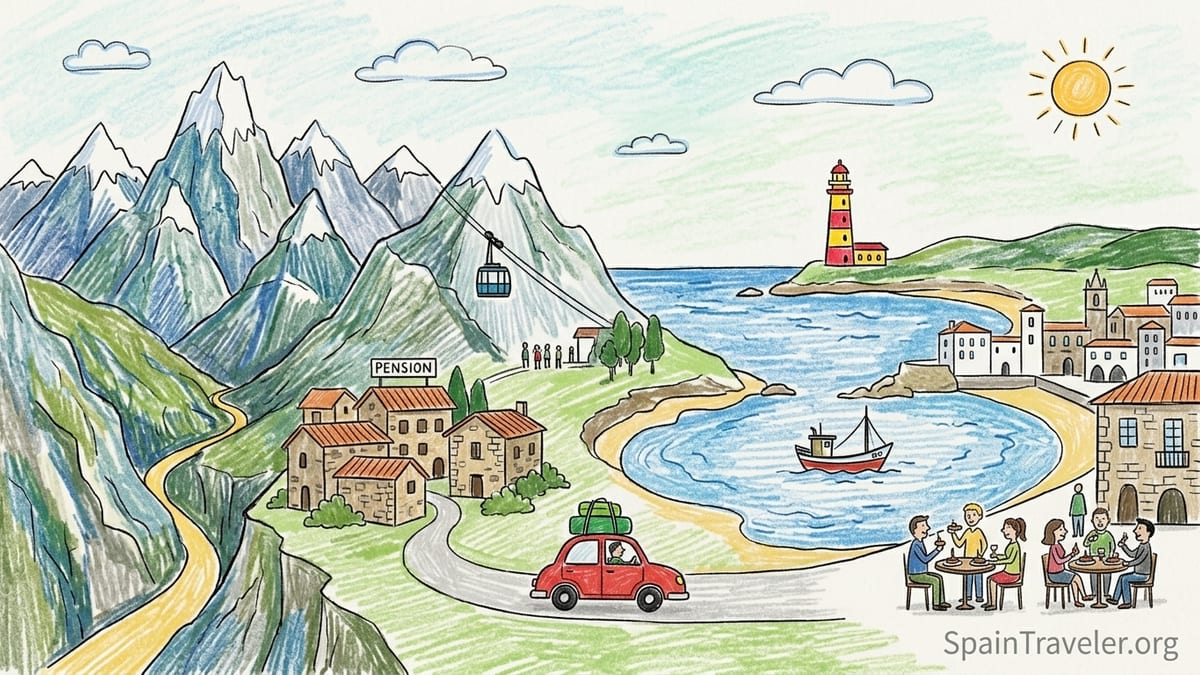
Green Spain stretches along the Bay of Biscay from the Basque Country to Galicia, a lush Atlantic strip of small cities, fishing villages, farmhouses and deep green valleys. Planning where to stay here is less about giant resorts and more about picking the right mix of compact cities, seaside towns and rural bases that match your time, interests and driving tolerance. This guide compares the main bases in San Sebastián, Bilbao, Cantabria, the Picos de Europa, Asturias and Galicia so you can decide where to linger for two or three nights and where a one-night stop actually makes sense.
How to Choose Your Base in Green Spain
Accommodation in Green Spain looks very different from the big hotel strips of the Mediterranean costas. Outside the main cities you are dealing with family-run pensiones above cafés, 8 to 20 room rural hotels and stone farmhouses converted into guesthouses. In a coastal village near Llanes, for example, a typical double room in a small ocean-view hotel in high summer often runs around 110 to 160 euros per night, while an inland casa rural in a village behind Cangas de Onís might be closer to 80 to 120 euros for a similar date. There are fewer chains, and things like on-site restaurants or 24 hour receptions are not guaranteed, which makes choosing your bases in advance particularly important.
For most trips of 7 to 14 days, it is more efficient to string together a handful of two or three night bases rather than changing beds every night. This works especially well around San Sebastián, Bilbao, Oviedo or Gijón, and Santiago de Compostela, which all have good road access and plenty of day trip options. One night stops are more sensible when you are genuinely breaking a long drive, such as pausing in Santillana del Mar on the way between Bilbao and the Picos de Europa, or when you want to sample a single highly atmospheric village but not live out of the car boot for days.
Driving distances can be deceptive on the map. A 90 kilometre drive from Santander to Potes looks short but can take close to two hours in summer because the road follows a deep gorge, with slow traffic and frequent photo stops. The same applies in Galicia around the Rías Baixas and parts of interior Asturias. This is why many travellers prefer to stay put for several nights in a central village or town, then radiate out on day trips, rather than packing up daily.
Prices, opening months and even availability shift markedly between seasons. In August, rooms in San Sebastián’s Old Town book out months ahead for 200 euros and up, while in May or late September you may find the same rooms around 140 to 180 euros. Rural properties in mountain areas may close in November or February. If you are travelling outside July and August and are happy with simpler comforts, you can often book village accommodation only a week or two in advance. In peak summer and around major fiestas like Semana Grande in San Sebastián in mid August, you should reserve your bases several months ahead, especially for the coast and the Picos de Europa.
San Sebastián: Food-Driven Coastal Stay
San Sebastián is Green Spain’s most obvious foodie base. The compact city curls around La Concha Bay and is dense with pintxos bars, traditional sidrerías and some of Spain’s most famous Michelin starred dining rooms. The Old Town is still the best area for travellers whose priority is eating and atmosphere. Streets like Calle Fermín Calbetón and Calle 31 de Agosto are lined with bars doing signature bites, from slow cooked beef cheeks to sea urchin cream and salt cod, and in high season it is normal to spend 3 to 4 euros per pintxo and around 2.50 euros per small beer. Staying in a small hotel or pension inside the Old Town means your first night can simply be a stroll between bars without worrying about transport.
For a more relaxed coastal feel, the Centro and La Concha beachfront areas offer a classic promenade atmosphere but still keep you within a 10 minute walk of the Old Town. Here you find a mix of belle époque hotels, mid range properties in elegant apartment blocks and a few design hotels. A mid range double with partial bay views in high season can be around 180 to 250 euros. This suits visitors planning at least two or three nights, using the city as a base for a day trip to coastal villages like Getaria for grilled turbot, or to inland cider country, returning each evening for another round of pintxos.
Gros, across the river from the Old Town, works well for surfers and younger travellers. It sits behind Zurriola Beach, where surf schools rent boards by the hour and run group lessons, and the nightlife skews more local. It is also a good compromise if you are arriving by train or bus, since the main stations are closer to this side of town. Accommodation is a mix of contemporary hotels and apartments, and prices can be a little lower than around La Concha, especially midweek. If you mostly want the beach and a less crowded bar scene and are happy walking 10 to 15 minutes for the densest pintxos action, Gros is a smart base for two or three nights.
San Sebastián also works efficiently as a two or three night hub in a longer Green Spain itinerary. Many travellers fly in or out of Bilbao’s airport but choose to spend more nights in San Sebastián because the city is smaller and more walkable. A common pattern is two or three nights here for food and the bay, then drive west to Cantabria or south into inland Basque Country. One night in San Sebastián can work if you are on a tight schedule and simply want a single evening pintxos crawl, but you will not scratch the surface of its food scene and will lose a good part of the next day checking out and travelling again.
Bilbao: Best for City Access and Transport
Bilbao is the most practical big city base in Green Spain and often the easiest gateway, with its international airport offering regular flights from major European hubs. The revitalised riverfront, Guggenheim Museum and lively bar areas give you an urban hit that mixes well with a road trip along the coast. Most visitors stay around the Abando and Ensanche districts, close to the river and the Guggenheim. Here you find modern chain hotels, design boutiques and business style accommodation, with nightly rates from around 110 euros off season to 180 or more in peak summer, plus the reliability that comes with 24 hour reception, parking garages and consistent Wi-Fi.
If you want a more atmospheric historic base, Casco Viejo, the old quarter around the Siete Calles, is a compact grid of narrow streets filled with pintxos bars, independent shops and small pensions. Rooms here might be smaller and buildings older, but you step outside into the main tapas area, and the tram stop gives quick access to the Guggenheim and bus station. Casco Viejo suits travellers who plan to be out in the city from mid morning until late at night, and do not mind a little more noise under the balconies on weekend evenings.
Bilbao makes logistical sense for two or three nights at the start or end of a trip. You can spend a full day on the city itself, including the Guggenheim, Fine Arts Museum and the funicular to Mount Artxanda, and then use another day or two for easy day trips along the coast to Getxo, the UNESCO listed transporter bridge at Portugalete or small surfing towns like Sopelana. Bus and metro connections are generally quicker and more frequent here than in the smaller cities to the west, so travellers relying on public transport often benefit from basing in Bilbao longer and then doing one night hops by bus to Santander or San Sebastián if needed.
On a mostly coastal road trip, Bilbao can also work as a simple one night staging post, especially if you land late or fly out early. In that case it makes sense to stay near Abando station or the airport bus terminal so that you can walk to your hotel with luggage, have a single evening in Casco Viejo and leave promptly the next morning. For travellers who are more interested in countryside and villages than contemporary architecture, Bilbao is usually the city to compress rather than expand.
Santander and Santillana del Mar: Gateways to Cantabria
Santander, capital of Cantabria, is not as instantly photogenic as San Sebastián but makes an efficient, pleasant coastal base, particularly if you are driving. The city stretches along a broad bay, with beaches like El Sardinero and a mix of 20th century and contemporary buildings. Accommodation ranges from large seafront hotels to modest pensions around the centre. Prices tend to be a little lower than San Sebastián in summer, with many decent three star hotels near El Sardinero offering doubles around 120 to 160 euros in August. This makes Santander a comfortable two night stop for travellers who want city services, a beach and straightforward road access to the rest of Cantabria.
From Santander you can day trip out to coastal villages like Comillas with its Modernist mansion designed by Gaudí, or to San Vicente de la Barquera for seafood and views back to the snow capped Picos de Europa on clear days. Inland, the Cabárceno Nature Park, built in a former open cut mine, is a popular stop for families and can be reached as an easy half day trip. Using Santander as your only base for all of Cantabria is possible, but you will spend more time in the car on winding secondary roads to reach mountain areas.
Santillana del Mar, by contrast, is a preserved medieval village inland from the coast, all stone houses, cobbled lanes and a Romanesque collegiate church. The town sits close to the Altamira cave complex and its replica visitor centre, one of Spain’s key prehistoric attractions. Most accommodation in Santillana is small scale: 10 room posadas, stone built guesthouses and a few upmarket rural hotels just outside the centre. Because the village is heavily day tripped, staying here one night lets you enjoy the streets early and late, when the tour buses have gone and many visitors have returned to the coast.
In practice, Santander often works best as a base for two or three nights, especially if you want a mix of beach, restaurants and day trips along the Cantabrian coast. Santillana del Mar is ideally a one night stop combined with nearby Altamira or as a stepping stone between Bilbao and the Picos de Europa. Spending three nights in Santillana makes sense only if you are happy to spend evenings in a very small, quiet village and do not mind repeating the same handful of restaurants and bars.
Picos de Europa: Potes, Fuente Dé and Cangas de Onís
The Picos de Europa mountains are the rugged heart of Green Spain, rising abruptly behind the coast. Picking the right base here matters more than in the cities, because roads are slower, and accommodation is highly seasonal and small scale. On the Cantabrian side, Potes is the main gateway town, sitting at the junction of four valleys where the Deva River flows down from the high peaks. It has a medieval tower, several stone bridges, plenty of bars and supermarkets and a wide choice of hotels, apartments and rural posadas in the surrounding villages. A simple double room in a rural hotel just outside Potes often falls in the 80 to 120 euro range in shoulder season, with prices climbing in late July and August.
Potes makes a strong two or three night base if you want to ride the cable car at Fuente Dé, drive the dramatic Desfiladero de la Hermida gorge and hike marked trails without changing beds repeatedly. The cable car station at Fuente Dé is about a 30 minute drive from Potes in normal conditions, but queues for parking and tickets can be long in summer, which is another argument for staying nearby and arriving early or later in the day. Several rural hotels and hostels sit within 20 to 25 kilometres of Fuente Dé, surrounded by pasture and forest, offering balconies with mountain views and on site restaurants serving local stews and cheeses.
On the Asturian side, Cangas de Onís is the main base. It is a small town by Spanish standards, with an old Roman style bridge, a compact centre and dozens of hotels, guesthouses and campgrounds spread along the valley. Cangas works well for two or three nights if your priorities are visiting the lakes of Covadonga, hiking in the western Picos and perhaps driving out to the coastal villages around Ribadesella or Llanes. Many rural properties nearby are converted stone houses with 6 to 12 rooms, often family run and frequently closed in the deepest winter months. Expect to pay from roughly 70 to 120 euros for a double room in shoulder season, a little more in August or when major religious festivities occur at Covadonga.
Because driving between the different massifs of the Picos can take longer than expected, trying to cover everything using a single base is not always realistic. If you want to experience both the Fuente Dé cable car and the Covadonga lakes with unhurried hikes, consider three nights split as two in Potes plus one in or near Cangas de Onís, or vice versa. One night stops in villages deeper into the mountains, such as a tiny hamlet on a gravel lane, can be rewarding if you are specifically seeking seclusion and starry skies, but for most travellers they are better treated as special add ons rather than the backbone of an itinerary.
Asturias: Oviedo, Gijón and Coastal Villages
Asturias is one of the greenest and most varied sections of Spain’s north coast, combining a rugged shoreline with dairy pastures, cider culture and quick access to the mountains. Oviedo and Gijón are the two main urban bases. Oviedo, inland, is known for its pedestrian old town, elegant squares and concentration of sidrerías where waiters pour cider from arm’s height. It is well connected by bus to Cangas de Onís and several coastal towns, which makes it a natural hub for travellers without a car. A decent central hotel room in Oviedo can often be found in the 90 to 140 euro bracket outside the very peak of summer.
Gijón, on the coast, combines beaches with a working port and a slightly more industrial edge. The old Cimavilla district on the headland retains the feel of a former fishing quarter, and there are long promenades and parks along the waterfront. If your idea of Asturias involves morning swims, watching surfers and strolling along the seafront in the evening, Gijón is the better base. Accommodation here is varied, from simple pensions above bars in Cimavilla to modern four star hotels facing San Lorenzo Beach, with typical summer prices around 110 to 170 euros for a double, depending on sea views.
Beyond the cities, a chain of coastal villages offers some of the most scenic stays in Green Spain. Towns like Llanes, Ribadesella and Lastres sit close to small urban beaches backed by cliffs, with stone built centres and easy access to walking trails along the shoreline. In Llanes, for example, you can stay in a restored townhouse close to the harbour, then spend days exploring cove beaches such as Cuevas del Mar or Torimbia within a 20 to 30 minute drive. Most properties are independent hotels or casas rurales, often family run and closed outside Easter and summer, with rooms in mid season around 80 to 140 euros.
When deciding between a two or three night base in Oviedo or Gijón and several one night village stops, think about how often you want to park, unpack and find dinner in a new place. For a first visit, many travellers choose three nights in a city plus two or three nights in a coastal village, which allows day trips into the Picos de Europa while still giving time to walk empty morning beaches. One night stops make sense if you are following the coast road in a linear way from the Basque Country to Galicia and simply want to sample two or three different Asturian harbour towns without backtracking.
Galicia: Santiago de Compostela and the Rías Baixas
Galicia, on the western end of Green Spain, offers a different mood again: weathered granite architecture, lush rías where the sea pushes deep inland, and a cooler, wetter climate. Santiago de Compostela is both the region’s historic heart and its best connected city, acting as the final point of the Camino de Santiago routes. The old town around the cathedral is dense with stone houses, arcades and small hotels. Because many visitors are Camino walkers arriving for just a night or two at the end of their journey, there is a wide range of beds from basic albergues with shared dorms to characterful boutique hotels in former monasteries.
Staying in Santiago for two or three nights lets you join the evening atmosphere around the cathedral square, visit the main museums and experience the daily pilgrim arrivals without rushing. Prices vary widely, but a comfortable mid range double close to the old town can often be found between 100 and 160 euros outside major holy years or festival weeks. Santiago also works as a base for public transport day trips to the coast, such as the train to A Coruña or buses to smaller Galician towns, though many of the most scenic rías are best reached by car.
Southwest of Santiago, the Rías Baixas form a series of flooded river valleys lined with fishing ports, vineyards and beaches. Small towns such as Cambados, O Grove or Sanxenxo are typical bases, with clusters of family hotels and guesthouses, many of them closed outside the main summer months. A seaside hotel with balcony in a resort like Sanxenxo in July might cost two to three times what you would pay in early June or late September. These coastal bases are ideal for travellers focusing on seafood, Albariño wine tasting and relaxed beach days, especially families who want to settle in one spot for a week.
For most itineraries, combining Santiago with one base in the Rías Baixas works better than hopping every night. For example, you might spend three nights in Santiago, then drive to a small hotel near O Grove or on the O Salnés peninsula for another three nights, exploring nearby beaches and vineyards by day and returning to the same restaurant lined harbour each evening. One night stops in smaller inland Galician towns are more justifiable if you are driving from Asturias toward Portugal and need a convenient place to break the journey, but they rarely offer the same variety of dining and activities as Santiago or the Rías.
One-Night Stops vs 2–3 Night Bases
Deciding when to move every night and when to slow down is as important as deciding which town to pick. In Green Spain, the combination of winding roads, changeable weather and compact but characterful towns generally rewards longer stays. A two or three night base allows you to adapt if a day starts rainy, explore both the main town and nearby villages, and return to a favourite bar or restaurant more than once. It also means fewer check in and check out routines and less time spent hunting for parking on narrow streets, which can be surprisingly tiring after a week.
Think of one night stops as special experiences or logistical necessities. Staying one night in Santillana del Mar or in a hamlet above Potes can give you magical early morning walks through empty cobbled streets or mist filled valleys. Sleeping one night in Santiago at the end of a Camino stage is almost a ritual for many walkers. An overnight by Bilbao’s riverfront before an early flight is simply practical. In all of these cases, the town or your transport schedule creates a clear reason for the single night.
Longer two or three night bases work best in places that offer both atmosphere and a cluster of day trips within an hour’s drive. San Sebastián, Santander, Oviedo or Gijón, Santiago and Potes or Cangas de Onís all fit this pattern. From San Sebastián, one day might be entirely urban and food focused, the next a drive to Getaria or a hike on Monte Igueldo. From Potes, you can combine the Fuente Dé cable car one day with a slower drive through the Hermida gorge another. Staying put means you are not watching the clock for hotel check in in a different town each evening.
The independent, small scale nature of accommodation in Green Spain also makes longer bases easier to manage. A rural guesthouse with six rooms may only have reception staffed for a limited window in the afternoon, and owners often appreciate guests who are staying for several nights and eating in their restaurant more than once. In many villages, restaurants keep traditional Spanish hours, opening for dinner from around 8.30 or 9 pm, so arriving late after a long drive can mean scrambling for food if you have not planned ahead. Choosing a base and getting to know its rhythms over several days smooths these bumps and helps you tune in to local life.
FAQ
Q1. How many nights should I spend in San Sebastián on a Green Spain trip?
For most travellers, two or three nights in San Sebastián is ideal. It gives you one full day for beaches and pintxos, another for a side trip or a long coastal walk, and still leaves time for a special dinner at a destination restaurant if you book ahead.
Q2. Is Bilbao or San Sebastián a better base if I want city culture and good transport?
Bilbao is usually better for transport, with a larger airport, major train and bus connections and a more extensive metro and tram network, while San Sebastián is smaller, walkable and more focused on coastal scenery and food. Many travellers fly in or out of Bilbao but dedicate more actual nights to San Sebastián.
Q3. Does it make sense to base in Santander for all of Cantabria?
Santander works well as a comfortable two or three night base for the coast and nearby attractions, but if you want to spend serious time in the Picos de Europa or explore remote valleys, adding at least one or two nights closer to Potes or the mountains will cut down on daily driving.
Q4. Should I stay in Potes or Cangas de Onís for the Picos de Europa?
Potes is best if you want to focus on the Fuente Dé cable car and the Hermida gorge on the Cantabrian side, while Cangas de Onís is better for the Covadonga lakes and easier access to the Asturian coast. If you have four or more nights for the Picos, splitting time between both towns works very well.
Q5. Is Oviedo or Gijón a better base in Asturias?
Choose Oviedo if you prefer a historic inland city with strong bus connections into the mountains and a lively cider culture. Choose Gijón if you want to be by the sea, walkable beaches and a more overtly maritime feel, accepting that some day trips into the interior will be slightly longer.
Q6. Are the small coastal villages in Asturias and Cantabria suitable for longer stays?
Yes, villages like Llanes, Ribadesella, San Vicente de la Barquera or Comillas are excellent for three to five night stays if you enjoy beaches, coastal hikes and quiet evenings. They are less suited to travellers who want late nightlife or a wide range of museums and shopping.
Q7. How many nights do I need in Santiago de Compostela?
Two nights is the minimum to appreciate Santiago beyond a quick cathedral visit, while three nights allows you to explore its museums, follow parts of the pilgrim routes into town and possibly add a short train or bus trip to another Galician city without rushing.
Q8. Where should I stay in the Rías Baixas for beaches and wine?
Towns such as Cambados, O Grove or Sanxenxo make strong bases. They offer a concentration of seaside hotels, seafood restaurants and easy access to Albariño vineyards, with plenty of beaches reachable within a 20 to 30 minute drive.
Q9. Is one night enough in villages like Santillana del Mar or mountain hamlets?
For many travellers, one night is perfect in very small or highly touristed villages. Arriving in the afternoon lets you enjoy the streets after the day trippers leave, and a quiet morning walk before moving on often captures the atmosphere without needing a longer stay.
Q10. Do I need to book accommodation in advance in Green Spain?
In July, August and during big festivals it is wise to book at least your main bases several months ahead, especially for San Sebastián, coastal villages and the Picos de Europa. Outside peak periods, you can be more flexible, but rural properties and small hotels still book out on popular weekends, so reserving a few days in advance is prudent.