


Green Spain is not one place but four distinct Atlantic regions that together draw hikers, food lovers and road trippers to the country’s cooler, wetter north. Galicia, Asturias, Cantabria and the Basque Country are marketed jointly as “Green Spain,” yet each offers a different blend of ocean, mountains, cities and culture. This guide compares them side by side to help you decide whether to sweep across all four on a road trip or focus on one or two regions for a deeper experience.
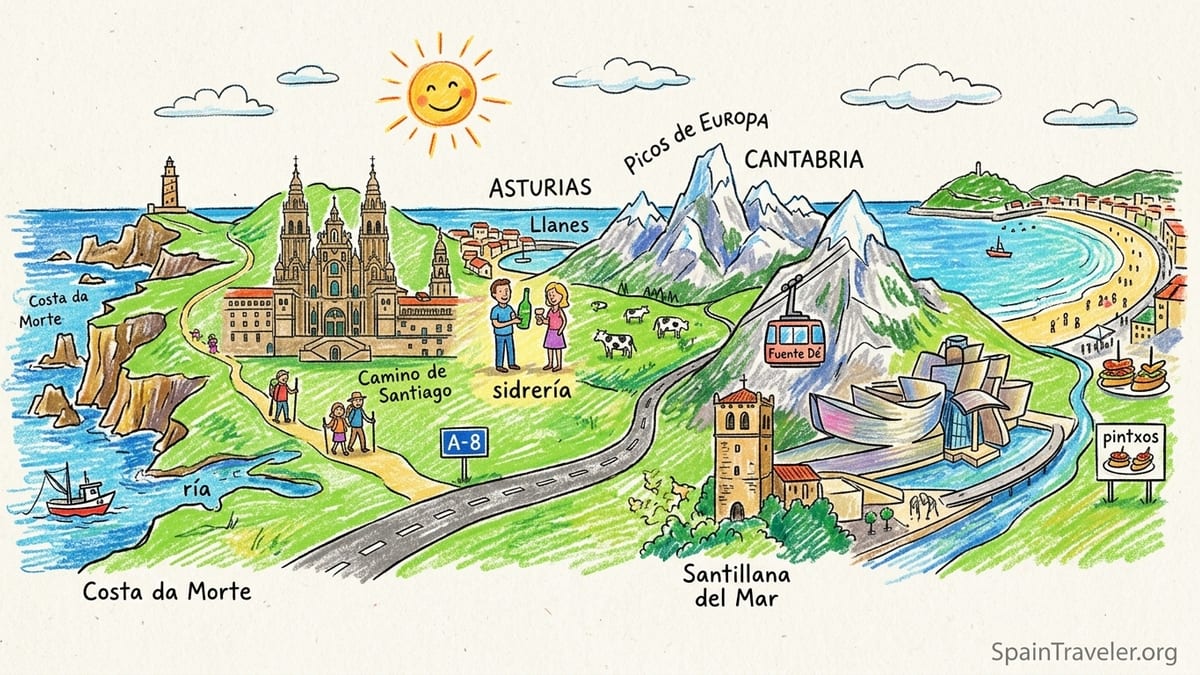
Green Spain at a Glance: One Coast, Four Characters
Official Green Spain promotions describe the north coast from Galicia to the Basque Country as a single macro-region of lush hills, fishing towns and Atlantic beaches. In practice, you are dealing with four autonomous communities, each with its own identity, language or dialect, and travel style. You could drive the whole coastal route between Santiago de Compostela and San Sebastián in around 8 to 10 hours of pure wheel time on main roads, but the experience on the ground changes markedly every couple of hours.
Galicia, at the western end, is defined by the Camino de Santiago, the granite spires of Santiago’s cathedral, ría estuaries like the Rías Baixas and Ría de Arousa, and seafood markets in towns such as Vigo and A Coruña. The coastline feels wild and Atlantic, especially around Costa da Morte, with lighthouses, dramatic cliffs and often moody weather. Inland you find vineyards like Rías Baixas and Ribeira Sacra producing celebrated white wines and increasingly known reds.
Asturias, marketed domestically as a “natural paradise,” puts mountains front and center. The Picos de Europa National Park rises sharply from dairy pastures and villages like Cangas de Onís and Arenas de Cabrales, yet the sea is never far away. Coastal towns such as Llanes and Ribadesella combine sandy beaches with easy access to high-mountain day hikes, while cider bars in Gijón and Oviedo highlight a deeply rooted sidra culture.
Cantabria occupies a relatively compact strip where you can drive from the capital Santander to the Picos de Europa foothills near Potes or the cable car at Fuente Dé in roughly two hours. It packs in sheltered bays like Playa El Sardinero, historic inland towns such as Santillana del Mar and Comillas, and prehistoric cave sites including Altamira’s famous replicas. The Basque Country, at the eastern end, leans more urban and culinary, anchored by Bilbao with its Guggenheim Museum and San Sebastián with its beach promenades and legendary pintxos bars, backed by a craggy, cinematic coastline at places like Gaztelugatxe and Zumaia.
Driving & Getting Around: Where a Car Helps and Where It Hurts
The Green Spain coast is one of the best driving areas in the country if you like winding coastal roads, constant sea views and small-town stops. The A-8 and AP-8 highways run broadly parallel to the coast from the Basque Country through Cantabria and Asturias into Galicia, with the older N-634 coastal road providing a slower, more scenic alternative through many fishing towns. For a typical summer rental, expect small manual cars to start around 40 to 60 euros per day, depending on demand and pick-up city.
In Galicia, a car is extremely useful if you want to get beyond Santiago de Compostela. Reaching spots like Finisterre, Muxía, or the Rías Baixas wine country is significantly easier by car than by bus. You might, for example, base in Santiago for three nights and drive day trips to the Costa da Morte, a Rías Baixas bodega, and a beach such as Praia de Carnota or Playa de las Catedrales near Ribadeo, timing the latter for low tide with advance access registration when required.
Asturias and Cantabria are ideal for road trips where you combine coast and mountains in the same week. Many travelers drive from Santander to Llanes, then inland to Cangas de Onís or Potes, combining Picos de Europa hiking with beach days at places like Playa de Torimbia. Roads into the Picos, including access to Covadonga Lakes or Fuente Dé, are mountain routes with bends and occasional summer congestion, but they are generally well maintained and manageable for confident drivers. Public transport exists but makes one-day hikes less flexible.
In the Basque Country, a car is helpful for exploring fishing villages such as Getaria, Lekeitio and Bermeo, or for combining coast and inland vineyards in La Rioja Alavesa. However, it is a liability in the dense, often expensive parking environments of Bilbao and San Sebastián. Many visitors pick up a car when leaving Bilbao or drop it on arrival there, relying on local trains, buses and trams within the cities. For a first-timer focusing on Bilbao and San Sebastián with a day trip or two, you can easily manage without a car at all.
Beaches & Coastlines: Choosing Your Ideal Shoreline
All four regions share the Cantabrian Sea but deliver very different coastal atmospheres. Galicia’s coastline is the most rugged and varied, cut by deep estuaries and indented with small coves. Around the Rías Baixas you find long, soft-sand beaches such as Playa de Rodas on the Cíes Islands and Praia de A Lanzada near O Grove, popular in summer but less developed than Mediterranean resorts. Costa da Morte, northwest of Santiago, is wilder, with cliffs, lighthouses and Atlantic swell that appeal to photographers and road trippers rather than pure sunbathers.
Asturias offers an almost continuous run of beaches beneath green hills, often backed by cow pastures. Standout examples include Playa de Torimbia, reached by a short walk from a clifftop parking area, and Playa del Silencio, whose viewpoint reveals a perfect rocky cove. Many are still relatively low-rise and surrounded by walking trails, so you can combine a coastal hike and a swim in the same afternoon. Weather can be changeable even in July and August, and the sea is cooler than in the Mediterranean, which suits travelers who prefer a fresher climate.
Cantabria’s coast feels compact and manageable, with a series of bays and headlands centered on Santander’s harbor and beaches like El Sardinero. Further west, San Vicente de la Barquera offers a postcard mix of beaches, a medieval bridge and Picos peaks visible on clear days. Urban beaches, including those in Santander, have promenade infrastructure, playgrounds and beach bars, while more rural stretches remain low-key. For many travelers, Cantabria offers the easiest taste of both surf and history in a few days.
The Basque coast is dramatic and often steep, with smaller, more enclosed beaches such as La Concha and Zurriola in San Sebastián and Playa de Ereaga in Getxo near Bilbao. Sections like the flysch cliffs around Zumaia or the island hermitage of San Juan de Gaztelugatxe provide cinematic viewpoints rather than classic long beaches. If you imagine mornings surfing or swimming followed by afternoons in Michelin-listed pintxos bars, the Basque Country will match that picture better than the wilder corners of Galicia or Asturias.
Hiking & Nature: From Camino Paths to High Peaks
For walkers, Galicia is best known for the Camino de Santiago routes that converge on Santiago’s cathedral. Even if you are not doing a full pilgrimage, you can walk quiet sections of the Camino Francés, the Portuguese routes, or the coastal Camino del Norte near towns like Mondoñedo or Ribadeo. Inland, areas such as the Ribeira Sacra canyon and the Fragas do Eume forest offer half-day trails with river views and historic monasteries, accessible by car from cities like Lugo or A Coruña.
Asturias is the top choice if alpine-style hiking is a priority. The Picos de Europa range crosses into both Asturias and Cantabria, but many classic access points such as Covadonga Lakes, Cangas de Onís and Cabrales lie on the Asturian side. Signature day hikes include the Cares Gorge trail between Poncebos and Caín, well-organized paths around Lagos de Covadonga, and routes in Somiedo Natural Park, known for high passes and, with expert guides, occasional bear watching in the wider region. Even casual walkers can reach viewpoints by combining short hikes with road or cable car access.
Cantabria combines shorter mountain excursions with easier family-friendly nature. From Potes, you can ride the Fuente Dé cable car up into high-mountain scenery without committing to a strenuous ascent. Lower down, green valleys like Liébana and river gorges provide moderate walks, while coastal paths around villages such as Comillas and Santillana del Mar give sea views with minimal elevation. Cave visits, including the Altamira Museum and nearby decorated caves, add an all-weather nature and culture option.
The Basque Country’s appeal for walkers lies in coastal and rural routes rather than very high peaks. You can follow marked coastal paths near San Sebastián, such as the trail over Mount Ulia, or walk between fishing villages like Zarautz and Getaria through vineyards with views of the sea. Inland, nature reserves such as Urkiola or Gorbea offer forested hikes and summit viewpoints within easy driving distance of Bilbao or Vitoria-Gasteiz. For most hikers, the Basque Country complements rather than replaces a dedicated mountain base in Asturias or Cantabria.
Food, Drink & City Break Appeal
Galicia is Spain’s reference region for seafood and straightforward Atlantic cooking. In Santiago de Compostela, the old town’s market and surrounding streets are filled with restaurants serving percebes (gooseneck barnacles), octopus a feira, grilled scallops and shellfish from the nearby rías. Coastal towns like O Grove, Cambados and Vigo revolve around fish auctions and mariscadas, while white wines such as Albariño from Rías Baixas and Godello from Valdeorras pair naturally with the cuisine. Smaller cities like A Coruña and Lugo offer more local than international dining, ideal if you want a low-key, traditional food scene.
Asturias shines with hearty mountain and coastal dishes and its unique cider culture. Fabada asturiana, a rich bean stew, appears on many menus, as do grilled fish and seafood on the coast. Sidrerías, especially in Gijón and Oviedo, pour natural cider from a height in the traditional escanciado style, creating a social, informal atmosphere. Cheeses such as Cabrales and Gamonéu illustrate the region’s dairy heritage, and prices in local bars and restaurants are generally lower than in the Basque capitals, particularly outside peak summer.
Cantabrian cuisine bridges the two, with both seafood and robust inland dishes. In Santander you will find rabas (fried squid strips) on bar counters, fish stews and daily menus including fresh hake, bonito or anchovies from Santoña. Inland, cocido montañés and local cheeses appear more frequently. Historic towns like Santillana del Mar have a mix of traditional restaurants and tourist-oriented options. Overall, eating out in Cantabria is often slightly cheaper than in Bilbao or San Sebastián, but somewhat more expensive than rural Galicia or interior Asturias.
The Basque Country is Spain’s most internationally famous food destination, centered on pintxos bars in San Sebastián’s Parte Vieja and Bilbao’s neighborhoods, plus numerous Michelin-starred restaurants scattered across the region. A typical evening might involve hopping between bars, ordering two or three pintxos and a drink in each, with an approximate spend of 2.5 to 4 euros per pintxo and similar for a glass of local txakoli wine or beer. This makes urban Basque nights somewhat more expensive than casual tapas in other regions but also uniquely concentrated and high quality. Bilbao and San Sebastián are also the top picks in Green Spain for culture-heavy city breaks, with art museums, design hotels and more international buzz than smaller regional capitals.
Costs, Accommodation & How Long to Stay
In broad terms, accommodation and dining are often most expensive in the Basque Country, then slightly cheaper in Cantabria, and generally more affordable in much of Galicia and Asturias, especially away from beachfronts in peak August and major pilgrimage dates. In summer 2026, a mid-range double room in central San Sebastián or Bilbao can easily run 150 to 250 euros per night or more, particularly near La Concha or the Guggenheim area. In contrast, you may find comfortable family-run hotels or rural casas rurales in Galician or Asturian villages for roughly 80 to 130 euros per night, depending on location and season.
Galicia rewards a minimum of four to six days if you want to experience both Santiago and the coast. A common first itinerary is three nights in Santiago de Compostela, then two or three nights split between the Rías Baixas and the Costa da Morte or the northern Lugo coast. Travelers who are especially drawn to wine regions or multiple Camino day walks could easily extend to a full week without repetition.
Asturias and Cantabria can be combined in a shared five to eight day loop built around the Picos de Europa. For instance, you might spend two nights in Oviedo or Gijón for city life and cider culture, two or three nights in a Picos base such as Cangas de Onís, Arenas de Cabrales or Potes, and one or two nights on the Cantabrian coast in towns like Llanes or San Vicente de la Barquera. This gives at least two full days for hiking plus time for beach stops and cave visits.
The Basque Country deserves at least three to four nights if your focus is cities and food, split between Bilbao and San Sebastián or based entirely in one with a day trip to the other. Adding an extra two or three nights opens up more time for the coast and inland villages. If you aim to cover all four Green Spain regions in one go, a realistic timeframe is about 12 to 16 days, using the coastal highway to connect Santiago, Asturias, Cantabria and the Basque Country with one- to three-night stops in each key zone.
Which Region Fits Which Traveler?
Choose Galicia if your priorities are historic cities, Atlantic scenery and a slower pace built around seafood and wine. It is particularly appealing for travelers interested in walking sections of the Camino de Santiago without committing to a full pilgrimage, or for those who want a less crowded coastal experience than the Mediterranean while still having access to beaches. Couples and culturally inclined travelers often base in Santiago and add coastal side trips, while families may gravitate to the Rías Baixas, where beaches and boat trips to islands such as the Cíes and Ons are easy day outings.
Opt for Asturias if you dream of mountains rising directly from green valleys and want to mix serious hiking with time by the sea. The region suits active travelers who prioritize Picos de Europa and other parks such as Somiedo, but still appreciate evenings in lively, authentic cities like Oviedo or Gijón with generous, good-value menus. Road-trippers who enjoy scenic drives, small villages and dramatic viewpoints will also feel at home.
Cantabria works well for visitors who like the idea of a compact base from which coast, mountains and historic towns are all within manageable driving distances. It is an excellent choice for families with a car who want a mix of beaches, gentle hikes and cultural visits such as the Altamira cave museum. If you only have four or five nights and would like a “sample platter” of Green Spain in one area, Cantabria can deliver that efficiently.
Head to the Basque Country if your main goals are world-class food, urban culture and dramatic yet accessible coastline. Bilbao plus San Sebastián make a strong pairing for a long weekend or short break, with modern architecture, major galleries and high-caliber restaurants all walkable within compact centers. Adding a rented car for a couple of days allows you to reach smaller coastal towns and inland wine country, but even without driving you can fill several days comfortably using public transport.
The Takeaway
Green Spain’s four regions share a mild Atlantic climate and a reputation for unspoiled landscapes and strong local food, yet each offers a distinct experience. Galicia stands out for Santiago de Compostela, pilgrimage routes, ría landscapes and seafood paired with distinctive white wines. Asturias is the choice for rugged peaks, villages where the mountains meet the sea and evenings in cider houses. Cantabria is the convenient all-rounder, with a compact mix of coast, Picos de Europa access and historic towns like Santander and Santillana del Mar. The Basque Country excels in city breaks centered on Bilbao and San Sebastián, pintxos culture and a bold, rocky coastline.
If you have 12 days or more and enjoy driving, stringing all four together along the coast is entirely feasible and will showcase the variety that makes Green Spain more than a single destination. With a week or less, focusing on one or two regions is usually more satisfying, letting you slow down enough to actually walk the trails, linger at bar counters and listen to the Atlantic at dusk. Start by deciding whether you are most pulled toward cities and food, mountains and hiking, or quieter coastal villages, then choose the region or combination that aligns with that vision.
FAQ
Q1. Can I visit all four Green Spain regions in one trip?
Yes, with about 12 to 16 days you can comfortably drive from the Basque Country through Cantabria and Asturias to Galicia, stopping two to three nights in each core area.
Q2. Which region is best if I only have five days?
Cantabria or a combined Asturias and eastern Cantabria loop works well for five days, giving you beaches, Picos de Europa access and historic towns without long drives.
Q3. Where should I go for the best hiking?
Asturias is the strongest choice, particularly around Picos de Europa and Somiedo, with Cantabria’s Fuente Dé and nearby valleys offering excellent additional day hikes.
Q4. Is the Basque Country too expensive compared with the other regions?
Urban stays in Bilbao and San Sebastián are typically the priciest in Green Spain, especially in high season, while rural Galicia, Asturias and Cantabria often provide better value.
Q5. Do I need a car to enjoy Green Spain?
You can experience Bilbao, San Sebastián and Santiago de Compostela without a car, but driving greatly increases flexibility for beaches, villages and mountain areas in all four regions.
Q6. Which region is best for a food-focused trip?
The Basque Country leads for high-end dining and pintxos culture, while Galicia excels in seafood and white wines, and Asturias and Cantabria offer hearty regional cooking at good value.
Q7. What is the weather like in summer in Green Spain?
Summers are generally warm but not as hot as much of Spain, with more cloud and occasional rain; temperatures are often comfortable for hiking and sightseeing.
Q8. Is Green Spain suitable for families with children?
Yes, especially Asturias and Cantabria, which combine family-friendly beaches, short hikes, caves, wildlife parks and small towns that are easy to explore with kids.
Q9. How many days should I spend in the Basque Country?
Plan at least three to four nights to enjoy either Bilbao or San Sebastián with a day trip, and add extra nights if you want to explore more coastline or inland wine country.
Q10. Is it easy to combine a Camino de Santiago walk with visiting other regions?
Yes, many travelers spend several days walking Camino stages into Santiago in Galicia, then use buses or a rental car to continue east into Asturias, Cantabria and the Basque Country.