


Driving across Spain’s lush northern coast is one of Europe’s great road trips, and the easiest way to unlock it is with a smartly planned one-way rental car. This guide explains how to arrange an open-jaw itinerary between Bilbao and Santiago de Compostela, with practical comparisons of airport pickups, one-way fees, compact versus SUV, automatics, insurance and city parking in Bilbao, Santander, Asturias and Santiago. It is written for travelers who want concrete, real-world advice rather than theory, so you can book with confidence and enjoy the quiet roads, fishing villages and mountain landscapes of Green Spain.
Why a One-Way Road Trip Works So Well in Green Spain
The term Green Spain describes the cool, rainy strip of coast from the Basque Country through Cantabria and Asturias to Galicia. Distances are short, the A-8 and AP-9 motorways are modern, and yet many of the most rewarding places are villages like Santillana del Mar, Cudillero or Combarro that are awkward to reach by train or bus. Spain’s national tourism bodies actively encourage self-drive itineraries here because a car lets you reach small coves, viewpoints and rural guesthouses that public transport simply does not serve regularly.
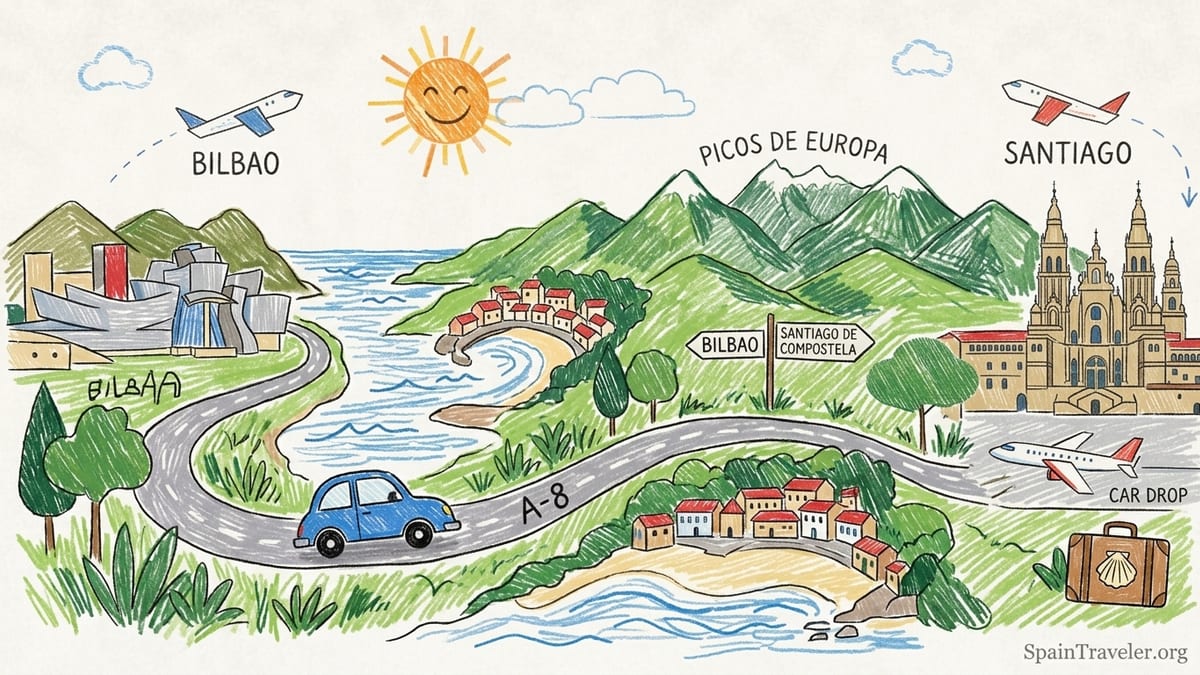
An open-jaw route between Bilbao and Santiago de Compostela is especially efficient. Instead of looping back to your starting point, you collect a car at one end of the coast, drive west or east over 5 to 10 days, then drop the vehicle at the other city and fly or take the train onward. For example, many travelers now arrive on a morning flight into Bilbao, spend several days exploring Bilbao and San Sebastián, then pick up a car at Bilbao Airport and drop it in Santiago just before their return flight.
One-way rentals within Spain are straightforward, but fees and conditions vary by company and pick-up point. On a typical summer booking, you might see a basic compact car quoted at around 30 to 45 euros per day when taken for a week, with an additional one-way drop charge ranging from roughly 40 to 120 euros depending on brand and demand. Understanding where these fees are lowest, and how they compare with extra fuel or tolls, helps you choose the best airport and direction for your itinerary.
Equally important is timing. Many first-time visitors instinctively want to collect a car as soon as they land, but in cities like Bilbao and San Sebastián it often makes sense to delay pick-up until after you have explored the urban centers on foot. This can shave days off your rental, cut parking headaches, and still leave you with ample time for the scenic drive between the Basque Country and Galicia.
Choosing Your Direction: Bilbao → Santiago or Reverse
Most visitors start in Bilbao and end in Santiago de Compostela, but the reverse direction is increasingly popular thanks to good international flight connections at both ends. The choice often comes down to flight timings and the kind of finale you want. Ending in Santiago works well if you like to drop the car, spend a night or two in the historic center, and walk everywhere among pilgrims and granite squares before flying home.
Driving from Bilbao westwards gives you a gentle build-up from urban to rural. You can start with modern architecture and pintxos in Bilbao, add a day trip by bus or train to San Sebastián, then collect your car at Bilbao Airport for the coastal drive via Santander, the Picos de Europa and Asturias. From there, you can follow the Costa Verde past Cudillero and Luarca, cross into Galicia and finish with the rías around Ría de Arousa before returning your car at Santiago’s airport.
Starting in Santiago and driving east reverses the mood. Many travelers who have just completed the Camino de Santiago enjoy hiring a car at Santiago Airport for three to five days in the countryside before catching a flight out of Bilbao. That route might include detours to the Ribeira Sacra canyons or the Costa da Morte before joining the A-8 eastward across Asturias and Cantabria. You then drop the car at Bilbao Airport and spend your last night near the Guggenheim or in the old town.
In both directions, the one-way drop fees are generally similar when you stay with the major international brands that have desks at all the key airports. This gives you flexibility to let your chosen flights and hotel availability dictate the direction of travel rather than being locked into a specific start or end point.
Airport Pickup Comparison: Bilbao, Santander, Asturias and Santiago
Bilbao Airport is the strongest all-round starting point for a Green Spain road trip. It is a major gateway with frequent flights and a full spread of international rental brands. At the time of writing, Aena’s official information confirms that Avis, Enterprise/National, Europcar, Hertz and Sixt all operate on site in the terminal, alongside several other providers. This competition usually keeps prices reasonable and gives you good coverage for one-way returns across northern Spain.
Santander Airport is smaller but still offers a solid selection of companies, typically including at least one or two of the big multinationals plus Spanish and pan-European mid-range brands. Because fleet sizes are smaller than Bilbao, prices in peak July and August can be similar or slightly higher for last-minute bookings. One advantage is that Santander Airport sits almost on the A-8 motorway, so you can drive straight out toward Asturias or back toward Bilbao with minimal city traffic.
Asturias Airport, serving Oviedo and Gijón, is another practical pickup for the middle stretch of Green Spain. It is especially convenient if you plan to focus on the Asturias region’s coastal villages and mountain walks without venturing far into the Basque Country or Galicia. Car hire desks here tend to be compact but efficient, and inventory is sometimes weighted toward slightly smaller vehicles that suit the narrower local roads. It can be an excellent compromise if Bilbao’s prices have spiked for your dates but you still want to avoid a very long initial drive.
Santiago de Compostela’s airport, officially known as Santiago Rosalía de Castro, has a broad mix of international and local car hire brands clustered around the arrivals area and nearby lots. Current aggregators listing the airport show a range of firms such as Avis, Budget, Enterprise, Europcar, Hertz, Goldcar and several others operating here. Because Santiago is both a tourism and pilgrimage hub, competition can keep daily rates attractive in shoulder seasons like May, June and September, especially for week-long rentals.
Understanding One-Way Fees and How to Minimize Them
For an open-jaw itinerary between Bilbao and Santiago, the key extra cost to watch is the one-way drop fee. This is the charge a rental company applies when you return the car to a different location from where you collected it. Within northern Spain, fees are usually moderate compared with cross-border or long-distance drops, but they are not negligible.
On recent searches for a week-long rental in June, a compact car rented from a major brand at Bilbao and dropped at Santiago commonly showed a one-way fee in the region of 40 to 80 euros, itemized separately from the daily rate. Some mid-range or budget-focused brands can push this to around 100 to 120 euros in peak weeks, especially if you collect at a busy Friday or Saturday slot. The reverse direction, starting in Santiago and dropping in Bilbao, often shows very similar figures.
There are several ways to keep these fees manageable. Booking earlier typically yields better availability of the lowest one-way surcharges, because companies can plan fleet movements in advance. Keeping your pickup and drop at airports, rather than city branches, also helps, because airport locations have higher turnover and more flexibility to balance vehicles. Finally, compare brands carefully: two quotes that look similar on daily price can differ by 50 euros or more once you factor in the one-way supplement.
If you find that the fee from Bilbao to Santiago with your preferred company is uncomfortably high, consider picking up or dropping at an intermediate airport such as Santander or Asturias. For example, you might spend a few car-free days in Bilbao and San Sebastián, then collect a vehicle in Santander for the drive through Asturias and western Galicia, returning it in Santiago. The overall driving distance is shorter, and some providers treat this as a more local route with lower redistribution costs.
Compact vs SUV and the Rise of Automatic Cars
The northern Spanish coast is well-served by modern highways, but the most charming sections of Green Spain are defined by tight village streets, single-lane rural roads and steep coastal lanes. For this reason, a compact or intermediate car is often more practical than a large SUV. A typical compact hatchback in the rental listings might be similar to a Volkswagen Golf or Seat Leon, while an intermediate SUV could be a Nissan Qashqai or Hyundai Tucson.
In real terms, you might see a compact manual advertised at roughly 30 to 45 euros per day for a week in shoulder season, with an equivalent compact SUV costing 10 to 20 euros more per day. Travelers who are not used to parking in tight underground garages or navigating narrow historic centers often find the smaller footprint of a compact easier. In coastal towns like Llanes, Ribadesella or Comillas, you will appreciate being able to slot into shorter curbside spaces or small public car parks without stress.
Automatic cars, once rare in Spain, are now increasingly available at all four airports. However, they still make up a smaller share of fleets than manuals, so they tend to cost more. As a rough guide, expect an automatic version of a compact car to price at around 30 to 60 percent higher than the equivalent manual when demand is strong. For example, where a manual Seat Ibiza might appear at 32 euros per day in late May, the automatic variant or similar could be closer to 48 or 50 euros per day with the same company and conditions.
If you need an automatic, booking earlier is essential, especially for July and August or around major Spanish holidays. Look closely at the rental class codes; models labeled as compact automatic or intermediate automatic are usually fine for Green Spain’s roads. Full-size SUVs or large people carriers are best avoided unless you are in a bigger group and certain you will be staying in hotels with generous surface parking rather than historic centers with tight underground garages.
Insurance, Deposits and What to Watch in the Fine Print
Rental car insurance in Spain is layered and can be confusing, especially when you are comparing Bilbao, Santander, Asturias and Santiago offers on aggregator sites. Most base rates from the major brands include legally required third-party liability plus a form of collision damage cover with an excess. That excess, or deductible, can be substantial, often in the range of 800 to 1,500 euros for compact and mid-size cars. The company will typically place a hold on your credit card for this amount when you collect the vehicle.
To reduce the excess to zero or a low figure, you can either buy the rental company’s own premium coverage at the desk or pre-purchase a separate excess reimbursement policy from a third-party insurer before your trip. Buying at the desk is convenient but can add 15 to 25 euros per day to the bill, sometimes more for SUVs or young drivers. Third-party policies bought in advance are usually cheaper per day but require you to pay for any damage upfront and then claim reimbursement with documentation.
In Green Spain, special care is needed with tires, windscreens and underbody coverage. Many rural roads are narrow with stone walls, and parking in small coastal villages can involve tight maneuvers near curbs and rocks. Check whether your chosen policy explicitly includes or excludes damage to glass, wheels and mirrors. If not covered, even a minor scrape can become an expensive add-on. When you collect the car at Bilbao or Santiago, take clear photos and a short video of all sides, wheels and the interior before leaving the lot, and make sure any existing marks are documented on the checkout form.
Fuel policies also vary between brands and locations. The most straightforward is full-to-full, where you collect with a full tank and return full, paying only for the fuel you actually use. Some lower-cost brands operating at northern Spanish airports still offer a full-to-empty model, where you pay for a full tank at a set price plus a service charge. In practice, this is rarely good value on a one-way route of around 600 kilometers, so it is usually worth filtering for full-to-full rentals when comparing offers from Bilbao, Santander, Asturias and Santiago.
City Parking Realities: Bilbao, Santander, Asturias and Santiago
Parking is one of the biggest arguments for delaying car pickup in Green Spain. Bilbao, San Sebastián and Santiago all have compact historic centers, one-way systems and a mix of resident-only zones that can be stressful if you are jet-lagged and new to Spain’s rules. Daily parking in central Bilbao public garages can easily run from 18 to 25 euros, and hotel garages often charge a similar rate. If you keep a car for three or four city days, that adds up quickly before you even begin the coastal drive.
In Bilbao, a common strategy is to stay central without a car, using the airport bus, trams and local taxis, then pick up the vehicle at Bilbao Airport on the morning you leave the city. The airport is about 15 minutes from central Bilbao by road, and rental lots are purpose-built for easy access. This way you avoid paying for an unused car while you visit the Guggenheim, stroll the riverside or take a bus day trip to San Sebastián. Once you have collected the car, you drive straight onto the AP-8 or A-8 toward Santander or into the Basque interior.
Santander itself has more open waterfront areas and some large surface car parks, but central hotel garages can still be tight and relatively costly. Along the Cantabrian and Asturian coasts, resort towns employ regulated street parking in high season, with blue zones that require payment at meters and have time limits. You can often find free parking a short walk from old towns or beaches, but this may involve navigating narrow residential streets better suited to a compact car than a large SUV.
Santiago de Compostela’s old town is mostly pedestrianized or restricted, with car parks circling the historic core. Many travelers choose to drop the car at Santiago Airport and then take a taxi or shuttle into the center for the final nights of the trip. This avoids hunting for spaces near hotels and eliminates any risk of small parking dings right at the end of the rental. It also simplifies your departure day: you are already in town and only need a short taxi ride to the terminal, rather than returning the vehicle under time pressure.
When to Collect Your Car: After Visiting Bilbao and San Sebastián
Although it is tempting to collect a car as soon as your flight lands, there are clear advantages to delaying pickup until after you have explored Bilbao and San Sebastián. Both cities are easy to navigate without a vehicle, thanks to reliable buses, regional trains and taxis. The airport bus in Bilbao, for example, runs frequently into the city center, and from there a direct bus or train can whisk you to San Sebastián for a day or overnight visit without the headaches of parking in two dense urban areas.
Consider a concrete itinerary. You land in Bilbao on a Saturday, take the airport bus to your hotel and spend the weekend in the city on foot, enjoying the Guggenheim, the old town and riverside walks. On Monday, you take an early bus to San Sebastián, spend the day by La Concha beach and return to Bilbao in the evening. On Tuesday morning, you ride the airport bus back to Bilbao Airport, collect your pre-booked compact car from Avis, Enterprise, Europcar, Hertz or Sixt, and drive straight out toward Santander. You have effectively removed three or four days of parking and rental costs while still seeing both cities.
This logic also works in reverse. If you are starting in Santiago, you might arrive by air or train, enjoy the city without a car for two nights and then pick up your vehicle at Santiago Airport or a city branch on the morning you depart for the coast. You will appreciate not having to worry about underground garages or resident-only parking zones while exploring the cathedral, museums and pilgrims’ streets.
Delaying pickup is particularly sensible for travelers who are not confident driving in busy European city traffic or who arrive on long-haul flights. Starting the driving portion on a fresh morning, after you have adjusted to the time zone and local habits, makes the first day on the A-8 or AP-9 far more relaxed. In practical terms, this approach often shaves 20 to 30 percent off your total rental bill on an eight to ten day trip, especially once you factor in avoided city parking charges.
The Takeaway
A one-way road trip between Bilbao and Santiago de Compostela is one of the most rewarding ways to experience Green Spain’s mix of cities, fishing villages, beaches and mountains. With thoughtful planning around airport pickups, one-way fees, car size, transmission type, insurance and parking, it can also be straightforward and cost-effective.
Bilbao and Santiago airports offer the widest choice of rental brands, including Avis, Enterprise/National, Europcar, Hertz, Sixt and others, while Santander and Asturias provide flexible alternatives and mid-route entry points. Compact cars generally suit Green Spain’s roads and parking better than large SUVs, and automatic models are now common but still command a premium and must be booked early. Insurance choices, especially around excesses and coverage for glass and wheels, deserve close scrutiny so that minor mishaps on narrow rural lanes do not turn into major expenses.
Perhaps the single smartest move is to align your pickup with the start of your rural driving and avoid keeping a car during purely urban days in Bilbao, San Sebastián or Santiago. Doing so simplifies your trip, reduces stress, and often saves a meaningful amount of money that you can instead spend on memorable meals, small guesthouses and extra nights in the landscapes that make Green Spain special.
FAQ
Q1. Is it cheaper to start my rental in Bilbao or Santiago for a one-way trip?
The base daily rates are often similar at both airports, and one-way fees between them are usually in the same broad range. Price differences tend to depend more on your travel dates, how early you book and which company you choose than on the direction itself, so compare both options before deciding.
Q2. How many days do I need for a Bilbao to Santiago road trip?
Many travelers are comfortable with five to seven days, which allows time for two or three overnight stops between the Basque Country and Galicia. If you want to add extra detours into the Picos de Europa or the Galician interior, plan on eight to ten days so you are not rushing from one hotel to the next.
Q3. Do I really need a car, or can I rely on trains and buses in Green Spain?
You can travel between major cities like Bilbao, Santander, Oviedo and Santiago by train or long-distance bus, but many smaller coastal villages and rural viewpoints have limited public transport. A car gives you far more flexibility for exploring coves, cliffs and countryside that are hard to reach on fixed timetables.
Q4. Are automatic rental cars widely available in northern Spain?
Yes, all four airports now offer automatic vehicles with the main brands, but they are still a minority of the fleet and often book out first in peak months. If you require an automatic, reserve as early as possible and be prepared to pay more than for a manual.
Q5. What type of car is best for narrow village streets and parking garages?
A compact or small intermediate car is usually ideal. Models similar to a Volkswagen Golf or Seat Leon strike a good balance between comfort on the motorway and maneuverability in tight village lanes and underground garages, especially in historic centers.
Q6. How can I avoid high parking costs in Bilbao and Santiago?
The simplest way is to avoid having a car while you are focused on sightseeing in the city centers. Use airport buses, taxis and local transport at the beginning and end of your trip, and time your car rental for the days you are mostly driving between regions.
Q7. Are toll roads common between Bilbao and Santiago?
Some sections, such as parts of the AP-8 and AP-9, have tolls, while other stretches are toll-free motorways. The overall cost for a typical Bilbao to Santiago route is manageable, but you can reduce toll spend by mixing toll roads with slower scenic coastal sections if you are not in a hurry.
Q8. What should I know about fuel policies and extra charges?
Look for rentals with a full-to-full fuel policy, where you return the tank full and avoid flat refueling fees. Be cautious of offers with mandatory pre-purchased fuel and service charges, as these often work out more expensive on a one-way trip of around 600 kilometers.
Q9. Is it necessary to buy extra insurance from the rental company?
It is not mandatory, but it can greatly reduce or eliminate your excess and financial risk if something goes wrong. You can either buy the company’s premium cover at the desk or use a separate excess policy, but in any case read the inclusions carefully, especially for glass, wheels and underbody damage.
Q10. Can I pick up my car in one city center and drop it at a different airport?
Yes, most major brands allow mixed pickups and drop-offs, such as collecting in central Bilbao and returning at Santiago Airport, but they may apply a one-way fee. Always check the total price, including supplements, before confirming, and compare it with starting and finishing at airports, which can sometimes be cheaper.