


From the pintxo bars of San Sebastián to the misty peaks of the Picos de Europa and the stone-paved streets of Santiago de Compostela, Green Spain strings together some of Europe’s most rewarding slow-travel landscapes. This selective guide focuses on a realistic route that connects San Sebastián, Bilbao, Santander, Santillana del Mar, Picos de Europa, Oviedo, Gijón, Cudillero or Llanes, Ribadeo, Galicia’s coastal areas and Santiago. It explains why each place deserves a stop, which towns work best as overnight bases, and how to link them into a coherent journey rather than a rushed checklist.
How to Use This Green Spain Route
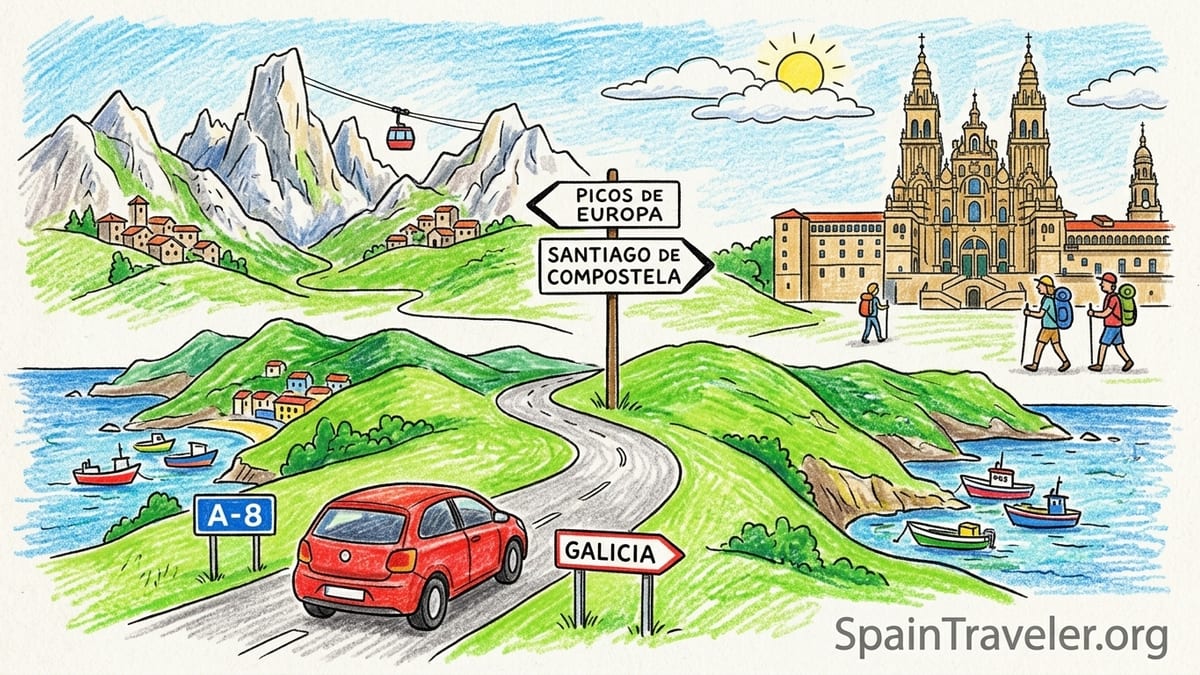
Green Spain refers to the lush Atlantic arc that runs from the Basque Country through Cantabria and Asturias into Galicia. Official regional itineraries often highlight a spine that connects Bilbao, San Sebastián, Santander, Picos de Europa, Oviedo or Gijón and Santiago, because this combination balances culture, cities, mountains and sea. Think of it as a two to three week framework you can trim or stretch depending on your time and travel style.
Most travelers arrive via the airports at Bilbao, Santander, Asturias (near Oviedo and Gijón) or Santiago, all with seasonal international links and frequent connections from Madrid and Barcelona. A compact hire car is usually the most flexible way to cover this route, especially for reaching mountain villages and small coves. For example, driving the 100 kilometers between Santander and Llanes typically takes about 1.5 hours on the A-8 motorway, while the mountain detour up to Potes in the Picos de Europa can easily add half a day of scenic curves and photo stops.
To avoid turning this into a road marathon, treat San Sebastián, Bilbao, Santander, Picos de Europa and either Oviedo or Gijón plus Santiago as your main overnight bases. Smaller spots like Santillana del Mar, Cudillero, Llanes and Ribadeo work best as one or two night stays or even relaxed daytime stops between bigger hubs. This pattern lets you unpack for several nights in key cities, then thread in quieter coastal villages and viewpoints.
Accommodation ranges from simple family-run pensiones for around 70 to 100 euros per night for a double room, up to historic paradors and design hotels that can easily run 200 euros or more in high season. Booking ahead from June to early September is important, especially in San Sebastián, coastal Asturias and around Santiago during major pilgrimage dates and summer festivals.
San Sebastián: Basque Beach City and Food Capital
San Sebastián, or Donostia in Basque, is often the first or last stop on a Green Spain itinerary, and it is one of the strongest overnight bases. The city combines a compact Belle Époque core with the golden sweep of La Concha Bay, backed by forested hills. In summer, locals swim before work, then cross town on foot to the office or market. Off-season, the same promenade turns into a windswept stage for runners, dog walkers and bundled-up strollers as Atlantic squalls roll in.
The main draw, though, is food. San Sebastián has an unusually dense cluster of Michelin-starred restaurants and a legendary pintxo bar scene in the Parte Vieja and the more local-feeling Gros district. Visitors often spend evenings hopping between bars such as Ganbara or Txepetxa in the old town, ordering a few small bites and a glass of txakoli at each, with individual pintxos typically costing between 2.50 and 5 euros. It is common to see queues on narrow streets outside popular counters, and local tourism materials still promote the city as one of the world’s great places to eat.
San Sebastián is also an easy car-free city. You can walk between the three main beaches, funicular up Mount Igueldo for views, and take local buses to suburban hikes like the Camino de Santiago coastal path toward Pasajes. Many travelers choose to spend three or four nights here at the start or end of a trip, using the city as a recovery zone for late-night dinners and slow mornings before tackling longer drives along the coast.
In practical terms, San Sebastián works best as a base rather than a brief stop, especially if you want a table at sought-after restaurants such as Arzak or to join a guided pintxo tour in English or French. With at least two full days, you can mix food-focused wandering with half-day beach time and short hikes without feeling rushed.
Bilbao and Santander: Culture, Coasts and Easy Connections
Bilbao has reinvented itself from industrial port to cultural anchor of the Basque Country, and it is one of the most logical gateways to Green Spain. Many visitors land at Bilbao’s compact airport, pick up a rental car and spend two or three nights in the city before driving along the Cantabrian coast. The titanium curves of the Guggenheim Museum remain the headline sight, and the riverside promenade around the museum is a good first-day stroll to shake off jet lag.
Beyond the Guggenheim, the Casco Viejo, or old town, offers tight lanes lined with bars serving Basque pintxos, though generally with a quieter, more local feel than in San Sebastián. Room prices in central Bilbao can be lower than in San Sebastián during summer weekends, so budget travelers sometimes base themselves here and take a day trip by bus or train to the beaches and restaurants of San Sebastián, which is usually around 1.5 to 2 hours each way by public transport.
Two hours west by road from Bilbao, Santander makes a useful overnight or two-night base that conveniently bridges the Basque Country and Asturias. The city spreads around a sweeping bay with upscale neighborhoods like El Sardinero fronting long city beaches. It has a working port atmosphere mixed with resort touches, and on summer evenings families gather on the waterfront paseo for ice cream or fried rabas, the local term for battered squid rings, at simple marisquerías where a generous plate might cost 12 to 18 euros.
Santander is also an efficient staging point for excursions to nature and historic villages. The Cabárceno wildlife park lies about 15 kilometers inland, and to the west the A-8 motorway quickly connects you with the coast road toward Santillana del Mar and Asturias. For a classic Green Spain route, it is reasonable to spend one or two nights in Santander, especially if you arrive by ferry from the United Kingdom or by air, before continuing toward the Picos de Europa or Asturias’ beaches.
Santillana del Mar and the Road to Picos de Europa
Often described as one of Spain’s most beautiful villages, Santillana del Mar sits inland from the Cantabrian coast amid rolling green pastures. Cobblestone lanes lined with stone mansions, carved wooden balconies and small plazas give it an almost museum-like atmosphere, especially early in the morning before day trippers arrive. Most travelers treat Santillana as a one-night stay or a leisurely lunch stop between Santander and Asturias, rather than a multi-night base.
Nearby attractions include the Altamira Cave complex, historically famous for Paleolithic paintings. The original cave has been closed to preserve the art, but a meticulous replica and modern museum present the prehistoric environment. Families often combine a morning in Santillana with a visit to the museum, then drive on to coastal viewpoints at Suances or Comillas, both within roughly 30 to 40 minutes by car.
From this corridor, the route begins to bend inland toward the Picos de Europa, one of Europe’s most dramatic but still relatively uncrowded mountain ranges. Roads from Santander or the Cantabrian motorway funnel toward the Deva and Sella river valleys, leading to towns such as Potes on the Cantabrian side or Cangas de Onís on the Asturian side. Government visitor information highlights highway routes like the N-621 and N-625 as the main access strands into the national park, with buses linking larger cities like Santander and Oviedo to gateway towns in season.
Because distances that look short on a map can become slow in practice, many travelers plan the day as a gradual progression: a morning in Santillana del Mar, a late lunch in Potes and an evening arrival at an inn near Fuente Dé or Cangas de Onís. Using Potes or Cangas as two or three night bases lets you experience the Picos at an unhurried pace while still rejoining the coastal route efficiently afterward.
Picos de Europa: Peaks, Cable Cars and Alpine Villages
The Picos de Europa National Park stretches across parts of Asturias, Cantabria and Castile and León. Jagged limestone peaks, deep gorges and tiny stone villages provide a mountain counterpoint to the Atlantic beaches just an hour or two away by car. Weather can change quickly here, even in July and August, so travelers often aim for flexible plans that allow clear mornings for hikes and foggy afternoons for long lunches in village dining rooms.
On the Cantabrian side, Potes works well as an overnight base, with small hotels and rural guesthouses serving hikers who ride the Fuente Dé cable car up to high viewpoints or tackle trails in the Liébana valley. The cable car, managed by the regional tourism company, shoots visitors from about 1,100 meters to almost 1,800 meters in minutes, which makes sunrise or sunset views possible without technical climbing gear. A typical round-trip ticket costs in the region of 20 euros per adult, and queues build quickly on summer weekends, so arriving early is wise.
On the Asturian side, Cangas de Onís and the sanctuary of Covadonga anchor access to the famous glacial lakes and high meadows. In peak periods, park authorities restrict private car access to the lakes, encouraging visitors to use shuttle buses or park-and-ride systems from lower villages. This keeps traffic under control on the narrow switchback roads and preserves some mountain quiet even in August. One or two full days based around Cangas de Onís allows a mix of easy lakeside strolls, moderate hikes and visits to nearby cider houses serving hearty fabada bean stews.
For most Green Spain itineraries, the Picos de Europa segment works best as a two to four night inland loop between Santander and Asturias’ coastal cities. Treat Potes or Cangas de Onís as your main base, then add short side trips to tiny hamlets, cheese farms producing local cabrales cheese or scenic miradors, before dropping back to the A-8 motorway to continue west.
Oviedo, Gijón and the Asturian Coast: Cities and Fishing Villages
Once you rejoin the coast after the Picos, the twin urban centers of Oviedo and Gijón provide a soft landing. Oviedo, the regional capital, lies inland with a compact historic core, stately squares and a reputation for cleanliness and safety. Many visitors use it as a cultural base for a night or two, exploring pre-Romanesque churches backdropped by green hills and eating traditional menus del día in cider bars, where a three-course lunch with bread and house wine often runs around 15 euros.
Gijón, by contrast, is a port city right on the sea with a working-class energy and an attractive urban beach, Playa de San Lorenzo. Local buses connect its neighborhoods, but the historic Cimavilla quarter and the beachfront promenade are walkable, lined with sidrerías where waiters pour natural cider from bottles held high above their heads. Because Gijón has a wide range of midrange hotels and apartments, it makes a convenient two or three night base for travelers who want access to both city comforts and day trips along the coast.
Between and beyond these cities stretch some of Spain’s most photogenic fishing villages. Cudillero, west of Gijón, is often described in regional tourism campaigns as one of the most admired and photographed villages in Asturias. Its amphitheater of tightly packed, brightly painted houses tumbles down a natural hollow to a small harbor, creating a bowl effect that hides the town from road and sea approaches until you are almost inside. Restaurant terraces on the main square serve plates of grilled fish and percebes, or gooseneck barnacles, landed by small boats that still work the Cantabrian Sea.
Further east, Llanes blends medieval streets with a string of easily accessed coves like Playa de Toro and Playa de Poo, making it another popular stop. Many Green Spain travelers overnight in either Gijón or nearby villages for urban conveniences, then visit Cudillero or Llanes for half-day excursions or one-night stops. Expect parking challenges in the narrow streets during high summer; arriving before 10 a.m. or staying overnight allows you to enjoy the villages when the day-trip crowds thin out.
Ribadeo and Galicia’s Rugged Coastline
Crossing the Eo estuary from Asturias into Galicia, Ribadeo is a small town that serves as gateway to one of northern Spain’s most photographed stretches of shore: the Praia das Catedrais area. Here, at low tide, natural rock arches and buttresses form cathedral-like silhouettes along the sand. Regional authorities have introduced a free but mandatory reservation system in high season to control visitor numbers, so travelers driving from Ribadeo need to check tide charts and booking requirements before arrival.
Ribadeo itself has a modest historic center with Galician manor houses and viewpoints over the estuary, plus a practical selection of hotels and simple seafood restaurants. For many itineraries it works best as a one-night stop between Asturias and deeper Galicia, especially if you want an early morning or late evening walk at the cathedral beach with minimal crowds. In shoulder seasons, when the Atlantic can be wild and gray, the cliffs and viewpoints feel especially remote.
Continuing west, the Galician coast offers a series of options depending on time and interest. Some travelers follow the northern route through towns like Viveiro and Ortigueira toward A Coruña, favoring wild headlands and surf beaches used by local clubs. Others drop south into the Rías Altas and Rías Baixas, where protected inlets shelter fishing villages and shellfish farms. In places like the Ría de Arousa, you can join small boat tours that visit mussel rafts and serve plates of steamed mussels or clams on board for prices comparable to a casual restaurant meal.
Because this part of Galicia is more dispersed, it helps to choose one or two coastal bases rather than trying to change hotels each night. For example, you might spend two nights near the Ría de Arousa to explore Cambados, O Grove and local wineries that pour Albariño, then position yourself closer to Santiago for the end of the trip. Driving times can be deceptively long due to winding roads and local traffic, so planning no more than three hours of driving on any given day keeps the journey relaxed.
Santiago de Compostela: Pilgrim City at Journey’s End
For many travelers, Santiago de Compostela is an emotional endpoint to the Green Spain route, even if they have not walked the Camino. The city’s granite old town hums with a mix of pilgrims, students from the historic university and residents who still shop in the Mercado de Abastos for local cheese, fish and seasonal produce. Hearing bagpipers under arcades as evening rain taps the stone creates a northwestern atmosphere closer to Ireland or Brittany than to the stereotypical image of sun-baked Spain.
The cathedral, with its baroque facade and Romanesque core, anchors the main squares where Camino routes officially end. Visitors who arrive by car often spend a moment watching backpacked pilgrims stride into Praza do Obradoiro, then wander the cloisters and chapels. Access rules to certain cathedral areas and the famous swinging botafumeiro incense burner can vary by season and liturgical calendar, so checking local information offices on arrival is sensible.
Santiago deserves at least two nights as an overnight base. Mornings can be devoted to the cathedral, museum visits and a loop through the market, where bars cook ingredients bought at the stalls, such as scallops, padrón peppers or slices of creamy tetilla cheese. Afternoons invite slower explorations of parks like Alameda, with views back toward the old town, or short drives out to nearby vineyards and monasteries.
Many flights out of Santiago depart early, so positioning yourself in the city for the final night of the trip avoids a rushed pre-dawn drive from the coast. Because the historic center streets are narrow and often pedestrianized, some hotels provide nearby paid parking or valet-style arrangements. Once checked in, you can forget the car and continue on foot, following wandering pilgrims and students through the arcades as your own Green Spain journey winds down.
FAQ
Q1. How long do I need for a Green Spain route from San Sebastián to Santiago?
Most travelers are comfortable with 14 to 18 days, which allows two to four nights each in San Sebastián, Bilbao or Santander, the Picos de Europa, an Asturian city base, a Galician coastal stop and finally Santiago without constant hotel changes.
Q2. Do I need to rent a car, or can I rely on trains and buses?
It is possible to stitch the route together by public transport between major cities like Bilbao, Santander, Oviedo, Gijón and Santiago, but a rental car gives you far more flexibility for reaching places like Cudillero, Llanes, Ribadeo and the Picos de Europa, especially outside peak summer schedules.
Q3. When is the best time of year to visit Green Spain?
Late May, June, September and early October usually offer a balance of mild temperatures, longer daylight and fewer crowds, though showers are possible year round. July and August have warmer seas and lively festivals but also higher prices and busier roads and beaches.
Q4. Which towns are best as overnight bases and which as short stops?
San Sebastián, Bilbao, Santander, a Picos de Europa base such as Potes or Cangas de Onís, an Asturian city like Oviedo or Gijón and Santiago work best for multiple nights. Smaller spots including Santillana del Mar, Cudillero, Llanes and Ribadeo are ideal as one or two night pauses or long lunch and stroll breaks between your main bases.
Q5. How expensive is eating out along this route?
In most cities and towns you can find pintxos or tapas for 2.50 to 5 euros each and menus del día at around 12 to 18 euros at lunchtime. Upscale tasting menus in destinations like San Sebastián can exceed 200 euros per person before wine, so mixing simple bars with one special splurge dinner keeps budgets manageable.
Q6. Is Green Spain suitable for families with children?
Yes. Beaches in San Sebastián, Gijón and parts of Galicia have gentle sections at low tide, and Spanish bars and restaurants generally welcome children. Families often combine short coastal walks, cable car rides in the Picos de Europa and casual seafood lunches where kids can try mild dishes like grilled hake or tortilla.
Q7. What should I pack for the weather in Green Spain?
Pack layers, including a light waterproof jacket, even in summer. The Atlantic climate can shift quickly from sun to drizzle, and temperatures in the Picos de Europa are often significantly cooler than on the coast, especially in the evenings and at higher elevations.
Q8. Do I need to speak Spanish, or is English widely understood?
Basic Spanish helps a lot, particularly in smaller villages and local bars, although in major cities and tourist zones you will usually find someone who speaks some English. Learning simple phrases for ordering food, parking and hotel check in makes everyday interactions smoother and often more welcoming.
Q9. How much driving should I plan each day to keep the trip relaxed?
Planning no more than three hours of driving on travel days is a good rule. For example, driving from Santander to a Picos base or from Gijón to Ribadeo fits easily into a half day, leaving time for visits to villages or short walks en route without feeling rushed.
Q10. Can I combine walking part of the Camino de Santiago with this route?
Yes. Sections of the Northern Way follow the same coast you will be driving, so it is easy to park in a town like Llanes, Ribadeo or near a Galician ría and walk a signed stretch of the Camino for a few hours before returning to your car and continuing along the route.