

I drove the classic stretch of Spain’s Costa Blanca from Dénia to Alicante the way many visitors imagine it but few actually do it: in a rental car, sticking as close to the Mediterranean as the roads realistically allow. Over several days I followed the coast through Jávea, Calpe, Altea, Benidorm and Villajoyosa, trading the speed of the AP‑7 for smaller regional roads whenever the sea views and old towns looked worth the detour. What follows is the route as I genuinely drove it, warts and all, with the car pick‑up, road conditions, navigation quirks, parking realities and the coastal sections that justified leaving the highway.
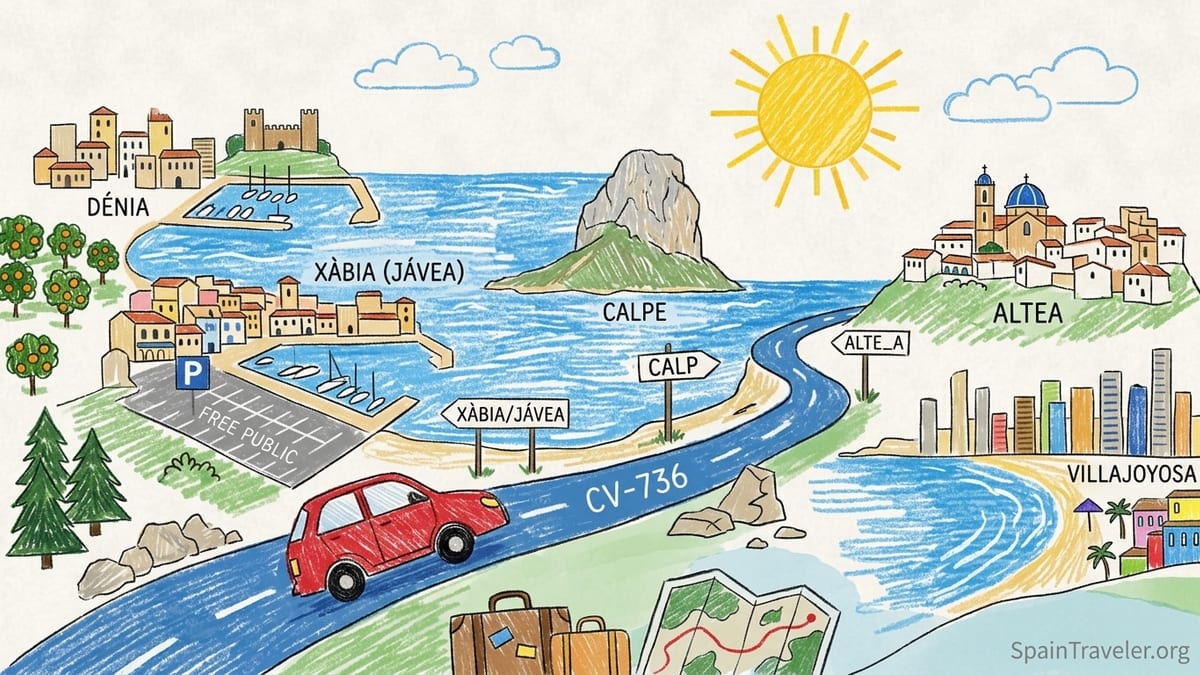
Picking up the car in Dénia and planning the route
I began the trip in Dénia, arriving by intercity bus at the town’s main station and walking to a local rental office a few blocks inland from the marina. Several agencies cluster around Dénia’s center and port area, including small local firms that focus on serving visitors who arrive by ferry or bus. I chose a compact automatic because street parking along the coast towns can be tight and older historic centers still have narrow streets built long before cars existed. Paperwork was straightforward with a passport, driving licence and credit card deposit, a pattern you can expect across most Spanish rental agencies.
From the rental office I opened Google Maps and set a first short hop to Jávea instead of trying to program the entire journey to Alicante. In this part of the Costa Blanca, the official tourist route suggested by regional authorities highlights a chain of coastal towns, but any navigation app will instinctively push you inland to faster roads such as the AP‑7 motorway or the N‑332. To stay near the sea I had to overrule those suggestions and manually select smaller roads like the CV‑736 and CV‑737, which I learned to do early in the trip by zooming in and forcing the blue line to follow the coast rather than the default highway.
Another early lesson was timing. I started the Dénia to Jávea leg late morning to avoid the commuter traffic on the N‑332 and the hottest part of the afternoon in summer. Local news and weather apps showed no major road closures, and fuel prices around Dénia’s larger supermarkets were a bit lower than the branded stations on the motorway, so I made a point of starting the trip with a nearly full tank even though the overall distance to Alicante was modest. The peace of mind was worth it once I found myself meandering on smaller roads with fewer fuel options between towns.
Parking in Dénia itself was my first small challenge. Near the port and castle, surface spaces fill up quickly in high season and many streets have informal pressure on parking even where there is no meter. I chose to leave the car a little back from the seafront on a residential street, which meant a five to ten minute walk to the promenade but saved the stress of circling near the harbor. If you start from Dénia as I did, budget extra time simply to get away from the most popular waterfront blocks.
Dénia to Jávea: edging closer to the sea
Leaving Dénia, my goal was Jávea’s port and Arenal beach, both just over 20 kilometers away as the crow flies but a little longer if you favor coastal roads. The obvious inland shortcut uses the CV‑735, yet I preferred the more coastal CV‑736 and adjacent local roads that connect the orange groves and low hills between the two towns. The route quickly shifted from urban avenues to a single carriageway road with some bends, roundabouts and occasional slow‑moving local traffic. The pavement was in good condition, and despite being a regional road it felt safe and well marked, although I kept speeds conservative on shaded curves where visibility was reduced.
Navigation between Dénia and Jávea required more attention than a motorway run. There are several roundabouts where signage points toward residential urbanisations, beaches or the inland village of Jesús Pobre, and the quickest coastal way is not always obvious at first glance. I found that following signs for Xàbia or Jávea (the Valencian and Spanish names are used interchangeably) and then the puerto or Arenal brought me naturally down to the sea without needing to cut through the old town’s tightest streets. The reward for staying off the highway appeared gradually as glimpses of the Montgó massif on one side and, as I approached, stretches of blue Mediterranean opened on the other.
Parking in Jávea turned out far easier than I feared. Around the port area, there is a large free surface car park near the fishing quay and yacht club, often referred to locally as the public parking by the harbour, with over a hundred spaces and several public charging points for electric vehicles. Recent local guides confirm that street parking around Jávea’s old town, Arenal and port remains mostly free outside a few regulated summer zones near popular coves, and I found that to be true when I visited. I left the car in that harbour lot and was walking along the pebble beach of La Grava within minutes, grateful I had not tried to force my way into a non‑existent blue‑zone spot.
Jávea was the first place that clearly merited an overnight stay. The combination of the historic center a few minutes inland, the family‑friendly Arenal beach and the quieter port makes it more than just a brief coffee stop. I changed hotels here, trading my more basic room in Dénia for a small guesthouse within walking distance of the Arenal, which allowed me to leave the car parked for long stretches and explore on foot. That decision paid off when I realized how much traffic builds up along the seafront at sunset; being able to walk back to the hotel while others sat in slow‑moving lines felt like a luxury achieved by one simple overnight choice.
Jávea to Calpe: slow scenic roads vs the faster N‑332
On the next leg from Jávea to Calpe I consciously weighed two options: cut inland via the faster N‑332, or attempt to hug the coves and capes along smaller local roads like the CV‑737. For a first‑time drive I chose a mix. Leaving Jávea, I followed signs for Gata de Gorgos briefly, then rejoined the main N‑332 southbound. The N‑332 is a busy single carriageway national road that runs parallel to the AP‑7 motorway, with frequent roundabouts, varying speed limits and mixes of local, tourist and occasional heavy traffic. The asphalt was generally good, but I had to stay alert for sudden braking near junctions or where the road passes commercial strips.
South of Teulada, I took the turnoff toward Benissa and Calpe rather than remaining inland. Approaching Benissa, the older coastal road snakes down toward the sea, but many navigation apps still favor the new bypass or even the toll‑free AP‑7 that replaced the former concession motorway. I chose to leave the faster road near Benissa and followed signage to Calp, trading speed for views as the route descended toward the Peñón de Ifach, the dramatic limestone rock that anchors Calpe’s skyline. This section felt like entering the classic postcard Costa Blanca, with apartment towers, roundabout sculptures and flashes of sandy beach between buildings.
Calpe itself presented my first significant parking puzzle of the trip. Around the main Playa del Arenal‑Bol and the marinas near the Peñón, street spaces were tightly packed by midday. I eventually found a space in a mixed residential and commercial area a few blocks behind the seafront, watching carefully for local signage about time limits or resident permits. In high season, several surface car parks on bare ground near the salt lake and beach open to ease demand, but even then spaces can turn over quickly. One practical strategy I would repeat is aiming for the neighborhoods slightly inland from the promenade, where a short walk saves considerable stress.
In Calpe I stayed only for a long lunch and a stroll, and in hindsight this town did not need an overnight stop for my style of trip. The seafront is wide and pleasant, and walkers can circle part of the salt lake to spot flamingos at certain times of year, yet the urban fabric is quite dense. After a few hours I felt ready to move on rather than check into a hotel. This meant my decision to change accommodation in Jávea rather than Calpe was the right one. Had I booked a non‑refundable night in Calpe, it might have felt like unnecessary backtracking compared to pushing on toward Altea later that afternoon.
Altea and the prettiest detour off the highway
Leaving Calpe for Altea, I rejoined the N‑332 for a short stretch, then looked for turnoffs that allowed me to drop closer to the sea. Regional tourist information mentions local roads such as the CV‑746 that weave through coastal urbanisations between Calpe and Altea, and when I ventured onto them I understood both their charm and their limits. These smaller roads tend to pass gated communities, scattered bars and coves, with frequent speed bumps and sharp bends. The pavement was fine, but progress was slow, and there were few places to stop the car for panoramic photographs without blocking someone’s driveway. I would recommend these minor roads only if you have time and enjoy seeing the quiet residential side of the Costa Blanca.
As I neared Altea, the scenery shifted. The whitewashed old town sits on a hill, with the blue‑tiled dome of its church visible from the road, while modern apartment blocks line the pebbly shoreline along the lower strip. I stayed on the N‑332 long enough to reach clear signposts for Altea and the seafront, then followed avenues down to the beachside promenade. The road quality here was good, though roundabouts required attention, and traffic thickened as I entered town. Weekends and evenings bring more cars as locals and visitors converge on the restaurants that face the sea.
Parking in Altea proved manageable but required patience. Along the seafront there are parallel and angled street spaces, many of them free but heavily used. I circled once and then opted for a street a block inland, where I found a space in the shade of an apartment building and walked down to the promenade. There are also municipal lots further from the water that cost a modest hourly rate according to local signage, which can be a good option if you plan to climb up to the old town and do not want to watch the clock constantly. I used the car simply as a link between the modern seafront and the historic hilltop, then left it parked while I spent the late afternoon winding through the old streets.
Altea was another place that deserved more time than I originally allowed. I treated it as a half‑day stop rather than an overnight, driving on to Benidorm before dark, but I could easily have stayed the night. The contrast between the tranquil evening atmosphere in the old town and the busier road below made me think that booking a small hotel up on the hill would be ideal on a return visit. My choice to keep the same hotel in Jávea and then push all the way to Benidorm afterward meant a slightly rushed visit and more time on the road that day than was strictly necessary.
Benidorm and Villajoyosa: high rises, traffic and smart parking choices
The short distance from Altea to Benidorm hides a big change in driving conditions. Staying on the N‑332, the road flows past commercial zones, campings and theme parks, with multiple lanes and regular roundabouts. As I approached Benidorm proper, traffic density increased significantly, particularly near the exits for the Poniente and Levante beach areas. The city’s skyline of high‑rise hotels and apartments appears well before you arrive, and so do the coach bays and taxi ranks serving package‑holiday visitors. It is very different from the smaller resort towns earlier in the trip.
Benidorm’s seafront promenades are attractive for a walk, but I quickly learned that trying to drive too close to the sand is a mistake unless you have a confirmed parking space. Many central streets are one way, and on busy days double‑parked delivery vans narrow lanes further. Instead of following the navigation app directly to the waterfront, I aimed for a multi‑storey car park signposted from one of the interior avenues. Paying a daily maximum there was more comfortable than circling side streets in ever widening loops. Once parked, I did everything on foot, from the old town balconies between the two main beaches to the tapas bars in the center.
Benidorm worked best as a place for one night. Hotels in high‑rise blocks are plentiful, and many offer garage parking for an extra fee, which is worth considering if you know you will be staying inside the city rather than day‑tripping in. I switched hotels here, leaving behind the smaller coastal lodgings of Jávea for a larger, modern hotel within walking distance of the old town. This avoided me having to retrieve the car every time I wanted to move between neighborhoods, but it also meant that checking out the next day required navigating back through Benidorm’s morning traffic. If I were repeating the trip, I might stay in a smaller property on the edge of town with easier access to the main road.
From Benidorm to Villajoyosa, I again chose the N‑332 over the AP‑7, since the national road stays closer to the sea and allows for a glimpse of the coast from occasional elevated stretches. This is not a pure clifftop scenic drive, but there are moments when you see the Mediterranean to your right while passing hills and industrial zones on the left. Traffic remained steady but manageable, with a mix of local commuters and travelers. Villajoyosa itself appeared suddenly as a splash of color, with its line of painted houses fronting the beach just off the main road.
Driving down into Villajoyosa’s center, I followed signs for the playa centro, which led to surface parking areas and some street spaces near the promenade. The town felt more relaxed than Benidorm, both in scale and driving intensity. I found a space in a public lot only a short walk from the sand, then spent a couple of hours wandering through the older streets and along the waterfront. This was a classic example of a stop that was rewarding as a long pause but did not strictly need an overnight stay for my itinerary. Staying would have meant another hotel change for a relatively small gain, so I kept Villajoyosa as a day stop on the way to Alicante.
Rolling into Alicante: traffic, parking and low‑emission rules
The final stretch from Villajoyosa to Alicante continued along the N‑332 before the road blended into the approaches for Spain’s Autovía and the wider metropolitan network. Here the driving felt more like entering a regional capital than cruising a holiday coast. Lane counts increased, there were overhead signs for industrial zones and the port, and traffic during late afternoon built into sustained flows rather than short bunches. I kept right, followed signs for Alicante centro and the port, and trusted the navigation app to choose a sensible exit near the seafront.
One factor that mattered more in Alicante than in any previous town was the existence of a regulated historic center and a low‑emission zone. Since January 2025, Alicante has operated an environmental zone that restricts non‑resident vehicles in parts of the city center, and the old town around the Santa Cruz quarter has additional access controls where only residents with permits can drive freely. Official municipal information emphasizes that visitors who need occasional access can request authorizations, but for a simple hotel stay or sightseeing visit it is far easier to park outside the restricted area and continue on foot or by tram. With that in mind, I decided not to attempt driving directly into the old town streets.
Instead, I targeted one of the underground car parks on the edge of the historic and commercial core, near avenues such as Alfonso el Sabio and the Plaza de los Luceros. Facilities like the large underground parking under that avenue, with hundreds of spaces and direct access to the city’s tram network, offer 24‑hour service and feel safer than leaving a rental car on a crowded street overnight. I drove in, took a ticket and parked the car for the remainder of my stay in Alicante, choosing to move around the city on foot and by public transport. Closer to the waterfront, the Postiguet beach area has a reopened car park along the Paseo de Gómiz, which is convenient if your accommodation is by the sea rather than up near the market or Luceros.
Traffic in central Alicante varied widely depending on the date and events. During my visit, local radio and municipal channels reported temporary restrictions and diversions linked to festivals and construction near the waterfront. During key days of the Hogueras celebrations in June, for example, authorities recommend parking in designated car parks and relying on trams or walking, as access streets can be closed or turned one way. Even outside festival periods, it pays to check the city’s mobility information before arrival and to avoid the narrow, hilly streets of the casco antiguo by car. Once I reached my hotel near the edge of the old town and Rambla, I did not use the car again until it was time to leave the city.
Fuel in Alicante was no longer a concern by that stage, but I noted that larger service stations on the ring roads and approaches advertised prices roughly in line with those I had seen in Dénia, Jávea and Benidorm. For an itinerary of only about 120 to 130 kilometers of active driving between Dénia and Alicante, a single full tank in a compact rental car was more than sufficient. Still, the habit of topping up near bigger towns rather than hoping for a conveniently located station on smaller coastal roads felt like a smart precaution that reduced anxiety throughout the trip.
Navigation lessons, hotel changes and avoiding backtracking
Looking back at my route, several patterns stand out that could help anyone planning a similar Costa Blanca drive. The first is to embrace a hybrid approach between scenic coastal roads and the practical N‑332. There were stretches, such as between Dénia and Jávea or between Calpe and some of the smaller coves, where leaving the faster inland alignment truly brought me closer to the sea and provided a stronger sense of place. At the same time, forcing coastal roads at all costs sometimes meant crawling through residential areas with little to see from the car and few safe turnouts. Accepting that the N‑332 would be my backbone while I dipped toward the shore for specific towns worked better than a purist coastal obsession.
Hotel changes shaped the rhythm of the journey. I began with one night in Dénia, moved to a base in Jávea for more relaxed coastal exploration, then switched to a hotel in Benidorm before finishing the trip in Alicante. That pattern gave me three main “home bases” and a sequence of short hops rather than constant packing and unpacking. Places like Calpe and Villajoyosa worked well as unhurried daytime stops without the extra step of checking into accommodation. The main backtracking I created for myself came from underestimating how much driving in and out of large resort cities adds, not in kilometers but in minutes. Every time I took the car back into a dense beachfront zone just to move hotels or search for dinner, I could feel time slipping away.
If I were refining the itinerary, I would keep overnight stays in Jávea and Alicante, but I might choose a smaller coastal town such as Altea or even Villajoyosa rather than central Benidorm for the intermediate night. That would reduce time spent in heavy urban traffic while still allowing an evening stroll along an attractive promenade. It would also make it easier to park on the edge of town and walk in, instead of negotiating multi‑storey garages under high‑rise blocks. On the other hand, travelers who enjoy nightlife and entertainment might find Benidorm’s energy worth the parking and traffic tradeoffs.
Navigation technology was both helpful and occasionally misleading. On several occasions the app tried to direct me onto the AP‑7 motorway or along completely inland routes to save five or ten minutes, despite my clear interest in the coastal strip. I learned to zoom in and visually trace where a road ran in relation to the sea, then drag the suggested route back toward the N‑332 or the minor CV roads that served the towns I actually wanted to visit. Saving offline map segments for the entire province of Alicante also proved valuable in areas where mobile coverage dipped briefly, especially on hilly sections between towns.
Parking strategy might sound mundane, but it defined much of my stress level. I consistently found it easier to leave the car a little further from the absolute seafront or monument and accept a ten minute walk, rather than insisting on the closest possible spot. This was true in Dénia, Jávea, Calpe, Altea and Villajoyosa, while in Benidorm and Alicante using underground or multi‑storey car parks removed the constant worry of fines or damage. In Jávea specifically, knowing in advance that much of the street parking around the old town, port and Arenal is still free encouraged me to explore by car without the fear of hidden meters, though summer restrictions at remote coves still require attention to local signs.
The Takeaway
Driving from Dénia to Alicante along the Costa Blanca is less about racking up kilometers and more about making smart choices between speed, scenery and simplicity. The route I actually drove, using the N‑332 as a spine and branching off toward Dénia, Jávea, Calpe, Altea, Benidorm and Villajoyosa, balanced those factors reasonably well, though there are tweaks I would make with hindsight. Choosing a small, maneuverable rental car in Dénia, filling the tank before diving into smaller roads, and resisting the urge to push the car into the narrowest old streets all contributed to a smoother journey.
Overnight stays in Jávea, Benidorm and Alicante provided different flavors of the coast, from small‑town seaside calm to high‑rise energy and finally a historic port city with its own traffic and environmental regulations. Some stops, especially Altea and Villajoyosa, merited long leisurely visits without necessarily justifying a separate hotel night, while Calpe offered iconic views but felt better suited to a half‑day pause on this particular itinerary. Above all, keeping flexibility in daily distances and embracing walking within each town turned a straightforward drive into a richer travel experience, allowing the Costa Blanca’s variety to unfold one stop at a time.
FAQ
Q1. How long does it take to drive from Dénia to Alicante along the coast?
The direct drive using mainly the N‑332 can take around two hours without long stops, but allowing a full day or more lets you explore Jávea, Calpe, Altea, Benidorm and Villajoyosa without rushing.
Q2. Which car type is best for this Costa Blanca road trip?
A small or compact car is ideal, as streets in older town centers can be narrow and parking spaces tight. It makes maneuvering in Dénia, Jávea, Calpe and Alicante noticeably easier than with a larger vehicle.
Q3. Is it worth leaving the highway for smaller coastal roads?
Yes, in selected stretches such as between Dénia and Jávea or when dropping down into Altea and Villajoyosa. However, staying mainly on the N‑332 and using it as a backbone avoids frustratingly slow residential detours.
Q4. Where is parking easiest on this route?
Parking felt easiest in Jávea, where street parking near the port and old town is still widely free, and in Villajoyosa, which has relaxed surface lots near the beach. Larger cities like Benidorm and Alicante are smoother if you use underground car parks.
Q5. Do I need to worry about low‑emission zones in Alicante?
Yes. Alicante has introduced a low‑emission zone and separate access restrictions in the historic center. Visitors are better off parking in edge‑of‑center garages and walking or using public transport instead of driving into the old town streets.
Q6. How many nights should I plan between Dénia and Alicante?
Three to four nights works well. One night in Dénia or Jávea, one around the mid‑coast such as Benidorm or Altea, and at least one in Alicante allows you to see each town at a relaxed pace.
Q7. Is fuel readily available on this route?
Yes, there are plenty of service stations near Dénia, Jávea, Benidorm and the approaches to Alicante. Filling up near larger towns before exploring smaller coastal roads reduces the need to hunt for fuel in more remote areas.
Q8. Which town is best as a base for exploring nearby beaches?
Jávea makes an excellent base, with easy driving access to multiple coves as well as a historic center and Arenal beach. From there you can reach other Costa Blanca towns on comfortable day trips without constant hotel changes.
Q9. Is driving in Benidorm stressful for first‑time visitors?
Traffic density and one‑way systems can feel intense in Benidorm, especially near the beachfront. Using a central multi‑storey car park and moving around on foot significantly reduces stress.
Q10. Can I do this route without using toll motorways?
Yes. The journey described relied mainly on the toll‑free N‑332 and local CV roads, avoiding the AP‑7 motorway. This keeps costs down and brings you closer to the coastal towns you will actually want to visit.