


I arrived on the Costa Blanca with the lazy confidence of someone who thinks they “knows” Spain already. I had visited Barcelona and Andalusia, I could order a coffee without hesitating, and I assumed this southeast stretch of coastline would simply be more of the same. Instead, a week tracing a rough line from Alicante up to Dénia, via Benidorm, Villajoyosa, Altea, Calpe and Jávea/Xàbia, gave me a very different picture. The White Coast is not one single beach destination but a chain of very distinct worlds, stitched together by a tram line, a highway and an almost absurd amount of sunshine.
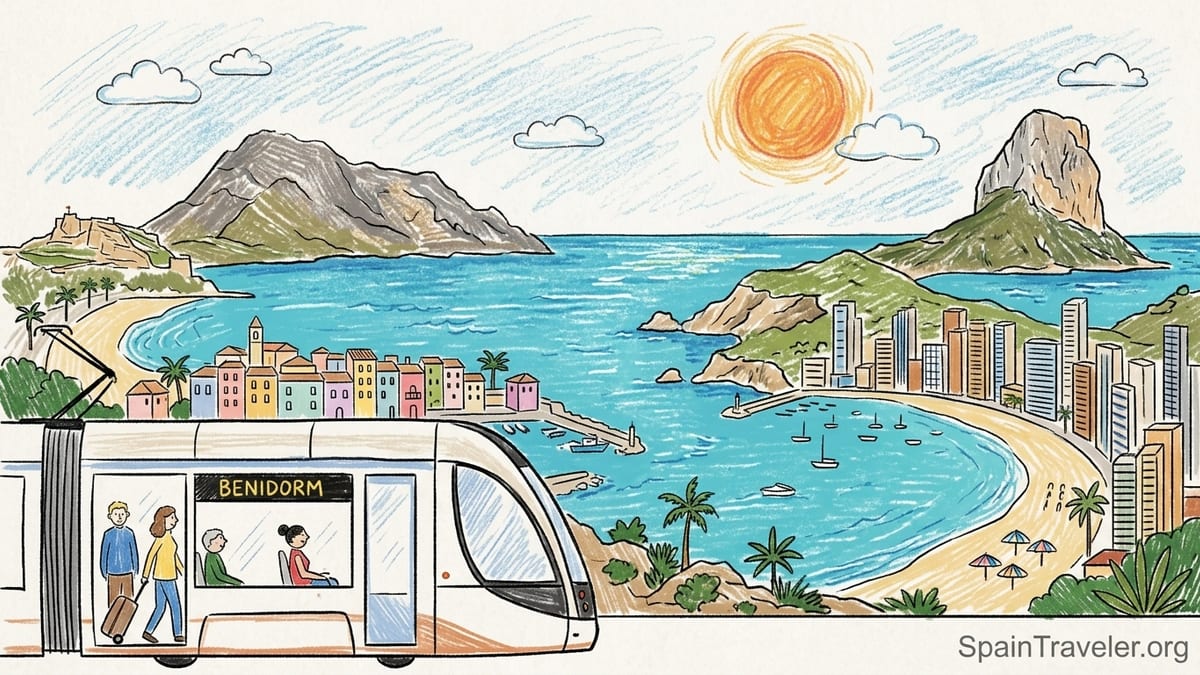
Landing in Alicante and My First Coastal Tram Ride
My trip began at Alicante–Elche Miguel Hernández Airport, where the heat hit me as soon as the sliding doors opened. Instead of renting a car straight away, I decided to see how far public transport could take me. The C6 airport bus pulled up outside arrivals, its digital sign flicking between “Alicante” and a list of stops I did not yet understand. I paid the driver in cash, joined a mix of locals commuting home and visitors clutching rolling suitcases, and in around 20 minutes I was stepping off at Luceros, the underground hub of the TRAM d’Alacant network that links Alicante with Benidorm and Dénia along the coast.
Luceros station surprised me. I expected a basic suburban platform. Instead, I found a clean underground concourse with clear signage for Line 1 to Benidorm and other routes running out to university and the northern beaches. I bought a simple single ticket to Benidorm from the machines, which offered English among other languages, and soon a modern tram train slid in. The journey to Benidorm takes around an hour, passing first through the urban fabric of Alicante and then breaking out into coastal light, picking up day trippers for El Campello and Villajoyosa along the way.
The first moment that really reset my expectations came as we emerged from one of the tunnels and the Mediterranean suddenly appeared, a flat strip of intense blue cut by apartment blocks and palm trees. This was not the romantic, old-town Spain I had pictured but a linear, lived-in coast: stretches of sand, concrete promenades, beach bars, supermarkets and long lines of holiday apartments. It felt unapologetically seaside and very different from the image I had seen in brochures. That contrast between postcard coves and ordinary everyday coastal life became a theme of the whole trip.
For my first two nights, I based myself in Alicante city near Playa del Postiguet. It meant short walks to the beach, easy access back to Luceros station, and plenty of restaurants within a few blocks. Arriving in the late afternoon, I dropped my bag and went straight down to Postiguet, the urban beach tucked below the Santa Bárbara Castle. The sand was softer and wider than I expected for a city beach, there were lifeguard towers and marked swimming areas, and families were still lingering under rented umbrellas as the sun dropped behind the castle walls.
Alicante: Evening Atmosphere, Meals and Early Missteps
My first evening taught me two quick lessons. First, in summer Alicante does not really breathe properly until after 9 pm. Second, you should book dinner if you care where you eat. At 8 pm I wandered into the old town, past the Ayuntamiento and into the warren of streets behind it, hungry and a bit jet lagged. Many terraces were already fully reserved for later, and the popular tapas bars had people waiting. In the end I slipped onto a stool at a modest bar on Calle Castaños and ordered a cold caña, a ración of patatas bravas and grilled sepia a la plancha. It was simple food, but the freshness of the cuttlefish and the smoky char underlined one of the constants of the Costa Blanca: the sea is never far from your plate.
My misstep was footwear. Alicante’s old town climbs steadily up toward the castle, and I decided to hike up for sunset in flimsy sandals. The zigzag path from the beach side is steep and exposed. By the time I reached the ramparts of Santa Bárbara, my feet were protesting and my shirt was soaked. The payoff, however, was enormous. Looking down, I saw the tight lattice of streets, the curve of Postiguet beach and, hazy in the distance, the shape of the coast I was about to follow north, with Benidorm’s high-rise skyline barely visible. It was the first time I really grasped the length of the Costa Blanca and how varied it might be.
Later that night, around midnight, I sat on the promenade along Postiguet. A warm breeze carried music from a beach bar, teenagers were still playing paddle ball near the shore, and older couples walked slowly arm in arm. I had expected the kind of loud, concentrated nightlife that many people associate with Spanish coastal resorts. In Alicante itself, the atmosphere felt more balanced. The city is a working provincial capital as well as a holiday spot, and that mix gave it more texture than I had anticipated.
If I went back, I would stay slightly further from the busiest bar streets. My room overlooked a lively square, which was delightful in the early evening but stayed noisy until well past 2 am. Next time I would trade some of that buzz for a quieter side street or a spot closer to the promenade, where the soundscape is more about waves and soft chatter than thudding bass.
Benidorm: High-Rise Shock and Beach Practicalities
From Alicante, I took Line 1 of the TRAM d’Alacant north to Benidorm, where I had booked two nights specifically to see if the reality matched the clichés. As we approached, the change in skyline was immediate. Benidorm really does deserve its nickname as the Manhattan of Spain, with towers stacked along the curve of the bay. Stepping out of Benidorm Intermodal station, dragging my suitcase downhill toward Levante Beach, I felt a mix of curiosity and mild culture shock. This was not the understated Mediterranean of whitewashed villages but a full-scale resort machine.
My hotel was one of the mid-range high-rises a few blocks back from Levante. The benefits were clear. From the balcony I could see a wedge of turquoise sea framed by balconies and rooftop pools. The beach itself was just a five minute walk, and every corner nearby had a supermarket or a café serving breakfasts tailored to British and Northern European visitors. That convenience came with crowds. By mid-morning in August, Levante Beach was a dense forest of sun umbrellas, many in neat rows belonging to rental concessions. Lifeguard towers were visible at intervals, blue flags flew, and loudspeakers occasionally crackled to remind people about swimming zones.
On my first full day, I made a classic mistake: heading down at midday with no shade booked. The queue at the official sunbed rental kiosks was long, and by the time I reached the front many of the front-row spots were gone. I ended up crammed into a busy second row, paying what felt like a fair price for two loungers and an umbrella but wishing I had either arrived early or brought my own lightweight sunshade. Even with the umbrella, the August heat reflected off the pale sand, and the beach felt more like a social event than a place to relax. Groups played loud music from portable speakers, inflatable unicorns bobbed offshore, and there was a constant flow of vendors weaving between towels selling cold drinks and fruit.
What I did appreciate in Benidorm were the practical facilities. Showers lined the edge of the promenade, there were accessible walkways down to the sand, and information boards clearly marked lifeguard hours and water quality. In the late afternoon I walked along the promenade all the way to the Balcón del Mediterráneo, the white lookout that juts between Levante and Poniente beaches. The view there softened my earlier ambivalence. Looking back at the skyscrapers from the headland, framed by sea on both sides, Benidorm’s drama made sense. It may not be subtle, but it is undeniably a spectacle.
Villajoyosa and Cala de Finestrat: Colourful Streets and a Smaller Cove
One of the most memorable surprises of the trip came just a short ride away from Benidorm. I took the tram and a local bus down to Villajoyosa, a town that feels like a palette cleanser after the intensity of Benidorm. The first thing you notice is colour. Along the seafront, tall narrow houses are painted in pastel pinks, deep blues, ochres and greens, traditionally used so that fishermen could identify their homes from the sea. Walking along that promenade, with palm trees overhead and fishing boats visible in the small port, I felt as if I had stepped into a different story along the same coastline.
I spent the late morning on the central beach, Platja Centre, which had a very different rhythm to Levante. There were sunbed rentals and lifeguards, but more people seemed to bring their own umbrellas and picnic supplies. I rented a lounger for a few hours, swam in clear, calm water and listened mostly to Spanish conversation around me. For lunch, I slid into a table at a simple restaurant opposite the beach and ordered a menú del día: a starter of salmorejo, a main of arroz a banda cooked in a shallow pan, and a glass of local white wine. It felt both overtly coastal and quietly local.
Back near Benidorm, I also visited Cala de Finestrat, a smaller sandy cove at the southwestern end of the big bay. Getting there by bus from Benidorm’s centre was fairly straightforward, though the traffic in August meant the journey took longer than the timetable suggested. The cove itself is hemmed in by low cliffs and mid-rise apartments, with a compact promenade. Because it is more enclosed, the water felt even calmer, and I noticed families with small children gravitating here. There was an open-air car park just back from the promenade, and by late morning it was already close to full. This was one of the moments when I was glad I had not rented a car right away. Finding parking along the busier parts of the Costa Blanca in peak season looked like a competitive sport.
If I returned, I would try to visit Villajoyosa and Cala de Finestrat outside the absolute peak summer weeks. Even then, they felt more relaxed than Benidorm, but the combination of narrow streets, limited parking and high demand meant that by mid-afternoon both places were noticeably busier. An early start paid off in quieter swims and easier café tables.
Altea and Calpe: From Whitewashed Calm to Iconic Rock
Continuing north, I finally picked up a rental car in Benidorm for the next leg. I had resisted it at first, wanting to test the tram and buses, but I realised that some of the smaller coves and hilltop viewpoints would be much easier with wheels. The drive from Benidorm to Altea along the N-332 is short, but as you approach Altea the tone of the coast changes. The high-rises fall away, replaced by smaller buildings and a more low-key skyline. I parked near the seafront and began the climb up through Altea’s whitewashed old town, following cobblestone lanes toward the blue-and-white tiled dome of the church of Nuestra Señora del Consuelo.
Altea surprised me with its quiet corners. Just a few streets back from the main church square, where restaurants set up terraces with views down to the sea, I found almost empty alleys lined with small galleries and workshops. In the heat of early afternoon, most shutters were half closed, and bougainvillea spilled over the tops of white walls. Looking out over the bay from the mirador, the sea looked softer and the coast more fragmented, dotted with smaller beaches and marinas instead of long continuous strips of sand. For lunch, I opted for grilled sardines and a simple salad on a terrace overlooking the water. It was one of the meals that felt perfectly aligned with its setting: light, salty and unhurried.
The next base was Calpe, just up the coast. Driving in, the huge limestone rock of Peñón de Ifach dominates everything, rising sharply from the sea beside the marina. My hotel was sandwiched between the two main beaches, Playa del Arenal-Bol and Playa de la Fossa. Both are wide, sandy and rimmed with a solid wall of apartment buildings and hotels, but the presence of the rock gives Calpe a distinct identity. I spent one morning walking from the fishing port, where fish auctions take place in the afternoon, around the base of the rock along a paved path and then on to Playa de la Fossa for a swim.
Here I made another small mistake: underestimating the sun reflected off the pale facades and the water. Even with sunscreen, a hat and periodic retreats to a café for shade, I ended up slightly burnt after what felt like only a couple of hours outdoors. The heat in high summer along the Costa Blanca is not only about temperature but about reflection and lack of wind on some days. The upside in Calpe was the easy availability of services. Showers, toilets, rental umbrellas and a long string of chiringuitos made beach days straightforward, provided you respected the conditions and were prepared for company.
Jávea/Xàbia and Dénia: Discovering a Different Costa Blanca
From Calpe onward, I felt as if I had crossed an invisible boundary into a subtly different Costa Blanca. The landscape around Jávea/Xàbia and Dénia becomes more rugged, with headlands and the bulk of the Montgó massif standing watch over the sea. Instead of continuous urbanised seafront, there are more coves, rocky inlets and pockets of pine forest that run right down to the water. I based myself in Jávea for two nights, splitting my time between the Arenal sandy beach, the stony but beautiful La Grava beach near the port, and short drives out to viewpoints like Cabo de la Nao.
The contrast with Benidorm was striking. Jávea is still a major holiday destination, with English and German clearly audible on every promenade, but the scale feels more horizontal than vertical. There are height limits on buildings, so instead of towers there are low-rise apartments, villas hidden behind hedges and small hotels. On Platja de l’Arenal, families strolled along the palm-lined promenade in the evening, children darted between ice-cream parlours, and the restaurants leaned heavily into local rice dishes and seafood. One evening I had arroz del senyoret, a peeled seafood rice, on a terrace facing the bay while paddleboarders traced slow lines across the water as the light went orange.
The biggest surprise here was how much I enjoyed the rocky coves, even though they demanded more effort. At Cala Portixol, for instance, the descent from the parking area is steep and stony, and the cove itself is made of rounded pebbles rather than sand. Lying on a towel is less comfortable, and entering the water requires water shoes to avoid slipping. In return, the water clarity was extraordinary, with fish visible close to shore and shades of blue that looked almost manufactured. Standing waist-deep with a mask and snorkel, watching schools of small fish flicker around the rocks, I felt further from the mass-tourism image of the Costa Blanca than at any other point of the trip.
My final stop was Dénia, just a little further north and technically still part of the same coastal strip. Here, the town’s castle sits on a hill above the centre, and the port looks not only to local fishing grounds but also to the Balearic Islands, with ferries coming and going. I walked up through the old quarter one evening and then down to the marina area, which has been redeveloped with waterfront restaurants and bars. The beaches north of town stretch for kilometres, with dunes and low development in places, while to the south there are rockier sections under the Montgó. I only had time for a late-afternoon swim on the long sandy section near Las Marinas, where the atmosphere was decidedly Spanish, with multi-generational families folding up umbrellas as the sun sank.
Heat, Crowds, Parking and What I Would Do Differently
One of the strongest impressions I brought home from the Costa Blanca was how heavily timing shapes your experience. I travelled in the thick of summer, when the sun is fierce and the coast is busy with both international visitors and Spaniards on holiday. On the plus side, almost every beach service was active: lifeguards on duty into the evening on major beaches, beach bars open, water sports available, and extended tram and bus timetables serving late-night crowds. On the minus side, the combination of heat and crowds made midday hours on the most famous beaches almost oppressive.
If I returned, I would shift my main beach time to early morning and late afternoon, particularly in Benidorm, Calpe and on the Arenal in Jávea. The couple of days when I set an alarm, reached the sand by 8 am and claimed a spot near the water were far more comfortable. The light was softer, the sand cooler, and the crowd noticeably more local. By 11 am, the character of the same beach had changed completely, with inflatable toys, loud music and a more frenetic pace.
Parking is another factor I underestimated. In Alicante and Benidorm, I managed without a car, relying on the tram and buses, which worked well and spared me the frustration of circling for a space. Once I rented a car, the reality of high-season Costa Blanca parking became clear. Beachfront spots filled early, many central areas were regulated with blue-zone pay-and-display spaces, and in smaller coves signs warned of fines for parking outside designated areas. In places like Cala Portixol and around Cabo de la Nao, cars spilled along narrow roads by mid-morning, and local police presence was visible. Next time I would combine a car for certain legs with a more strategic use of park-and-walk, and I would avoid relying on parking at small coves after about 9 am in high summer.
Heat management is not just about sunscreen, either. I began carrying a lightweight long-sleeved shirt, a refillable water bottle, and a small folding fan, which made waiting for trams or queuing at beach kiosks far more tolerable. Siesta hours make practical sense here. By the end of the trip, my rhythm had shifted to match the coast: active mornings, a retreat indoors or to shaded terraces in the early afternoon, and another round of activity, swimming or walking after 6 pm, when the sun had dipped.
The Costa Blanca’s Split Personality: Resorts, Villages and Inland Escapes
What surprised me most, perhaps, was how clearly the Costa Blanca lives up to its official image as a mix of major resorts, small seaside villages, coves, gastronomy, marinas and inland nature rather than a single uniform beach strip. Seeing Benidorm’s vertical skyline and then walking through the quiet alleys of Altea on the same day felt like visiting two entirely different destinations. The same applied to moving from the broad sands of Levante or Postiguet to the pebble coves near Jávea or the long, sometimes less developed stretches north of Dénia.
I only scratched the surface of the inland side of the region, but even a short detour revealed another layer. From Calpe, I drove inland toward the Jalon Valley (Vall de Pop), swapping sea views for rows of vines and small villages. In about half an hour, I was parking in a square shaded by plane trees, ordering a coffee and a slice of almond cake. The temperature was a few degrees cooler, and the atmosphere felt years away from the beach crowds, even though the coast was less than an hour behind me. It was a strong reminder that the “Costa” in Costa Blanca does not tell the whole story.
Next time, I would deliberately build in more inland time. Towns with castles and historic centres, mountain routes with marked hiking trails, and small bodegas offering tastings of local wines are well within reach of the main resorts. They offer not just a break from the beach but a different understanding of the region’s history, from Moorish influences to agricultural traditions that predate tourism by centuries.
In terms of likes and dislikes, my feelings ended up more nuanced than I expected. I liked the sheer convenience and infrastructure of places like Benidorm and Calpe, where a beach day is logistically easy. I loved the atmosphere and aesthetics of Altea, Villajoyosa and the older parts of Dénia and Jávea, where the combination of architecture, local life and sea views felt more balanced. I disliked the sense of being compressed on the sand in the busiest areas at peak hours and the visual clutter of some overbuilt stretches. Overall, though, the variety along Spain’s White Coast won me over.
The Takeaway
After a week moving from Alicante up to Dénia, any simplistic idea I had of the Costa Blanca dissolved. This is not just a long, anonymous run of beaches. It is a sequence of very different coastal and near-coastal worlds, stitched together by a tram line, highways and the constant presence of the Mediterranean. In Alicante, I found a working city with a genuine evening paseo and a castle that gives a sense of the coastline’s scale. In Benidorm, I confronted the full force of high-rise, high-season tourism, but also appreciated the efficient beach services and surprisingly scenic viewpoints.
In Villajoyosa and Altea, colour and calm took over, from painted fishermen’s houses to whitewashed alleys. Calpe showed how a single geological feature, the Peñón de Ifach, can give a resort a distinct character, even when surrounded by apartments. Jávea and Dénia, under the shadow of Montgó, revealed a more fragmented, cove-filled shore that felt closer to the Costa Blanca that nature designed before developers arrived. Along the way I learned to respect the heat, to accept that crowds are part of the summer equation, and to seek out early mornings and inland detours as antidotes.
If you are planning your own trip, my main piece of advice would be to avoid treating the Costa Blanca as a single destination. Choose a couple of contrasting bases, allow time both on and off the main beaches, and be honest about what you enjoy. If you love nightlife and easy logistics, you may genuinely thrive in Benidorm or central Calpe. If you crave atmosphere and views, Altea, Villajoyosa, Jávea or Dénia may speak more to you. Above all, leave room for surprise. Spain’s White Coast is more layered than its postcard images suggest, and the most rewarding moments often arrive when you step away from the obvious strip of sand and follow a side street, a tram line or a winding inland road to see what else lies beyond.
FAQ
Q1. Is it better to use public transport or rent a car on the Costa Blanca?
From my experience, a mix works best. The tram and buses between Alicante, Benidorm and nearby towns are reliable for main routes, while a rental car helps reach smaller coves and inland villages, especially north of Calpe and around Jávea and Dénia.
Q2. Which Costa Blanca town felt most different from the big resorts?
Altea and Villajoyosa stood out. Altea’s whitewashed old town and hilltop church give it a village feel, while Villajoyosa’s colourful seafront houses and quieter central beach felt worlds away from Benidorm’s high-rise intensity.
Q3. How crowded are the beaches in summer?
In August, major beaches like Benidorm’s Levante, Calpe’s Arenal-Bol and Jávea’s Arenal were very busy by late morning, with sunbeds and umbrellas filling quickly. Early mornings and late afternoons were noticeably calmer and more enjoyable.
Q4. What surprised you most about the northern Costa Blanca?
The shift in landscape. Around Jávea and Dénia, headlands, rocky coves and the Montgó massif create a more rugged coastline, with clear water and smaller coves that feel quite different from the wide, urban beaches further south.
Q5. Were there any beaches you would skip next time?
I would not skip them entirely, but I would spend less midday time on the busiest central stretches of Benidorm and Calpe in peak season. I preferred visiting those beaches early, then moving to quieter coves or inland villages later in the day.
Q6. How did you handle the summer heat?
I adjusted my schedule. Beach or walking activities happened early in the morning or after 6 pm, with the hottest hours spent indoors, in shaded cafés or exploring cooler inland areas. Lightweight clothing, a hat and constant hydration were essential.
Q7. Is Benidorm worth visiting if you usually avoid big resorts?
For me, yes, at least for a night or a day trip. Even if you prefer quieter places, seeing Benidorm’s skyline, beaches and nightlife firsthand helps you understand one important face of the Costa Blanca, and the viewpoints around the Balcón del Mediterráneo are genuinely impressive.
Q8. Which place had the best food on your trip?
My favourite meals were in Altea and Jávea, where I found excellent rice dishes like arroz a banda and arroz del senyoret, often eaten on terraces overlooking the sea. I also enjoyed simple fresh seafood in Villajoyosa and Alicante’s old town.
Q9. When would you choose to return to the Costa Blanca?
I would aim for late May, June or September. Services are still running, the sea is warm enough for swimming, but the beaches and roads are quieter than in peak August, and the heat is usually a little less intense.
Q10. How many bases do you recommend for a one-week trip?
For a week, I would choose two or at most three bases. A combination like Alicante or Benidorm for the southern section, plus either Altea, Calpe, Jávea or Dénia for the northern part, gave me a good balance of experiences without too much packing and unpacking.