


I have done the classic Costa Blanca indecision loop more than once, staring at a map between Alicante and Dénia and wondering which base would actually feel right on the ground. Over several trips I have now slept in all of the big six bases on this stretch of coast: Alicante, Benidorm, Altea, Calpe, Jávea (Xàbia) and Dénia. The notes below come from those stays and from hours of walking their promenades, driving their access roads, wrestling for parking and trying to get home at 1 a.m. without a car.
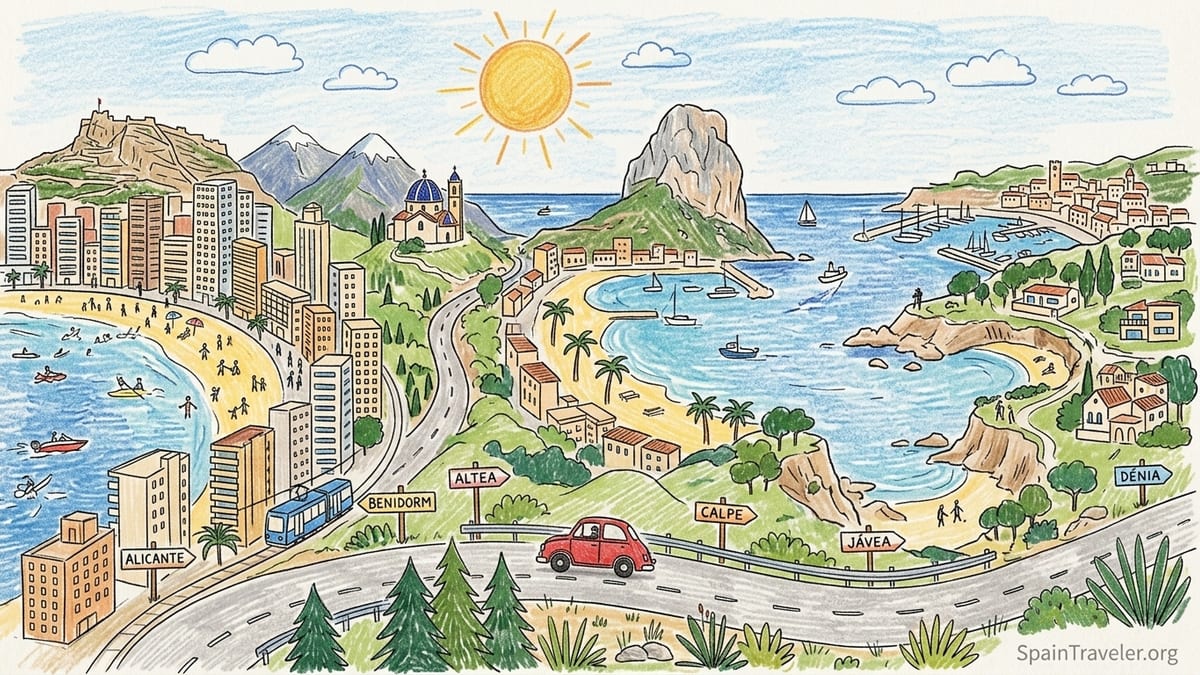
How the Costa Blanca Changes As You Drive North
Arriving at Alicante and driving north along the Costa Blanca feels like travelling through different versions of the Mediterranean. South of Altea the coast is denser and more vertical, with Alicante’s compact city beach giving way to Benidorm’s wall of high-rises around Levante and Poniente. The atmosphere is energetic, extrovert and built up, especially in summer months when package tourism peaks and weekenders from Madrid flood the coast.
Once you pass Altea and continue towards Calpe, Jávea and Dénia, things loosen up. The mountains move closer to the sea, the coastline breaks into coves, and the urban fabric becomes more dispersed. Instead of a single skyline, you get pockets of low-rise apartments, villas in the hills and small centres around marinas or historic old towns. Distances between beaches and supermarkets lengthen, buses thin out and the car suddenly becomes far more useful than it ever feels in central Alicante.
This split underpins most location decisions along the Costa Blanca. Do you want the convenience and infrastructure of a resort city, where you can land at Alicante airport and be on the beach or in a tapas bar within an hour without ever renting a car? Or would you rather spread out in a quieter bay, perhaps trading nightlife and public transport for cliff walks, calmer evenings and that sense that the Mediterranean is something you step into from your own little corner?
On my trips, I have used Alicante and Benidorm when I wanted easy logistics, nightlife and public transport, and turned to Altea, Calpe, Jávea and Dénia when the priority was views, hiking, coves and slower evenings. There is no universal winner, but each base strongly shapes what your Costa Blanca actually feels like from breakfast to midnight.
Alicante: City Beach Living With Car-Free Freedom
Every time I stay in Alicante I am reminded how rare it is to have a proper Mediterranean city built right on a usable sandy beach. Playa del Postiguet sits directly under Santa Bárbara Castle, and if you base around the Explanada de España or the old town (El Barrio) you can leave an apartment and float in the sea in under ten minutes on foot. On one June stay I rented a small place near the Town Hall square and would walk to Postiguet for a swim before breakfast, then stroll back through the narrow streets as delivery vans threaded into the old quarter.
Evenings in Alicante have a layered feel. Late afternoon often starts on Calle Castaños with tardeo, that local tradition of tapas and drinks that begins long before dark. By dusk, the Explanada fills with strolling families and buskers, while in El Barrio the streets around the concatedral and Calle Labradores slowly heat up as bars put out high tables and music spills from doorways. When I stayed in a room on a side street just off El Barrio, I could feel the thump of bass on weekend nights until well after 3 a.m., even in early spring, so light sleepers should either choose streets on the edge of the quarter or base closer to the seafront where the sound softens.
What makes Alicante such an easy base is how little you need a car. The airport bus runs directly into the centre and the seafront, and from Puerta del Mar and Luceros you can pick up the coastal tram that runs north through Playa de San Juan, El Campello, Altea, Calpe and eventually to Dénia. On one October visit I spent a week without renting a car, using the tram for day trips to Altea and Villajoyosa and walking everywhere in town. Parking in the historic centre is limited and garages around the port and Rambla fill on festival nights, so if you are driving, it is often simpler to book accommodation that explicitly includes a space and leave the car parked for most of your stay.
For a first Costa Blanca city stay, especially without children, Alicante is the base I personally choose. It balances real Spanish city life, accessible nightlife, proper restaurants and beach access you can reach in flip-flops. For families, the city still works, but I tend to recommend staying near Postiguet or at the San Juan beach area, where the sand is wider and playgrounds easier, and then using the tram into the centre for an evening paseo. Alicante is also one of the best bases for travellers who want to rely entirely on trains and buses, with long-distance services inland and along the coast joining the local tram lines.
Benidorm: Infrastructure, Nightlife and High-Rise Convenience
Benidorm divides opinion, but as a base it is extraordinarily practical. The two big beaches, Levante and Poniente, curve around a headland with the old town in between, and behind Levante in particular rises that famous forest of high-rise hotels and apartments. When I stayed in a modest aparthotel a couple of streets up from Levante, I could see that infrastructure in action: cleaning trucks working the promenade before 7 a.m., bars opening for English breakfasts, mobility-scooter rental shops and supermarkets stacked with beach gear and picnic food.
Levante is the busy, young and often loud side. At night the strip behind the beach pulses with British bars, karaoke, sports pubs and neon-lit cabaret venues. On one August weekend stay I remember walking down to the front at about 11 p.m. and feeling like half of northern Europe had decided to sing Robbie Williams at the same time. If you want nightlife where you do not need to think about dress codes, where cheap mixers and tribute acts are part of the fun, Benidorm delivers, and the deep accommodation stock means you can find beds at a wide range of prices even at relatively short notice.
Poniente offers a different mood. When I later based myself there, in a small hotel a block back from the beach, the feel changed to slower afternoon walks, older couples on benches and families pushing strollers under the palm trees. The promenade here is broad and more relaxed, and if you walk west you quickly reach sections of beach that feel much less crowded, even in high season. The old town between Levante and Poniente has narrow streets, tapas bars with counters loaded with skewers and croquettes, and smaller Spanish-style bars that feel far from the caricature of Benidorm as only “Little Britain.”
From a practical perspective, Benidorm is one of the easiest car-free bases on this coastline outside Alicante. Long-distance buses serve it directly, many hotels offer airport transfers, and once there you can walk almost everywhere. There are local buses and taxis up to viewpoints and nearby coves, but in three different stays I have never rented a car just for Benidorm itself. Parking can be tight near Levante in high season, so if you drive in, it is often kinder on your nerves to choose accommodation with on-site or reserved parking and forget about moving the car until you leave.
Where Benidorm shines is for travellers who see their Costa Blanca trip as a social, nightlife-heavy holiday or who want all-inclusive convenience with minimal planning. For a friends’ trip or a first-time beach holiday where budget and activity options matter more than old-world charm, I would pick Benidorm over the quieter northern towns. I would not choose it for a couples’ escape seeking silence, but I would happily use it as a base for a no-car week mixing beaches by day and late bars at night.
Altea: Whitewashed Calm Between Tram Line and Sea
Altea is where the Costa Blanca begins to feel undeniably pretty. The old town rises steeply from the coast, a cluster of white houses crowned by a blue-tiled church dome, while the seafront below strings together pebble beaches and a flat promenade lined with cafes. When I stayed here, I split my time between an apartment near the promenade and, on a later trip, a guesthouse halfway up the hill towards the old town square.
Down by the water, life is easy and walkable. I could leave my apartment, cross the tram tracks and be on the promenade in seconds. The beaches here are pebbly rather than sandy, so you feel the stones underfoot as you wade in, but the water is clear and there is usually space even in popular months. Restaurants lean towards seafood, rice dishes and simple grills, with many offering fixed-price menus at lunch that felt slightly cheaper than equivalent meals in central Alicante. Evenings on the promenade are gentle, with families walking, children on scooters and terraces filling gradually rather than erupting at midnight.
Up in the old town, the atmosphere is different again. The climb from the seafront takes about ten minutes, as one local guide warned, and it is genuinely uphill, but once you reach the church square you are rewarded with views over the bay towards Benidorm’s skyline and a web of narrow streets with galleries, small hotels and restaurants. I remember a late September evening where we lingered over a paella with the church dome glowing above us while street musicians played below. It felt Mediterranean and romantic without feeling manicured to the point of unreality.
Altea works well without a car because the coastal tram runs right through it, with stations close to both the promenade and the main access road. I have used Altea as a base with no vehicle, taking the tram south to Benidorm for a day of people-watching and north to Calpe for beach time and climbing the rock. That said, parking is a known constraint around the old town and the seafront, especially on market days and summer evenings, so on a later trip when I did have a car I made a point of using signposted free car parks on the edge of the centre and walking in. For a quieter couples’ trip or a family holiday where nightlife is not the focus, Altea is one of the places I would happily return to again and again.
Calpe: Beach Convenience and Iconic Rock
Calpe feels like a halfway house between Benidorm-style convenience and the more spaced-out northern towns. Two big sandy beaches, Playa Arenal-Bol and Playa de la Fossa, flank the Penyal d’Ifac rock, which dominates almost every view. When I based here, in an apartment building one block back from Arenal-Bol, my days had a simple rhythm: walk under five minutes to the beach, swim or rent a sunbed, then retreat to the promenade for coffee or a menu del día lunch.
The beaches are broad and easy for families, with playgrounds spaced along parts of the promenade and calm water on most summer days. The older town centre, a few streets inland, has more traditional shops, a weekly market and residential life that feels less tourist-specific than the waterfront. At night, both main beaches offer a steady but not overwhelming row of bars and restaurants. I found Calpe’s evenings busier than Altea’s promenade but far quieter than Levante in Benidorm, with more Spanish families and domestic tourists in the mix.
Calpe is also where having or not having a car starts to change your experience more noticeably. The coastal tram does call here, and from my apartment it was a moderate walk up to the station to reach Altea or Benidorm. However, many of the most dramatic viewpoints and smaller coves sit a short drive out of town in residential areas, and the supermarkets with the best parking tend to be clustered along the main approach roads. During a week-long stay with a hire car I appreciated being able to nip out to these coves early, before they filled up, something that would have been slower and less flexible by bus or on foot.
For a family beach holiday where you want big, safe beaches and easy access to restaurants, but where you do not need the full nightlife engine of Benidorm, I often steer people towards Calpe. It offers the comfort of high-rise apartments and plenty of mid-range hotels, with a slightly tamer evening atmosphere. If you enjoy walking, there are signposted routes around the salt lake and up towards the lower slopes of the rock, although access to the most exposed parts of the summit route has at times been controlled for safety, so it is worth checking conditions locally.
Jávea (Xàbia): Dispersed Bays and Villa Country
Jávea, or Xàbia, was the first place on the Costa Blanca where I genuinely felt that I needed a car. The municipality is spread across three main zones: the historic town a few kilometres inland, the port area, and the Arenal beach zone with its semicircle of sand and evening promenade. These are connected by roads and local buses, but not in a way that feels as immediate as stepping out of an apartment in Alicante and wandering everywhere on foot.
On my first stay I took an apartment near Arenal beach. The bay itself is shallow and sandy, very attractive for families with young children, and behind it stretches a wide pedestrian zone lined with bars, ice cream parlours and restaurants ranging from simple burger joints to more polished Mediterranean kitchens. In August, evenings here buzzed until well after midnight but with a family-friendly tone: live music on terraces, kids still out at 11 p.m., and people lingering over cocktails or gin and tonics rather than funneling into clubs.
During that stay I did not have a car, and quickly felt the limits. Walking from Arenal to the port is possible, but it is a fair distance in the heat, and getting up to the old town on the hill by public transport required paying attention to local bus times. Some of the most beautiful coves in Jávea, such as those tucked under the cliffs to the south, were awkward to reach without driving. On a later trip, with a hire car and a small villa in the hills, the town transformed: mornings became drives to quiet coves before breakfast crowds arrived, and evenings meant choosing between dinner in the old town’s narrow streets or a seafront table on the Arenal promenade.
Parking, though, is the flip side of this freedom. In peak season, spaces close to Arenal and the smaller coves fill quickly. I learned to treat the car as a way to hop between zones early or late in the day, then left it parked and walked during the busiest hours. For a quieter couples’ trip outside the busiest school holidays, Jávea is one of my favourite bases because it combines serious coastal scenery with enough restaurant choice to keep evenings interesting. I would hesitate to recommend it for a car-free first trip, but for a repeat visitor who wants to feel they are living in a residential corner of the Costa Blanca rather than a resort strip, it makes a lot of sense.
Dénia: Port Town With Space to Roam
Dénia sits at the northern end of this chain as a working port town with a long ribbon of beaches stretching west and a more rugged coastline under the Montgó massif to the south. When I stayed here, in a small hotel near the historic centre, I was struck by how large and lived-in it felt compared with some of the more obviously tourist-shaped towns further south. Ferries depart for the Balearic Islands from the port, fishing boats still operate, and the central streets host a solid year-round population, not just holiday apartments.
Beach-wise, Dénia offers choice at the cost of some distance. The long Las Marinas area to the northwest has kilometres of mostly sandy shoreline, with sections that feel almost empty outside of August, especially if you drive or bus a little way out of town. To the southeast, the Las Rotas area has rocky coves and clear water that attracts snorkellers and walkers. During a spring visit I used local buses and, on some days, walked further than expected to reach the quieter sections, which confirmed again that while you can do Dénia without a car, having one opens up many more realistic options, particularly if you are carrying beach gear or travelling with children.
Evenings in Dénia’s centre are atmospheric without being frenetic. The streets around the castle and Carrer Marqués de Campo fill with locals out for a paseo, terraces spill into the roadway in good weather, and there is a notable cluster of high-quality restaurants, from simple tapas bars to more ambitious kitchens. Compared with Benidorm, the nightlife is more about lingering dinners and wine than large clubs. On the nights I walked back to my hotel from dinner, the noise level felt closer to a mid-sized provincial Spanish town than a resort, which will appeal strongly to some travellers and feel too quiet for others.
For a coastal road trip, Dénia makes a logical northern anchor. I have used it in exactly that way, driving down to Jávea, Calpe and Altea on successive days while returning each evening to a town that felt like it had its own life beyond tourism. The trade-off is that you rarely step directly from a city-centre accommodation straight onto sand in the way you do in Alicante or Benidorm. If your priority is apartment-to-beach in five minutes in flip-flops, Dénia may frustrate. If you value a sense of living in a real town with access to both sandy and rocky shorelines, it rewards repeat visits.
How I Choose: Matching Bases to Trip Types
After staying in all six bases, I now match each one to trip types rather than asking which is best in some universal way. For a first-ever Costa Blanca visit without a car, Alicante is my top choice. You can land at the airport, take the bus into town, base in or near the old town or Explanada, swim at Postiguet, ride the tram for day trips to Altea or Villajoyosa, and enjoy a nightlife scene that ranges from relaxed wine bars to full club nights around the port, all on foot.
For a classic family beach holiday where sun, sand and pool time matter most, my personal short list is Calpe and Benidorm. Benidorm wins on sheer infrastructure: kids’ menus, water parks, budget-friendly packages, entertainment for all ages and shallow access to the sea on Levante and Poniente. Calpe offers a toned-down version with broad sandy beaches, slightly less intense nightlife and easier escapes by car to quieter corners. In both, you can manage without a car, although in Calpe I find a car handy for supermarket runs and occasional cove visits.
For a quieter couples’ trip, I lean heavily towards Altea or Jávea. Altea works particularly well if you are travelling by tram or train, want to walk most of the time and appreciate evenings of good food and sea views rather than late-night clubs. Jávea, by contrast, shines when you are willing to rent a car and treat the coastline as a string of small experiences: an early swim in a rocky cove, a coffee at the port, a siesta at a villa in the hills, tapas in the old town at dusk and a drink on the Arenal promenade to end the day.
If your main goal is nightlife and social energy, Benidorm remains unmatched along this stretch. The concentration of bars, cabaret venues and late-night clubs near Levante is not to everyone’s taste, but if it is what you are seeking, no other Costa Blanca base replicates it. Alicante offers a more Spanish-flavoured version of nightlife distributed between El Barrio, Calle Castaños and the port, and I often recommend it to travellers who want lively evenings without the all-in resort feel of Benidorm.
For a coastal road trip with several bases, my own pattern is to start in Alicante for a night or two, move up to either Altea or Calpe for beach time and day trips, then finish in Dénia with a more relaxed, town-based few days before either crossing to the Balearics or looping back by road. With a car, that sequence lets you feel the transition from compact city beach to resort skyline, then to whitewashed hill town, cliff-framed bays and finally to the more northern, slightly wilder edge of the Costa Blanca.
The Takeaway
Choosing where to stay on the Costa Blanca is less about finding the one perfect town and more about being honest about how you want your days and nights to feel. Alicante gives you urban energy and car-free convenience wrapped around a city beach. Benidorm layers dense accommodation, deep leisure infrastructure and nightlife into a walkable resort grid. Altea and Calpe soften the pace while keeping beach access easy, each with its own balance of promenade life and views. Jávea and Dénia stretch things out into bays, coves and road trips, where a car increasingly becomes part of the experience rather than a burden.
From my own stays, if you told me you were flying in for your first ever Costa Blanca weekend without a car and wanted a mix of beach, food and nightlife, I would point you to central Alicante. If you were organising a friends’ holiday around sun, budget and staying out late, I would steer you towards Benidorm. For couples, especially outside peak school holidays, I would start the conversation with Altea and Jávea. Families with small children who want sandy beaches and short walks from apartment to sea are likely to feel most at home in Calpe, Benidorm or the beach districts of Alicante.
The good news is that this stretch of coast is comparatively compact. With the tram line running north from Alicante and straightforward driving between all six bases, you rarely lock yourself into a single experience. Even if you pick one place as your main base, it is entirely plausible to sample the others on day trips: tapas in Alicante’s old town one evening, an afternoon walk on Altea’s promenade another day, or a drive up to Dénia’s coves if you have a car. Over time, and with repeat visits, most travellers end up building their own personal map of favourites. Mine is still evolving, but the notes here reflect what it has genuinely felt like to sleep in, wake up in and walk out into each of these Costa Blanca bases.
FAQ
Q1. Which Costa Blanca town is best if I will not rent a car?
Alicante is the most practical base without a car, followed by Benidorm. Both have direct airport or long-distance bus connections, good local buses, and in Alicante’s case, the coastal tram for day trips. You can walk easily between beach, old town and nightlife without needing a vehicle.
Q2. Where should I stay for a family beach holiday with young children?
For sandy, shallow beaches and lots of facilities, Calpe, Benidorm and Alicante’s beach districts work very well. In Calpe and Benidorm you can walk from many apartments straight to broad, lifeguarded beaches, with playgrounds and casual restaurants close by, which simplifies days with children.
Q3. Which base has the liveliest nightlife?
Benidorm has the most concentrated nightlife, especially behind Levante Beach, with rows of bars, pubs and late-night venues packed into a small area. Alicante offers a more Spanish-style mix of tapas bars, cocktail spots and clubs spread between El Barrio, Calle Castaños and the port, but nothing matches Benidorm for sheer density.
Q4. Is it worth staying in Altea if the beaches are pebbly?
Yes, if you value atmosphere over sand softness. Altea’s pebble beaches have clear water and plenty of space, and the real charm lies in the promenade life and the whitewashed old town above. If you need soft sand for children to play on, you might prefer Calpe or Benidorm but many couples and repeat visitors choose Altea precisely for its calmer feel.
Q5. Do I need a car in Jávea (Xàbia)?
Strictly speaking, no, but having a car makes a big difference. The town is spread between the old centre, the port and the Arenal beach, and several of the best coves sit along roads with limited public transport. When I stayed there without a car I could enjoy Arenal and the port, but with a car I was able to reach quieter coves and viewpoints much more easily.
Q6. How difficult is parking in these towns in summer?
Parking tightens considerably in July and August. In Alicante and Benidorm, central garages and hotel car parks often fill at peak times, while in Altea, Calpe, Jávea and Dénia the streets closest to beaches and coves are busy from mid-morning. I try to book accommodation that includes parking when I know I will travel in high season and then walk or use local transport once parked.
Q7. Which base works best as part of a wider Costa Blanca road trip?
For a road trip, I like starting in Alicante, then moving north through either Altea or Calpe and finishing in Dénia. Alicante gives you an easy urban arrival, the middle stop provides classic beach time, and Dénia offers a slightly different, more local-feeling finish with access to both sandy and rocky shores and the option to continue towards Valencia or the Balearic ferries.
Q8. Is Benidorm suitable for travellers who are not interested in nightlife?
It can be, if you choose your area carefully. Staying near Poniente Beach or in the old town gives a calmer experience than basing behind Levante. From there you still benefit from Benidorm’s infrastructure, long promenade and day-trip options, while avoiding most of the late-night noise around the main bar strips.
Q9. If I want an authentic Spanish town feel, which place should I choose?
Dénia and Alicante offer the strongest sense of being in functioning Spanish cities that happen to be on the sea. Both have year-round populations, central markets, local businesses and festivals. Altea and Jávea’s old towns also feel characterful, though they are more clearly shaped by tourism during peak months.
Q10. Can I realistically visit several of these towns on day trips from one base?
Yes. The coastal tram connects Alicante with Benidorm, Altea and Calpe, making day trips straightforward from any of those. With a car, you can comfortably reach Jávea and Dénia in under a couple of hours from the southern bases, which means you can sample different atmospheres even if you only have one primary base booked.