

I have stayed in Benidorm, Altea, Calpe and Jávea on separate trips over the past few years, always with a rental car and usually in self-catering apartments. On paper they all sit on the same Costa Blanca coastline, within about an hour’s drive of each other, yet the day-to-day experience in each was so different that it sometimes felt like visiting four separate countries. This is my personal, on-the-ground comparison of what it was actually like to base myself in each place, from walking Benidorm’s neon beachfront to climbing up through Altea’s old town, looking at Peñón de Ifach over Calpe’s bay and driving the winding roads between Jávea’s coves.
How the Four Bases Felt the Moment I Arrived
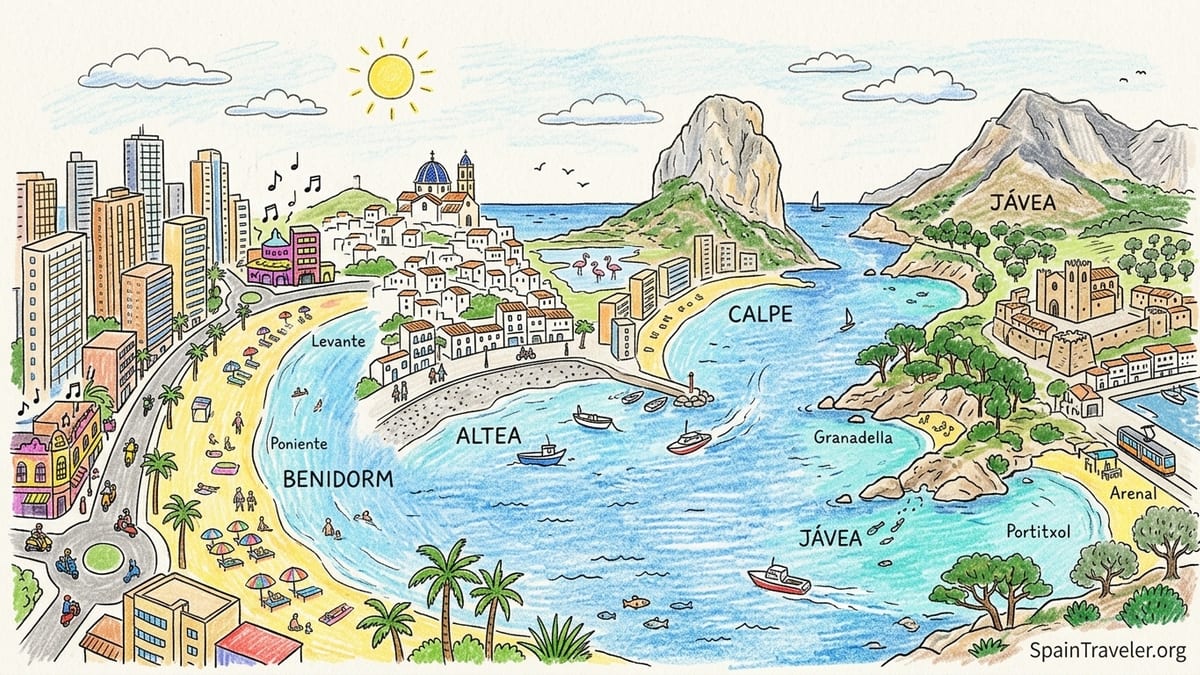
Driving into Benidorm for the first time felt like entering a Mediterranean version of a compact resort city, with high-rise towers lining Levante and Poniente beaches and traffic circling big roundabouts near the seafront. Even before I parked, I could see why Spain’s national tourism board classifies Benidorm as one of the major resort destinations of the Costa Blanca, with large hotels, long urban beaches and dense nightlife all pressed into a relatively small bay. The skyline is the first thing that hits you, then the noise: scooters, bar music, beach clubs testing their speakers long before sunset.
Altea, in contrast, felt like exhaling. Approaching from Benidorm along the coast, the high-rises dropped away and I found a low-rise town climbing quietly up a hill, whitewashed houses shining under the afternoon sun and the blue-domed church of Nuestra Señora del Consuelo marking the top of the old town. The sea promenade is only a few minutes’ walk from the tram stop, and the pace immediately slowed: small hotels instead of giant complexes, people strolling with ice creams, a couple of street musicians rather than competing karaoke bars.
Calpe landed somewhere in between those two. The first sight when you arrive from the south is Peñón de Ifach, the huge limestone rock that sticks out into the sea and has become a nature symbol for this stretch of coast. The town itself spreads around it, with long sandy beaches and a port area where fishing boats still unload in the late afternoon. It is clearly a tourist town, but the tower blocks feel more spread out than Benidorm, and the presence of the rock and salt flats behind gives it a stronger sense of landscape and nature wrapped around the resort strip.
Jávea took me the longest to understand, largely because the town is not concentrated in one zone. There is an inland historic centre, a separate port area and then the Arenal beach strip with its modern bars and apartments. When I first drove in from Dénia, it did not feel like a classic “resort” at all but more like a spread-out coastal municipality tucked between the Montgó massif and the Mediterranean. It was only after a day of driving between coves such as Granadella and Portitxol that I felt I understood why official tourism descriptions highlight this area as part of the more nature-focused Costa Blanca, different in character from Benidorm’s resort density.
Beaches, Coves and Swimming: Sand vs Rock
My swimming days in Benidorm were almost entirely about Levante and Poniente, the two big sandy beaches that curve along the bay. Levante, especially around the central section, felt like the social beach, with sunbed concessions, bars behind the promenade and constant movement from morning walkers to evening joggers. The sand is soft, the entry into the water gradual, and in September I saw lifeguards on duty and plenty of families. Poniente felt a little calmer, especially further west where the promenade becomes more residential, but it is still continuous urban beach, not remote coves.
In Altea my relationship with the sea changed because most of the central beaches are shingle rather than sand. I remember my first swim at Platja de la Roda: clear water, small waves and rounded pebbles that required water shoes if I wanted to move gracefully, but the payoff was visibility for snorkelling just a few metres from the shore. Further along towards Cap Negret and La Olla I found narrower strips of stones and coves that felt more local, with small chiringuitos that served grilled sardines and cold drinks in summer. The beaches were less comfortable for sandcastle-building but better for quiet swims and long shoreline walks.
Calpe is where I felt the Costa Blanca poster images come to life. Playa de la Fossa, with the Peñón de Ifach on one side, and Arenal-Bol on the other bay, are long sandy beaches that blend resort convenience with views of dramatic rock and shifting light. My days there often looked the same: a morning coffee on the promenade, a swim in relatively calm water, then a slow walk to the fishing port to watch the boats come in. The sand quality and gentle slope into the sea made it easy for families, yet I could walk fifteen minutes and be on a rocky outcrop near Cala Calalga where locals entered the water with snorkels and paddle boards.
Jávea is where beaches turn into an exercise in choice. Arenal is the only true sandy stretch, with shallow water that suited the families and paddleboard rentals lining the promenade. But my most memorable swims were in the rocky coves: Granadella, Barraca / Portitxol and smaller calas reachable only by skinny local roads. One August morning I drove before 9 a.m. towards Granadella and still ended up in a slow queue of cars for the last few parking spots, which tells you how popular these coves have become. Once in the water, though, it was easy to see why. The clarity was better than any urban beach I had swum from that week, with fish visible around scattered rocks, and the surrounding cliffs made the cove feel enclosed and wild despite the crowd behind the sunbeds.
Old-Town Atmosphere and Evening Walks
In Benidorm, my evening walks split between the extravagant energy of Levante and the more traditional feel of the old town on the hill between Levante and Poniente. One night I walked from the busy English-style bars on Calle Gerona down to the Balcón del Mediterráneo, where white balustrades and a small square look out over the sea. The contrast within fifteen minutes on foot was striking: neon and tribute bands fading into families eating ice cream, local couples sitting on benches and a few traditional tapas bars tucked into side streets. The old town there is compact, slightly tourist-tacky in places, but it does give a sense that Benidorm is not only about high-rise hotel strips.
Altea’s old town is a different world altogether. My memories of evenings there always involve climbing. I would park near the lower part of town and then start zigzagging up narrow cobbled streets, passing small studios displaying local art and restaurants that had hidden terraces overlooking the bay. By the time I reached the church square at the top, the light would be fading, the blue-and-white dome glowing softly, and musicians setting up under the trees. It felt very much like the archetypal Mediterranean hill town, and it attracted a different crowd: more couples, small groups of friends, families with older children wandering between restaurants rather than groups intent on late-night bar crawls.
Calpe’s historic centre sits slightly behind the seafront, and on my first visit I almost missed it, so focused was I on the promenade and the rock. When I finally followed signs uphill from the main avenue, I found a compact maze of streets with coloured flags, mural art, and old stone steps. It is calmer than Benidorm’s old quarter and less dramatic than Altea’s climb, but it gave me somewhere to escape the beach strip when I wanted a slower-paced evening. I often combined a late-afternoon swim at La Fossa, a walk along the salt flats to watch flamingos, and then a drive or walk into the old town for dinner on a terrace.
Jávea’s old town is inland and not naturally on the path if you are based near the beach, which means it retains a more local feel. On one June evening I parked on the edge and wandered into streets with stone houses, a covered market and the fortified church of San Bartolomé. The atmosphere was more “small Spanish town that happens to be near the sea” than classic resort. I noticed far fewer souvenir shops and more daily-life services, plus bars where locals watched football on television while visitors like me picked at plates of grilled octopus.
Accommodation, Parking and How Dependent You Feel on a Car
Accommodation in Benidorm is dominated by hotels and apartment towers, and that shaped my experience. I stayed once in a mid-range hotel a few blocks back from Levante beach that offered full-board and half-board options targeted at package holidays. The advantage was clear: I could ditch the car for days, as supermarkets, bars, the beach and bus stops sat within a ten-minute walk. The downside appeared each evening when I tried to park after a day trip outside town. On-street parking near the centre was either pay-and-display or simply full, so I learned to book places with on-site parking or to leave the car in a paid public garage and treat it as a sunk cost for that part of the trip.
In Altea I deliberately chose a small apartment at the lower edge of the old town, accepting that I would walk up to the historic centre at night to avoid trying to drive those narrow streets. Street parking in the newer seafront grid was easier than in Benidorm, especially outside peak weekends, but the trade-off was that public transport is more limited. There is a coastal tram that links Altea with Benidorm and Dénia, and I used it one day to avoid taking the car south, but within Altea itself daily life felt walkable: beach, supermarkets, cafes and evening strolls were all within ten to fifteen minutes on foot.
Calpe presented a mixed picture. Along the main beaches there are many apartment buildings that cater to self-catering stays, and I stayed in one overlooking Arenal-Bol with underground parking included. That made a big difference because I could return from drives without circling for space, then do everything locally on foot. The town is quite linear, so walking from my apartment to the far end of La Fossa or to the port rarely took more than half an hour, but if you want to explore hilltop viewpoints or small out-of-town coves, a car remains practically essential.
Jávea is where car dependence really shaped my stay. Basing myself in an apartment near Arenal beach gave me an easy, walkable strip of restaurants and a safe sandy beach for morning swims, but the historic centre, the port and most of the famous coves required driving. In high season there are sometimes local shuttle arrangements or parking controls for popular spots like Granadella, and on one occasion I had to park further away and walk down. That did not spoil the experience, but it meant planning: leaving early to secure a space, accepting that you might not be able to “pop over” to another cove spontaneously at midday.
Nightlife, Restaurants and the Feel After Dark
Benidorm’s nightlife reputation is well known, and from my stays it is also accurate, at least along certain streets of the Levante side. One Friday night I walked past a stretch of bars showing Premier League football, karaoke venues and stag and hen parties in themed outfits, all within a few busy blocks. It felt like a compact entertainment district specifically built around late nights and cheap drinks. However, I also found a different evening atmosphere in the old town, with traditional tapas bars around Calle Santo Domingo and small family-run places where the menu leaned towards grilled fish, rice dishes and simple house wine. The key in Benidorm was choosing the neighbourhood that matched my mood.
Altea in the evening leaned heavily towards restaurants rather than bars. In the old town I remember menus that highlighted seafood paella, arroz a banda and fideuà, often at prices that reflected the setting but were still reasonable compared with big-city Spain. On the seafront promenade there were pizza places and informal tapas terraces where a couple could share a few plates and drinks without breaking the budget. The nightlife was more about lingering over dessert and coffee than dancing until dawn. After midnight, many streets felt quiet enough that you could hear your own footsteps echo on the cobbles.
Calpe offered a middle ground again. Around the port there were straightforward seafood restaurants advertising the catch of the day brought in by the local fishing fleet. On one late afternoon I joined the small crowd watching the boats unload and then chose a simple restaurant where they served fried fish and seafood platters at shared outdoor tables. Later, near La Fossa and Arenal-Bol, there were bars with live music or football on screens, but the overall scale of nightlife felt more compact than Benidorm. It is very possible to have a low-key evening of ice cream and a promenade walk without feeling pulled into louder zones.
Jávea surprised me with how varied the dining scene was within a relatively spread-out area. At Arenal, the front line is packed with contemporary restaurants offering everything from burgers and sushi to modern Mediterranean small plates, with people dressed for “holiday smart casual” rather than beach wear. In the port, there are more traditional bars and cafes facing the marina. Inland in the old town, I ate in a tiny restaurant housed in a stone building where the focus was on local rice dishes and market-driven tapas. Nightlife here felt less about mass tourism and more about a blend of visitors and residents, with evenings stretching late but rarely reaching the intensity or volume of Benidorm’s club streets.
Driving Between the Towns and Exploring the Coast
One of the advantages of staying in this part of the Costa Blanca is that it is genuinely easy to combine the four towns on a single trip, especially with a rental car. Official regional itineraries even suggest road trip routes that link Dénia, Jávea, Calpe and Altea as relaxed Mediterranean stops focused on sea and nature, while Benidorm appears as the big resort further south. On my own trips I often treated them the same way: a week or ten days based in one town, with day excursions to the others.
The drive from Benidorm to Altea, for example, felt almost comically short given how different the towns are. Within about twenty minutes, the skyline gave way to low-rise white houses and a quieter bay. Calpe, further north, took me roughly forty minutes from Benidorm by car along the coast, longer if I stopped at viewpoints. The first time I saw Peñón de Ifach from a distance, rising above Calpe’s bay, it became an immediate orientation point. Later, when I climbed a short portion of the path into the natural park, I could look back south and make out Benidorm’s skyscrapers as a cluster on the horizon, underlining how geographically close yet experientially separate these places are.
Driving between Jávea’s coves demanded more concentration. The roads down to Granadella or between Arenal and Portitxol are narrow and twist through residential areas and pine forest. On one occasion Google Maps estimated fifteen minutes for a journey that took nearly half an hour because of summer traffic and cautious driving on tight bends. The reward was arriving early enough to claim a spot by the water and snorkel in bays framed by cliffs and pines. Those drives, and the contrasting simplicity of just stepping out of a hotel and onto the sand in Benidorm, are what made me think carefully about what kind of stay I wanted each time.
Public transport does exist as an alternative. The coastal tram connects Benidorm, Altea and beyond, and I once left the car parked in Altea and used the tram to reach Benidorm for a day, avoiding parking headaches there. However, for Calpe and especially for exploring Jávea’s coves, I found a car close to essential. Without one, your experience would likely focus on the main central beaches and town centres, which are still enjoyable but give you a narrower angle on what each place can offer.
Which Base I Personally Prefer for Different Trip Styles
People often ask which of the four is “best,” but after staying in all of them I do not think there is a universal winner. Instead, each one fit a different version of the trip I wanted. When I travelled with friends who valued nightlife choices, urban beaches and did not want to drive every day, Benidorm worked. We booked an apartment with access to a pool a few streets back from Levante, accepted that it would be busy, and enjoyed the fact that we could step out to bars, live music and late-opening supermarkets without planning anything.
For quieter, more atmospheric long weekends where evenings were more about food and views than dancing, I gravitated to Altea. Climbing the old town at sunset, eating dinner on terraces that overlooked the bay and then walking down to a pebble beach the next morning suited trips when I wanted a slower rhythm. It also worked well as a base to explore inland mountain villages and nearby coves by car, returning each evening to a town that felt lived-in but not frenetic.
Calpe became my choice when I wanted something between those two: the ease of sandy beaches right in town, family-friendly promenades, a recognisable resort structure, but with a strong sense of natural setting thanks to Peñón de Ifach and the salt flats. I would recommend it to families or mixed-age groups who want a classic beach holiday with the option of simple nature walks, boat trips from the port and solid local services without quite the same intensity of Benidorm’s party reputation.
Jávea, on the other hand, is where I would base myself for a trip built around coves, snorkelling and a feeling of being surrounded by headlands and cliffs rather than one long continuous beach. It suited me best when I was happy to drive most days, to wake up early to secure parking at coves, and to split time between the sandy comfort of Arenal and the rocky drama of Granadella or Portitxol. Friends who visited with young children and no car found it more fragmented, but for me, with a vehicle and the desire to explore, it felt like the most “coastline-focused” of the four.
The Takeaway
Staying in Benidorm, Altea, Calpe and Jávea showed me that the Costa Blanca is not a single, uniform strip of resorts but a sequence of very different ways to live by the Mediterranean for a week. Official tourism material is right to present Benidorm as a major resort destination and to highlight Altea, Calpe, Jávea and nearby Dénia as more relaxed Mediterranean towns closely tied to nature and the sea, yet even within that broad framing, the day-to-day experience of walking to the beach, parking your car, choosing dinner and going for an evening stroll can feel radically different.
If you picture yourself walking out of a high-rise hotel into a lively urban beach scene, eating in international restaurants and having nightlife choices within a few blocks, then Benidorm will probably fit. If your mental image leans more towards climbing cobbled streets to a whitewashed church, looking back over a bay of small fishing boats and pebble beaches, Altea may resonate. For a compromise between resort convenience and a dramatic natural symbol, Calpe offers sandy family beaches with the Peñón de Ifach as a constant backdrop. And if your perfect Costa Blanca day involves driving before breakfast to a rocky cove to swim in clear water under cliffs, Jávea might feel like your natural base.
On my own trips, I have returned most often to Altea and Jávea when I wanted slower, more nature-linked stays, and to Benidorm or Calpe when travelling with friends or family members who preferred simple logistics and urban beaches. Rather than looking for one “best” town, I now think of them as a toolkit. The right base is the one whose daily rhythm matches the kind of Costa Blanca story you want to tell when you come home.
FAQ
Q1. Is it realistic to visit all four towns in one Costa Blanca trip?
Yes, with a rental car it is realistic to visit Benidorm, Altea, Calpe and Jávea on a single trip of a week or more, using one as a main base and the others as day trips. Driving times between neighbouring towns are usually under an hour, although summer traffic can slow you down near popular coves.
Q2. Which town felt best if I do not plan to rent a car?
From my experience, Benidorm worked best without a car because accommodation, beaches, supermarkets and nightlife were all within walking distance, and there were frequent buses and trams to nearby resorts. Altea can also function without a car if you are content with the seafront and old town and occasionally use the coastal tram.
Q3. Where did I find the calmest atmosphere in the evening?
Altea and Jávea’s old town both felt calmer in the evenings compared with Benidorm’s Levante area. In Altea, nights revolved around restaurant terraces and quiet cobbled streets, while Jávea’s inland centre had more of a small-town local feel, with people dining outdoors but far less loud bar music.
Q4. Which base suited family travel in my experience?
For families who value easy sandy beaches and straightforward facilities, I found Calpe and Benidorm the most convenient. Calpe’s Arenal-Bol and La Fossa beaches had gentle entries into the water and family-friendly promenades, while Benidorm offered urban beaches with lifeguards and many accommodation options close to the sand.
Q5. How different did the beaches feel between the four towns?
Benidorm’s Levante and Poniente are long urban sandy beaches backed by towers and promenades. Altea’s central beaches are mostly pebbly with very clear water. Calpe combines wide sandy bays with views of Peñón de Ifach and nearby rocky corners for snorkelling. Jávea mixes one main sandy beach at Arenal with multiple rocky coves that require short drives and, in high season, early starts to find parking.
Q6. Was parking a major problem in any of the towns?
Parking near Benidorm’s central seafront was the most challenging, especially in summer evenings, so I relied on paid garages or accommodation with parking. In Altea and Calpe, I usually found spaces a few streets back from the sea. Around Jávea’s coves such as Granadella, parking was limited and filled early in peak season, which pushed me to arrive in the morning.
Q7. Which place did I prefer for nightlife?
For dense, varied nightlife with many bars and live music options in a small area, Benidorm was my clear choice, particularly around the Levante side. If I wanted more relaxed nights focused on dinner and a drink with a view, I preferred Altea’s old town or the waterfront and mixed-scene bars along Jávea’s Arenal.
Q8. How did prices compare between the four towns during my stays?
Within similar standards of accommodation and restaurant quality, I did not experience extreme price gaps. Benidorm sometimes offered good value in package-oriented hotels and drink deals in bar zones. Altea and Jávea, particularly in atmospheric old-town locations or seafront spots, could be slightly pricier for dinner, though still reasonable compared with major European cities.
Q9. Which base worked best when I wanted to focus on nature and hiking?
For nature and hiking, I personally preferred staying in Jávea or Calpe. Jávea gave me easy access by car to coves and nearby headlands, while Calpe allowed me to explore the Peñón de Ifach natural park and short coastal paths, as well as day trips to surrounding mountains, before returning to a beachside apartment.
Q10. If I prioritise old-town charm over beaches, where would I stay?
Altea would be my first choice purely for old-town charm, thanks to its hilltop church square, whitewashed streets and views over the bay. Jávea’s inland old town would be my second pick for a more local, less overtly tourist-focused atmosphere, with the understanding that I would drive to the beach instead of walking.