


The Costa Blanca is often reduced to one neat line in brochures: more than 3,000 hours of sun each year and an average temperature of around 18°C. That is broadly true, and it explains why Benidorm and Alicante have grown into year-round destinations. But as a traveler, what matters far more is how the Costa Blanca actually feels in different seasons: the sting of August heat on Poniente Beach, the cool bite of the sea in April in Alicante, the empty parking bays in October outside Calpe, or the warm, still evenings on the promenade in Jávea. Over several trips spread between late spring, high summer and early autumn, I have come to trust my own skin more than the averages. This guide is built around what those trips really felt like, with researched guidance clearly signposted where I have not yet been in person, so you can pick the moment that fits the kind of Costa Blanca you want to meet.
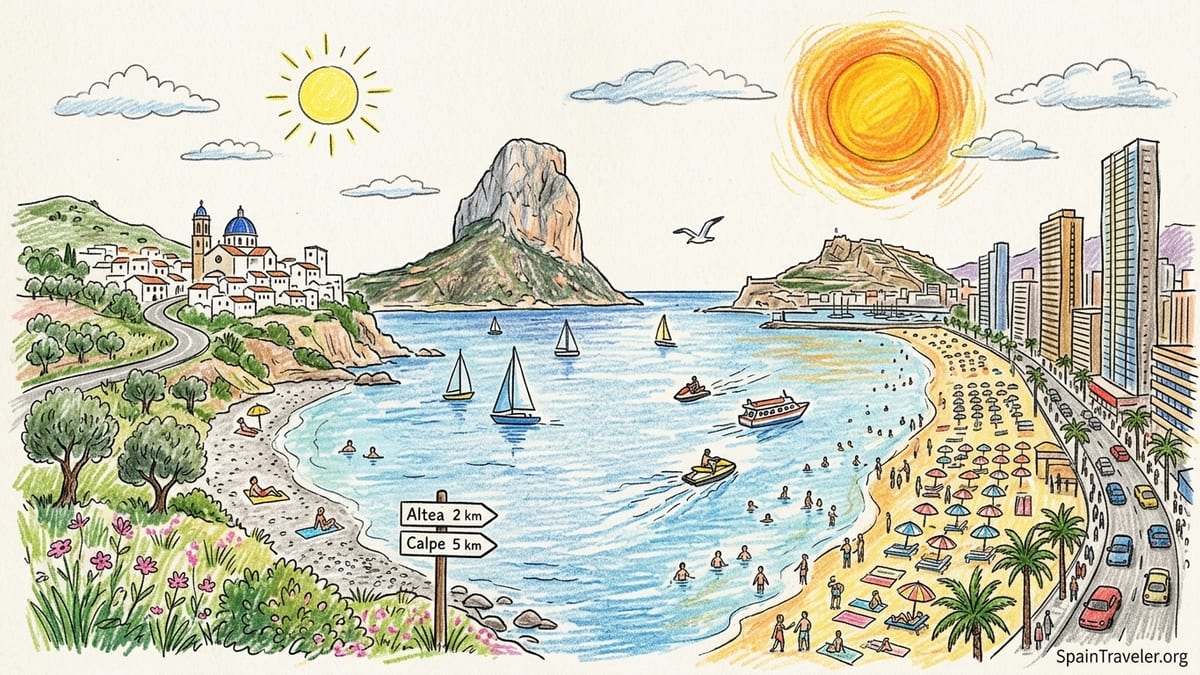
How the Costa Blanca Climate Really Behaves
Spain’s official tourism information often highlights that the wider Valencia region, including the Costa Blanca, enjoys more than 3,000 hours of sunshine a year and an annual average around 18°C. Local tourism boards and climate summaries echo that, and historical records from Benidorm and Alicante show mild winters and hot, very dry summers. In practical terms this means there is no true “off-season” in the way northern beaches shut down, but the lived experience from month to month still varies a lot more than a single average suggests.
Across several trips I have made between April and early June, and again in September and early October, the constant has been light. Even on days with passing cloud, the brightness is strong enough that you will feel it on bare skin within minutes. In late spring and early autumn, daytime temperatures I recorded on my phone’s weather app hovered mostly between 21 and 27°C along the coast, which matched well with the published monthly averages for places like Benidorm and Alicante that show mid 20s by May and again in September. Inland, even a short drive toward the hills behind Calpe or Jávea, the car’s thermometer regularly climbed three or four degrees higher in the afternoon.
Heat and wind are the other two constants that shape how the Costa Blanca feels. When the air is still, even 26°C in May can feel hot on the long, exposed promenades, because there is little shade away from buildings. On blustery days, especially in April and early October, I have needed a light jacket in the evening in coastal towns, even when the official temperature was still around 20°C. Local sea temperature data for Benidorm and Alicante shows a typical rise from about 14 to 16°C in March to 20 to 23°C by June, then peaking around 26°C in August before slowly falling again through autumn, and in my experience that curve closely matches when my body moved from “bracing but manageable” to “effortlessly comfortable” in the water.
The sea plays a bigger role than you might expect. In late spring and early autumn the Mediterranean acts as a giant thermal buffer, keeping nights mild and lending a damp softness to the air without tipping into full summer humidity. In August, when sea surface readings in Benidorm have recently touched the mid 20s Celsius, the combination of bath-warm water, strong sun and barely any wind can make the feeling on the sand much more intense than the forecast number alone.
High Summer in Benidorm and Alicante: Heat, Crowds and Nightlife
My first peak-summer visit was to Benidorm in early August, and it left a vivid physical memory. Mid-afternoon readings on the promenade boards showed 32 to 34°C on several days, which lines up with recent climate summaries that place Benidorm’s average August highs around 30 to 31°C, with heat spikes higher. One day, when I walked from the old town across to Levante Beach around 3 p.m., the air felt heavy and slightly hazy, and the building facades radiated stored heat. There was barely a hint of wind between the towers. On Poniente Beach, the shallow bay water felt like a warm bath, much closer to 26°C than to anything “refreshing”. You could enter without a wince, but you never cooled fully down.
The crowds added to that sense of intensity. Recent hotel occupancy figures for Benidorm in August have been reported in the local Spanish press at more than 90 percent, and it shows on the sand and the streets. In my August stay, by 10 in the morning Levante Beach was already patterned with lines of umbrellas and rented loungers, and by late morning it felt genuinely hard to claim a large free patch of sand near the waterline. Umbrella vendors threaded between towels, and loudspeakers from beach bars blended into a constant soundtrack. On the Avenida del Mediterráneo and Avenida Europa, restaurant terraces were bustling even at what would elsewhere be off hours, and getting an outdoor table at a popular tapas bar without a reservation between 9 and 10:30 p.m. meant either arriving unfashionably early or waiting.
Alicante in late July, on a different trip, felt marginally less compressed but still very busy. The walk from the marina to Playa del Postiguet at 5 p.m. was like stepping into an evening market, with families, couples and cruise-ship day trippers all funneling toward the sand. The air temperature sat in the low 30s and there was almost no shade along the beach road. Postiguet itself was crowded, though not to the degree of Benidorm at its tightest. Swimming was easy and comfortable; the sea felt in the low to mid 20s, well within the published summer sea temperature range for Alicante. But the still water and lack of breeze made the beach noticeably hotter than nearby, breezier coves further north that I reached later by tram.
Parking in both Benidorm and central Alicante in high summer is the clearest sign of how stretched the destinations become. In Benidorm, I had pre-booked underground hotel parking, and I was glad of it. On evenings when I drove out for dinner away from the beachfront and returned after 11 p.m., I saw cars circling the blocks around Calle Gerona and the old town, waiting for any space to open. In Alicante, around the marina and old quarter, I abandoned the idea of free street parking after my first attempt and relied instead on the paid underground lots near the port. Prices varied by operator, but in several cases the hourly rate I paid in 2025 was in the two to three euro range, which built up quickly on long beach days.
Spring on the Costa Blanca: My April and May Stays
Spring is when the Costa Blanca feels like it belongs most fully to locals again, and that is why I keep returning then. My first spring trip began in Alicante in late April. Daytimes ranged from 20 to 24°C, with plenty of sun and only the odd shower. On the promenade above Postiguet Beach, short sleeves were comfortable by late morning, and many locals were already relaxing on the sand. In the water, though, my experience matched what sea temperature records suggest for this time of year: around 16 to 18°C. I could swim for 10 or 15 minutes without discomfort, but the first immersion drew a full-body shiver. Most swimmers I saw were either children or northern Europeans. Many Spaniards stayed ankle deep or simply sunbathed.
Evenings in Alicante in April cooled quite fast once the sun slid behind Castillo de Santa Bárbara. On calm nights, having dinner outside in the old town in a light sweater felt pleasant at about 16 to 18°C. On windier nights, especially when gusts funneled through the narrower alleys, I was glad of a thin jacket. Restaurants in the Santa Cruz and old quarter were lively on Friday and Saturday but rarely full mid-week. I could usually walk into a bodega-style tapas bar at 9 p.m. without a reservation, and only one small place near the central market turned me away with a smile and a suggestion to come back the following night.
On a later May trip, I based myself in a rental apartment near Altea and used a hire car to explore Calpe and Jávea. This is where spring really shines. Roads were busy enough to feel safe but free of the long holiday-weekend tailbacks I have seen in August near Benidorm. Driving the coastal N-332 up toward Calpe in mid-morning, traffic flowed steadily but I never crawled. Parking near Altea’s old town was manageable. In the beachfront lot below the whitewashed upper streets, I could still find a space after 10 a.m., and the pay-and-display machine charged in the modest single euros for several hours, noticeably less than I later paid in July.
Walking around Altea’s steep cobbled lanes in May felt warm but never oppressive. Under direct sun, particularly around midday, the white facades reflected light, and it was a relief to duck into shady alleys, but air temperatures still sat mostly between 22 and 26°C. In Calpe, the long curve of Playa de la Fossa already had a fair scattering of towels and parasols by late morning, yet there was still generous empty sand between groups. Restaurants on the frontline promenade were open and keen for business, with menu del día boards advertising lunch menus in the mid-teens of euros, and staff often inviting passers-by to sit. I did not need a reservation anywhere at lunchtime and only once was told to wait ten minutes for a waterfront table.
Autumn Road Trips and Evenings: My September and October Visits
Autumn is my favorite time on the Costa Blanca, particularly from mid-September into early October. On my last early-autumn visit I picked up a rental car from Alicante Airport and headed straight north. Daytime temperatures were a near-ideal 25 to 28°C for most of the week, with a couple of hotter spikes inland, and sea temperatures still felt close to their summer peak, around 23 to 24°C in shallow bays according to both my own impression and what local sea temperature charts show for September.
In Jávea, late September afternoons at Playa del Arenal had a soft, relaxed rhythm. This wide, sandy bay can feel very busy in August according to both locals and tourism studies that track beach attendance, but by the time I visited, the beach was comfortably populated rather than crowded. Families with school-age children had thinned out and were replaced by older couples and small groups of friends. I could arrive around 11 a.m., rent a pair of loungers and an umbrella without advance booking and still have wide sea views with only a handful of neighbors within earshot. The sea itself was near-perfect for swimming. Stepping in felt neither shocking nor lukewarm, and I could stay in the water for half an hour without any chill creeping in.
Driving in autumn is a joy. On a loop from Altea to Calpe and up toward the Mirador del Cap de Sant Antoni near Jávea, I found the coastal roads clear enough that I could stop at viewpoints without stress. Lay-bys that I remembered as jammed in August had several empty spaces. In Calpe, parking near the Peñón de Ifach natural park in late afternoon was still competitive but not desperate; I secured a spot in a public lot a short walk from the trailhead without circling more than once. Inland, on smaller roads toward the Jalón Valley, there were long stretches where I saw few other cars at all, which made spontaneous photo stops easy.
Evenings in September on the Costa Blanca coast are close to ideal for outdoor dining. Temperatures at 9 or 10 p.m. in Altea and Jávea hovered in the low to mid 20s. I often wore just a light shirt with no extra layer, and only one breezy evening in early October did I pull on a cardigan while sitting on a terrace directly facing the water. Restaurant demand sat in a sweet spot: enough people to give a buzz, not so many that dinner turned into a logistical puzzle. In Jávea’s Arenal area, I booked ahead for one especially in-demand restaurant on a Saturday, but on weekdays in September I could usually secure a table on the seafront with just a short wait, even arriving close to 9 p.m.
Sea Temperature, Swimming Comfort and Wind by Season
Although official charts for Benidorm and Alicante present neat monthly sea temperature averages, your body does not experience an average, it experiences a moment. On my spring trips, the sea shifted from bracing in April to reasonable by late May. At Postiguet Beach in Alicante in late April, a short plunge felt like around 16 or 17°C. I could swim vigorously for a while but emerged with pink, goose-bumped skin. By mid to late May in Altea and Calpe, getting into the water still evoked a sharp breath in, but within a minute or two my body adjusted and I could float comfortably. That matches published figures that nudge toward 19 or 20°C by May for this stretch of coast.
In mid-summer Benidorm, by contrast, the sea felt closer to a tepid pool. Sea temperature measurements for August in Benidorm show typical peaks around 26°C and recent daily readings have even pushed slightly beyond that. This matched my August swim: no jolt of cool at all, just a gentle, enveloping warmth that actually felt less refreshing after a while than the brief breeze you caught when you emerged. If you love long, lazy floats this is bliss, but if your idea of a swim involves cooling down after sunbathing, you may find it less satisfying than a shoulder-season dip.
By late September and early October, sea temperatures ease down but remain thoroughly swimmable. In Jávea and Altea at this time I was happy in the water for extended periods. Based on long-term data for the Costa Blanca, this is typically the period when the sea sits around the low 20s Celsius, and my experience matched that. Swimming in early October at Calpe’s Playa del Arenal-Bol, under a hazy afternoon sky, felt similar to an indoor pool kept just a touch cooler than body temperature: invigorating as you entered, but never cold.
Wind is the wild card that shapes how all of this feels. In April and early May I encountered several days where a steady onshore breeze around 20 to 25 km/h turned a 22°C forecast into something that demanded a light jacket if you stayed still. On Benidorm’s high-rise front in August, though, the concrete canyons blocked much of the sea breeze, trapping heat in the streets. Out on the open, slightly more exposed headlands around Calpe and Jávea, even minimal airflow took the edge off the heat and made cliff-top walks possible in the early morning and again toward sunset in both spring and autumn.
Beach Crowds, Restaurant Demand and Parking in Different Months
Beyond the thermometer, what will most shape your day is how many other people want to be in the same place at the same time. Benidorm’s role as one of Spain’s busiest beach destinations means its high season is very high indeed. Recent figures from the local hotel association have reported August occupancy above 90 percent, and when I walked Poniente and Levante beaches during my own early August stay, those numbers felt entirely plausible. Sunbed concessions were close to full by late morning, queues formed at beach showers, and the promenade was a slow-flowing river of people well into the night.
Alicante’s urban beach, Postiguet, sees a different pattern. My late April visit showed how locals reclaim the sand before the full summer influx. There were plenty of people, especially on sunny weekends, but large open patches remained between groups, and lifeguard posts were staffed without feeling under pressure. In July, during a separate short stopover, the atmosphere changed: while not as densely packed as Benidorm, the combination of residents, domestic holidaymakers and visiting cruise passengers noticeably compressed space on the sand in the afternoon, and food stands along the paseo had visible lines.
In smaller towns such as Altea, Calpe and Jávea, spring and autumn are the clear sweet spots for both beaches and services based on my trips. In May in Altea, I could still stroll onto the pebble beach with a rented lounger available mid-morning, and even in late September in Jávea there was choice. Beach bars were open and well staffed, but rarely oversubscribed. Parking mirrored this. In May and again in late September I usually found a space within one or two passes of my target street, even close to promenades. In contrast, on an August afternoon excursion to Jávea, every bay near Arenal and the old port seemed full, and I ended up leaving the car on a residential backstreet and walking 15 minutes to the seafront.
Restaurant demand tracks these patterns. Benidorm in August was the only place on the Costa Blanca where I genuinely struggled to eat where I wanted without forward planning. Popular seafront restaurants were booking out prime times a day or more in advance, and even mid-range international spots along main streets often had waitlists at peak hours. In Altea in May or Jávea in September, I could usually trust my nose and choose spontaneously, with only the most talked-about places truly needing a booking. This balance between availability and atmosphere is one of the strongest arguments for avoiding deep high season if your dates are flexible.
Spring vs Autumn for Road Trips and Walking
Both spring and autumn work well for road trips and walking, but after several trials I would lean slightly toward autumn. Spring on the Costa Blanca, especially April, brings a fresh green to the hills and an energy to towns as terraces reopen and locals spend more time outdoors. On my April and May visits, day trips from Alicante up the coast felt simple. Roads like the N-332 and AP-7 carried steady traffic but never reached the kind of saturation you see in August, and parking near hilltop old towns such as Altea’s was still readily available by mid-morning. Walking circuits, for example around the base of the Peñón de Ifach in Calpe or along the promenade in Villajoyosa, were busy with dog walkers and joggers rather than tour groups.
Spring is also when inland excursions around the Costa Blanca, for example into the Guadalest Valley or up into the limestone ridges that climbers favor, benefit from slightly cooler air. Guidebooks aimed at outdoor enthusiasts often single out November to April as the prime climbing season on this coast, with May already becoming warm enough that climbers seek shade. When I hiked in late April on a short route above Calpe, the combination of mid-20s temperatures and an onshore breeze felt close to perfect as long as I stayed in motion, though standing in direct sun for long photo stops quickly grew hot.
Autumn, though, adds maturity and calm. On a September loop that took me from Altea through Calpe and up to Jávea and back, the hills above the sea glowed in softer, slightly dusty light. The worst of summer’s heat spikes had gone, and my car’s dashboard spent most of the day around 27°C on the coast, dipping a degree or two higher inland mid-afternoon. Crucially, the sea was warmer than in spring, so I could cap walks with genuinely comfortable swims. After a late afternoon stroll around Jávea’s port area, for example, I slipped into the water at a small cove and floated for a long time without any chill.
Traffic in autumn felt marginally lighter than in May on the key tourist axes, and the traveler mix shifted. I met more retired northern Europeans on longer stays and fewer large family groups. On a weekday in late September, the usually popular viewpoints near Cap Negret and the miradores north of Calpe had plenty of room to pull over for photos. Walking through Altea’s old quarter after dinner, I heard more low conversations than loud groups, and the overall tempo had slowed. If you value long walks through coastal towns and relaxed, reflective evenings on terraces as much as beach time, early autumn has a slight edge over spring.
The Takeaway
Deciding when to visit the Costa Blanca is less about finding a single “best” month and more about matching your own heat tolerance and crowd preference to what the coast actually feels like at different times of year. My skin, notebook and memory all agree on a rough framework. High summer in Benidorm and Alicante delivers huge energy and textbook Mediterranean scenes, but also punishing mid-afternoon heat, bath-warm water and intense pressure on beaches, restaurants and parking. Spring, especially late April and May, brings bright, mostly reliable sun, cooler but manageable sea temperatures and a friendlier balance between locals and visitors, which works beautifully for city breaks and gentle beach days.
Autumn, particularly from mid-September into early October, edges ahead for me. On my trips then, I found sea temperatures still high enough for easy, extended swims, daytime air warmth that made driving and walking comfortable, and a calmer mood in towns such as Altea, Calpe and Jávea. Roads were clearer, restaurant terraces busy but not frantic, and parking rarely a drama. Behind all this lies the Costa Blanca’s generous baseline of sun and mildness mentioned in official statistics, but those averages are only the starting point. If you want the region at full volume and do not mind heat or crowds, aim for August. If you want to explore, eat outside, swim without shivering and still feel you are in a lived-in, local place, then spring or, better yet, early autumn may be your best bet.
FAQ
Q1. Is August too hot to visit Benidorm or Alicante?
In August, daytime highs in Benidorm and Alicante typically reach around 30°C or slightly above, and on my visit the promenade thermometers showed 32 to 34°C in mid-afternoon. Combined with high hotel occupancy and very busy beaches, it can feel intense if you are sensitive to heat or crowds, though sea and pool swimming are very easy.
Q2. When is the sea warm enough for comfortable swimming?
From my own trips, the water starts to feel reasonably comfortable from late May, when it reaches the high teens Celsius, becomes truly effortless for swimming in June, July and August at around the low to mid 20s, and stays very pleasant into September and early October before cooling gradually toward winter.
Q3. Are spring evenings on the Costa Blanca cold?
In April and early May, evenings in coastal towns like Alicante and Altea usually drop to the mid to high teens Celsius. I was comfortable eating outside with a light sweater or jacket, but if a breeze picked up off the sea it could feel cool enough to want an extra layer, especially if you were sitting still for a long dinner.
Q4. How busy are the beaches in May compared with August?
On my May visits to Altea, Calpe and even parts of Alicante, beaches were in use but far from packed. I could find generous space on the sand and rent loungers without advance booking. In early August in Benidorm, by contrast, Levante and Poniente beaches were near full by late morning, with umbrellas and towels laid almost edge to edge and a constant flow of people along the shoreline.
Q5. Is autumn a good time for a Costa Blanca road trip?
Yes. On my September and early October trips, daytime temperatures around 25 to 28°C, combined with lighter traffic than in high summer and still-warm sea temperatures, made road trips along the coast and into nearby valleys very comfortable. Parking near viewpoints and old towns was also notably easier than in July or August.
Q6. Do I need to book restaurants in advance outside of summer?
In April, May, and again in September, I generally managed without reservations in most places, especially on weeknights, and could walk into many seafront or old-town restaurants. I only booked ahead for particularly popular spots on weekend evenings. In August in Benidorm, however, several busy restaurants were fully booked at peak times, so reservations were advisable then.
Q7. What is parking like in Benidorm and Alicante in different seasons?
In August in Benidorm and central Alicante, finding free street parking near beaches or old towns was very difficult, and I often relied on paid underground car parks. In late spring and early autumn, parking was still easier, and I usually found a space within a short walk of where I wanted to be, especially in smaller towns like Altea, Calpe and Jávea.
Q8. Is spring or autumn better for walking and exploring towns?
Both work well, but based on my visits I give a slight edge to autumn. Spring brings fresh greenery and comfortable temperatures, but the sea is cooler for post-walk swims. Early autumn combines warm but not extreme days, softer light, quieter streets and very pleasant sea temperatures, which made walking and then cooling off in the water particularly enjoyable.
Q9. Can I rely on sun outside the peak summer months?
The Costa Blanca’s climate statistics show a high number of sunny days year-round, and on my April, May, September and October trips I enjoyed mostly clear or lightly cloudy skies, with only occasional brief showers. Nothing weather-related ever forced a full day indoors, though wind and cooler evenings did influence clothing choices in spring.
Q10. If I want nightlife, should I avoid the shoulder seasons?
If your priority is big, late-running nightlife with very busy bars and clubs, high summer in Benidorm and, to a lesser extent, Alicante is when venues feel most intense. In shoulder seasons like April, May, September and October, there is still a good choice of open bars and beach clubs, but the atmosphere is more relaxed, and nights tend to focus more on dining and socialising than on packed dance floors.