


On my most recent trip to Spain’s Costa Blanca, I made a deliberate decision I had always avoided before. I would not rent a car. Instead, I would rely entirely on the C6 airport bus, the TRAM d’Alacant network and a patchwork of regional trains and buses to reach beaches, hilltop towns and resort strips I had previously only seen from behind a steering wheel. What follows is not a theoretical guide, but exactly how those journeys unfolded, where public transport felt liberating, and where I quietly missed my keys.
Landing at Alicante Airport and Committing to the C6
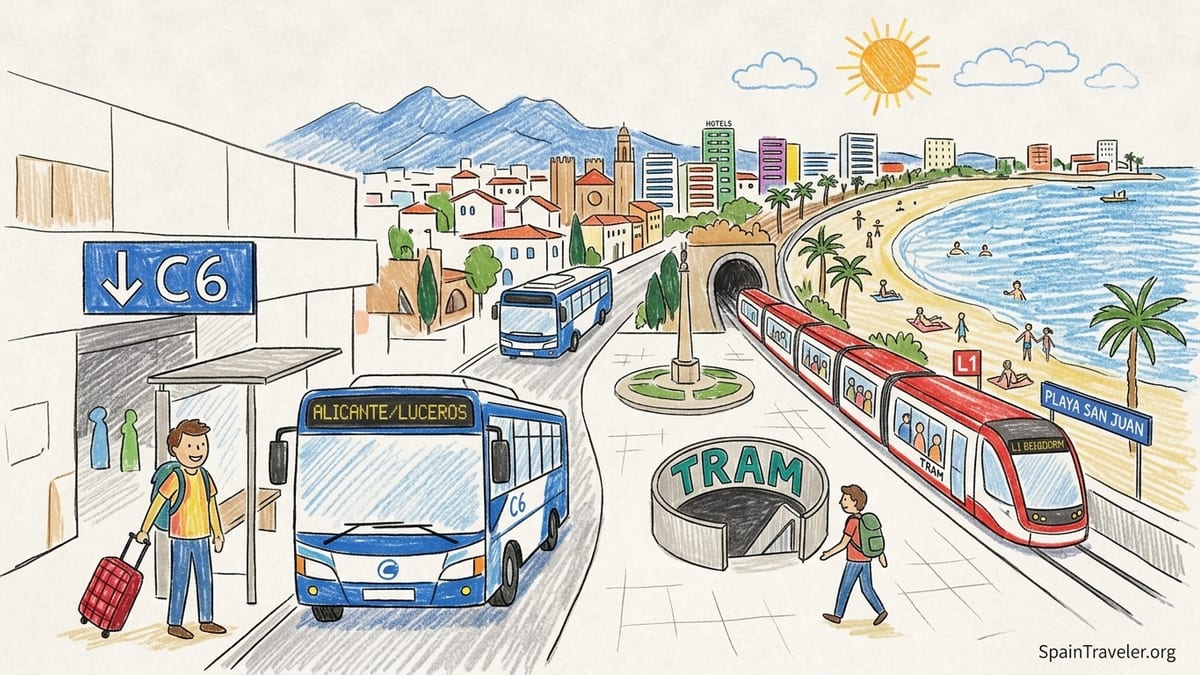
My no-car experiment began in the arrivals hall at Alicante-Elche Miguel Hernández Airport, standing under the blue C6 signs that point you down the ramp to the dedicated airport bus stop outside the terminal. Alicante’s airport has no rail station, so if you want to use the TRAM network you first have to ride this bus into the city. Aena, the airport operator, explicitly describes the C6 as the link between the terminal and Luceros, the central TRAM hub that connects Alicante with Benidorm and Dénia, and my trip confirmed that is exactly how it works in practice.
I boarded the C6 with a medium checked suitcase and a backpack. The luggage situation was less stressful than I had feared. The bus has a low floor and wide central aisle, so I could roll my case on board and park it beside me without blocking seats. Above the driver, a screen showed the route toward Alicante centre, including stops at the main railway station, Plaza de los Luceros and Puerta del Mar by the waterfront. The driver accepted contactless card payment directly on boarding. The official operator, Vectalia, has adjusted fares several times, and during my 2026 visit the single airport fare was higher than a normal city bus but still reasonable for a 20 to 25 minute ride into town.
Frequency is where the C6 shines. It runs every day of the year, including Sundays and holidays, and during my stay I never waited more than about 15 minutes. The timetable says it is 24 hours, and at both midday and late at night there was always another bus on the electronic display. Real life was slightly messier than the timetable suggested. On my pre-dawn ride back to the airport the bus arrived several minutes early and left as soon as it had loaded, which meant people who arrived exactly on time had to wait for the next one. For flight days, I learned to be at the stop at least 10 to 15 minutes ahead of the scheduled departure.
Finding the right stop in the city was straightforward once I understood that the same C6 route loops through central Alicante and then returns to the airport. Coming from the terminal I rode all the way to Plaza de los Luceros, a circular square that doubles as the underground entrance to the TRAM network. The driver called out main stops, and inside the bus there were illuminated buttons and digital displays, but what helped most was watching for the tram logo on street signs outside. When I stepped off at Luceros, I could see the TRAM entrance right on the square, a short roll away with my suitcase over clean pavement.
First Encounter with Luceros: Buying TRAM Tickets and Finding Platforms
Luceros station became my anchor for exploring the Costa Blanca without a car. It is a modern underground hub beneath the plaza, with clear signage in Spanish and Valencian, ticket machines and staffed counters. From here the key lines spread out: L1 to Benidorm, L3 to El Campello and the northern beaches, L2 inland to the university and San Vicente, and L4 as an urban loop toward Playa de San Juan. Maps from the regional tourism office and city guides show Luceros as the starting point for the coastal axis toward Benidorm and, via a change to L9, to Dénia.
Buying tickets was my first small test. Machines at Luceros accepted cash and cards, and I could choose between a single ticket or a rechargeable contactless card valid across the network. Staff at the small ticket office near the gates confirmed that the same transport card works on trams and some buses, but airport C6 fares are handled separately. With two weeks on the coast ahead of me, I opted for a reloadable card and added enough credit for a few long rides. The interface let me choose the number of zones, and the screen displayed the price before I tapped my card.
Platform access was simple even with luggage. Descending from the street, I passed ticket barriers that scan either a paper ticket or your contactless card, then followed signs for L1 and L3 toward the seafront. Platforms are clearly marked with destination boards; Luceros is at one end of the system, so every tram in my direction was heading outward. Overhead screens showed departure times, usually in intervals of 15 to 30 minutes depending on the line and time of day. On two occasions in late evening, a temporary disruption on L1 toward Benidorm meant the next tram was listed 40 minutes away, but announcements in Spanish and Valencian explained the delay, and staff on the platform gave rough real-time updates.
The Vossloh tram-trains that serve line L1 have level boarding at Luceros. I wheeled my suitcase straight onto the carriage with no gap or step. The interior layout felt closer to a regional train than a city tram, with pairs of seats on each side and luggage space near the doors. Electronic displays showed upcoming stops, and audio announcements alternated languages. After the chaos of the airport, this felt remarkably calm.
Riding L1 from Alicante to Benidorm: Beaches, Tunnels and Travel Time
The backbone of my car-free Costa Blanca trip was line L1 from Luceros to Benidorm Intermodal. According to published information and station posters, L1 connects central Alicante with El Campello, Villajoyosa and Benidorm along the coast. The full journey to Benidorm takes roughly 70 minutes. During my stay in September 2026, weekday daytime frequencies hovered around every 30 minutes, with additional services in peak periods. In July and August the operator also runs a special night service between Luceros and Benidorm on Fridays and Saturdays, giving all-night coverage during the main holiday season.
On my first ride I boarded at Luceros just after 10:00. The tram glided out of the underground tunnel near MARQ station before emerging into daylight by the sea. This early stretch, shared with city lines, passes residential areas and then hugs the coastline northwards. My suitcase sat beside me in the open standing area, and I quickly understood why so many visitors choose this instead of a car. Out the window I could see coves, apartment blocks and the blue line of the Mediterranean, while I jotted notes in a notebook instead of watching for junctions and roundabouts.
As we moved beyond El Campello, the stops spread out, and the trip felt more like a traditional coastal railway, which fits with the line’s heritage as part of the old Trenet de la Marina, the route that historically ran all the way from Alicante to Dénia. Modernisation has turned L1 into an electrified tram-train line, while the more northerly stretch operates as L9. What mattered to me as a traveler was the predictable rhythm. Trams arrived broadly on time, and although we occasionally waited at passing points for an oncoming service, the total journey time stayed close to the posted timetable.
Arriving at Benidorm Intermodal, the terminus sits slightly inland from the beachfront. Platforms are ground-level, with clear signage for transfers to buses and to the L9 line toward Dénia. There is a small indoor waiting area, ticket machines, and basic facilities. With luggage, it took me a few minutes to orient myself. The station sits above the town, so to reach my hotel near Playa de Levante I followed signs down the hill and joined a local bus at the stop outside, trading the clean geometry of the TRAM network for a few minutes of urban traffic.
From Benidorm to Dénia on L9 and Regional Trains
The coastal TRAM system does not stop at Benidorm. For travelers heading further north, L9 continues from Benidorm toward Dénia, passing Altea, Calp, Benissa, Teulada and other smaller towns. Unlike L1, this section is not fully electrified and is operated with diesel multiple units rather than tram-trains, which changes the feel of the journey. I took L9 from Benidorm toward Altea and later continued to Dénia, using the Benidorm Intermodal platforms to transfer.
Changing from L1 to L9 in Benidorm was simple in theory and slightly confusing in practice. The lines share the same station, but the platforms for L9 services are on a different track. Overhead displays show the destinations, and staff on site confirmed which train was heading to Dénia. Tickets and zones carry over, so I did not need a separate purchase for the transfer, but I did need to validate my card again when boarding the L9 unit.
The ride north felt slower and more rural than the sleek trip from Alicante. Speeds drop through the hillier sections, and there were sections of single track where we paused to let another train pass. On one day, planned engineering works near Calp meant a section of the route was replaced by a bus, and announcements at Benidorm explained that passengers would need to transfer to a waiting coach. These mixed-mode segments are where traveling without a car requires patience. With luggage, changing from a train to a bus and back again added stairs and short walks in the heat, and the total trip to Dénia stretched toward three hours door to door.
Arriving into Dénia, the station sits inland from the historic center and port. From the terminus I followed pedestrian signs through residential streets to reach the waterfront. The positive surprise was how close the TRAM brings you to the old town. Within 15 to 20 minutes on foot I was standing under the castle walls and later eating grilled fish near the marina, all without needing a car. The tradeoff was the time spent en route. Had I been driving on the AP-7 motorway, the same day trip from Alicante to Dénia and back would have been significantly faster, but I would have missed the sequence of coves, whitewashed villages and orange groves that unfurled outside the tram window.
Beach Access along the TRAM: San Juan, Costa Blanca Stop and Beyond
One of the strongest arguments for a car on the Costa Blanca is beach access. Yet much of the northern shoreline near Alicante is surprisingly well served by the TRAM, particularly line L3 to El Campello and line L4, the urban loop toward Playa de San Juan. During my stay I made repeated TRAM journeys from Luceros to the northern beaches, testing how straightforward it was to combine sea and public transport.
From Luceros, I took L3 towards El Campello and got off at Costa Blanca, a stop named for the coastal avenue that runs parallel to the sea. Maps of the network show this station sitting behind the line of beachfront apartment blocks, and that matches what I found on the ground. From the platform, a signed walkway led down toward Avenida Costa Blanca and the sand. Within five minutes I had crossed a couple of junctions and was standing on a wide, pale beach with blue water and a row of chiringuitos behind me.
Traveling with only a day pack, this walk was easy. With a full suitcase, it would have been a little more cumbersome, especially at midday when shade is limited. Still, compared with hunting for parking along the seafront as I had done on previous car trips, being able to step off a tram and stroll to the shore felt liberating. On another day I rode L4, which runs as a loop, to get off closer to Playa de San Juan itself. Frequencies on L3 and L4 were generally better than on L1, with trams every 15 minutes or so during much of the day, making quick beach outings feel spontaneous.
Further up the coast, in towns like Villajoyosa and El Campello, the TRAM stops are often within walking distance of the waterfront, though the routes sometimes sit slightly above the town. In Villajoyosa I stepped off at the main station and followed a descending street toward the colorful seafront houses and arc of sand. The walk added ten minutes, but the trade for not driving was that I could leave wet towels and sandy sandals in my bag and simply board the next tram back, without worrying about returning to a specific parking spot or navigating narrow backstreets.
When Public Transport Felt Inconvenient or Limiting
For all its strengths, traveling the Costa Blanca without a car did expose definite pain points. Frequency, while generally acceptable, required more planning in the evenings and on Sundays. On line L1, the last regular tram from Luceros toward Benidorm on a typical weekday left shortly after 23:20, with the final return service from Benidorm only a few minutes later in the opposite direction. On nights without the special summer night service, that meant watching the clock carefully if I wanted to linger in Benidorm’s old town or on the seafront promenade.
Delays and disruptions are another reality. During my stay, a fatal incident on the line near Villajoyosa suspended L1 services for several hours, with replacement buses operating between affected stops. Information at stations mentioned the interruption, but on-board announcements were limited, and many tourists looked confused as we were told to disembark and wait at street level. A car would not have been immune to the wider disruption, but it would have offered alternative routes without the need to queue for a crowded replacement bus.
The inland and hilltop villages of the Costa Blanca highlighted the biggest gap. Public buses do exist, but they are far less frequent than the coastal TRAM, and information is scattered across different operators. On a previous trip with a rental car, I had easily reached mountain towns like Guadalest and small inland bodegas for wine tastings. On this car-free visit, I studied timetables and realised that attempting the same with buses would mean one or two departures per day, long waits for connections, and limited flexibility to return. In the end, I decided not to attempt Guadalest by public transport, accepting that some experiences remain far more practical with a car.
A more mundane inconvenience was grocery shopping and carrying supplies. Staying in a rental apartment in Alicante’s centre, I relied on walking to supermarkets. That was perfectly workable, but on days when I stayed in Benidorm and Dénia the distance from stations to larger supermarkets meant lugging bottles of water and groceries further than I would have from a hotel car park. For solo travelers and couples this is manageable; for families with small children, a car starts to feel much more attractive.
Comparing Car and No-Car Travel Where I Tested Both
Because I had previously driven large parts of this coastline, I could directly compare specific journeys. Alicante to Benidorm is the clearest example. By car on the AP-7 or N-332, the trip can be as quick as 40 to 45 minutes outside peak traffic, with toll-free options available and fast access to inland attractions. By TRAM on L1, my rides took around 70 minutes from Luceros to Benidorm Intermodal, plus the walk or short bus journey down to the beach or hotels. In pure time terms, the car wins.
Yet the quality of the experience was different. Driving, I spent most of the journey focused on exits and lanes, and my memory of the coastline is limited to glimpses between guardrails. On the tram I watched the sea, read a book and arrived less tired. Parking was another stark contrast. In Benidorm’s high season I have circled for 20 to 30 minutes looking for a space at street level or paying for a multistorey garage. With the TRAM I stepped off and immediately began walking, with no parking ticket to worry about.
Alicante to the northern beaches around Playa de San Juan and Muchavista was even more clearly in public transport’s favour. Previously, I had driven there, inching along the Avenida de Niza and adjacent streets hunting for spaces. On this trip I boarded L3 at Luceros and stepped off at Costa Blanca or Campo de Golf, walking directly to the sand in under ten minutes. The combination of predictable frequency and proximity to the beach outweighed any marginal time savings I might have achieved in a car, especially once parking and traffic were accounted for.
The inland contrast was reversed. For places beyond the TRAM’s reach, such as the mountain village of Guadalest, bodegas near Jalón, or scattered rural casas, my car-based trips had been effortless. I could stop at viewpoints, detour to small villages and depart whenever I wanted. Attempting those same excursions without a car would have required stitching together sparse regional buses and taxis. After pricing a private transfer to Guadalest from Benidorm, I found that the door-to-door cost approached or exceeded what I would pay for several days of car rental, which underlined how quickly the economics can shift once you leave the rail corridor.
The Takeaway
By the end of my stay, my notebook was full of departure times and scribbled tram numbers, but also of quiet moments that would never have happened from a driver’s seat. Sunrise glimpsed through the window of the C6 as it climbed from the airport toward Alicante’s skyline. The slow transition from city to suburb to open coastline as L1 rolled toward Villajoyosa. Watching local commuters step on and off at small stations that barely register on tourist maps.
Traveling the Costa Blanca without a car worked best where the TRAM d’Alacant is strong. If your plans focus on Alicante, the northern city beaches, El Campello, Villajoyosa, Benidorm and perhaps as far as Altea and Dénia, you can build an entire trip around the combination of C6 airport bus, TRAM lines and occasional local buses. You will trade some speed and spontaneity for lower costs and less stress, but you will rarely feel stranded.
Where public transport thins out, particularly inland and in late-night hours outside the summer night services, a car still offers unmatched flexibility. Families with small children, travelers planning winery visits or ambitious multi-stop day trips may find that a few days of rental unlocks experiences that buses and trams cannot easily reach. For others, a hybrid approach also makes sense: start without a car in Alicante, then rent for a shorter inland loop.
What my experiment taught me is that “no car” on the Costa Blanca is not an extreme stunt. It is a viable and often enjoyable way to travel, provided you honour the reality that Alicante Airport is connected by bus, not rail, and that everything flows through Luceros. From there, a lattice of trams and trains can carry you surprisingly far, not just across the map, but into a slower rhythm of travel where the journey becomes part of the point.
FAQ
Q1. Can I get from Alicante Airport to Benidorm without a car?
Yes. Take the C6 airport bus from the terminal to Plaza de los Luceros in Alicante, then connect to TRAM line L1 from Luceros to Benidorm Intermodal.
Q2. How late do trams run between Alicante and Benidorm?
On regular weekdays during my 2026 visit, the last L1 tram from Luceros to Benidorm left shortly after 23:20, with the final return service from Benidorm only a few minutes earlier.
Q3. Is the C6 airport bus suitable if I have large luggage?
Yes. The C6 has low-floor access and space near the doors where you can keep a medium or large suitcase without using the underfloor hold.
Q4. Do I need separate tickets for the C6 bus and the TRAM?
Yes. The airport C6 uses a specific airport fare, while the TRAM network uses its own zone-based tickets or contactless transport cards.
Q5. Is beach access easy by TRAM from central Alicante?
Yes. Lines L3 and L4 link Luceros with stops such as Costa Blanca and Playa de San Juan, from which it is typically a five to ten minute walk to the sand.
Q6. How long does the TRAM take from Alicante to Benidorm compared with driving?
My journeys on L1 took about 70 minutes from Luceros to Benidorm Intermodal, whereas driving via the main roads can be closer to 40 to 45 minutes outside heavy traffic.
Q7. Can I reach Dénia by public transport from Alicante?
Yes. Travel on L1 from Luceros to Benidorm, then transfer to L9 toward Dénia. Allow several hours in total, especially if there are works or replacement buses.
Q8. Are there night trams on the Costa Blanca in summer?
Yes. During the main summer season special night services operate on several lines, including L1 between Luceros and Benidorm on weekend nights.
Q9. Is a car still useful if I mainly want beaches and coastal towns?
If you stay within the main coastal strip from Alicante to at least Altea, the TRAM and local buses are usually enough. A car becomes more useful for inland villages or scattered rural stays.
Q10. Where does traveling without a car on the Costa Blanca become impractical?
It becomes challenging for inland destinations such as mountain villages, wineries and rural accommodations where buses are infrequent and journeys involve multiple slow connections.