


I have been back to the Costa Blanca often enough to know that not every “must see” deserves a precious day of your holiday. The coast between Dénia and Alicante is dense with resorts, whitewashed towns and rocky headlands, and it is very easy to spend the week shuttling between similar beach promenades that blur into one. This is a first-person account of the places and experiences that genuinely felt different, where I would happily carve out half a day or more again, based on recent trips in 2025 and 2026.
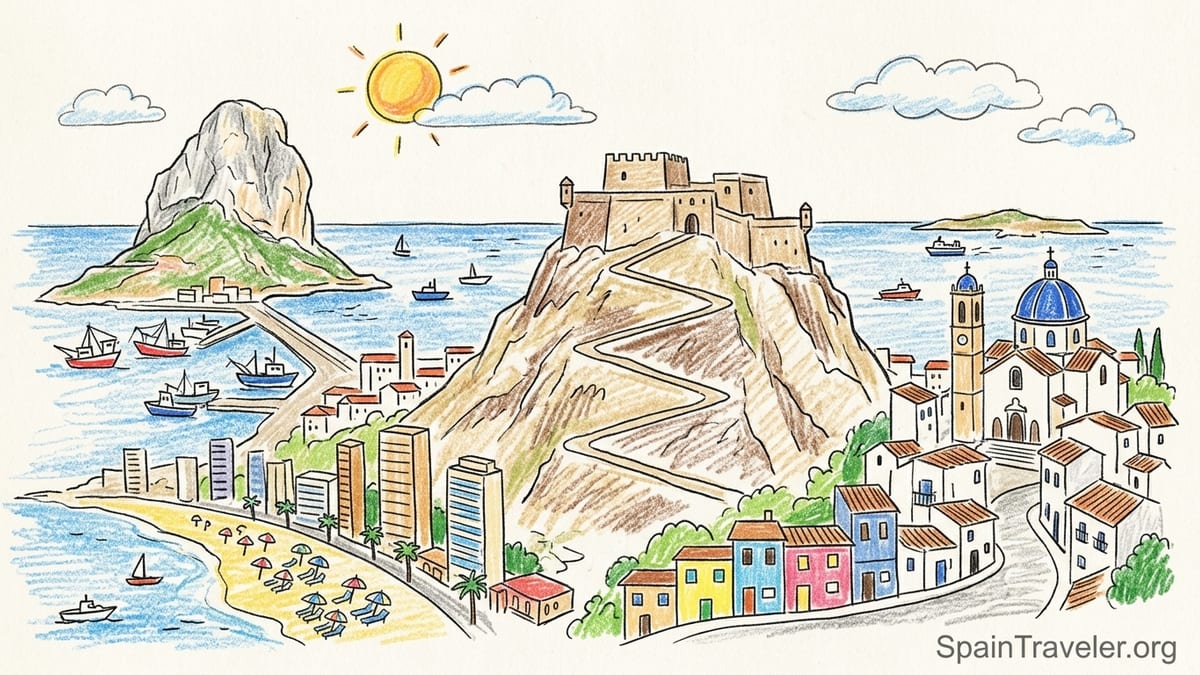
Climbing Up to Santa Bárbara Castle in Alicante
Santa Bárbara Castle is the one place in Alicante I now plan a whole morning around, not just “something to do if it is cloudy.” The fortress crowns Mount Benacantil 166 metres above the sea, and on my last visit in May 2026 I set out on foot from the Explanada de España just after 9 a.m., when the pavements were still in shadow and the cafes were opening. Instead of heading straight for the lift, I walked through the old streets behind the Town Hall and picked up the signed path that zigzags up the hill. It took me about 25 minutes of steady climbing with a few pauses at viewpoints where the Portiguet beach and the marina opened up below.
On other visits I have made use of the lift that tunnels through the rock from Avenida Juan Bautista Lafora, opposite Playa del Postiguet. The official site lists the elevator at 2.70 euros per person for a return journey, with free access for pensioners over 65 on production of ID, and the last ascent around 40 minutes before closing. Entry to the castle itself remains free, which still surprises first-timers at the ticket machines. In high season there is also a small shuttle bus and taxis can drop you at the upper entrance, but cars and tuk-tuks are now more restricted, something that became a local political issue in summer 2026.
I usually spend about three hours at the top, which comfortably makes this a half-day experience once you add the walk up and a coffee. The complex is larger than it appears from the city. You can roam the old dungeons and water cisterns, dip into the small museum spaces that tell Alicante’s story from Iberian settlements through Muslim rule to modern times, and then climb to the higher battlements for 360-degree views. On my last visit I simply sat along the wall for almost an hour watching ferries edging out towards Tabarca Island and planes skimming in over the harbour. The official tourism guide suggests one to two hours as a minimum, but if you like views and photography you will want longer.
What keeps drawing me back is the combination of history and the way the castle slots into everyday Alicante life. It never feels like a remote monument. School groups pour through the gates, local families come up at sunset with picnic bags, and in the evenings there is often a programme of concerts or food events in the bailey. The overrated part, for me, is the main souvenir stall near the lift exit, which sells the same fridge magnets and plastic swords you can find down in the old town. Save your money for a coffee at the terrace bar, where prices are only slightly higher than in the city below and the views are included.
Benidorm’s Beaches: Levante Energy vs Poniente Breathing Space
I visit Benidorm without irony. It is crowded and unapologetically built-up, yet the two main beaches, Levante and Poniente, each offer a distinct experience that I have come to appreciate on different terms. I typically arrive by car from Alicante, following the signs for the free parking areas near the western entrance; a large free car park that reopened in July 2026 has made it more realistic to leave the car on the edge of town and walk in, avoiding the worst of the summer traffic. From there it is ten to fifteen minutes on foot down to Poniente beach.
Poniente is where I now base myself if I am in Benidorm for more than a couple of hours. The long arc of pale sand is backed by a broad promenade with palms, benches and a calmer rhythm than Levante. On a weekday in late June I paid around 7 to 8 euros for a sunlounger and parasol set for the day, which is in line with other resort prices along this coast. The crowd felt mixed, with Spanish families, older northern Europeans and a few locals ducking in for a midday swim. I stayed from about 10 a.m. until mid-afternoon, taking turns between the sea and the shady terraces of the cafes that run along the seafront. For me Poniente is worth at least half a day, especially if you are travelling with children or anyone who prefers space and quieter water.
Levante, on the other side of the headland, is where Benidorm becomes the vertical, neon-lit version you see in magazine photos. Here the promenade is narrower and edged with high-rise hotels and bars. When I came in August 2025 the sand was already dotted with sunloungers by 9.30 a.m., and by late morning it was difficult to walk a straight line along the water without zigzagging through inflatables and people. That said, if you want warm, lively beach energy, easy access to cheap menus of the day and late-night bars with live music, this is the place. I tend to limit Levante to a couple of hours, usually late afternoon or early evening, before heading back to Poniente or up to the old town for dinner.
What impressed me in Benidorm was how well maintained the beaches are despite the volume of visitors. Rubbish crews swept the sand every night, lifeguards were visible and active, and water quality on my visits was clear enough to watch shoals of small fish around my ankles. What I find overrated are many of the generic “British strip” bars behind Levante, which could be almost anywhere and add little that is specifically Costa Blanca. If you are short on time, I would focus on Poniente and the small cove of Mal Pas below the old town, which has clearer water and a more intimate feel than its oversized neighbours.
Getting Lost on Foot in Altea’s Old Town
Altea’s old town is the Costa Blanca hilltop cliché that actually lives up to the postcards. I first arrived by tram from Alicante, taking the coastal line that hugs the shore through Campello and Benidorm. The journey took around an hour and a half, and from Altea station it was about 15 minutes on foot to reach the lower edge of the old town. On later trips with a hire car, I followed local advice and left the vehicle in the free Carrer Benidorm car park, known as La Basseta, at the base of the hill, then walked up through the stepped streets. A recent parking guide from early 2026 confirmed this is still the sensible option, as the immediate streets around the church are either restricted or simply too narrow to drive.
I usually allow at least half a day in Altea, often stretching into an entire lazy day when I link the morning in the old town with an afternoon along the seafront below. The climb is steady rather than brutal, and every few corners reveal a new composition of whitewashed walls, wrought-iron balconies and flashes of the sea. I stopped more than once simply to photograph an alleyway framed by blue shutters or a cat asleep on a doorstep. At the top, the plaza around the blue-domed church of Nuestra Señora del Consuelo is where everything converges: buskers, local painters, cafe terraces and that wide view over the bay towards the Sierra Helada.
Prices in the square are not low, but they are no worse than other scenic spots on this coast. In April 2026 I paid just under 3 euros for a cortado and around 4 euros for a slice of tart at one of the cafes under the trees. The atmosphere, however, felt distinctly more local than in some coastal resorts. The languages around us shifted from Valencian to Spanish to English and back again, and older residents sat on the low walls chatting as the sun went down. The only thing that now feels slightly overrated to me are some of the more touristy craft stalls around the main square. I have found much nicer ceramics and textiles in the side-street boutiques just off the main routes, where the owners are happy to talk about local designers and production.
If you can, time your visit so that you are up by the church for golden hour. One evening in late summer I watched as the whole bay gradually turned from bright blue to copper and finally a soft indigo, the tiled dome glowing in between. I walked back down to the car in semi-darkness, passing families heading up for dinner at small restaurants I had barely noticed on the way up. That is the moment Altea feels most itself, when the excursion buses have gone and the town exhales.
Calpe and the Pull of the Peñón de Ifach
Calpe’s skyline is dominated by the Peñón de Ifach, a limestone rock that juts 332 metres straight out of the sea, joined to the mainland by a narrow causeway. On my first trip I saw it from the motorway and immediately knew I wanted to be up on its flank. I drove in from Altea along the N-332, which offers a series of lay-bys where you can pull over for photos of the rock framed by the coastal lagoon and apartment towers. In town I parked in a paid municipal car park near the fishing port for just under 8 euros for around five hours, which felt reasonable given the proximity to the trailhead.
Access to Peñón de Ifach is via a small visitor centre and a controlled path that now requires free advance reservations in peak periods. I booked my slot for 9 a.m., one of the first of the day, and was glad I did. The initial paved section up to the tunnel took me about 30 minutes and was busy but manageable, with families and older walkers. Beyond the tunnel the path narrows, becomes rockier and more exposed, and it took another 30 to 40 minutes to reach the main viewpoint below the summit. I would comfortably rate the whole outing as a three to four hour half-day, including time at the top and a slow walk back down.
The reward from up there is a panorama that explains the Costa Blanca better than any brochure. To the north the coastline kinks towards Moraira and Jávea, with headlands and coves breaking up the urban strip. To the south, the more heavily built-up section towards Benidorm and Alicante lies like a chain of light-coloured blocks along the water. On the descent I looked down into the salt lagoon with its flocks of flamingos and then out to the port where fishing boats were beginning to return. It is one of the few places on this coast where you really feel the mix of wild rock and seaside city at the same time.
What felt slightly overrated was the immediate strip of restaurants opposite the fish market, where waiters stand outside with picture menus and prices that creep higher than in the streets a block back. I had a very decent menú del día of fried fish, salad, dessert and wine for around 15 euros at a simpler place a few streets inland, where the clientele was mostly local workers. As an experience, though, Peñón de Ifach is one I would repeat without hesitation, ideally again in the shoulder seasons of spring or autumn when the temperatures are kinder and the path is less congested.
Hunting for Coves around Jávea and Slowing Down in Dénia
Jávea (Xàbia) has taught me that sometimes the best Costa Blanca experiences are not a single attraction but a string of small, specific places. Each time I visit, I rent a car, because the real magic lies in the coves around the headland rather than in the main town beach. Driving from Alicante takes about an hour and a half on the AP-7 toll motorway or slightly longer if you opt for the free N-332. I usually aim straight for Cala Granadella early in the morning, arriving by 8.30 a.m. to slip into one of the limited parking spaces near the water. In summer 2025 the local council began restricting vehicle access at busy times, with traffic marshals turning cars away once the small valley filled, so the early start is worth it.
I rarely spend less than three to four hours at a cove like Granadella or Portixol. The beaches themselves are mostly pebbled, so I bring reef shoes, but the water is exceptionally clear and the rocky sides create easy snorkelling routes. On my last visit I rented a kayak for 25 euros for two hours, paddled out along the cliffs and ducked into small caves where the light turned the water electric blue. Back on shore, there are a couple of simple beach bars where a sandwich and a cold drink come to around 10 to 12 euros. It is not cheap, but the setting does a lot of the work.
In contrast, Dénia, further north, is where I slow down. The drive from Jávea is about 20 minutes following the CV-736 and then the coastal road. I like to park near the port in one of the municipal lots and then explore on foot. Dénia’s appeal, for me, lies less in a single headline sight and more in the combination of castle, working harbour and food culture. The castle sits on a low hill in the centre; entry has hovered around a few euros and gives you a network of walls and towers to wander, along with views over the ferry terminals where boats depart for Ibiza and the Balearic Islands.
Dénia is also home to a cluster of restaurants that have given it a reputation in Spanish food media, including one with three Michelin stars, but you do not need a high-end budget to eat well. On my last visit I joined the evening paseo along Calle Marqués de Campo, then ducked into a small bar for a plate of red prawns from the local fish auction and a glass of white wine for under 15 euros. It felt rooted in the town rather than designed for tourists. If I only had one day to split between Jávea and Dénia, I would give the morning and early afternoon to a cove in Jávea and the late afternoon and evening to Dénia’s streets and castle.
Villajoyosa’s Colourful Waterfront and Chocolate Detour
Villajoyosa is the place I recommend whenever someone tells me they want a coastal town that feels lived-in year round. I have always arrived by tram, usually hopping off between Alicante and Benidorm. From the station it is a 10 to 15 minute walk down through ordinary residential streets to the seafront, where the town suddenly reveals its most famous feature: a line of tall fishermen’s houses painted in terracotta, yellow, blue and green along the main beach.
This is not a town where you tick off a long list of attractions. Instead, I give myself three or four hours to wander the old quarter, walk the promenade and sit with a coffee watching the sea. In October 2025, on a warm weekday afternoon, I paid around 1.70 euros for a cafe solo and a little more for a pastry at a bakery just back from the front, noticeably cheaper than the front-line terraces. The beach itself is wide, sandy and family friendly, and there is usually space even in mid-summer compared with Benidorm.
Villajoyosa is also known for its chocolate industry, and I have twice visited one of the factory museums on the edge of town. Guided tours have been priced at under 10 euros, with a short film, a walk through the historical machinery and a tasting at the end. It is a pleasant diversion on a cloudy morning or when you need a break from the beach. The part that feels slightly overrated now is the small historic centre behind the waterfront, which local tourism increasingly packages as a “hidden gem” in its own right. It is attractive, but if you have already walked through Altea or Alicante’s Barrio de Santa Cruz it will not feel radically different. What is unique is the combination of colourful houses right on the sand and the sense that this is still a working town with a tangible everyday rhythm.
A Day on the Water to Tabarca Island
If there is one excursion from Alicante I have willingly repeated, it is the boat trip to Tabarca, the small inhabited island that sits off the coast. I have sailed there both from Alicante city and from Santa Pola, and the choice of departure point matters. From Alicante, the journey takes about an hour each way, with adult return fares currently advertised around 21 to 24 euros depending on the operator and season. From Santa Pola, which I usually reach by car or bus in about 30 to 40 minutes, it is a shorter 15 to 20 minute crossing, with return tickets more in the region of 15 euros for adults and lower child prices according to the 2026 fare tables.
Either way, Tabarca is at least a full-day commitment by the time you factor in boarding, sailing, exploring and swimming. I typically catch a mid-morning boat, arrive on the island around 11 a.m. and take the last or second-to-last return in the late afternoon. Tabarca has been a protected marine reserve since the 1980s, which means the waters around its rocky coves are rich in fish and seagrass meadows. Snorkelling is free as long as you bring your own mask, and I have spent entire afternoons drifting above shoals of damselfish and bream in water so clear you can see the patterned sand four or five metres below.
On land, the walled village is tiny and quickly walked. There is a fortified gate, a narrow main street, a church that is sometimes open for visits and a scattering of houses, some of them holiday rentals. Lunch is almost always some variation of rice with seafood at one of the open-air restaurants facing the small harbour. Recent menus have placed a basic arroz a banda or paella around 18 to 25 euros per person, with simpler dishes like fried fish or salad coming in lower. It is not a cheap lunch compared with the mainland, but you are paying for the setting and the logistics of getting supplies to an island.
Tabarca does get crowded in July and August, especially on weekends. The beaches are small, and by midday it can be difficult to find a patch of shade that is not already claimed by umbrellas from earlier boats. That, for me, is the overrated side of the experience: if you only see Tabarca in high summer, you might find it feels more like a theme-park day out than a tranquil island. My favourite visits have been in late May and late September, when the sea is still warm, the marine life just as vibrant and the village relaxed enough that you can actually hear the wind in the cactus and the slap of boats against the quay.
Inland Detours: Guadalest and the Walks Behind the Coast
Although the Costa Blanca brand is firmly about the sea, some of the most memorable days I have had here involved driving inland for a change of scale. One that stands out is the trip to Guadalest, a small fortified village about an hour’s drive from Benidorm into the mountains. I set off in a hire car, leaving the apartment blocks behind and winding up through terraces of citrus and almond trees. Parking in Guadalest is straightforward: there are several paid car parks on the edge of the village, where in 2025 I paid around 3 euros for several hours.
From there it is a short walk into the whitewashed streets and up to the castle remains perched on a rock above the turquoise reservoir. Guadalest has become a textbook day-trip destination, complete with multiple small museums, souvenir shops and cafes, and in peak holiday weeks it can feel saturated with coaches. Despite that, I still think it deserves half a day if you are staying on the coast for a week or more. The views from the top, with the reservoir below and the surrounding peaks, reset your sense of the region. It becomes easier to understand that the Costa Blanca is not just beachfront but also a series of valleys running inland.
I have also used inland days to walk sections of trails behind Altea and Benidorm, particularly in the Sierra Helada natural park. One October morning I took the local bus from Albir up to a trailhead and followed a cliff-top path that undulated above the sea for several hours before dropping back down near Benidorm. There was no entry fee, just a set of information boards and waymarks, and in four hours of walking I passed only a handful of other hikers. Experiences like this may not feature as heavily in tourism brochures as the beaches, but if you enjoy walking, factoring in one inland or hill day balances a week of coastal towns very well.
The Takeaway
After several trips up and down the Costa Blanca, the pattern that has emerged for me is simple. The places that justify half a day or more are those that combine a distinct sense of place with enough to do once you arrive: Santa Bárbara Castle in Alicante, a morning or evening in Altea’s old town, a climb on Peñón de Ifach above Calpe, a cove-and-town pairing of Jávea and Dénia, and a full day to Tabarca. These are the experiences I would rebuild a future itinerary around.
By contrast, a couple of hours is often enough for the more generic parts of the coast. A walk along Benidorm’s Levante, a spin along Villajoyosa’s seafront or a quick look at yet another beachfront strip of bars can all be enjoyable in moderation, but they do not need to dominate your time. The key is to be deliberate: decide which days deserve an early start and a planned route, and which can be left open for a spontaneous swim or a second coffee in a plaza you like.
Most importantly, the Costa Blanca rewards slowness much more than list-ticking. My best memories from this coast are not of how many towns I fitted into a day, but of watching the light shift across Alicante from the castle walls, floating face-down over seagrass off Tabarca, or nursing a coffee under the blue dome in Altea while nothing in particular happened. Those are the experiences I would happily make time for again.
FAQ
Q1. Is it better to use a car or public transport along the Costa Blanca?
For coastal hops between Alicante, Villajoyosa, Benidorm and Altea, the tram is reliable and inexpensive. For coves around Jávea, inland villages like Guadalest or flexible early starts, a hire car gives you far more freedom.
Q2. How much time should I plan for Santa Bárbara Castle in Alicante?
I recommend at least half a day if you walk up, explore the exhibitions and stay for a drink with the views. If you ride the lift and only want the panoramas, two to three hours can suffice.
Q3. Which Benidorm beach is better for families?
Poniente is generally calmer, with more space on the sand and a wider promenade, which I have found better for families. Levante suits those who want livelier bars and nightlife within a few steps of the beach.
Q4. Do I need to book the Tabarca Island boat in advance?
In July and August or on weekends, I would book online a day or two ahead, especially from Alicante. Outside peak season, I have been able to buy tickets at the port on the morning of travel without issues.
Q5. Is the Peñón de Ifach hike in Calpe suitable for children?
The lower section to the tunnel is manageable for most children used to walking. Beyond the tunnel the path is steeper and more exposed, so I would only continue with older, sure-footed kids and in good weather.
Q6. When is the best time of year to visit the Costa Blanca for these experiences?
Late April to early June and late September to October have been ideal on my trips, with warm sea temperatures, long daylight and fewer crowds than the peak of July and August.
Q7. Can I visit Altea, Calpe and Jávea in one day?
It is technically possible by car, but I would not recommend it. Each place deserves at least half a day, and trying to combine all three dilutes the experience into a rushed drive-by of viewpoints.
Q8. How expensive are meals in these Costa Blanca towns?
In 2025 and 2026 I regularly found daily menus in local restaurants for 12 to 18 euros, including a couple of courses and a drink. Seafront and island locations, like Tabarca, tend to be on the higher end of that range.
Q9. Is swimming and snorkelling good everywhere along the coast?
Water quality has been consistently good on my visits, but clarity and marine life are best around rocky coves such as those near Jávea and around Tabarca, which is a designated marine reserve with richer underwater scenery.
Q10. Do I need to speak Spanish or Valencian to get by?
In the main coastal towns, English is widely understood in hotels, restaurants and on transport. Learning a few basic phrases in Spanish is appreciated and helps in smaller inland places and local bars.