


The Costa Blanca stretches for more than 200 kilometres along Spain’s Alicante province and officially counts more than 170 beaches and coves along its shore. It is a long list. After several extended stays spread over recent years, I have swum from Alicante’s city sands to the small coves tucked into the cliffs around Jávea, Benissa and El Poble Nou de Benitatxell. This article is not a ranking of everywhere, but a personal account of the few beaches and coves I would return to tomorrow, and how they actually work on the ground: parking, the walk down, sand or pebble, shade, showers, toilets, bars and the chances of finding a quiet patch of shore, even in a busy Costa Blanca summer.
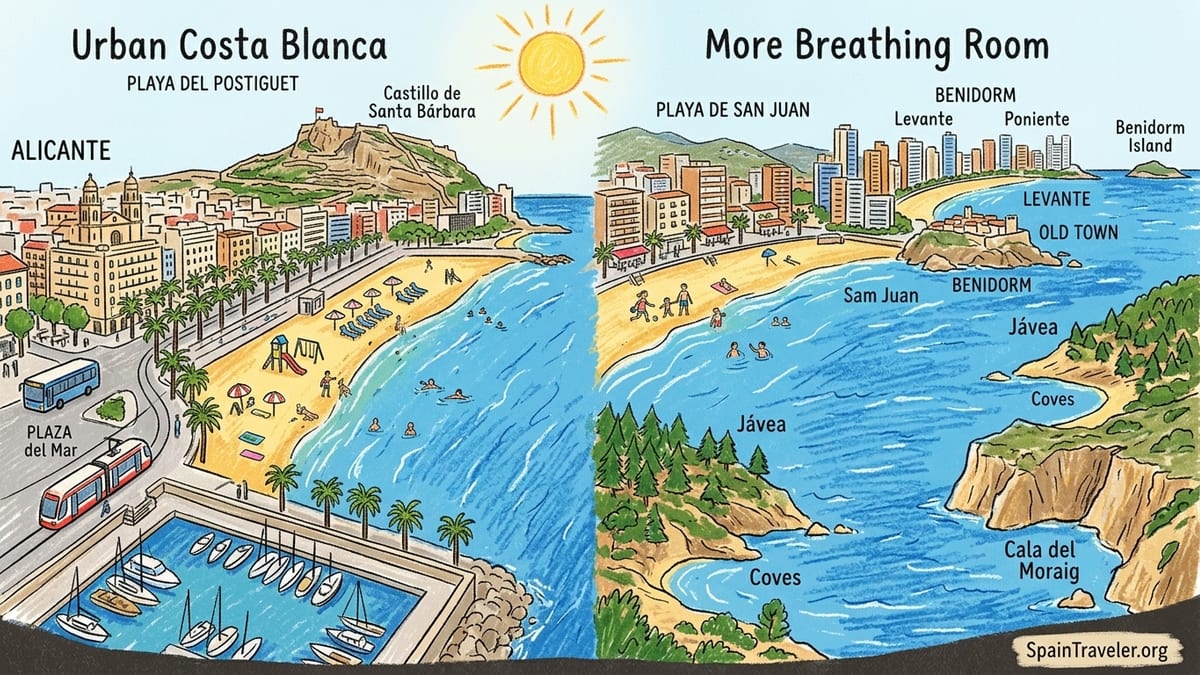
Urban Costa Blanca: Big Sands, Easy Logistics
When you first arrive in Alicante, the Costa Blanca brand can sound abstract. In reality, the city makes it very concrete with Playa del Postiguet, a 900 metre arc of fine golden sand laid right at the foot of Castillo de Santa Bárbara and a short stroll from the Explanada de España promenade. It is the archetypal urban Mediterranean beach: lifeguards in season, rentable sunbeds, parasols, a children’s play area, and a mostly flat seabed that lets you walk out for some distance before the water reaches your chest. The official tourism office describes it as an open, urban beach of fine sand with accessible walkways and basic services including toilets, foot showers, first aid and an accessible bathing point in summer.
In practical terms, Postiguet is one of the easiest beaches on the Costa Blanca to use without a car. Alicante’s tram line stops behind the waterfront, and several city buses run to Plaza del Mar and the port area, a few minutes’ walk from the sand. If you do drive, underground car parks cluster around the marina and port, and a dedicated accessible parking zone sits near one of the main ramps to the beach. A recent local parking guide for September 2026 lists several garages with live occupancy data and typical daytime rates in the range many city drivers would expect to pay for central parking in Spain, which felt fair given the location.
On the sand, Postiguet is busy. On peak August afternoons, it can feel like there is barely a towel’s width between groups near the waterline. I learned to time visits for early morning, when older locals were already swimming in the marked lanes, or for the last two hours of daylight, when families began to pack up. Finding space then was relatively easy, especially toward the eastern Cocó end, where a new breakwater project has been under way since 2025 to stabilise the sand. Toilets and accessible bathing points follow typical municipal schedules that, according to local council documents and disability advocates, usually cover roughly mid morning to early evening in high season. Outside those hours, facilities may be closed, which is worth considering if you prefer dawn or late night swims.
Showers here, as in much of the Costa Blanca, tend to be foot showers rather than full body units. Several residents and visitors have noted that many municipalities have removed or restricted full showers in recent years, partly to reduce water use and partly because some people were treating beach showers as free bathrooms. If you like a proper rinse, Postiguet is not the place to expect one, and the same is increasingly true of other large urban beaches in the region.
Playa de San Juan: Long Sand, More Breathing Room
About 7 kilometres northeast of central Alicante, Playa de San Juan feels like Postiguet’s more relaxed cousin. It is another wide, fine sand beach, around 3 kilometres long, backed by mid rise apartment blocks, playgrounds and cafes rather than a tight city centre. The official tourism narrative for the Costa Blanca often mentions San Juan as the classic long, open beach where Alicante residents actually go, and local comments reinforce that idea. When I asked around in the city in 2026, several people said they avoided Postiguet in favour of San Juan’s cleaner water and more space.
Getting there without a car is straightforward. Tram line L3 and L4 trundle up from central Alicante to stops right behind the beach, and the ride takes roughly half an hour from the city centre. If you drive, you can usually find free street parking a few blocks back from the seafront outside peak weekends, although on August Sundays I have still spent 15 to 20 minutes circling before squeezing into a spot. Once on the promenade, you can simply pick a ramp and walk onto wide, soft sand. The gradient is gentle and the seabed sandy underfoot, though small shore breaks can catch toddlers off guard on windy days.
Facilities along San Juan are broadly similar to Postiguet: seasonal lifeguards, rentable sunbeds on designated zones, foot showers, taps for rinsing sand, public toilets at intervals along the promenade and beach bars ranging from simple kiosks selling coffee and cold drinks to full restaurant terraces offering grilled sardines and paella. Compared with Postiguet, it is noticeably easier to claim a generous patch of sand, particularly if you walk 10 minutes away from the main tram stops. Even in early August I have been able to lay towels with several metres of space around them in the late afternoon.
Shade, however, is limited. There are few natural trees on the sand itself. Most people either rent parasols or bring their own, and by midday the unshaded sections can feel punishing in a Costa Blanca summer. If sitting under solid shade matters to you, reserve one of the sunbed-and-parasol sets or plan to arrive early and hug the shadow cast by the taller buildings on the promenade edge during the first and last hour of direct sun.
Benidorm’s Levante and Poniente: High Rise Backdrop, Surprisingly Clear Water
Benidorm’s skyline is famous across Spain and beyond, and it shapes how you experience its beaches. Levante and Poniente are both broad, fine sand bays with long promenades and regimented lines of sunbeds. The city often stands in for the whole Costa Blanca in foreign press, but on the sand the experience is distinct from Alicante. You are always aware of the wall of towers behind you, yet in front there is an open sweep of sea and, on clear days, views to the rocky islet of Benidorm Island.
On Levante, the younger, livelier side, I found water clarity better than the built up backdrop suggests. Early in the day the sea was a clear blue-green, and swimming 30 or 40 metres out still allowed a view of my hands underwater. The seabed is mostly flat sand and shelves gradually, which is comfortable for weaker swimmers. Poniente, which curves away to the southwest and has a more residential feel, struck me as slightly quieter and more relaxed, with more Spanish families and older northern European visitors than big groups of friends.
Parking is the main stress point. Central Benidorm is dense, and street spaces within a short walk of either beach fill quickly after mid morning in high season. I often opted for paid multi storey car parks a few blocks inland, accepting the daily fee as part of the cost of a relatively frictionless day. The trade off is that once parked you hardly have to walk. Both Levante and Poniente promenades have frequent access ramps, boardwalks onto the sand and lined rows of bars, ice cream shops and restaurants. Toilets are usually attached to beachfront establishments or in municipal blocks set back from the promenade.
If your idea of the Costa Blanca involves quiet coves, Benidorm will feel overwhelming. Yet it is a revealing contrast, because it shows the “resort city” version of the coast that grew up along with the Costa Blanca brand in the mid twentieth century. After a day on Levante or Poniente, driving north toward Jávea and seeing the cliffs close in over smaller, rockier coves is like changing channels to another program.
Cala de la Granadella, Jávea: A Managed Gem in the Pines
La Granadella, tucked into the southern end of the Jávea coastline, is one of the places I would go back to in a heartbeat, though visiting in 2026 requires a little more planning than it did some years ago. The cove itself is small, enclosed by pine covered slopes and cliffs, with white pebbles that tumble into turquoise water. Official guides and local tourism materials describe it as a Blue Flag cove surrounded by natural landscape, used for swimming, kayaking and snorkeling. The water clarity on my visits has been exceptional, with visibility that invites you to bring a mask.
Because of its popularity and environmental pressure, the municipality of Xàbia introduced an access management scheme that the town has confirmed will continue at least through the 2026 season. Recent local reporting and specialist beach guides describe a system where private cars cannot simply drive down and park at the water’s edge in high season. Instead, regulated parking is concentrated in designated upper car parks, and a shuttle service in the form of a small road train ferries visitors down toward the cove during operating hours. The 2026 notice sets a defined season for regulation from early June to early September plus some September weekends, with a fixed number of parking spaces and a timetable published by the council.
From a visitor’s point of view, this means you should expect to park once at an upper lot, then walk to the shuttle stop and ride the short but winding descent. The shuttle was free or low cost on my last visit, and the queues moved quickly outside the sharpest mid morning peak. At the bottom, a short walk leads you onto the pebbles. There is little natural shade on the actual beach, and the steep slopes behind you mean shade only reaches the back of the cove later in the afternoon. In summer I bring sturdy sandals because the pebbles are uncomfortable in thin flip flops and can shift underfoot at the water’s edge.
Facilities at Granadella are minimal compared with urban beaches. In season there is usually a small lifeguard point and a couple of fixed kiosks or beach bars offering drinks and simple meals such as bocadillos and grilled fish, but you should not rely on a full supermarket style selection. Simple foot showers and toilets have been present in past years, though exact opening hours can vary with the regulated season. Because of the shuttle system and parking cap, crowding on the pebbles is controlled. On a busy August day you will still share the cove with plenty of people, kayaks and paddle boards, yet there is usually at least enough space to stretch out on a towel without touching your neighbour, something that is far from guaranteed on Postiguet at the same time of year.
Cala del Moraig, El Poble Nou de Benitatxell: Cliffs, Pebbles and Regulations
Just up the coast from Jávea, in the small municipality of El Poble Nou de Benitatxell, Cala del Moraig is perhaps the most dramatic of the coves I have visited along the Costa Blanca. It is a natural cove enclosed by high limestone cliffs, recognised with a Blue Flag, where a gravel and pebble beach meets deep, clear water above rocky seabeds and meadows of Posidonia sea grass. The local tourism office highlights its geological setting, next to the Moraig Fault and the Cova dels Arcs sea cave, as a key attraction. Standing on the pebbles looking up at the cliffs, the sense of scale is striking.
For drivers, however, the experience starts at the top. In recent years, the municipality has progressively tightened vehicle access to protect the area and manage crowds. The official tourism page now states clearly that vehicle access to the cove itself is not permitted, and that visitors must park in the designated area at the top of the descent and continue on foot. Additional documentation tied to a European funded mobility project explains that parking along the access road has been banned for safety reasons, because the carriageway is too narrow to accommodate roadside parking. In high season, a reservation and payment system has been used to manage the upper car park, with residents of the municipality granted specific privileges.
From this upper area, the walk down follows a steep paved road that snakes toward the sea. It is manageable for healthy adults in regular shoes, but people with knee or mobility issues may find the return climb challenging, particularly in midday heat. There are some railings and small lay bys to pause, but very little natural shade. I make a point of going early, when the descent and the beach are cooler, and carrying more water than I think I need. Once at the bottom, the reward is a beach where the sea turns a deep, glassy blue almost at the shore. The bottom drops more quickly here than on urban sands, so weaker swimmers should stay close in. For snorkelers, the rocky edges and submerged boulders support abundant fish life.
Facilities match the coves’ natural setting. Moraig has seasonal lifeguards, a buoyed bathing area, information panels about sea conditions and, in recent years, a modest beach bar presence. Toilets and basic showers operate during the bathing season, but outside those months or hours you should not count on services. One end of the cove has a long standing naturist tradition, and while this is not aggressively signposted, you may notice a more relaxed dress code at that far flank of the shore. Space on the pebbles fills quickly in high summer weekends, and with access now controlled from the top, there will be days when the car park or reservation system effectively caps visitor numbers and forces latecomers to change plans. On the upside, that same control helps preserve water clarity and reduces the worst overcrowding.
Coves Around Jávea and Dénia: Smaller, Rockier, Worth the Effort
Beyond Granadella and Moraig, the stretch of Costa Blanca known as the Marina Alta, around Jávea, Dénia and Benissa, is where the coast becomes a necklace of small rocky calas that the region’s own tourism materials single out for their turquoise water and cliffs. Over several trips I have sampled a few of these, including coves accessible from the Jávea and Dénia sides of the Montgó massif. They are different in character from the broad urban sands of Alicante and Benidorm. You swap easy access and long promenade strolls for shorter strips of pebble or rock platform, steep paths, and water that can look almost impossibly clear.
One of the appeals of these northern coves is the mix of surfaces. Instead of long runs of uniform sand, you might find flat rock shelves that warm in the sun, patches of large rounded pebbles that require sturdy sandals, and narrow entry points into deep water. This suits confident swimmers and snorkelers more than toddlers or people who like to wade in gradually. The depth can increase quickly, and you are often just a few strokes away from rocky underwater walls covered in seaweed and darting fish, especially around the headlands and near marine reserve boundaries.
Parking at these coves is usually limited to small surface lots or roadside pull outs at the top of the access path. In high season they fill early, and some municipalities now experiment with barriers, shuttle systems or resident priority spaces similar to those at Granadella and Moraig. Services are basic. You may find a single chiringuito selling cold drinks and snacks, a composting toilet or none at all, and no formal showers. Shade depends on the orientation of the cliffs and the time of day. In several coves near Jávea, morning shade lasted on one side of the inlet until late morning before full sun hit every rock, only to see shade return in slender strips by late afternoon as the cliffs cast long shadows back across the water.
For visitors used to the broad sands of Alicante, this can feel more like a day out in nature than a classic beach day. There are no long seaside promenades, few if any rentable loungers, and crowds are often more mixed, with local residents, snorkelers with their own gear and families willing to climb. Yet these small coves embody the other Costa Blanca that regional tourism offices often highlight, the one of hidden spots tucked below cliffs and pine forests. They are where I have most often felt like returning the next morning, despite the steeper walks and the occasional scramble back up in flip flops carrying a cooler.
Researched Alternatives Worth Knowing About
Beyond the places I have personally visited, there are several beaches and coves along the Costa Blanca that come up repeatedly in current local sources and official tourism information as noteworthy alternatives. I have not yet swum there, so what follows is clearly labelled as researched rather than experienced first hand, but the details are useful if you are building a broader itinerary along this coast.
In Alicante province’s official tourism descriptions and Spain’s national tourism portal, Playa de Levante and Playa de Poniente in Benidorm, as well as Calpe’s beaches under the Peñón de Ifach, are cited as major family friendly sandy stretches with extensive services. North of Benidorm, municipalities such as Altea, Alfàs del Pi and Calpe promote a mix of fine sand beaches and smaller pebble coves, many with Blue Flag recognition in recent seasons and promenades lined with restaurants and bars. To the south of Alicante city, long beaches such as Urbanova, Guardamar del Segura and parts of the Torrevieja coastline are highlighted in official guides for their dunes, pine groves or accessible facilities.
Regional documentation about the Costa Blanca notes that the coastline includes more than 200 kilometres of shore and more than 170 coves and beaches, with dozens of Blue Flag awards across the province in recent years. Exact counts and which beaches hold the Blue Flag change annually as municipalities apply and renew. For up to date details on particular beaches, such as whether dogs are allowed, if a specific cove is naturist or whether there is step free access or a current parking restriction, local municipal tourism sites and town hall notices are the most reliable sources, since rules can shift from one season to the next.
Several coves near Benissa and Moraira, such as those under pine lined cliffs with small stone platforms and clear water, are singled out in up to date regional beach guides for snorkeling and kayaking. Again, access and parking arrangements can be dynamic, particularly since some town halls have begun experimenting with shuttle services and access controls similar to those implemented at Granadella and Cala del Moraig in response to crowding and environmental stress. If you plan to explore beyond the better known beaches, it is increasingly important to check the latest local information shortly before you travel.
The Takeaway
The Costa Blanca’s 200 plus kilometres of shoreline contain a far greater variety of beach experiences than the brochures sometimes suggest. From the fine urban sands of Alicante’s Playa del Postiguet and the long run of Playa de San Juan, to the high rise backed bays of Benidorm and the pebbled coves of La Granadella and Cala del Moraig, the coast offers distinct trade offs between convenience and wildness. Having driven and trammed between them, the pattern is clear. The closer you are to tram stops, city centres and all day promenades, the easier parking and services become, but the harder it is to find personal space and shade. The further you drive along narrow roads into the cliffs north of Jávea and Benitatxell, the more the day turns into a small adventure, with cove access, parking reservations and steep walks standing between you and those clear turquoise waters.
For a first visit to the Costa Blanca, combining at least one urban beach day in Alicante or Benidorm with a carefully planned excursion to a managed cove such as La Granadella or Cala del Moraig gives a good sense of that contrast. On the city sands you learn the rhythms of Spanish summer days, the hours when families arrive, and how services concentrate into the core of the bathing season. In the northern coves you see up close how popular nature can push municipalities to introduce shuttles, quotas and car bans to preserve fragile environments. Both sides are part of the real Costa Blanca in 2026, and both are worth experiencing with open eyes and realistic expectations.
When I look back on my own time along this coast, the places I would most readily return to are those where the walk down to the water feels connected to the landscape. That includes city beaches like Postiguet, framed under a medieval castle, as well as coves like Moraig where limestone cliffs close overhead. Just as importantly, they are places where the basics work: where you can park or reach the tram without anxiety, find a functioning toilet and at least a foot shower, and still stretch out a towel without sitting almost on top of your neighbours. On a coast with more than 170 official beaches and coves, those may not be rare, but it is still worth choosing them deliberately.
FAQ
Q1. How easy is it to visit Costa Blanca beaches without a car?
Alicante and Benidorm beaches are relatively easy without a car, thanks to tram and bus lines that stop close to the sand. Playa del Postiguet and Playa de San Juan are particularly straightforward from central Alicante. The smaller northern coves around Jávea, Benissa and El Poble Nou de Benitatxell are harder to reach on public transport and usually require at least a short taxi ride from the nearest town or a hire car combined with regulated parking and, in some cases, shuttle services.
Q2. Do Costa Blanca beaches still have full body showers?
Many large beaches along the Costa Blanca, including those around Alicante, now focus on foot showers and taps for rinsing sand rather than full body showers. Local discussions and municipal decisions in recent years have pointed to water saving concerns and misuse as reasons for reducing or removing full showers. If a proper rinse matters to you, plan to shower at your accommodation rather than relying on beach facilities.
Q3. Are La Granadella and Cala del Moraig suitable for small children?
Both La Granadella and Cala del Moraig are beautiful but are better suited to confident swimmers and families comfortable on pebbles and rock. The beaches are mostly pebbled, which can be uncomfortable under bare feet, and the seabed becomes deeper and rockier more quickly than on flat urban sands. There are no long shallow paddling zones like those on Playa de San Juan or Poniente. For toddlers and very young children, the broad sand beaches around Alicante or Benidorm generally offer easier entry and more space to play.
Q4. How early do I need to arrive to park at the smaller coves?
At popular coves such as La Granadella and Cala del Moraig in the peak of summer, regulated parking areas at the top of the access roads can fill by late morning on weekends. Municipal schemes now use car park capacity limits, booking systems or timed access windows to protect these sites. To reduce the risk of being turned away, it is wise to arrive early in the morning, check for any reservation requirements before leaving your accommodation and be flexible enough to divert to a different beach if the car park is already full.
Q5. Are there shaded areas on Costa Blanca beaches?
Natural shade is limited on most Costa Blanca beaches. Urban sands like Postiguet and San Juan have almost no trees on the beach itself, so shade comes from umbrellas or the shadow of nearby buildings during the earliest and latest hours of the day. In smaller coves around Jávea and Benitatxell, some shade appears where cliffs cast shadows onto the pebbles, but this pattern changes with the time of day and the orientation of the cove. If staying out of direct sun is important, bringing or renting a parasol is the most reliable option.
Q6. What is the water clarity like along the Costa Blanca?
Water clarity varies along the coast. On broad urban beaches in Alicante and Benidorm, the sea can be a pleasant blue-green, though waves and sand churned up by swimmers can reduce visibility near shore. In the smaller northern coves, especially those with rocky seabeds and Posidonia sea grass like Cala del Moraig and La Granadella, water clarity is often outstanding on calm days, which is why these spots are popular for snorkeling. The trade off is steeper access and fewer facilities.
Q7. Are beach toilets and accessible services open all year?
Most beach facilities, including toilets, accessible bathing points and staffed lifeguard stations, operate on a seasonal schedule tied to the main bathing months. Council documents and local news in 2026 highlight that some accessible services in Alicante, for example, only open from early summer to mid September and keep specific daytime hours. Outside those periods you may find beaches unguarded and facilities closed. It is best to check municipal information if you are travelling in shoulder seasons or outside school holidays.
Q8. Can I find quiet spots even in August?
Finding real solitude in August on the Costa Blanca is challenging, but not impossible. On long beaches such as San Juan or Poniente, you can usually secure a bit more space by walking 10 to 15 minutes away from tram stops and main access points. In the managed coves, overall numbers are capped by parking and shuttle capacity, so while they are still busy, they typically avoid the wall to wall towels you see on central city sands. For truly quieter experiences, early mornings and late afternoons are the best windows, when day trippers are either yet to arrive or already packing up.
Q9. Are there beach bars on the smaller northern coves?
Many of the smaller coves from Jávea to Benissa have at least one seasonal beach bar or kiosk, but the scale is modest compared with urban promenades. At La Granadella and Cala del Moraig, for example, you may find a couple of establishments serving drinks, snacks and simple meals during the main season, yet you should not rely on them for all your needs. Bringing water, some food and basic shade is sensible, especially if you plan to stay several hours or visit outside the peak summer weeks when some businesses may be closed.
Q10. How many beaches and coves are there on the Costa Blanca overall?
According to recent regional tourism materials, the Costa Blanca coastline in Alicante province extends for more than 200 kilometres and includes more than 170 officially recognised beaches and coves. The exact number in any given year can vary slightly as municipalities update their inventories and classifications, and as new small coves or stretches of shore are equipped or signposted. Rather than trying to see them all, focusing on a handful that match your preferred balance of sand versus rock, services versus wildness, and ease of access versus seclusion will usually make for a better trip.