

The Community of Madrid is much more than the capital. Within an hour or so of Puerta del Sol you can walk in high mountain cirques, wander through royal gardens on the banks of the River Tagus and get lost in medieval streets where Cervantes once lived. If you are already planning several days in Madrid city, the real question is not whether to add the wider region but how much of it, and in what order. This framework helps you build 3, 5 or 7 regional days around Madrid without turning your trip into a blur of rushed day trips.
Understanding the Community of Madrid Beyond the Capital
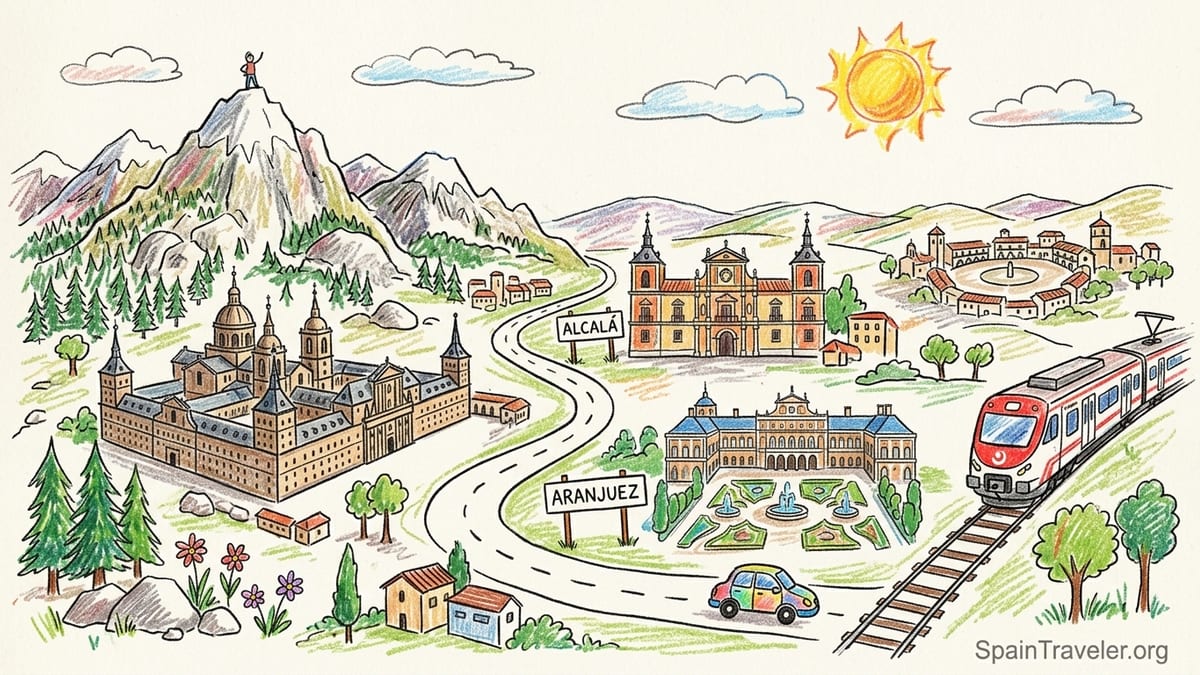
The Community of Madrid is a compact region, but its tourism structure is clear. There are three UNESCO World Heritage destinations linked under the World Heritage in Madrid brand: the university city of Alcalá de Henares, the royal monastery complex and town of San Lorenzo de El Escorial, and the royal town and gardens of Aranjuez, recognized as a Cultural Landscape. To this list you can now add the Hayedo de Montejo beech forest, which forms part of a wider UNESCO inscription focused on primeval beech forests. These sites concentrate much of the region’s headline culture and history.
Nature is anchored by the Sierra de Guadarrama National Park, created in 2013 and preserving more than 33,000 hectares of high mountain ecosystems. Peaks such as Peñalara, at around 2,428 meters, and the Abantos ridge above El Escorial bring an Alpine feel within roughly an hour of Madrid. Surrounding protected areas, including the Cuenca Alta del Manzanares Regional Park and landscapes around Manzanares el Real, effectively extend this green belt and give the capital an accessible mountain backyard.
Overlaying this, the regional government promotes the 11 Villas de Madrid, a group of smaller historic towns that represent different corners of the region. They include places like Chinchón with its famous plaza mayor, Colmenar de Oreja among vineyards and quarries, Villarejo de Salvanés with its striking tower, and Manzanares el Real under the granite walls of La Pedriza. These are not museum pieces. They are real towns where weekend locals fill terraces, and that is exactly why they balance the more formal World Heritage sites so well.
Most visitors base themselves in Madrid city and explore outwards. That makes sense, because almost every destination in this article is reachable in about one hour by Cercanías commuter train, regional bus or a short rental car drive. The trap is to assume that proximity equals simplicity. Timetables, weekend mountain crowd limits and the feel of each place at different times of day all affect how pleasant your trip will be. The following sections use that regional structure to show how many days you might add, depending on your interests.
Transport Basics: When Trains, Buses or Cars Make Sense
The Community of Madrid has one of Spain’s densest public transport networks. Renfe Cercanías, the commuter rail system, runs nine lines radiating from central hubs such as Atocha and Chamartín and linking directly with places like Alcalá de Henares, Aranjuez, San Lorenzo de El Escorial (via El Escorial station) and mountain foothill towns such as Cercedilla. Services typically start around 5 to 6 in the morning and run until close to midnight. Fares are distance based, with single tickets starting from around 1.50 euros for short hops and increasing stepwise with additional stations.
The Regional Transport Consortium of Madrid coordinates buses and tickets. It divides the region into zones that also apply to many train journeys, and publishes official prices for 2026 that continue the subsidies introduced in previous years. For visitors staying several days, a rechargeable transport card with a short term tourist pass can be very good value, especially if you rely on metro and Cercanías to get to Atocha or Chamartín before each day trip. You buy the physical card from machines in metro or Cercanías stations and then load the pass or single tickets on top.
For most World Heritage and village destinations, public transport is so frequent and cheap that renting a car adds little. For example, trains from Madrid to Alcalá de Henares can take around 40 minutes, and trains to Aranjuez or El Escorial are in a similar range under normal conditions. In each case, stations are within an easy 10 to 15 minute walk of the historic center or main sights. Long distance intercity trains on the same corridors are faster but often cost several times more and are unnecessary for day trips.
Car rental becomes valuable if you want to string together several smaller towns, reach trailheads inside the Sierra de Guadarrama at flexible times or stay overnight in rural accommodation. Reaching villages such as Rascafría, Patones de Arriba or some of the lesser visited Villas de Madrid usually means at least one bus connection and conservative planning for return services. A two or three day rental from a city office, timed to start the day you leave Madrid city overnight, lets you combine El Escorial with mountain walks, detours through villages like Manzanares el Real and perhaps a winery in the southeast. The key is to avoid a car in central Madrid unless you have hotel parking and to be aware of weekend vehicle limits inside the national park.
Why Rushing the Region Ruins Good Itineraries
On paper it can look feasible to “do it all” in two long days: Alcalá de Henares in the morning, Aranjuez in the afternoon, then El Escorial and Chinchón plus a quick hike in the Sierra de Guadarrama. Distances on maps are short and public transport timetables show connections every 30 to 60 minutes. The reality on the ground is that each of these places deserves time, and transitions between them eat more of your day than you expect.
Take Alcalá de Henares as an example. Even a fairly brisk visit that includes a walk through the university courtyards, the Calle Mayor arcades, the Cervantes Birthplace Museum and lunch in the historic center can easily last five or six hours. In Aranjuez, much of the appeal lies not only in touring the palace but in strolling the Prince’s Garden and Island Garden, having a coffee near the Tagus and perhaps taking the seasonal historic Strawberry Train on a spring or autumn weekend. Cutting either destination to two hours so that you can rush back to Madrid for another train drains away what makes them special.
Transferring between towns is also slower than it appears. There are no direct public transport links that sensibly combine Alcalá, Aranjuez and El Escorial into single day triangles. You generally have to return toward Madrid and change lines, which means walking back to stations, waiting times, and the mental load of monitoring different schedules. Even with a car, driving between Aranjuez in the south and El Escorial toward the northwest in one afternoon means skirting or crossing the capital’s ring roads and hoping not to hit commuter traffic.
The mountains add a different kind of pressure. In winter snowfalls and on sunny weekends year round, the Sierra de Guadarrama experiences what local media repeatedly describe as bottlenecks, with access roads and car parks filling early in the morning. When the quotas are reached, authorities close access roads for safety and environmental reasons, a point that has been emphasized in reports on crowding in La Pedriza and at passes such as Navacerrada and Cotos. If your schedule expects you to race up from a morning in Chinchón for a short afternoon hike at Peñalara, the odds are high that you will meet a road closure or arrive so late that trails are already crowded and parking is full.
3 Regional Days: A Focused Mix of UNESCO and Nature
If you can only spare three days beyond Madrid city, it is better to choose depth over reach. A balanced plan usually means one or two UNESCO heritage towns and one clear nature or village day, not all of them. A realistic sequence for a first visit would be Alcalá de Henares, Aranjuez and one outing to either El Escorial or the Sierra de Guadarrama, depending on your interests and the season.
For a culture focused visitor, one day in Alcalá de Henares and one in Aranjuez already provides a strong sense of royal and intellectual Spain around the capital. A third day in San Lorenzo de El Escorial lets you connect the dots, seeing how Philip II’s monastery and palace complex dominates the landscape below Abantos and how the town grew around the royal site. Trains serve all three, so you can avoid renting a car and keep logistics simple. It is perfectly feasible to leave after breakfast from Madrid, arrive for a mid-morning walking tour, enjoy a leisurely lunch and still be back in the city by early evening.
If you want at least one day away from palaces, trade El Escorial for the Sierra de Guadarrama. In spring and autumn, a good option is to take a bus from Madrid’s Moncloa transport hub toward the high passes such as Cotos, or to catch a Cercanías train up to Cercedilla. From there, marked trails lead through pine forests and viewpoints, and in summer you can descend to a village terrace for a late lunch. This gives you a sense of the mountains without the need to understand complex access regulations or rent equipment.
Nature lovers might also use their third day for one of the 11 Villas de Madrid instead of the high peaks. Chinchón offers a classic day of balconies, churches and local gastronomy focused around its flagship square. Manzanares el Real pairs directly with La Pedriza, so you can walk from the town’s castle up into a granite landscape recognized as part of a protected regional park and the national park’s buffer area. Buses from Plaza de Castilla toward Manzanares el Real, for example, typically reach the village in around an hour, which makes this one of the simplest nature excursions from Madrid.
5 Regional Days: Contrasting Experiences Without Constant Transfers
With five regional days to work with, you can begin to combine several themes without turning every day into a commute. For most travelers, the sweet spot is three days anchored on the UNESCO cities and major royal sites, plus two days mixing mountains and smaller towns. Instead of adding more individual destinations, focus on changing pace and atmosphere between days.
A common structure is to start with Alcalá de Henares and Aranjuez on separate days, using Cercanías trains and avoiding car rentals. On a third day, visit El Escorial, which naturally blends culture and landscape thanks to its position on the slopes of the Sierra de Guadarrama. Walking out of the monastery complex and looking up at the Abantos ridge helps you understand why royal planners placed one of Europe’s largest monasteries here and how the mountains have always framed Madrid’s horizon.
The remaining two days can then lean toward nature and village life. One model is to dedicate a full day to the high Sierra, perhaps riding a bus to Cotos for a circuit around the Peñalara cirques or using the historic mountain railway from Cercedilla when it is operating. Another day might link a Villa de Madrid like Chinchón or Colmenar de Oreja with nearby wine estates that accept visits, especially in the southeast of the region where Denomination of Origin Vinos de Madrid vineyards are concentrated. Without over-planning, you could join a late morning bodega tour, have a winery lunch and still catch an afternoon bus back to the capital.
An alternative for those who prefer less elevation change is to split these two days between Manzanares el Real and another villa such as Villarejo de Salvanés. At Manzanares, you can walk a short stretch into La Pedriza’s granite chaos, then return to town to tour the castle and sit in a plaza café. At Villarejo, the draw is a medieval tower and a small historic center that feels entirely different from the university atmosphere of Alcalá or the courtly avenues of Aranjuez. You experience the region as a set of distinct micro-worlds instead of ticking off names from a list.
7 Regional Days: Building a Deeper, Overnight Trip
Once you reach seven days in the Community of Madrid beyond the capital, you can design a regional trip within your wider Spain journey. At least one overnight outside Madrid city becomes not only possible but recommended. This avoids commuting back and forth through Atocha or Chamartín and lets you see both cities and mountains at quiet times, such as evening blue hour in a small town or early morning on the trail.
A practical framework is to spend your first two or three regional days still based in Madrid and focused on rail-accessible UNESCO sites. Then, on day four, pick up a rental car in the city and drive to El Escorial for a half day visit before continuing up over the Sierra passes to stay in a mountain village like Cercedilla, Navacerrada, Rascafría or Miraflores de la Sierra. Local media and national park materials describe how spending more than a single afternoon in these valleys reveals quieter forests, small museums and traditional restaurants away from mid-day crowds.
From a mountain base you can devote one or two full days to hiking or low-key nature walks, adjusting depending on season and weather. For example, one day might focus on high routes around Peñalara or easier family circuits in the pine forests near Cotos. Another could be spent exploring river gorges or lower altitude trails that stay pleasant in summer heat. With your own car, you can time departures to arrive at car parks before access quotas are reached or to continue to alternative valleys if a particular area is closed or full.
The final two or three days might then bring you down to the southeast for vineyards and villages. You could drive from the Sierra to Chinchón, staying overnight in a traditional inn on the plaza and visiting nearby Colmenar de Oreja or Villarejo de Salvanés the next day. Dropping the car at a suburban rail station and taking a Cercanías train back into Madrid saves you the stress of driving into the center. This seven day arc shows you royal corridors, mountain ridges and wine country without requiring more than about 90 minutes of driving on any one stretch.
Public Transport vs Car: Crowds, Weekends and Smart Sequencing
Public transport within the Community of Madrid is robust enough that many residents complete entire trips without a car. For visitors, trains and buses are ideal for point to point journeys along major axes, such as central Madrid to Alcalá de Henares, Aranjuez or El Escorial. Services are frequent on weekdays, and a regional transport pass avoids the need to understand zonal pricing for every single ride. On days built around one key town, this is usually the most relaxing option.
Car rental becomes attractive when your plans are more open ended or when you want to react to conditions in the Sierra de Guadarrama. Crowd control measures have been tightened in specific hotspots such as La Pedriza and at high passes, especially in summer and on winter snow weekends. Regional news reports in 2026 describe how authorities close access roads once car parks are full and remind visitors that some areas operate with quotas on the number of people or vehicles allowed inside. With your own car, you can simply reroute to a different trailhead or valley if you arrive to find barriers in place.
Weekends add another layer. Saturdays and Sundays are peak days for Madrileños heading to the mountains, and media coverage regularly shows long lines of vehicles stuck below passes like Navacerrada. If you are working with a short 3 day add-on, it is usually wiser to schedule UNESCO towns for Saturday or Sunday, when they absorb visitors easily, and keep mountain days for weekdays. With 5 or 7 regional days you can be more flexible but should still avoid combining a Sunday in the Sierra with a same day rental car return or a fixed evening train booking to another part of Spain.
In all cases, sequencing matters more than squeezing. It is better to accept that you will not see both Chinchón and the Sierra de Guadarrama on the same afternoon than to gamble your enjoyment on clear roads and empty car parks. If mountain weather deteriorates or train works disrupt part of the Cercanías network, having an extra unscheduled regional day in a 7 day framework gives you room to swap plans without losing the essence of your trip.
Models for Different Traveler Types
First time visitors who focus on culture can confidently allocate at least two, and ideally three, regional days to the UNESCO cities. A classic sequence would be Alcalá de Henares for university heritage and Cervantes, Aranjuez for royal gardens and water, and El Escorial for monastic power and landscape. You can add a single mountain taster, such as a low effort trail near Cercedilla or a stroll around Manzanares el Real and its castle, without sacrificing cultural depth. Public transport fully supports this model, so car rental is optional at most.
Nature heavy travelers may want the opposite pattern. In a 5 or 7 day regional plan, three or four days could be spent in and around the Sierra de Guadarrama, possibly split between two different valleys. One base might be a village near Cotos and Peñalara for high routes, while another sits near La Pedriza for granite formations and river pools. A short visit to El Escorial gives cultural context and pairs well with a ridge walk above the town. You might then choose just one UNESCO town, perhaps Alcalá or Aranjuez, for a softer day of cafes and architecture between hikes.
Families often benefit from a mix of simple train rides, open air space and clear storytelling. The Strawberry Train to Aranjuez on selected spring and autumn weekends is a natural hit, combining a historic train journey with costumed staff and tastings of local strawberries, plus time to roam palace gardens. In Alcalá de Henares, children can enjoy following Cervantes themed signage and statues, or joining a guided walk tailored to younger visitors. A mountain day for families might focus on easy circuits around a reservoir, picnic areas near Cercedilla or cable car rides when available, rather than committing to long exposed climbs.
Food and wine focused travelers will find most options in the city, but the wider region adds valuable context. The southeast, tied to the Vinos de Madrid designation, is the natural focus for winery visits, with estates near towns like Arganda del Rey or Navalcarnero often offering tasting rooms and guided tours by reservation. Combining a lunchtime vineyard visit with an afternoon wandering a Villa de Madrid such as Chinchón, known for its anisette and traditional cooking, gives a full day built around local flavors. In Alcalá and Aranjuez, look for menus del día that feature seasonal vegetables, Tagus river fish or game from nearby estates to see how royal and rural kitchens have overlapped historically.
The Takeaway
Planning how many days to spend in the Community of Madrid beyond the capital is less about counting sights and more about understanding the region’s structure. Three days give you enough time for one or two World Heritage cities plus a taste of either the Sierra de Guadarrama or a historic village. Five days allow you to add genuine contrast, with at least one full mountain day and another focused on the 11 Villas de Madrid. Seven days open the possibility of a regional loop, including overnights in small towns and mountain bases, without constant backtracking through Madrid’s main stations.
The most common mistake is to see names like Alcalá, Aranjuez, El Escorial, Chinchón and the Sierra on a map and assume that you can combine them all in two days. Official transport, park regulations and local reporting on weekend crowding show why that leads to rushed, compromised trips. Trains and buses carry you efficiently to single centers, while a short car rental unlocks clusters of villages and flexible mountain access if you have enough time to use it calmly.
Whichever model suits you, aim to give each kind of landscape or town its own clear day. Let royal gardens, granite ridges and medieval squares breathe on the itinerary instead of being quick morning stops. The Community of Madrid is one of Spain’s easiest regions to combine with a city break precisely because it rewards this kind of thoughtful pacing. By using these 3, 5 and 7 day frameworks as a guide, you can shape a visit that feels both varied and coherent, with Madrid city at the center and its mountains, vineyards and heritage towns as interconnected worlds around it.
FAQ
Q1. Can I visit all three UNESCO World Heritage cities near Madrid in one day?
Trying to see Alcalá de Henares, Aranjuez and El Escorial in a single day is not realistic. Each needs at least a half day from Madrid once you factor in train rides, walking from stations and time inside monuments, so it is wiser to dedicate one full or nearly full day to each.
Q2. Do I need a car to reach the Sierra de Guadarrama from Madrid?
No, you can reach many parts of the Sierra by public transport, using buses from Moncloa to passes such as Cotos or taking Cercanías trains to Cercedilla or El Escorial. A car becomes useful if you want to link several valleys in one trip or react flexibly to access quotas and weather.
Q3. How crowded are the mountains on weekends?
On sunny weekends and during snow periods, local media regularly report traffic jams and full car parks in the Sierra de Guadarrama. Authorities sometimes close access roads once quotas are reached, especially in hotspots like La Pedriza or near high passes, so arriving early or visiting on weekdays is advisable.
Q4. Is a 3 day regional add on worth it if I only like cities?
Yes. With three days you can easily visit at least two of the UNESCO cities such as Alcalá de Henares and Aranjuez, plus perhaps a third like El Escorial, all by train. You can enjoy architecture, museums and cafes without needing mountain hikes.
Q5. When does it make sense to rent a car for the region?
A short rental of two or three days makes sense once you start combining mountain valleys and smaller villages, or when you plan a 7 day regional loop with at least one overnight outside Madrid. It is less useful for straightforward day trips to single cities along the rail corridors.
Q6. Can I base myself entirely in Madrid and still see the wider region?
Yes, if you are happy with day trips. Bases in central neighborhoods with good access to Atocha, Chamartín or Moncloa work well, and you can return to the city every night. Just remember that commuting in and out for seven consecutive days is more tiring than including one or two overnights in smaller towns.
Q7. How should I plan for possible train disruptions?
Occasional works and incidents can affect Cercanías lines around Madrid, especially in busy summer months. Check the Renfe Cercanías Madrid information channels the evening before a planned trip and allow extra time to reach your departure station, or have a backup bus route in mind.
Q8. Is it safe to hike in the Sierra de Guadarrama without a guide?
Established trails near passes and villages are well signposted, and many visitors hike independently. However, you should check weather forecasts, carry basic gear, choose routes appropriate to your fitness and avoid venturing into high or snow covered areas without experience or local advice.
Q9. Are there good options for wine tourism near Madrid?
Yes, the southeast of the region hosts estates under the Vinos de Madrid designation, often near towns like Arganda del Rey or Navalcarnero. Many wineries offer tours and tastings by prior reservation, which you can combine with visits to nearby historic villas.
Q10. How many regional days should I add if I have one week total in Madrid?
If you have seven days in and around Madrid, a common split is four or five nights devoted mostly to the city and two or three days for the wider Community of Madrid. That allows you to see at least one UNESCO city and either the Sierra de Guadarrama or a pair of smaller historic villages without feeling rushed.