


Central Spain is one of Europe’s easiest regions to explore without a car. Madrid sits at the heart of a dense web of trains, intercity buses and organized tours that make classic destinations like Toledo, Segovia and Salamanca straightforward even for first-time visitors. But some rural corners and wine or hiking regions are far harder to reach. Understanding the trade-offs between rail, bus and tour options will help you design a trip that feels rich and flexible without the stress of driving.
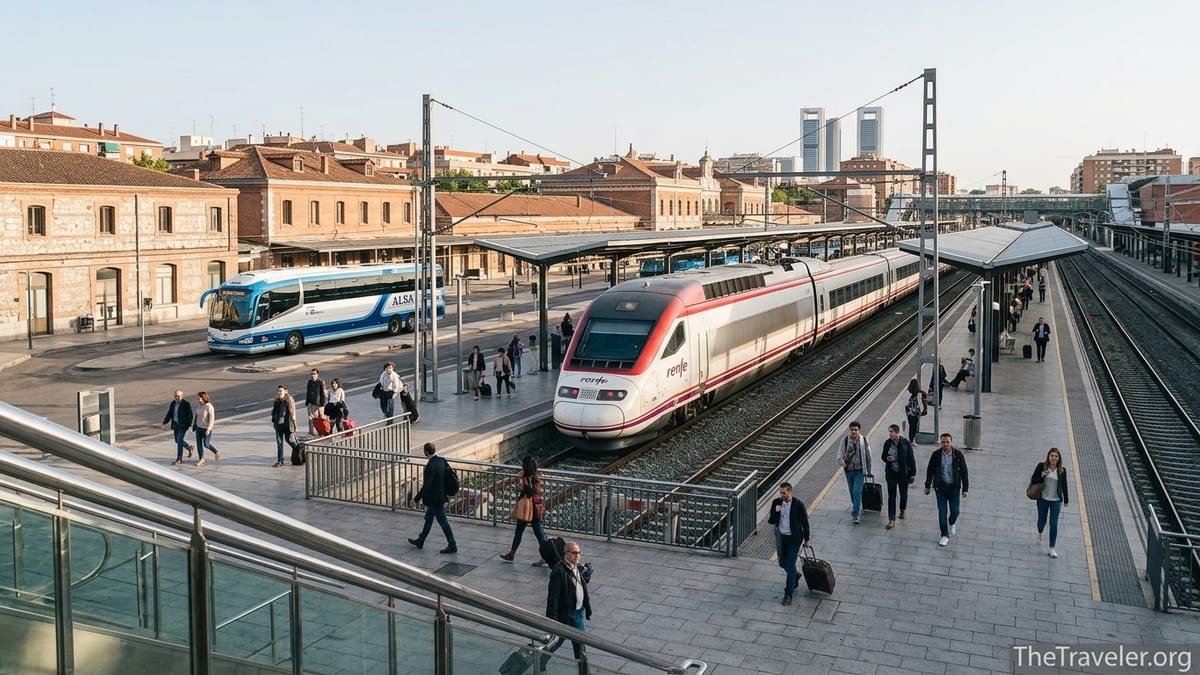
How Easy Is Central Spain Without a Car?
For most travelers, a car is optional rather than essential in central Spain. Madrid is the main hub for long-distance trains in the country, with fast AVE and Avlo high-speed services, mid-range Alvia and Avant trains, and slower Media Distancia regional routes radiating in every direction. This means you can be in Toledo in about 30 minutes by train, Segovia in under 30 minutes on many services, and Salamanca in around 1 hour 45 minutes on the better connections. Buses fill many gaps, especially to smaller cities and towns, and major operators like ALSA and Avanza link Madrid to provincial capitals and some larger villages.
Where things become harder is once you leave these main axes. Classic historic cities such as Ávila, Cuenca, Burgos and León work perfectly well without a car because of decent rail or bus links and compact historic centers. But smaller wine villages in La Mancha, hilltop castle towns in sparsely populated provinces, and rural natural parks often have limited or no public transport. In those cases, you either accept a more superficial visit via day tour, plan around the few available buses, or reconsider whether it is worth the effort without renting a vehicle for a day or two.
For a one or two week trip focused on cities, art and food, you can confidently rely on public transport and occasional tours. If your dream is drifting between windmills, remote monasteries and tiny villages, you will either need more time, more patience or a willingness to drive. The sweet spot for many visitors is to base themselves in well-connected cities like Madrid, Toledo or Salamanca, using trains and buses for independent day trips, and adding a couple of targeted small-group tours for rural experiences.
Trains vs Buses vs Tours: What Works Best Where
Trains are usually the fastest and most comfortable option for the main historic cities around Madrid. High-speed or mid-distance trains from Madrid to Toledo, Segovia, Salamanca and Cuenca are generally quicker than road travel and often only slightly more expensive than intercity buses if you book in advance. For instance, recent timetables show Madrid to Toledo services in roughly 30 minutes, with advance one-way fares commonly starting around the equivalent of 15 to 20 US dollars in standard class. Madrid to Segovia on Renfe services from Chamartín to Segovia Guiomar takes about 30 minutes on the faster trains, with typical low promotional fares under 15 US dollars when booked early.
Buses take over on corridors where high-speed rail has not yet been built or where train frequencies are lower. For Madrid to Salamanca, for example, you can choose between Renfe trains taking around 1 hour 45 minutes to just over 2 hours from Chamartín, and direct ALSA or Monbus coaches taking closer to 2.5 to 3 hours, often at slightly lower ticket prices if you buy in advance. Travelers report that the Salamanca bus station’s proximity to the old town can partly offset the bus’s longer journey time compared with the train, which stops a bit further out. Similar trade-offs exist on routes toward Ávila, Burgos and some La Mancha towns where regional trains are infrequent but buses run throughout the day.
Organized tours tend to make sense when the places you want to visit are awkward or inefficient by public transport, or when you want to see two or three destinations in a single long day. A typical example is a full-day coach tour from Madrid that combines Segovia and Ávila, or an ambitious 13-hour excursion visiting Toledo, Ávila and Segovia in one day. Travelers who have taken these report early departures around 7.30 in the morning and evening returns around 9, with limited time in each city but no logistics to worry about. These tours can cost from around 80 to over 130 US dollars per person depending on group size, whether cathedral or Alcázar entries are included, and whether lunch is part of the package.
For most city-to-city travel in central Spain, trains and buses offer more flexibility, lower per-day cost and a more local feel than packaged tours. However, a couple of carefully chosen tours can significantly expand what you can see without a car. A common pattern is to use trains or buses for independent trips to Toledo, Segovia, Salamanca and maybe Cuenca, then add one specialized experience such as a guided multi-stop heritage tour or a themed day around the windmills and castles of La Mancha that would be extremely awkward to organize independently by bus.
Best Cities to Use as Bases in Central Spain
Madrid is the natural primary base for exploring central Spain without a car. Its two major stations, Puerta de Atocha and Chamartín Clara Campoamor, offer dense schedules of high-speed and regional trains, while major bus terminals like Estación Sur, Moncloa and Avenida de América handle intercity coaches. From Madrid you can combine world-class museums and nightlife with day trips to Toledo, Segovia, El Escorial, Alcalá de Henares, Aranjuez, Ávila, Cuenca and even farther cities like Zaragoza or Córdoba if you are comfortable with early starts and late returns. Many travelers choose to spend at least four or five nights based in Madrid to take advantage of this connectivity.
Toledo makes an excellent second base if you want a smaller, atmospheric city and a slower pace. With frequent 30-minute trains from Madrid, you can arrive, settle into the medieval hilltop old town and then explore on foot without any need for local transport. From Toledo there are bus links deeper into La Mancha, including to towns like Consuegra with its photogenic windmills, although these involve longer rides and some schedule checking. Some visitors choose to spend three or four nights in Toledo specifically to allow for a day trip out into Don Quixote country by bus or organized tour, while still having time to enjoy the city’s cathedral, synagogues and evening views.
Salamanca is another strong base city further west. Direct trains from Madrid typically take under two hours on the faster services, and intercity buses provide an alternative with sometimes cheaper fares. Once there, Salamanca’s golden-stone old town is compact and walkable, and you can treat it as an overnight stop on a loop that might include Ávila or even Cáceres and Mérida in Extremadura if you are combining trains and buses. Because of its large student population, Salamanca also has a lively bar and restaurant scene, which appeals to travelers who want a blend of history and nightlife.
Other possible bases include Segovia, with its Roman aqueduct and fairy-tale Alcázar, reachable quickly by train from Madrid, and Cuenca, whose high-speed station at Fernando Zóbel puts it about an hour from Madrid by AVE. Segovia’s old town sits a short bus or taxi ride from its modern high-speed station, while Cuenca’s famous hanging houses are likewise a local bus or taxi ride from the AVE stop on the outskirts. Both cities reward at least one night rather than just a whirlwind day trip, since evenings are quieter and you can explore after the tour groups have left.
Classic Day Trips from Madrid by Train
Toledo and Segovia are the quintessential day trips from Madrid and both are straightforward by train. For Toledo, frequent high-speed Avant services depart from Madrid Puerta de Atocha, taking about 30 minutes. Recent price comparisons suggest that one-way fares often start around the equivalent of 15 to 20 US dollars in tourist class if booked ahead, with higher prices for flexible tickets. On arrival at Toledo’s station, you can either walk uphill into the old town in around 20 to 25 minutes or take a quick local bus or taxi. Many travelers prefer the bus up and a leisurely walk down in the evening to appreciate the river and skyline views.
Segovia is almost as simple, though you depart from Chamartín rather than Atocha. High-speed and Avant trains usually take around 28 to 30 minutes to reach Segovia Guiomar, with advance promotions sometimes under 10 to 12 US dollars one way. The historic center is a few kilometers from the modern station, so most visitors either hop on the frequent city bus that runs into town or share a taxi. Once in Segovia, everything from the aqueduct to the cathedral and Alcázar is walkable, making this a low-stress excursion for those unused to European public transport.
Salamanca and Ávila are slightly longer but still viable as day trips for early risers. Madrid to Salamanca trains on good connections are usually just under two hours, while some slower services take a little longer. Advance tickets can start around the equivalent of 20 to 25 US dollars, with prices rising for last-minute bookings or higher classes of service. Buses offer a backup option, especially at peak times when cheaper train fares have sold out, though journey times are often 30 to 60 minutes longer than the fastest trains. Ávila, known for its massive medieval walls, is reachable in roughly 1.5 to 2 hours by regional train from Madrid, or in a similar time by bus from the Moncloa terminal, giving flexibility if one mode is sold out or poorly timed.
Cuenca, famous for its hanging houses and canyon setting, is also increasingly popular as a day trip thanks to high-speed rail. AVE services from Madrid Chamartín can take about an hour to reach Cuenca Fernando Zóbel, with themed trains occasionally promoted by Renfe for special events such as paleontology excursions. Because the high-speed station is several kilometers from the old town, you should factor in a short taxi or bus ride at each end. While it is possible to visit Cuenca in a long day from Madrid, many travelers appreciate spending a night to soak up the atmosphere once the day trippers have gone.
When Buses Beat Trains in Central Spain
While the Spanish rail network is extensive, it does not reach every town nor always provide the most convenient timetable. Intercity buses are essential for filling these gaps and are often more frequent than regional trains. Madrid’s Estación Sur near Méndez Álvaro, Moncloa transport hub and Avenida de América terminal are the main departure points for buses heading across central Spain. Companies like ALSA, Avanza and Monbus operate modern coaches with reserved seating, air conditioning and, on many routes, Wi-Fi and power sockets.
On some corridors, buses are simply more practical than trains. For example, although there is rail service from Madrid to smaller towns in La Mancha, the timings can be sparse and stations lie on the outskirts. Buses from Estación Sur to places like Campo de Criptana or Alcázar de San Juan may offer more departures spread through the day, allowing day trips to Don Quixote windmill country without overnight stays. Similarly, while there are trains to cities such as Burgos or León, schedules might not line up well with your preferred day-trip hours, making a bus with mid-morning departure and evening return more attractive.
Buses also reach some provincial towns that have lost regular rail service or never had it. In the province of Guadalajara, for example, many villages are tied to bus schedules from Madrid rather than trains, making it possible but time-consuming to reach medieval towns or hiking trailheads. In Extremadura, buses complement the rail line by connecting smaller towns to regional capitals like Cáceres and Mérida, which some travelers reach as part of a longer loop from Madrid via Salamanca.
From a budget perspective, buses can be very competitive. Advance bus tickets on popular routes often fall into the 10 to 25 US dollar range for journeys of 2 to 4 hours, undercutting flexible train fares. Buses also tend to have clearer same-day availability around peak holidays when cheaper train fares sell out. The trade-off is longer travel time and less legroom than high-speed trains, so many travelers mix modes: take the train when you want speed and comfort on trunk routes, and use buses when you need coverage, frequency or lower prices on secondary routes.
Organized Tours for Multi-Stop and Rural Experiences
Organized tours play a useful supporting role for travelers without cars, especially when you want to chain together several destinations in a single day or access rural landscapes that are poorly served by public transport. In Madrid, dozens of operators offer day trips ranging from simple Toledo or Segovia walks to complex itineraries that combine up to three historic cities with licensed guides and skip-the-line tickets. Typical prices as of 2026 for a full-day group tour to one major city plus a nearby smaller town run from around 60 to 110 US dollars per adult, depending on inclusions and group size.
A common example is the Segovia and Ávila combo tour. These tours usually leave Madrid early in the morning by coach, reach Ávila for a guided stroll along and inside parts of its famous walls, then continue to Segovia for lunch and a visit to the aqueduct, cathedral and Alcázar before returning in the evening. Another, more intense, version adds Toledo for a three-city marathon lasting around 13 hours. Travelers who have taken such trips mention early departures around 7.30 and late returns close to 9 in the evening, which can be tiring but pack a lot into limited vacation time.
Beyond these city-hopping tours, there are more specialized rural options. Companies based in Madrid and Toledo operate small-group excursions to Consuegra to see La Mancha windmills and hilltop castles, often including wine tastings at local bodegas. Others focus on Ribera del Duero or Rueda wine country north of Madrid, where vineyards and tasting rooms are scattered across the countryside and virtually impossible to reach efficiently by bus. In Cuenca, themed excursions such as paleontology-focused days that bundle AVE tickets with guided visits show how combining rail and tour logistics can unlock experiences otherwise aimed at drivers.
For travelers who prefer flexibility, it is possible to mix a few pre-booked tours with plenty of independent time. Many people book just one or two structured days: for example, one guided city tour early in the trip to understand Spain’s history and religious architecture, and one rural or wine day in La Mancha or Castilla y León. The rest of the itinerary can rely on trains and buses, allowing you to choose your own restaurants, museums and walking routes while still benefiting from expert commentary and painless logistics for the trickier elements.
Rural Areas and Routes That Are Hard Without a Car
Despite the strong rail and bus network, some parts of central Spain remain challenging to visit without driving. La Mancha’s interior, away from Toledo and the main towns on the Madrid–Andalusia rail and road corridors, is one example. While it is theoretically possible to reach windmill towns like Consuegra or Campo de Criptana by bus from Madrid or Toledo, departures may be limited to a few per day, with long journey times and timetables that do not align well with sightseeing hours. Travelers on tight schedules often find that a small-group day tour from Madrid or Toledo is far more efficient than trying to piece together one or two buses in each direction.
Natural parks are another weak spot for public transport. The granite sierras north and northwest of Madrid, including areas near the Guadarrama National Park, have commuter rail links to some gateways, but trailheads and scenic valleys typically lie several kilometers from the nearest station or village bus stop. Hikers relying solely on trains and buses must either choose the closest and most popular routes or be prepared for long additional road walks. Organized hiking tours departing from Madrid, or guided day trips arranged through local hostels and guesthouses, can make more remote trails accessible without driving yourself.
Smaller historic villages between larger cities can also fall into a public transport gap. It is relatively easy to travel Madrid to Segovia or Salamanca, but towns like Pedraza, Sepúlveda or medieval hamlets in rural Ávila province may only have one or two buses per day from the nearest city. This makes them impractical for spontaneous day trips and better suited to travelers willing to spend a night or two and adapt their plans to the bus timetable. In some cases, taxis arranged in advance or private transfers booked through local hotels can provide the missing last-mile link, though these add significantly to the cost.
For many visitors, the most realistic solution is to focus a first trip on cities and larger towns that are well served by trains and buses, and then return in future with either a rental car or a willingness to book more bespoke rural tours. Central Spain’s big-name destinations are rich enough that you can have a memorable itinerary without setting foot in the most remote corners, and exploring primarily by public transport often leads to more interaction with local people and more time spent walking rather than navigating roads.
Practical Tips for Booking and Riding
A little planning goes a long way when navigating central Spain without a car. For trains, it is usually worth booking your main long-distance trips in advance, especially on high-speed services at popular times. Promotional fares on Madrid–Toledo, Madrid–Segovia, Madrid–Salamanca and Madrid–Cuenca routes can sell out, leaving only more expensive flexible tickets. Buying several weeks ahead typically yields savings, while same-day purchase is fine for less popular midweek journeys if you are flexible on departure time.
For buses, it helps to identify which Madrid terminal your route uses. Many coaches toward the west and northwest depart from Moncloa, including services to Segovia and Ávila, while buses to La Mancha, Extremadura and southern regions often use Estación Sur. Tickets can usually be bought online, at station counters or at automated machines, and for very popular holiday dates it is sensible to secure a seat in advance. Arriving 20 to 30 minutes before departure gives you time to find your platform and load luggage calmly, since Spanish intercity buses generally leave on time.
On both trains and buses, keep in mind that central Spain can be extremely hot in summer. Air conditioning is standard, but walking between station and old town under strong sun can be draining. Carry water, a hat and sunscreen, and consider planning more travel in the early morning or evening in July and August. In winter, highland cities like Ávila and Segovia can be surprisingly cold, with the possibility of snow, so layers and good footwear matter if you intend to walk along city walls or out to viewpoints.
Finally, when comparing independent travel with tours, think in terms of your own energy and comfort with logistics rather than price alone. Two high-speed train tickets plus museum entries and a local guided walk can easily equal or undercut a full-day bus tour, but someone else organizing hotel pickup, tickets and timing can be worth the premium if you are short on time or traveling with family. Many visitors find a mix works best: move between cities on your own by train or bus, then join a locally run walking tour or food tour once there to deepen your understanding without getting overwhelmed by planning.
The Takeaway
Central Spain rewards travelers who are willing to lean on its excellent public transport network. With Madrid as your main base, you can comfortably visit Toledo, Segovia, Ávila, Salamanca and Cuenca using a combination of trains and buses, all while avoiding the stress of Spanish city driving and parking. High-speed and mid-distance trains give you speed and comfort on major routes, while buses extend your reach to secondary towns and fill in timetable gaps.
At the same time, it is important to be realistic about where public transport stops being convenient. Rural La Mancha, lesser-known hill villages and many natural parks remain difficult to reach efficiently without a car. For these, organized tours from Madrid, Toledo or Salamanca can be a smart compromise, providing access and local knowledge without the need to drive. Building one or two such excursions into an otherwise independent itinerary lets you experience windmills, vineyards or remote landscapes that would otherwise stay off-limits.
If you choose your bases wisely, plan your main train and bus journeys ahead of time, and selectively add tours for the hardest-to-reach sights, you can see a remarkable amount of central Spain without ever getting behind the wheel. The result is often a more relaxed, more immersive trip, with more time spent walking medieval streets, lingering over long lunches and watching the countryside roll by from a train window rather than searching for parking on a narrow cobbled lane.
FAQ
Q1. Is it realistic to explore central Spain without renting a car?
Yes, it is realistic for most itineraries focused on cities and larger towns. Madrid, Toledo, Segovia, Ávila, Salamanca and Cuenca are all well served by trains or buses, and their historic centers are walkable. Rural villages, scattered windmills and some natural parks are harder and often require tours or very careful planning if you want to avoid a rental car entirely.
Q2. Which city is the best base for day trips in central Spain?
Madrid is the best all-around base, thanks to its dense network of high-speed trains and intercity buses. From there you can day-trip easily to Toledo, Segovia, El Escorial, Alcalá de Henares, Aranjuez, Ávila, Salamanca and Cuenca. For a smaller base, Toledo or Salamanca works well for multi-night stays with one or two local excursions.
Q3. Are trains or buses better for day trips from Madrid?
Trains are usually better for speed and comfort on main routes such as Madrid to Toledo, Segovia, Salamanca and Cuenca. Buses are essential for reaching towns with sparse rail service or where the bus station is more central than the train station. Many travelers use trains on trunk routes and buses when visiting secondary destinations or when train schedules do not fit their plans.
Q4. How far in advance should I book train tickets in central Spain?
For popular high-speed routes and peak periods, booking several weeks in advance helps secure lower promotional fares and preferred departure times. For regional trains and off-peak travel, purchasing a few days ahead or even on the day is often fine. If you have fixed dates and times, it is sensible to book as soon as your itinerary is decided.
Q5. Are organized tours from Madrid worth the cost?
Organized tours can be worth it when you want to combine several cities in one day or access rural areas that are awkward by public transport. A well-run tour to Segovia and Ávila or to La Mancha windmill country saves you multiple transfers and timetable worries. If you prefer maximum independence and are comfortable with train and bus logistics, you may need only one or two tours in a longer trip.
Q6. Can I visit La Mancha’s windmills without a car?
Yes, but it is more complicated. Towns like Consuegra and Campo de Criptana have bus connections from Madrid or Toledo, yet departures may be limited and schedules can change. Many travelers choose a small-group tour from Madrid or Toledo to see the windmills and nearby castles in a single day, avoiding the need to study bus timetables and arrange taxis between stations and viewpoints.
Q7. Is Salamanca too far from Madrid for a day trip by public transport?
Salamanca is at the outer edge of what many consider a comfortable day trip. Fast trains from Madrid can take under two hours each way, but you should still expect a long day with an early start and late return if you want to see the main sights. Some travelers prefer to spend at least one night in Salamanca to enjoy its evening atmosphere and avoid rushing.
Q8. How do I get from high-speed stations to old towns like Segovia and Cuenca?
In Segovia, local buses and taxis link the Segovia Guiomar high-speed station with the historic center in about 10 to 15 minutes. In Cuenca, city buses and taxis connect the Fernando Zóbel AVE station with the old town and the area around the hanging houses. The extra transfer is simple but worth factoring into your timing, especially if you have timed entries at attractions.
Q9. Are there direct public transport links from Madrid’s airport to other central Spanish cities?
Madrid Barajas airport has direct buses to some regional cities such as Salamanca operated by long-distance coach companies, which can be convenient if you are skipping Madrid at the start of your trip. In most cases, however, it is easier to take the airport train or metro into the city and then transfer to a train or bus from Atocha, Chamartín or one of the main coach terminals.
Q10. What is the biggest limitation of exploring central Spain without a car?
The main limitation is access to smaller villages, rural landscapes and certain natural parks where public transport is infrequent or nonexistent. While cities and larger towns are easy without a car, you may have to forgo some off-the-beaten-path places or rely on organized tours and taxis. Balancing what you want to see with realistic travel times is key to designing a satisfying, car-free itinerary.