


Travelers exploring central Spain often face a very specific dilemma: devote precious days to the Moorish alleyways of Toledo and the cliffs of Cuenca in Castilla-La Mancha, or to the Roman stones of Segovia, scholarly Salamanca and walled Ávila in Castile and León. All are within a few hours of Madrid, all are steeped in history, and all promise memorable food, landscapes and culture. The real question is not which region is "better," but which one deserves more of your limited time given how you like to travel.
Historic heavyweights: how the cities compare
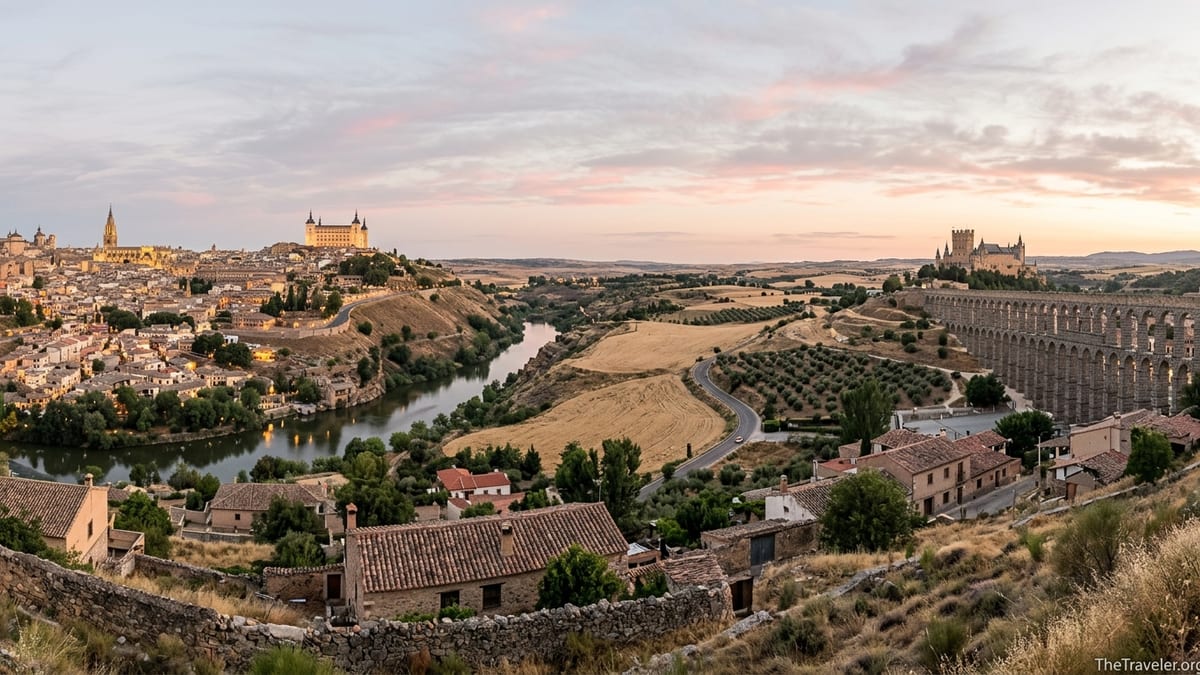
For concentrated monumental drama, both regions deliver. Castilla-La Mancha’s flagship city, Toledo, was once Spain’s capital and is still one of the country’s most complete medieval ensembles. Step off the train and within minutes you can be looking up at the Gothic cathedral, visiting the synagogue of Santa María la Blanca or standing before El Greco’s "Burial of the Lord of Orgaz" in Santo Tomé. A practical way to structure a first visit is with the Toledo Tourist Bracelet, which for about 14 euros from March 2025 gives access to a cluster of major monuments in the historic centre, making it easy to see several sites in one day without recalculating individual entry fees.
Cuenca, also in Castilla-La Mancha, is less about a checklist of monuments and more about atmosphere. The old town sits on a rocky ridge between the gorges of the Júcar and Huécar rivers, its most photographed sight the Casas Colgadas, or Hanging Houses, which jut out over the cliff edge. Inside these buildings you find, among other things, the Spanish Abstract Art Museum, tying medieval architecture to 20th century culture. Across the narrow gorge, the former Convent of San Pablo has been converted into the Parador de Cuenca, a state-run historic hotel that looks back toward the Hanging Houses and the old city from a spectacular vantage point.
Castile and León counters with Segovia, where the Roman aqueduct still strides into the city center on granite arches largely without mortar. From there, it is a short walk uphill to the late Gothic cathedral and onward to the Alcázar, a castle-palace perched on a rocky spur above the Eresma River. The route from aqueduct to Alcázar can comfortably fill a long day, especially if you add a walk down to a viewpoint like the Pradera de San Marcos for classic skyline photos.
Salamanca introduces yet another layer: academic and baroque splendor. Its old city, including the university quarter and the honey-colored Plaza Mayor, is recognized as a World Heritage site. You can spend hours moving between the twin cathedrals, the university’s ornate Plateresque façade and the arcades of Plaza Mayor, where cafés spill onto the square late into the evening. Nearby Ávila, encircled by some of Europe’s best-preserved medieval walls, rounds out the Castile and León group with a smaller but very distinctive historic core that can easily be visited in a day.
Landscape and countryside: cliffs, sierras and cereal plains
If you want drama in the landscape, both regions are strong but in different ways. Cuenca’s setting is arguably the most striking in Castilla-La Mancha. Walking the paths along the Júcar and Huécar gorges, you move between pine forest, limestone cliffs and viewpoints back to the old town. Trails start directly from the historic center or near the Parador, so you can combine morning sightseeing with an afternoon hike without needing a car. The Ventano del Diablo lookout, a short drive east of Cuenca, offers a classic view over a deep river canyon and gives a sense of the wider Serranía de Cuenca Natural Park.
Toledo’s landscape is gentler but still photogenic. The Tagus River curves around the city, creating several well-known lookouts; many visitors take a loop by taxi or tourist bus to viewpoints like the Mirador del Valle for sunset panoramas. Outside the city, Castilla-La Mancha spreads into a patchwork of olive groves, vineyards and wheat fields, occasionally punctuated by low sierras and whitewashed villages. If you drive south toward Consuegra, for example, you pass the windmills made famous by Don Quixote and the hilltop castle that anchors the skyline.
In Castile and León, Segovia offers a pleasing contrast of city and nature. A green belt encircles the old town, with paths down to the Eresma River and out to churches and monasteries on the far bank. This short countryside circuit gives you open views back to the aqueduct, cathedral and Alcázar while staying within walking distance of cafés and hotels. To the south, the Sierra de Guadarrama rises in wooded ridges that are easy to access on a half-day drive.
Salamanca and Ávila sit in broader, higher landscapes. The plains around Salamanca are open and pastoral, with big skies and light that shifts beautifully at sunset, while Ávila rests near the foothills of the Sierra de Gredos. The contrast between the walled city and the surrounding fields is one of the reasons evening views of Ávila from nearby viewpoints are so compelling. If your idea of a perfect day is a historic morning and a quiet countryside drive in the afternoon, this region makes that combination straightforward.
Food and wine: roast meats, stews and regional specialties
Culinary traditions in both regions are robust, hearty and closely tied to the land, so your decision is less about quality and more about which specialties you want to seek out. In Castile and León, Segovia is almost synonymous with cochinillo asado, roast suckling pig cooked in wood-fired ovens until the skin is crisp and the meat tender. Restaurants near the aqueduct and in the old town highlight this dish at prices that, in 2025 and 2026, typically range from about 20 to 35 euros per person depending on the establishment and whether you share a quarter pig between two diners. Salamanca, meanwhile, is a stronghold of cured meats; its chorizo and jamón ibérico from nearby Guijuelo frequently appear on tapas plates in bars around Plaza Mayor.
Castilla-La Mancha offers its own set of emblematic flavors. Toledo is known for marzipan made from finely ground almonds and sugar, which you can buy in small convent bakeries or historic pastry shops close to the cathedral. Game stews and dishes featuring partridge or venison appear on many menus in the cooler months. Around Cuenca, local cheeses from sheep and goat milk are common, often served with rustic bread and regional wine. Articles and recent coverage on Cuenca’s dining scene highlight how traditional dishes now sit alongside more contemporary cooking, with some restaurants incorporating local truffles or modern presentations into otherwise classic menus.
Wine is strong in both regions but in different denominations. Castilla-La Mancha is one of Spain’s largest wine-producing areas, with appellations such as La Mancha and Manchuela. You can easily detour from Toledo or Cuenca to visit a bodega for tastings, and many wines on local menus are priced attractively compared with more famous Spanish appellations. Castile and León, for its part, includes some of Spain’s best-known red wine regions, notably Ribera del Duero further north; while that core area lies beyond Segovia and Salamanca, you will still see Ribera bottles on many wine lists at moderate markups.
For value-conscious travelers, both regions can be fairly gentle on the budget compared with Madrid or Barcelona. A sit-down lunch menu of the day in non-touristy streets in 2025 or 2026 often runs between 12 and 18 euros in these cities, typically including two courses, dessert, bread and a drink. In the most central plazas, prices rise, but stepping a couple of streets away usually restores better value.
Accommodation and practical costs
Accommodation in Castilla-La Mancha is wide-ranging. In Toledo, you find everything from simple guesthouses in the old town for roughly 60 to 90 euros per night in high season to boutique hotels and historic properties edging toward 150 to 250 euros, depending on demand and views. Cuenca’s Parador, housed in the former Convent of San Pablo, is one of the city’s signature stays. Recent promotions and sample rates suggest that double rooms commonly run in the 130 to 220 euro range in busy periods, with breakfast sometimes included, placing it at the upper end of local prices but still competitive compared with luxury hotels in larger cities.
Castile and León’s cities offer a similar spread, but with some differences. Segovia has a cluster of mid-range hotels and small guesthouses just off the main streets between the aqueduct and the cathedral, where typical nightly rates fall in the 80 to 150 euro band in spring and autumn. Salamanca, with its university population, tends to have a bigger inventory of budget and mid-range options, from hostales and pensiones to modern business hotels on the fringe of the old town. In high season, you can often still find central rooms for under 100 euros if you book a bit in advance, while higher-end boutique hotels overlooking Plaza Mayor or near the cathedrals ask considerably more.
Ticketed attractions also affect your daily budget. In Segovia, access to the cathedral and Alcázar is relatively modest compared with big-city museums, often under 15 euros each for basic entry, with higher combined tickets if you add tower climbs or special exhibits. Salamanca’s major monuments and university sites generally follow a similar pricing structure, with individual entries around a few euros each. In Toledo, opting for the Tourist Bracelet consolidates several entries into one fixed price, which can be more economical than paying for sites one by one if you intend to visit most of the included churches and synagogues.
Transport costs from Madrid factor into the comparison. High-speed trains and frequent buses make Toledo, Segovia and Salamanca straightforward day trips, while Cuenca is also linked by both high-speed and conventional rail. Standard advance fares on regional or mid-distance trains often fall in the 15 to 35 euro range one way, depending on class, timetable and how far ahead you book. For couples or families, renting a car for around 35 to 60 euros per day plus fuel and tolls can become competitive, especially if you plan to string several towns together and stay overnight.
Road trips and suggested itineraries
One of the strongest arguments for giving more time to Castilla-La Mancha is how easily you can combine Toledo and Cuenca with classic "Don Quixote country." A logical three- or four-day loop from Madrid might be to pick up a car, drive to Consuegra for the white windmills and castle on the ridge, continue to Toledo for one or two nights, then head east to Cuenca via the rolling La Mancha plains. From Cuenca, you could add a day exploring the Serranía de Cuenca’s rock formations and viewpoints before returning to Madrid by highway or rail. This loop showcases Moorish, Christian and modern Spain layered over a semi-arid, agricultural landscape that many visitors find quintessentially Castilian.
Castile and León lends itself to a different style of road trip focused on stone cities and mountain edges. A popular three- to five-day route begins in Segovia, where you spend one or two nights exploring the aqueduct, cathedral and Alcázar, then drive west to Ávila for its walls and quieter old town atmosphere. From there, it is an easy push to Salamanca for at least two nights, giving you a full day to absorb the cathedrals and university buildings and an evening to enjoy Plaza Mayor as it lights up. If you have more time, you could extend further into wine country or to other Castile and León cities, but even this compact circuit offers a strong sense of the region’s identity.
Mixing regions is also realistic. Some tour operators already package Toledo with Segovia or Ávila as full-day excursions from Madrid, but independent travelers can take that a step further by allocating, for example, three nights in Segovia and Salamanca followed by three in Toledo and Cuenca. Rail connections between these clusters may require backtracking through Madrid, so those planning to cover all five cities in one trip often find a rental car more efficient.
When counting days, keep in mind the difference between a day trip and an overnight. Toledo and Segovia both work as day trips, yet many travelers report that staying overnight changes the experience entirely. Streets that feel crowded at midday with tour groups are suddenly quiet after dusk, and restaurants become easier to enjoy at a slower pace. Salamanca and Cuenca especially reward evenings, when the stone façades glow under floodlights and local residents reclaim the streets.
Which region deserves more of your time?
If your priority is concentrated architectural variety in a compact area, Castile and León usually edges ahead. Segovia, Salamanca and Ávila together deliver Roman engineering, Gothic and baroque churches, fortified walls and one of Spain’s most atmospheric main squares, all within a few hours of each other. Travellers who enjoy wandering historic streets, visiting museums and spending long evenings in plazas will likely feel that three to five nights across these cities are well spent, with a bias toward Salamanca for its depth and nightlife.
On the other hand, if you want a blend of historic cities and striking natural settings in a slightly more offbeat package, Castilla-La Mancha makes a strong case. Toledo’s layered Jewish, Christian and Muslim heritage paired with Cuenca’s cliffside skyline and access to canyons and highland trails offers greater variety in landscape. Costs for accommodation and dining can be slightly lower on average outside the most touristed zones, and the region’s association with Don Quixote, windmills and wide horizons gives it a literary, almost mythic appeal that resonates with many visitors.
For first-time visitors to Spain with limited time, a balanced strategy could be two nights in either Segovia or Salamanca and two nights in either Toledo or Cuenca. If you must choose only one region for a four- or five-day block, travelers most interested in historic urban fabric and iconic monuments will probably come away more satisfied giving extra time to Castile and León, especially if they base themselves in Salamanca and add Segovia and Ávila as stops. Those who lean toward quieter evenings, scenic drives and hiking or rural detours might do better to allocate that same block to Castilla-La Mancha, using Toledo and Cuenca as bases.
Context matters too. In the heat of July and August, higher-altitude Segovia, Salamanca and Ávila can feel more comfortable than parts of Castilla-La Mancha, which often see hotter daytime temperatures. In shoulder seasons like April, May, September and October, both regions are pleasant, and availability of accommodation is usually good enough to support more spontaneous itineraries.
FAQ
Q1. Is Castilla-La Mancha or Castile and León cheaper for accommodation and food?
In practice, prices are broadly similar, with both regions cheaper than Madrid or Barcelona. Small differences come down to specific cities and how close you sleep and eat to main monuments.
Q2. Can I visit Toledo, Cuenca, Segovia, Salamanca and Ávila without renting a car?
Yes, all five cities are reachable by train or bus from Madrid, but linking them directly often requires backtracking. A rental car adds flexibility if you want to combine several in one loop.
Q3. How many days should I spend in Castilla-La Mancha compared with Castile and León?
As a minimum, plan two full days for Toledo and Cuenca together and three for Segovia, Salamanca and Ávila. If you must choose, many travelers give a slight time advantage to Castile and León.
Q4. Which region is better for countryside walks and scenic views?
Both have good options, but Cuenca and its surrounding gorges offer some of the most dramatic scenery in Castilla-La Mancha, while Segovia combines city views with easy riverside and hillside paths.
Q5. Are the big monuments very crowded?
Toledo’s main churches, Segovia’s aqueduct and Alcázar and Salamanca’s cathedrals can be busy, especially in summer weekends. Visiting early in the day and staying overnight helps avoid peak tour-group times.
Q6. Is it worth staying overnight instead of doing day trips from Madrid?
Yes. All these cities change character in the evening when day trippers leave. Streets are quieter, local life is more visible and floodlit monuments create a different atmosphere.
Q7. Which region works better in the heat of summer?
Castile and León’s higher altitude around Segovia, Salamanca and Ávila often means slightly cooler temperatures than parts of Castilla-La Mancha, which can feel very hot in mid-afternoon.
Q8. Can I easily add winery visits to these itineraries?
Yes. Castilla-La Mancha has extensive vineyards near many towns, while from Castile and León you can detour to wine areas like Ribera del Duero, though this may require extra driving time.
Q9. Are these cities suitable for families with children?
They work well for families, with compact centers, pedestrian streets and castles and walls that appeal to children. Just be prepared for hills and cobblestones, especially in Toledo and Cuenca.
Q10. If I love university cities and nightlife, which base should I choose?
Salamanca in Castile and León is the strongest choice, with a large student population, plenty of bars and cafés and a very lively atmosphere around Plaza Mayor most evenings.