


Driving across the heart of Spain is one of the easiest ways to link Madrid with the historic cities of Toledo, Segovia, Ávila, Salamanca and Cuenca. Good highways, clear signage and a dense network of service areas make Central Spain ideal for a relaxed road trip, provided you plan ahead for rental conditions, parking near historic centers and realistic daily driving times. This guide focuses on practical, commercial details a traveler actually needs behind the wheel: how to rent, where to park, what to budget for fuel and tolls, and which overnight stops work best.
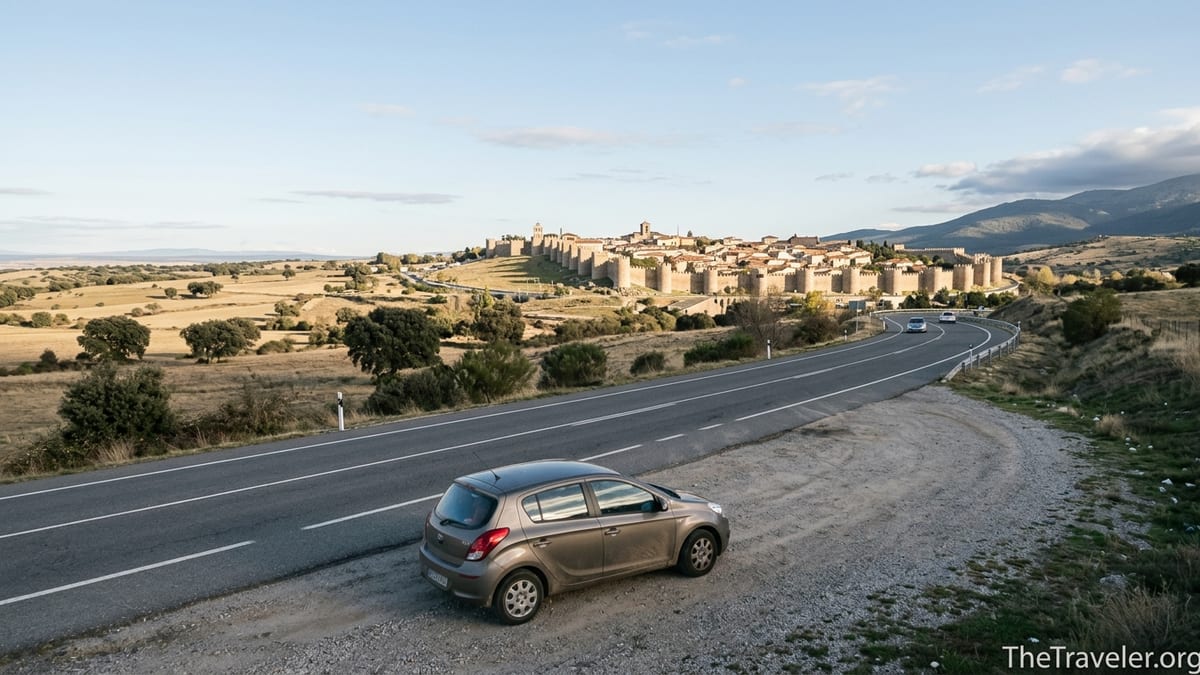
Why a Central Spain road trip works so well
Central Spain is built for road trips. Madrid sits at the hub of the national highway network, so within a couple of hours you can be under Toledo’s fortress walls, parked near Segovia’s Roman aqueduct, walking Ávila’s medieval ramparts, or checking into a Salamanca hotel a short stroll from Plaza Mayor. Highways such as the A-42 to Toledo, the A-6 and AP-61 to Segovia, the A-6 and AP-51 to Ávila, the A-50 to Salamanca and the A-3 plus A-40 to Cuenca are mostly dual carriageway and signposted clearly in both Spanish and international symbols.
For many travelers, combining these cities in a loop from Madrid works better than relying on trains and buses, particularly if you are traveling as a couple or family, carrying luggage, or planning detours into the countryside. A compact rental car can be cheaper than four rail tickets once you factor in flexibility and the ability to stay in rural hotels or paradores outside city centers. It also lets you time your sightseeing to early mornings or evenings, when summer heat and day-trip crowds ease.
The main caveat is that all of these destinations have tight historic cores where local authorities restrict traffic and much of the on-street parking is either resident-only or heavily regulated. The smartest strategy is to drive comfortably on highways, then park in a designated car park just outside the old town and explore on foot. In practice, this means knowing a few well-located garages and free lots ahead of time and allowing a small daily budget for parking.
Distances are manageable. Madrid to Toledo is roughly 75 kilometers and usually takes under one hour in normal traffic. Madrid to Segovia via the A-6 and AP-61 is around 90 kilometers in about 1 hour 15 minutes, and Madrid to Ávila is similar in distance depending on your route. Salamanca is the longest leg at around 210 kilometers from Madrid, while Cuenca sits about 170 kilometers east. With these figures in mind, most travelers find that 2 to 3 hours of driving per day is plenty, leaving the rest of the time to wander medieval streets and sample local food.
Planning your route: a realistic 5 to 8 day loop
A practical starting point is to collect your rental car at Madrid-Barajas Airport or on the city’s northern or southern fringe, then avoid driving deep into central Madrid if you can. Many travelers time pick-up for the morning they leave the capital, after using public transport and taxis to explore Madrid itself. That way, your first day of driving is a simple hop to Toledo or Segovia instead of a stressful search for hotel parking off Gran Vía.
One realistic 7-day loop is: Madrid to Toledo for 1 or 2 nights, then Toledo to Ávila via a countryside detour, Ávila to Salamanca for 2 nights, Salamanca back toward Madrid with a stop in Segovia, and finally Segovia to Cuenca before returning the car in Madrid. This pattern spaces out longer drives such as Salamanca to Segovia, which you can break with lunch in a smaller town, and gives you at least one full day without driving in Salamanca and another in Cuenca.
If you prefer a shorter 5-day trip, a compact route could be Madrid–Toledo–Ávila–Segovia–Madrid, adding Cuenca as a long day trip if you are comfortable with more time in the car. In shoulder seasons like April, May, late September and October, daylight hours are generous without the high summer temperatures, so you can comfortably arrive in each city in late afternoon and still enjoy a stroll and dinner.
When building your itinerary, remember that central Spanish highways can get busy on Sunday evenings and at the start and end of long weekends, when locals return to Madrid. It is often worth planning your city-to-city moves for mid-morning or early afternoon on weekdays. For example, leaving Toledo around 10:30 in the morning for Ávila avoids commuter traffic around Madrid’s ring roads and gives you time for a relaxed lunch in Ávila before checking into your hotel.
Rental cars: what to book, insurance and costs
Most international rental brands operate in Madrid, including Avis, Europcar, Hertz, Enterprise and Sixt, alongside well-regarded Spanish agencies and brokers. For this kind of itinerary, a manual compact hatchback is usually enough, and often the best value. As of mid-2026, a midweek 7-day rental in low season for a compact manual with basic insurance can start in the region of a few hundred euros, rising significantly in July, August and around Easter. Automatics are widely available but can cost substantially more per week, so book early if you need one.
Insurance is the most important commercial detail to clarify. Basic rental packages usually include third-party liability and a collision damage waiver with a high excess, meaning you are responsible for the first portion of any damage. You can either accept this risk, buy the rental company’s “super” cover to reduce the excess to near zero, or use an external excess insurance policy that you purchase before travel. At the counter, many travelers underestimate how persistent the upselling can be, so it helps to decide your maximum spend and insurance strategy in advance.
Include one additional driver only if you genuinely plan to share the driving, because this often adds a daily surcharge. Younger drivers, typically under 25, may face extra fees. When comparing offers, also check for caps on daily mileage; for a central Spain loop of around 800 to 1,200 kilometers, most standard “unlimited mileage” offers are fine, but very cheap deals may hide restrictions.
For travelers considering an electric vehicle, note that charging infrastructure along major corridors like the A-6 and A-3 is improving, with high-power chargers at some service areas and supermarket car parks on the outskirts of larger cities. However, fast chargers inside or right next to medieval centers remain limited, and hotel parking with EV charging should be confirmed explicitly. Unless you are an experienced EV driver comfortable with route planning and Spanish charging apps, a hybrid or efficient petrol car will be the easiest choice.
Fuel, tolls and practical driving tips
Fuel in Spain is not cheap compared with North America, but highway driving in a compact car is efficient. Unleaded petrol and diesel prices fluctuate, but as of 2026 it is common to see per-liter prices that translate into a full tank for a small car in the range of 60 to 80 euros. A realistic planning assumption for this route is that you will spend perhaps 150 to 250 euros on fuel over a week, depending on your vehicle and detours.
Most of the main corridors you will use are toll-free autovías, but you may encounter tolls on certain autopistas, depending on your exact choices. For example, if you use the AP-61 segment to reach Segovia from the A-6, you can expect a modest toll charge for the convenience of faster travel and the tunnel through the Sierra de Guadarrama. Tolls can usually be paid by credit card at the booth. In-car telepeaje devices are an option if your rental includes them, but for a short trip they are not strictly necessary.
Speed limits are generally 120 kilometers per hour on motorways, 90 to 100 on secondary roads and 30 to 50 in towns and cities, with strict enforcement at fixed cameras and occasional mobile traps. It is common to see cameras on approach to tunnels and at the entrance to some provincial capitals. Spain has stringent drink-driving rules and random roadside checks, so the safest approach is not to drive after consuming alcohol.
On the practical side, Spanish fuel stations along the main routes often have cafeterias serving coffee, sandwiches and simple hot meals. Many are open long hours, especially near Madrid. For instance, on the way from Madrid to Salamanca along the A-50 and related highways, you will find several large service areas roughly every 40 to 60 kilometers, where you can refuel, rest and pick up snacks without leaving the main road. Pay-at-pump card terminals are increasingly common, although some smaller stations still require you to pay inside.
Driving and parking in Toledo, Segovia and Ávila
Toledo is the most challenging city in this itinerary for first-time drivers, due to its hilltop location and steep, narrow lanes. The simplest tactic is to park in a modern lot below the old town and ride escalators or walk up. Practical options include large surface car parks on the approaches to the city and multi-story garages such as the Miradero complex near the Palacio de Congresos, which offers relatively competitive hourly rates and sits a short walk from the central Plaza de Zocodover. Many visitors find it reasonable to budget a handful of euros for several hours here, trading cost for maximum convenience.
Another popular choice is the large Safont car park area near the bus station, at the foot of the historic hill. From there, a system of escalators carries you up to the old town in under 10 minutes, making it especially convenient if you prefer to avoid driving closer to the medieval walls. Free surface lots on the outskirts, including areas near Paseo de la Rosa or Santa Teresa, can be very attractive for cost-conscious drivers, but can fill quickly on weekends and may involve a 15 to 20 minute walk or short bus ride to the core of the old town.
Segovia is much easier. Approaching from Madrid via the A-6 and AP-61, you will arrive near the modern outskirts and can follow signs toward the aqueduct. Around the base of the aqueduct and along the ring roads are several well-signed parking garages and surface lots, where daily caps are typically reasonable. One common pattern is to park for half a day within sight of the aqueduct, walk the compact historic core, then return to your car for the short drive to your hotel or onward destination.
Ávila has a similarly straightforward layout for drivers. You can follow the signs to car parks just outside the city walls, including underground car parks that allow you to emerge within a few minutes’ walk of the cathedral or main gates. While it may be tempting to drive along the narrow streets inside the walls to reach a hotel door, it is usually easier to park at a nearby public garage and walk your luggage in. Many small hotels and guesthouses are used to this and can advise the closest garage and drop-off point when you book.
Reaching Salamanca and Cuenca by car
From Ávila or directly from Madrid, the route to Salamanca runs on good autovías that skirt rolling fields and occasional hilltops. The drive takes around two hours from Madrid in normal traffic, or slightly less from Ávila. As you approach Salamanca, signage points you around the city on its ring roads and toward central parking. Many drivers choose garages near the historic core so they can spend a day or two entirely on foot, visiting the twin cathedrals, the university quarter and Plaza Mayor without touching the car.
Hotel parking in Salamanca varies from underground spaces directly under central hotels to reserved spots in nearby public garages. When choosing accommodation, it is worth checking whether the nightly parking fee is bundled or separate. A typical range might be from slightly under ten euros in a simple garage on the edge of the center to higher amounts in premium underground parking beneath historic plazas. For many visitors the convenience of leaving the car safely parked for 24 or 48 hours while they explore the city justifies the added cost.
Reaching Cuenca from Madrid is equally straightforward via the A-3 toward Valencia and then the A-40. The drive is roughly 170 kilometers, often under two hours in regular traffic. The scenery becomes more dramatic as you near Cuenca and the road begins to wind through hilly terrain framed by pine forests and rocky outcrops. Make sure to check your fuel gauge before you leave the main highway, because some smaller secondary roads have fewer service stations.
Cuenca’s historic core sits dramatically on a high ridge between deep gorges. Much of the old town is not practical for casual driving or parking, so the usual advice is again to park in designated lots around the base of the historic quarter or in modern neighborhoods, then walk or take a local bus uphill. Some hotels and guesthouses will provide instructions to reserved spaces, but these often involve tight turns and steep ramps, so confirm that you are comfortable with this before committing to drive into the upper old town.
Scenic routes, roadside stops and recommended overnight bases
Although the fastest highways are efficient, weaving in a few scenic stretches will make the road trip feel less like a sequence of transfers and more like a journey through Central Spain’s varied landscapes. Between Madrid and Segovia, for example, the climb through the Sierra de Guadarrama offers mountain views, particularly if you choose the older national road segments rather than staying entirely on the toll motorway. In clear weather you can pull into viewpoints or small towns such as San Rafael for a coffee and glimpse of pine-covered slopes.
The plateau between Ávila and Salamanca, on the other hand, is all about big skies and open farmland. Here, service areas or small roadside cafés provide natural pauses. In summer, consider timing your drive for early morning or late afternoon to avoid the most intense midday heat. One practical pattern is to leave Salamanca on the A-50 after an early breakfast, stop in a village café around mid-morning, and arrive in Segovia in time for lunch near the aqueduct.
As for overnight stops, Toledo works well as your first base after Madrid because you can drop your car in one of the established parking areas, check into a hotel in or near the old town and spend the evening walking. Segovia and Ávila both lend themselves to one-night stays, especially if you time your arrival for mid-afternoon and leave the following day after lunch. Salamanca deserves at least two nights for most travelers, partly because its nightlife and illuminated monuments are a highlight after dark. Cuenca can be either a one- or two-night stop depending on whether you also explore the surrounding countryside.
For a more rural experience, you might intersperse city nights with one or two nights at a countryside hotel or parador outside Ávila or in the foothills of the Sierra de Guadarrama. In those cases, look for properties advertising on-site parking, as these often include it in the room rate. This contrasts with central city hotels, where overnight parking is almost always an extra charge. Either style can work; combining city and countryside nights often creates a more balanced itinerary.
Parking hacks and city-center strategies
Parking is where many self-drivers in Spain either save or overspend. The key is to decide each morning how close you truly need to be to a city’s old town and how much walking you are comfortable with. In Toledo, free or very low-cost surface lots around the perimeter are attractive if you are staying all day and fine with a 15 to 20 minute walk or escalator ride. In contrast, if you are carrying luggage or arriving late at night, paying for a central covered garage such as those near Zocodover or Miradero is often the most stress-free solution.
Segovia and Ávila are in some ways simpler because their city centers are smaller and their parking areas more concentrated. In both cases, it pays to follow “P” signs to official lots as you approach, rather than improvising in residential streets with mixed regulations. This reduces the risk of inadvertently parking in a residents-only zone or on a street with timed restrictions. Keep a few coins and a bank card handy for ticket machines, and take a quick photo on your phone of the parking bay number or garage level to avoid confusion later.
In Salamanca and Cuenca, old town hotels may offer discounted rates at nearby public garages. When comparing room prices, ask explicitly whether parking is included, available nearby at a set nightly rate, or left entirely to the guest. Some central hotels offer short loading zones at the door where you can pull in, unload luggage in a few minutes, then drive to an underground garage a couple of blocks away. This “drop-and-park” pattern works well if one person in your group feels confident navigating narrow streets for a few minutes.
As for enforcement, Spanish cities do monitor regulated parking zones and issue fines for overstays or violations. While some visitors assume that tourist plates will go unnoticed, in practice local authorities are increasingly efficient at tracking rental vehicles, and unpaid fines may be passed on via your rental company with an added administrative fee. Treat hourly or resident zones seriously, and when in doubt, choose a signed car park rather than experimental street parking. The modest daily cost of a legal space typically compares favorably with the expense and hassle of contested fines.
FAQ
Q1. Is it difficult to drive in and out of Madrid for this road trip?
Driving on the highways around Madrid is generally straightforward, but central Madrid can be congested and includes low-emission restrictions. Many travelers avoid driving into the very center by using public transport while in Madrid, then collecting the rental car at the airport or a peripheral office on the day they leave for Toledo or Segovia.
Q2. How many days do I need for a Madrid–Toledo–Segovia–Ávila–Salamanca–Cuenca loop?
A comfortable pace is around 7 days, with 1 or 2 nights in Toledo, 1 night each in Segovia and Ávila, 2 nights in Salamanca and 1 in Cuenca. You can compress it into 5 days by dropping a night in one of the smaller cities, but that leaves less margin for relaxed exploration.
Q3. Do I really need a car, or can I do this route by train and bus?
You can reach all of these cities from Madrid by public transport, especially Toledo and Segovia, which have frequent train and bus connections. However, a car gives you more flexibility with timing, easier access to rural hotels and the option to link several cities in one loop without backtracking to Madrid between each stop.
Q4. What kind of rental car is best for Central Spain?
A compact hatchback with air conditioning is ideal for most travelers, offering enough space for luggage while staying maneuverable in tight streets and public garages. Manual transmission cars are cheaper and more common; if you require an automatic, book early and expect to pay more per day.
Q5. How much should I budget for fuel and tolls on this trip?
For a one-week loop covering roughly 800 to 1,200 kilometers, many travelers will spend in the region of 150 to 250 euros on fuel, depending on the car and driving style. Tolls are relatively modest on the sections you are likely to use, such as the AP-61 toward Segovia, and might add a small extra amount compared with your overall trip budget.
Q6. Is parking safe in these cities if my luggage stays in the car?
Public garages and well-used surface lots are generally considered safe, especially for daytime parking. That said, it is always sensible to keep valuables out of sight, avoid leaving important documents in the car and choose busy, well-lit car parks when possible, particularly if you are arriving or leaving after dark.
Q7. Can I drive right into the historic centers to drop my bags at the hotel?
In some cities, such as Salamanca or Ávila, hotels provide brief loading zones or instructions for short-term access, but others, including parts of Toledo and Cuenca, have restricted streets where access is limited to residents and authorized vehicles. It is best to contact your hotel in advance to ask about recommended parking and whether you can briefly drive in to unload luggage.
Q8. What is the best season for a Central Spain road trip by car?
Spring and autumn are ideal, with milder temperatures and generally lighter traffic than the peak summer months of July and August. In winter, driving is still possible on major roads, but you should be prepared for colder weather, shorter daylight hours and the chance of snow in higher areas around the Sierra de Guadarrama.
Q9. Are there many charging points if I rent an electric vehicle?
Charging infrastructure is improving along main routes, with an increasing number of fast chargers at service areas and near supermarkets on city outskirts. However, chargers close to medieval centers remain less common, and hotel charging is not guaranteed, so an EV road trip requires more careful planning than a standard petrol or diesel rental.
Q10. Do I need any special permits or documents to drive in Central Spain?
Most visitors can drive with a valid driving license from their home country, sometimes accompanied by an international driving permit depending on their nationality. Your rental company will also require a passport, credit card in the main driver’s name and standard rental paperwork. There is no separate permit needed specifically for Central Spain, though you should always carry identification and your rental agreement in the car.