


Central Spain rewards travelers who slow down. High-speed trains and reliable regional buses make it easy to hop between medieval hill towns, Roman aqueducts and lively plazas, but distances and timetables still matter if you want your trip to feel like a holiday rather than a race. This guide lays out realistic 5, 7, 10 and 14-day routes starting in Madrid and combining Toledo, Segovia, Ávila, Salamanca, Cuenca and an optional detour into Extremadura, with concrete examples of travel times and suggested overnight bases.
How to Think About a Central Spain Itinerary
Central Spain is compact on the map but dense with historic cities. Madrid is the obvious entry point thanks to its international airport and major train stations, so every route here assumes you arrive and depart from the capital. From Madrid, fast trains reach Toledo in around 35 minutes and Segovia in under 30 minutes, while Salamanca is roughly 1 hour 40 minutes away on Alvia trains and Cuenca about 50 minutes by high-speed service. That means you can comfortably mix day trips with strategic overnights without spending half your holiday in transit.
Season and travel style shape how far you should stretch. In summer, when afternoons in Castile-La Mancha and Castile and León can be very hot, many travelers prefer to build longer stays in places like Salamanca or Segovia and explore nearby villages in the cooler evenings. In March or October, with milder temperatures, it feels more pleasant to change bases every few days. A couple flying from the United States for 10 days, for example, might sensibly spend four nights in Madrid, two in Salamanca and two in Segovia, with day trips folded in rather than trying to sleep in a new town every night.
Public transport is frequent enough that you rarely need a car for this core circuit. Renfe’s high-speed and Alvia trains connect Madrid with Segovia, Salamanca, Cuenca and Toledo, while conventional Media Distancia trains and bus companies like Avanza and Alsa fill in the gaps to Ávila and Extremadura. For instance, trains from Madrid to Cáceres in Extremadura typically take around three and a half hours, so combining a stop there with a few days in Salamanca creates an easy westward loop. If you are traveling as a family or carrying heavy luggage, you might still choose to rent a car for a few days to reach smaller villages or vineyards.
Budget can be managed by mixing faster trains with cheaper regional options. Advance-purchase tickets on Alvia and AVE services between Madrid and cities like Salamanca or Cuenca can start in the 15 to 25 euro range in low season, particularly if you are flexible on departure times, while slower Media Distancia trains and intercity buses can be a few euros cheaper at the cost of an extra hour on the road. Hotel rates drop noticeably outside Madrid, so a three-night stay in Salamanca or Segovia can balance a slightly higher spend on a centrally located Madrid hotel.
5-Day Central Spain Highlights: Madrid with Classic Day Trips
Five days is just enough time for a taste of Central Spain if you keep Madrid as your base. A realistic structure is three full days in Madrid itself and two day trips to nearby historic cities. A common pattern for first-time visitors is to use day 2 for Toledo and day 4 for Segovia, leaving days 1, 3 and 5 for Madrid’s neighborhoods and museums. This avoids hotel changes and allows you to recover from jet lag without navigating new train stations every day.
For Toledo, fast Avant trains from Madrid Puerta de Atocha typically take about 35 minutes, and many departures run throughout the day. You might book a morning train around 9:00, arrive by 9:40 and take a taxi or local bus up to the walled historic center. Spending 7 to 8 hours here gives you time for the cathedral, the El Greco Museum, lunch in a traditional mesón and a late-afternoon stroll along the river before catching an early evening train back. Travelers who tried to squeeze Toledo into a half-day often report that they barely scratched the surface and felt rushed on the steep streets.
Segovia pairs well with another day trip. High-speed services from Madrid Chamartín to Segovia-Guiomar can take under 30 minutes, and a city bus or short taxi ride brings you to the Roman aqueduct and old town. With 6 or so hours you can walk from the aqueduct up to the Alcázar, stop for cochinillo asado in a traditional restaurant and still wander part of the medieval walls. Some tours advertise a combined Ávila and Segovia day from Madrid, but feedback from travelers who attempted this on their own suggests that while it is physically possible, each city deserves at least half a day, and doing both with luggage or in peak heat can be exhausting.
If you are not keen on two big day trips, you could swap one for a shorter excursion like El Escorial or Alcalá de Henares, both reachable in under an hour on commuter or regional trains. This keeps your Central Spain experience centered on Madrid, Toledo and one other town, which is ideal if you prefer slower mornings and long café stops to spending hours checking timetables.
7-Day Route: Madrid, Toledo and Segovia with an Overnight Outside the Capital
With seven days you can afford one or two nights away from Madrid so you can enjoy at least one smaller city after day-trippers leave. A common structure is four nights in Madrid, one in Toledo and two in Segovia. This allows you to see the main sights of each city without doubling back unnecessarily and keeps travel segments mostly under 90 minutes.
One practical 7-day sequence might look like this. Days 1–3: stay in Madrid, focusing on the Prado, Reina Sofía and Thyssen museums, plus neighborhoods such as La Latina and Malasaña. Day 4: travel mid-morning to Toledo by train, check into a hotel inside the walls and explore in the quieter afternoon and evening hours when many day visitors have gone. Day 5: take a morning train back to Madrid Atocha, cross the city on Cercanías or metro to Chamartín station and board an early afternoon high-speed train to Segovia, where you stay nights 5 and 6 before returning to Madrid on day 7 for your flight home.
This routing keeps each travel day manageable. The Toledo leg takes roughly 35 minutes, followed by 35 to 45 minutes back to Madrid on day 5; the onward train from Madrid to Segovia takes well under 30 minutes. Even allowing time to cross between stations in Madrid, you are rarely in transit more than two or three hours door to door. Doing it this way also allows for logistics like hotel check-in and lunch in each destination, rather than arriving late at night and hunting for food with luggage in tow.
In terms of real-world costs, in shoulder season you might find Toledo trains for around 15 euros return if booked ahead, with Segovia tickets priced similarly or a bit more on the fastest services. Modest, centrally located hotels in Toledo and Segovia often come in cheaper than equivalent properties in Madrid, so two nights outside the capital can keep your overall accommodation budget level. Many travelers comment that their best memories come from walking around Segovia’s illuminated cathedral or Toledo’s quiet lanes after dark, moments that are difficult to capture on a quick day trip.
10-Day Loop: Adding Salamanca and Ávila
Ten days give you the first real chance to build a loop through Castile and León without rushing. One robust pattern is to anchor the trip with three or four nights in Madrid at the start, then make a westward arc to Salamanca via Ávila and finish in Segovia before returning to Madrid. A sample structure for 10 days could be Madrid 4 nights, Salamanca 3 nights and Segovia 2 nights, with a stop in Ávila on the way.
On day 5, you could take a morning train from Madrid to Ávila, which generally takes about 1.5 hours on regional services. After storing your bags either at the station or a pre-arranged hotel, you can walk the medieval walls, visit the cathedral and have lunch inside the old town. Later in the afternoon you continue by train or bus toward Salamanca, usually around two more hours by rail depending on the connection. Arriving early evening gives you time to settle into a hotel near Plaza Mayor and join the evening paseo among students and locals.
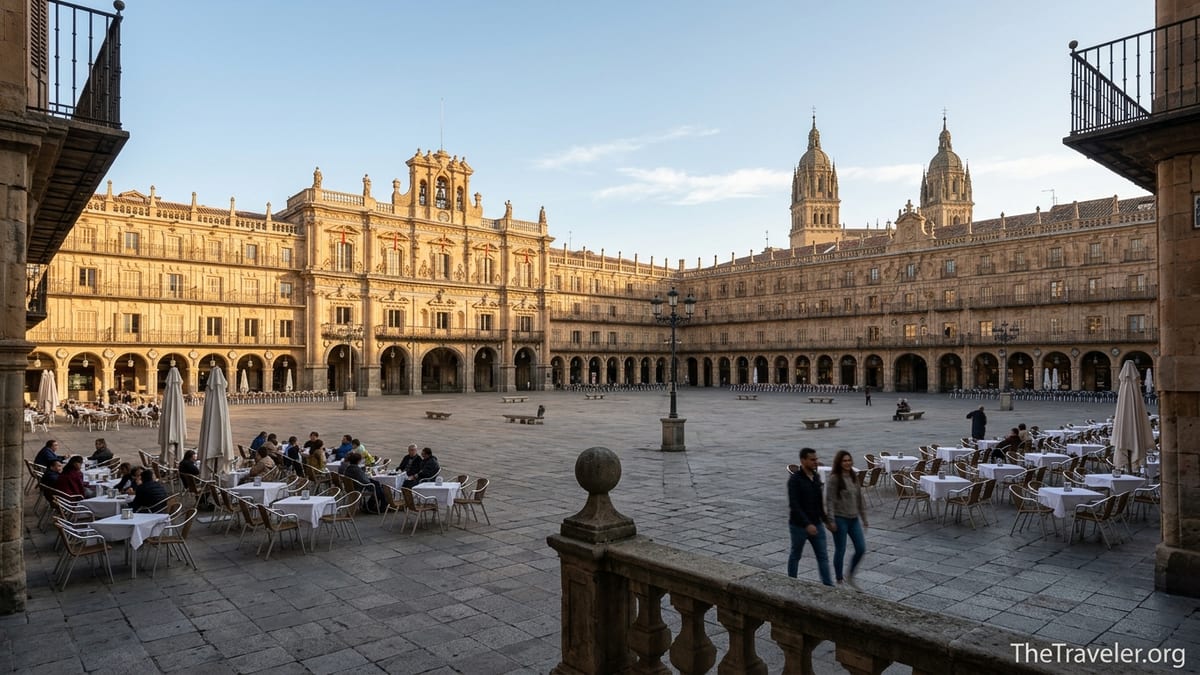
Salamanca deserves at least two full days, particularly if you appreciate architecture and university towns. Travelers who try to squeeze it into a single day from Madrid often report spending more than three hours each way on slower trains and buses, plus station transfers, for only a few hours in the city itself. By staying three nights you can visit both cathedrals, the university’s historic buildings and the Casa de las Conchas without hurry, and still take a side trip to nearby Zamora or a vineyard in the Arribes del Duero region if schedules permit. Fast Alvia trains from Salamanca back toward Madrid frequently take around 1 hour 40 minutes, making the return leg comfortable.
From Salamanca you can route back via Segovia using an Alvia service that passes through Segovia-Guiomar, allowing you to get off there rather than continuing directly to Madrid. This is especially handy in a 10-day itinerary, since you can spend two nights in Segovia at the end and then ride a 30-minute train to Madrid Chamartín on your departure day. Travelers planning a morning flight on the final day often choose to return to Madrid the night before instead; in that case, you might shorten Salamanca by one night and keep your last two nights in the capital.
14-Day Grand Circuit with Cuenca and Optional Extremadura
With two full weeks you can turn Central Spain into a generous circuit while still building in rest days, long lunches and quiet evenings in smaller cities. A balanced 14-day plan might look like this: Madrid 4 nights, Salamanca 3 nights, Cáceres or Mérida in Extremadura 2 nights, Toledo 2 nights, Cuenca 2 nights and a final night in Madrid close to your departure airport or train station. This keeps most individual travel segments in the 1.5 to 3.5 hour range and avoids backtracking where possible.
From Madrid you could head first to Salamanca for three nights, as in the 10-day plan, then continue by train or bus into Extremadura. Renfe-operated trains from Madrid to Cáceres typically run in about three and a half hours, while buses can be similar in duration depending on the route and stops. From Salamanca, people often route via Madrid or take regional buses, so it can make sense to plan a daytime transfer that includes a lunch stop in a station café rather than arriving late at night. Once in Cáceres, two nights give you a full day to explore the walled old town, which has gained popularity with visitors looking for a less crowded alternative to larger cities.
From Extremadura you return to Madrid and pivot eastward. A pair of nights in Toledo lets you experience the city at sunset and after dark, when the day-trip crowds thin and the views from the river walks are at their best. From Toledo, you take the fast train back to Madrid Atocha, change to a high-speed service heading toward Valencia, and get off at Cuenca-Fernando Zóbel station after roughly 50 minutes. Cuenca’s hanging houses over the Huécar gorge and its compact old town make it a rewarding two-night stop, especially for photographers and hikers, and travelers frequently describe it as one of the most atmospheric smaller cities in central Spain.
On day 13 you can return to Madrid in under an hour from Cuenca and spend your final night near your departure point, whether that is Atocha, Chamartín or the airport. This structure assumes you prefer trains and buses, but if you are comfortable driving, you could rent a car in Madrid for a one-way loop, particularly for the segment from Salamanca through Extremadura and back toward Toledo. Distances between these cities by road are typically in the 2 to 3-hour range, and having your own vehicle can make it easier to stop at viewpoints, small villages and rural restaurants that are hard to reach on public transport.
Choosing Bases and Booking Trains, Buses and Hotels
Because transport hubs in Central Spain are generally located outside historical centers, the best overnight bases are those with straightforward links between stations and old towns. In Madrid, many visitors choose to stay within walking distance of either Gran Vía or Plaza Mayor, which sit about 15 to 20 minutes by metro or taxi from both Atocha and Chamartín stations. This allows easy pre-dawn departures and late-night returns from places like Toledo and Segovia without feeling stranded far from your hotel.
In smaller cities, staying inside or just outside the old walls is usually worth the slightly higher price. In Toledo, for example, mid-range boutique hotels near the cathedral or Jewish Quarter offer step-out-the-door access to the main sights, and taxis from the train station up the hill are relatively inexpensive. In Salamanca, properties around Plaza Mayor and the university area give you short walks to both cathedrals and the riverfront. Real-world travelers often note how much they appreciate being able to stroll back to their hotel after dinner without needing to navigate unfamiliar bus routes.
For trains, it often pays to book high-speed and Alvia services in advance, particularly on weekends or during Spanish public holidays when locals travel. Purchasing a ticket for Madrid to Salamanca or Cuenca a few weeks out can bring prices down compared with last-minute purchases at the station. For shorter regional hops, such as Madrid to Ávila or Madrid to El Escorial, many travelers simply buy tickets on the day, especially outside peak commuting hours. Buses to cities like Cáceres, Mérida or smaller towns in Extremadura are typically less time-sensitive but can still fill up around holidays and summer weekends.
As for budget, a mid-range couple might plan on spending roughly 80 to 140 euros per night for a comfortable double room in cities like Salamanca, Segovia, Cuenca or Cáceres, and somewhat more in central Madrid, depending on season and demand. Daily train and bus costs for a 10-day itinerary that includes four or five intercity legs and a couple of day trips could average around 20 to 40 euros per person per travel day if you mix faster and slower services. Meals can be good value if you follow locals to menus del día at lunchtime, which often offer three courses and a drink at prices that help offset transport costs.
Practical Tips: Pacing, Weather and Local Rhythms
When planning a Central Spain route, it helps to think in terms of “base days” and “transfer days.” A base day is when you wake up and go to sleep in the same city, leaving room for a museum visit, a long lunch and a leisurely evening walk. A transfer day includes any significant intercity journey, even if it is only 90 minutes by train; realistically, with packing, hotel checkout, station transfers and check-in at the other end, you often lose three to five hours of usable sightseeing time. On a 10-day itinerary with three bases, you might have six base days and four transfer days, so try not to stack multiple big-ticket sights on transfer days.
Weather is another key factor. In July and August, midday temperatures in Toledo, Cáceres or Mérida often climb high enough that locals retreat indoors. In those months, it is wise to plan outdoor sightseeing and travel for mornings and evenings and reserve siesta hours for museums or air-conditioned cafés. In April, May, September and October, conditions are usually more comfortable for full sightseeing days, though short rain showers are not unusual, especially in higher-altitude cities like Ávila and Segovia.
Central Spain’s daily rhythm might be different from what you are used to. Many shops close for a few hours in the afternoon and reopen in the evening, dinner rarely starts before 8:30 or 9:00 p.m., and trains and buses can be quiet early on Sunday mornings. That means a “late” train at 8:00 p.m. from Salamanca to Madrid may still drop you into a city that feels lively and awake. Planning your itinerary with this rhythm in mind makes it easier to fit in both travel and local experiences, such as a late-night paseo or a football match on television in a neighborhood bar.
Finally, build a margin for surprises. Spaniards are generally relaxed but efficient when it comes to transport, and high-speed trains in particular have a reputation for punctuality. Still, minor delays, strikes or timetable changes can happen. Leaving at least three hours between intercity train arrivals and important flights, and avoiding tight back-to-back transfers between long-distance trains and last trains of the day to smaller towns, helps protect your itinerary.
FAQ
Q1. Is it realistic to visit Toledo, Segovia and Ávila as day trips from Madrid?
Yes, but it is more comfortable to choose two as full-day trips and save the third for a longer itinerary. Fast trains make Toledo and Segovia easy day trips, while Ávila works well as either a calmer day trip or a stopover on the way to Salamanca.
Q2. Do I need to rent a car for this Central Spain itinerary?
No, most travelers manage with trains and buses. A car can be helpful if you want to visit smaller villages, rural inns or vineyards between cities, but for Madrid, Toledo, Segovia, Ávila, Salamanca and Cuenca, public transport is generally sufficient.
Q3. How far in advance should I book train tickets in Spain?
For high-speed and Alvia routes like Madrid to Salamanca, Cuenca or Segovia, booking a few weeks ahead usually secures better fares and seat choices. For shorter regional trips, buying on the day is often fine outside peak holidays.
Q4. Which city makes the best secondary base after Madrid?
Salamanca and Segovia are strong choices. Salamanca offers a lively university atmosphere and plenty of dining options, while Segovia combines major sights with a compact, walkable old town and short travel time back to Madrid.
Q5. Is Salamanca doable as a day trip from Madrid?
It is physically possible on fast trains, but most travelers find it rushed. The journey can take around 1 hour 40 minutes each way, so staying at least one or two nights in Salamanca gives a much better experience.
Q6. How should I handle luggage on multi-stop itineraries?
Travel light with one medium suitcase and a daypack if possible. Many stations have luggage storage or nearby businesses offering bag holds, and taxis between stations and hotels are relatively affordable in most of these cities.
Q7. When is the best time of year to follow a 10 or 14-day Central Spain route?
Late spring and early autumn, especially May, June, September and early October, usually offer pleasant temperatures and long daylight hours. Summer can be very hot inland, and winter brings colder, shorter days, especially in higher-altitude cities.
Q8. Can I combine this Central Spain loop with Andalucía or Barcelona?
Yes, if you have at least three extra days for each added region. Fast trains connect Madrid with Seville, Córdoba, Málaga and Barcelona, but you should avoid trying to add another region to a very short 5 or 7-day Central Spain trip.
Q9. Are these routes suitable for families with children?
Generally yes, especially 7 and 10-day versions with two or three main bases. Choose family-friendly hotels or apartments near old towns, keep individual travel legs under three hours where possible and schedule park time and breaks around major sights.
Q10. Is Extremadura worth adding to a two-week Central Spain itinerary?
If you enjoy quieter historic towns and are curious about less-visited regions, adding Cáceres or Mérida for two nights can be very rewarding. Travel times from Madrid are longer, so it works best in 14-day itineraries with enough buffer days.