


Central Spain is where grand royal boulevards meet medieval hill towns and quiet stone villages. For a first-time visitor it offers a compact mix of blockbuster sights like Madrid’s Prado Museum, storybook cities such as Toledo and Segovia, university charm in Salamanca, the walled skyline of Ávila, the hanging houses of Cuenca, and Roman ruins in Extremadura. This guide focuses on what most first-timers need to know: where to go, how to get around, what things really cost in 2026, and how to stitch Madrid, Castilla-La Mancha, Castile and León, Extremadura and their headline cities into a realistic first itinerary.
Understanding Central Spain’s Regions and Highlights
Central Spain is less a formal region and more a cluster of historic heartlands around Madrid. At the center is the Community of Madrid, the country’s capital region and main gateway for international flights. Within an hour or two by train or bus lie three large autonomous communities: Castile and León to the north, Castilla-La Mancha to the south and east, and Extremadura to the west. Each has its own capital, but first-time visitors usually focus on a few standout cities: Segovia, Salamanca and Ávila in Castile and León; Toledo and Cuenca in Castilla-La Mancha; and Cáceres and Mérida in Extremadura.
Madrid itself rewards at least three full days. First-timers usually anchor their stay in central neighborhoods such as Sol, Huertas or La Latina, placing them within walking distance of the Prado, Reina Sofía and Thyssen museums, the Royal Palace, Plaza Mayor and the Retiro park. A typical pattern is three nights in Madrid with one day left for a nearby town like Toledo or Segovia, then another base elsewhere in Castile and León or Extremadura.
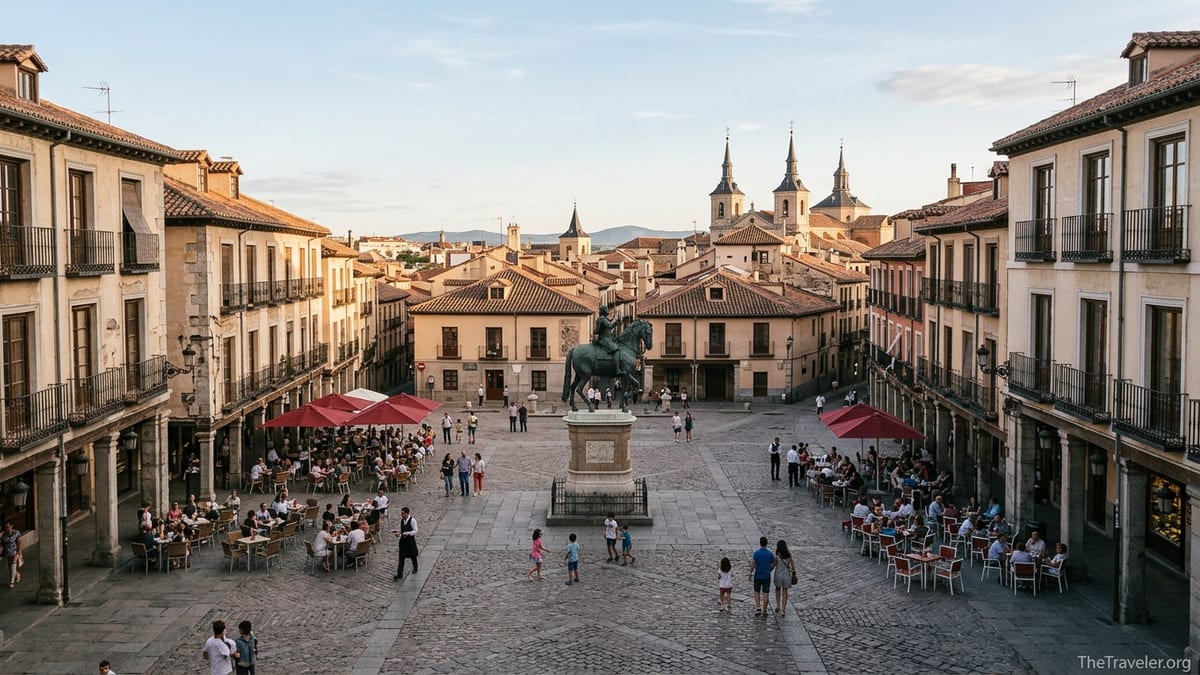
North of Madrid, Castile and León is known for its golden sandstone cities and Romanesque architecture. Salamanca’s Plaza Mayor is one of the most atmospheric squares in Spain, Segovia’s Roman aqueduct and hilltop Alcázar feel almost theatrical, and Ávila’s fully preserved medieval walls create a distinctive skyline visible from the surrounding plains. Travelers often link these in a loop by train or bus from Madrid, spending one or two nights in each rather than doing them all as rushed day trips.
South and east, Castilla-La Mancha is La Mancha of Don Quixote, a landscape of windmills, vineyards and whitewashed villages broken by historic cities. Toledo, perched above a bend in the Tagus River, is the top draw and easily reached in around 35 minutes by high-speed Avant train from Madrid’s Puerta de Atocha station. Further east, Cuenca sits dramatically between two river gorges, famous for its medieval core and the Casas Colgadas, or “hanging houses,” that appear to cling to the cliffs. Westward, Extremadura offers a quieter, less-touristed feel, with Cáceres’s perfectly preserved old town and Mérida’s large Roman theater and amphitheater complex both reachable by direct trains and buses from Madrid.
Suggested First-Time Itineraries and Bases
For a first trip of about a week, a workable structure is four nights in Madrid and three nights split between two historic towns. For example, you might spend four nights in Madrid with a day trip to Toledo, then take a one-hour high-speed train to Segovia for one night, and continue by bus to Salamanca for two nights before looping back to Madrid. This pattern lets you experience the capital’s museums and nightlife plus two or three very different Castilian cities without changing hotels every day.
On a 10 to 12 day itinerary, many travelers add Extremadura or Cuenca. One common approach is to stay three nights in Madrid, two in Toledo, three in Salamanca, and two in Cáceres, with day trips out of these bases. From Salamanca you could take a regional bus to smaller towns such as Zamora for its Romanesque churches, or explore nearby mountain villages in the Sierra de Francia on organized day tours. From Cáceres, many visitors day trip to Mérida to see its Roman remains, returning in the evening to stroll Cáceres’s cobbled lanes and dine in its stone courtyards.
If you prefer fewer hotel changes, pick two main bases and radiate out by train or bus. A practical combination is Madrid plus Salamanca. High-speed Alvia services link Madrid Chamartín with Salamanca in around 1 hour 40 minutes, so you can treat Salamanca as a second “city break” with different architecture and a slower pace. From there, day trips to Ávila, Zamora or even Segovia are straightforward by bus. Another option is Madrid plus Toledo or Segovia, especially if you like returning to a smaller, quieter town each evening instead of a big capital city.
Those with two full weeks can slow down further and include more rural experiences. An example route would be Madrid, Segovia, Salamanca, a few nights in a rural casa rural near the Sierra de Gredos in Ávila province, then Cáceres and Mérida in Extremadura before looping back to Madrid. This sort of itinerary benefits from a rental car between Salamanca and Cáceres, as it allows stops in small villages and national parks, while still relying on trains between the major cities on the Madrid end.
Getting Around: Trains, Buses and Driving
Madrid is the main transport hub for central Spain. Most international flights arrive at Adolfo Suárez Madrid-Barajas Airport, which is connected to the city by Metro line 8, a dedicated airport express bus running roughly every 15 to 20 minutes, and suburban Cercanías trains from Terminal 4 that reach central stations like Atocha in about 25 minutes. In 2026, a single Metro journey within zone A typically costs around 1.50 to 2 euros, while the airport express bus is usually about 5 euros one way, and Cercanías fares to or from the airport are in a similar band.
For visitors who plan to use public transport heavily, the Madrid Tourist Travel Pass remains a practical option. The zone A pass covers Metro, city buses and Cercanías trains within the central area, including the airport surcharge when valid, for a fixed period of 1 to 7 days. Recent official price tables show a 1 day zone A pass around 10 euros, three days about 22.50 euros and seven days around 42 euros, with children under 11 eligible for roughly half price. If you average three to four rides a day, including at least one airport transfer, the pass usually works out cheaper than paying single fares.
Beyond Madrid, Spain’s rail network makes many central cities straightforward to reach. High-speed services link Madrid to Segovia in about 30 minutes from Chamartín station and to Salamanca in under two hours, while Avant trains reach Toledo from Puerta de Atocha in around 35 minutes. Prices vary by time and how far in advance you book, but for planning purposes you can expect many one-way tickets between Madrid and these cities to fall roughly between 15 and 30 euros in standard class. Cuenca is reachable on the high-speed line towards Valencia, with some trains making the trip from Madrid in about an hour.
Buses fill in the gaps where trains are slower or less frequent, particularly for Extremadura. Direct buses from Madrid’s Estación Sur reach Cáceres in about 3.5 to 4 hours and Mérida in around 4 to 4.5 hours, with tickets often around 20 to 30 euros one way, depending on operator and date. Within each region, smaller towns and villages are connected by regional buses that may run only a few times per day, so first-timers should check schedules in advance and avoid planning very tight same-day connections.
Driving gives the most flexibility in rural Castile and León, Castilla-La Mancha and Extremadura, especially around mountain ranges and national parks. Major highways radiate out from Madrid, and driving times are manageable: roughly 1.5 hours to Ávila, 1.5 to 2 hours to Segovia by road, around 3 hours to Salamanca and around 3 to 4 hours to Cáceres or Mérida. International visitors can rent compact cars from Madrid city locations or the airport, often for around 30 to 50 euros per day before fuel and tolls, depending on season. In historic centers, though, narrow streets, resident-only zones and limited parking can be stressful, so many travelers choose to park on the edge of town and walk in, or they only use a car for rural stretches between cities.
Where to Stay: Madrid, Historic Cities and Rural Escapes
Accommodation choices in central Spain range from budget hostels in Madrid to historic parador hotels in converted palaces and convents. In Madrid, first-time visitors often aim for a central but not overly rowdy neighborhood. Around Puerta del Sol and Gran Vía you will find plenty of modern hotels and apartment-style rentals. Hostels in lively areas such as Malasaña and La Latina regularly advertise dorm beds in the 25 to 40 euro range in 2026, while simple but central three star hotels might run 90 to 140 euros per night for a double room in shoulder season, rising higher in peak summer and during major events.
In smaller cities like Toledo, Segovia and Salamanca, staying inside or just outside the historic core is worth the slightly higher price, because it lets you enjoy the atmosphere after day trippers have left. For example, a simple guesthouse or two star hotel on a side street near Toledo’s Plaza de Zocodover might cost 70 to 110 euros per night for a double room, while a boutique property in a restored building with views across the Tagus valley can be significantly more. In Segovia, accommodations within a short walk of the Roman aqueduct or the cathedral tend to be mid-range in price but compensate with stone walls, wooden beams and views of the Alcázar or surrounding countryside.
Paradores are a distinctive option in central Spain. The state run network includes standout properties in cities like Salamanca, Ávila, Segovia and Cáceres, often located in former monasteries, castles or noble houses with stone cloisters and panoramic terraces. Nightly rates fluctuate, but outside peak holidays you might find double rooms in some paradores from roughly 120 to 200 euros, occasionally less with promotional rates. These make sense for travelers who value historic ambiance and on-site dining over the lowest possible price.
Rural stays are another way to experience central Spain beyond the cities. In Castile and León and Extremadura, family run country houses and small inns known as casas rurales offer simple rooms, hearty meals and direct access to hiking in areas such as the Sierra de Gredos, Las Hurdes, or the Jerte Valley. Prices are often competitive with city hotels, sometimes 60 to 90 euros per night for a double including breakfast, depending on facilities and season. These bases work well for travelers who have already visited major sights and want a few quiet days between cities.
Food, Drink and What Things Really Cost
One of the strengths of central Spain is that eating and drinking out can still be relatively affordable compared with many other European capitals. A typical café breakfast in Madrid or Salamanca might be a café con leche and a toasted baguette with tomato and olive oil for around 3 to 5 euros. Time Out Madrid’s recent price guide points to weekday menú del día set lunches around 13 euros in many central restaurants, and in practice you will see daily chalkboard menus across Madrid and Castilian cities offering three courses with bread and a drink in the 12 to 16 euro range.
For dinner, small plates of tapas or raciones shared with friends can keep costs flexible. In Madrid’s La Latina or Lavapiés neighborhoods, it is common to pay around 3 to 4 euros for a small glass of house wine or draft beer and 3 to 7 euros for individual dishes like tortilla de patatas, croquetas, grilled mushrooms or patatas bravas. A sit down evening meal at a mid-range restaurant, including a starter to share, main course and a glass of wine, often falls in the 25 to 40 euro per person range, depending on location and choices. In smaller cities like Ávila or Cáceres, main dishes may be slightly cheaper than in central Madrid.
Regional dishes are a highlight. In Castilla-La Mancha you will see dishes like pisto manchego, a slow cooked vegetable stew, and migas, fried breadcrumbs with pork and peppers, alongside sheep’s milk Manchego cheeses from local dairies. In Castile and León, many visitors try cochinillo asado, or roast suckling pig, in Segovia, and chuletón, a large grilled steak, in cities such as Salamanca or Burgos. Extremadura is known for its acorn-fed Iberian ham from the dehesa oak landscapes, often served simply with bread and a glass of red wine. Trying one or two of these specialties at a reputable restaurant can push up a single meal’s cost, but many travelers find the splurge worthwhile.
On a full travel day, a budget minded visitor who eats a bakery breakfast, grabs a menú del día for lunch and enjoys an evening of tapas can realistically spend around 30 to 45 euros on food and drink in 2026. A mid-range traveler who opts for sit down restaurant meals twice a day, plus coffee breaks and dessert, might see daily food costs closer to 60 to 90 euros. Factor in a few museum entries, such as around 15 to 20 euros for the Prado if visiting outside free hours, and a couple of 1.50 to 2 euro Metro journeys or short bus rides, and a sensible overall daily budget might land somewhere around 70 to 120 euros for a budget traveler and 150 to 230 euros for a mid-range traveler in Madrid, with slightly lower figures in the smaller cities.
Practical Planning Tips for First-Time Visitors
Timing your trip can make a big difference to your experience of central Spain. Summers in Madrid, Castilla-La Mancha and Extremadura are often very hot in the afternoon, with temperatures commonly climbing above 35 degrees Celsius in July and August. Spring and autumn are generally more comfortable, with April to early June and late September to October bringing warm days and cooler nights. If you visit in high summer, plan sightseeing for early mornings and evenings and use the hottest hours for museum visits or long lunches indoors.
First-time visitors should be aware of daily rhythms. Many smaller shops close for a midday break, and dinner in Spain is usually later than in North America, often starting around 9 pm in Madrid and even later in some provincial cities. Restaurants in touristy areas will serve earlier, but if you want a local atmosphere for tapas, arriving at 8.30 or 9 pm in popular neighborhoods like Madrid’s La Latina or Salamanca’s Plaza Mayor usually works better. Sunday evenings and Monday closures are common for museums and some restaurants, so always check the weekly schedule of the sights that matter most to you.
Language is another planning consideration. In Madrid, staff in hotels, museums and many restaurants can typically communicate in English, and signage on public transport is usually bilingual. In smaller towns and rural areas of Castile and León, Castilla-La Mancha and Extremadura, English is less widely spoken, so carrying a few key phrases in Spanish or a translation app makes daily interactions smoother. In practical terms, even basic phrases like “una cerveza, por favor” or “la cuenta, cuando pueda” go a long way.
When booking core tickets, especially train travel around weekends and holidays, it helps to purchase in advance. High-speed routes between Madrid and popular day-trip cities like Segovia and Toledo can sell out of the cheapest fares, leaving only last minute tickets that might cost significantly more. Similarly, if your plans depend on a particular guided visit, such as limited-capacity tours of royal rooms in Madrid’s Palacio Real or access to smaller Roman sites in Extremadura, reserve ahead where online booking is offered. For most cathedrals and open air historic centers, however, it is still possible to turn up and buy tickets on the day.
The Takeaway
Central Spain bundles much of what many travelers picture when they imagine the country: lively plazas, layered history from Roman and medieval to baroque and modern, hearty food and an easy rhythm that invites long café stops. For first-time visitors, starting with Madrid and a handful of historic cities such as Toledo, Segovia, Salamanca, Ávila, Cuenca, Cáceres or Mérida offers a strong introduction without requiring long internal flights or overnight trains.
By using Madrid as a transport hub, taking advantage of high-speed trains and regional buses, and planning a realistic number of bases, you can experience both big city energy and the quiet of stone walled hill towns in a week to two weeks. Balancing menus of the day and tapas with a few splurge dinners, and mixing headline museums with unhurried strolls through old quarters, will keep both your budget and your energy in check.
With a bit of homework on seasons, transport passes and regional specialties, central Spain becomes a straightforward and rewarding first destination. The reward is seeing the country’s historic heartlands at your own pace, from Madrid’s grand boulevards to a sunset over Salamanca’s cathedral towers or the Roman stones of Mérida, and beginning to understand why so many travelers return for a second, slower visit.
FAQ
Q1. How many days do I need for a first trip to central Spain?
Most first-time visitors spend 7 to 10 days, splitting time between Madrid and two or three nearby cities such as Toledo, Segovia, Salamanca or Cáceres. With only one week, four nights in Madrid plus three in one other base works well.
Q2. Is it better to visit Toledo or Segovia as a day trip from Madrid?
Both make excellent day trips. Toledo offers a denser medieval core and more museums, while Segovia combines a dramatic Roman aqueduct with an Alcázar and lighter walking. If you have to choose one, many first-timers pick Toledo, but trains to Segovia are slightly faster.
Q3. Do I need to rent a car to explore Castile and León or Extremadura?
No, for the main cities you can rely on trains and buses from Madrid, especially to places like Salamanca, Segovia, Ávila, Cáceres and Mérida. A rental car becomes useful if you want to spend several days in rural areas or visit small villages and natural parks that have infrequent public transport.
Q4. What is a realistic daily budget in Madrid and nearby cities?
A budget traveler who stays in hostels, eats menú del día lunches and mostly uses public transport might spend around 70 to 120 euros per day. A mid-range traveler staying in standard hotels and eating at sit down restaurants could expect roughly 150 to 230 euros per day, slightly less outside Madrid.
Q5. Is English widely spoken in central Spain?
In Madrid, museum staff, hotel receptionists and many restaurant servers speak at least basic English. In smaller towns and rural areas of Castile and León, Castilla-La Mancha and Extremadura, English is less common, so a few Spanish phrases or a translation app are very helpful.
Q6. When is the best time of year to visit central Spain?
Spring and autumn are generally the most comfortable, with April to early June and late September to October bringing moderate temperatures and long daylight hours. July and August can be very hot in Madrid, Castilla-La Mancha and Extremadura, so plan for early morning and evening sightseeing if you visit in midsummer.
Q7. Are central Spain’s cities walkable?
Yes, the historic centers of Madrid, Toledo, Segovia, Salamanca, Ávila, Cuenca, Cáceres and Mérida are all compact and best explored on foot. You will often use public transport only to reach your neighborhood from the station or to connect between more distant sights.
Q8. How far in advance should I book train tickets from Madrid?
For popular routes like Madrid to Toledo, Segovia or Salamanca, booking a few weeks ahead usually secures better prices and preferred departure times, especially around weekends or holidays. For off peak midweek travel, buying tickets a few days in advance is often sufficient.
Q9. Are tapas free with drinks in central Spain?
In some bars, particularly in cities like Salamanca and parts of Extremadura, a small tapa may come automatically with each drink. In many Madrid bars and more upscale venues you will mainly order and pay for individual dishes. It varies by establishment rather than by city alone.
Q10. Is central Spain safe for solo travelers?
Central Spain is generally safe, and cities like Madrid, Salamanca and Cáceres see many solo visitors. As in any urban area, keep an eye on your belongings in busy Metro stations, on crowded streets and near major sights, but violent crime against tourists is rare and normal precautions are usually sufficient.