


I did not set out to design the perfect Catalonia loop. I simply picked up a compact rental car at Barcelona Airport, pointed it toward the Mediterranean, then kept following roads that looked promising on the map. Over ten days I ended up driving from the Costa Brava to volcanic hills and Pyrenean passes, down through wine country and into the quiet wetlands of the Terres de l’Ebre. Only afterward did I realize how closely my improvised journey echoed Catalonia Tourism’s Grand Tour, that official 2,000‑kilometre, motor-focused route across the region. It confirmed something I felt every day behind the wheel: in Catalonia, road travel is not just a way to get around, it is part of the experience itself.
Starting in Barcelona: Where the Car Helps and Where It Hurts
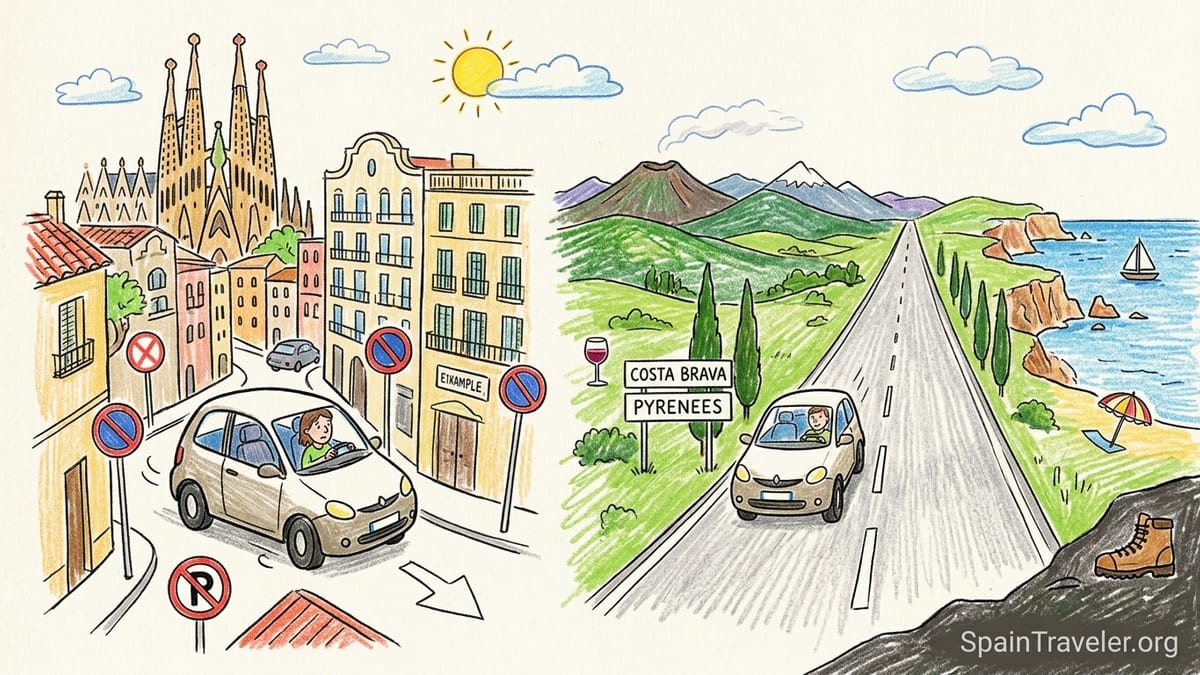
I picked up the car at Barcelona–El Prat Airport on a Sunday morning, after two nights in the city without wheels. This was the first lesson. You do not need a car inside Barcelona, and keeping it there is a mistake I had made on a previous trip. Back then I spent more time watching the GPS recalculate than watching the city. Barcelona operates a low-emission zone that covers most of the urban area on weekdays, which means older, more polluting cars need permits or are barred from entering. Rental cars are almost always modern enough to comply, but the practical issue is congestion and parking, not permits.
On that earlier visit I had driven straight from the airport into the Eixample district, only to discover that street parking was heavily regulated. Blue and green painted spaces are controlled zones with time limits, and prices on central streets can reach several euros per hour during the day. I paid for two hours, rushed through an early dinner, and then moved the car into a private underground garage for the night at a cost that almost matched my hotel bill. It felt like paying a penalty for bringing the wrong tool to the city.
This time I did the opposite. I arrived by train, used the metro and my feet to explore La Rambla, El Born and Montjuïc, and only booked the car for the day I planned to leave town. At the airport, a week-long compact rental in 2026 shoulder season was priced around 30 to 40 euros per day with a reputable agency, before insurance and extras, which put the base cost for ten days somewhere between 350 and 400 euros. I accepted the standard collision damage waiver with a deductible in the 1,200–1,500 euro range and declined the more expensive “zero excess” coverage at the counter, relying instead on a separate policy I had arranged at home. The deposit was blocked on my credit card at pickup, a reminder that car rental in Barcelona is financially comfortable only if your card limit has breathing room.
Leaving the airport, the car immediately became the right tool again. The ring roads around Barcelona are busy but well signed, and once I merged onto the AP‑7 heading north, the traffic thinned and the city dropped away. Since many major tolls in Catalonia were abolished in recent years, including parts of the AP‑7 and AP‑2, I passed through old toll stations that stood like empty gates, the barriers permanently raised. It felt symbolic: beyond Barcelona, the roads opened wide and the real trip began.
Up the Coast: Barcelona to Costa Brava on Open Highways
The first genuine driving day ran from Barcelona Airport to Calella de Palafrugell on the Costa Brava. With light Sunday traffic, the run on the AP‑7 and then inland highways took around 1 hour 45 minutes of pure driving. I refueled near Girona, where a litre of petrol hovered around the mid‑1 euro range. A full tank for a compact car cost roughly 70 to 80 euros and would comfortably cover 700 to 800 kilometres on a mix of highway and secondary roads.
North of Girona, the coast roads turned from functional to scenic. I dropped toward Palamós and then followed twisty local roads to Calella de Palafrugell, one of the whitewashed villages that cling to the rocky inlets of the lower Costa Brava. Here, the car was useful but already slightly in the way. Many of the most charming coves, like Tamariu or Llafranc, are essentially small bays backed by narrow streets that were never designed for modern traffic. I circled the centre twice before giving up on free parking and sliding into a paid municipal lot back from the water. The overnight cost was modest, but the frustration reminded me of another mistake that road-trippers make: trying to park directly in the historic or waterfront core instead of accepting a short walk.
Despite the parking dance, driving transformed my Costa Brava visit. With the car I could link beaches and villages that would have been complicated to combine by bus. Over two days I drove the coastal road between Palamós and Begur several times, a roller coaster of bends with sudden views of pine-covered cliffs dropping into glassy coves. On one afternoon run from Calella to Sa Tuna near Begur, the nominal 20-kilometre distance took 40 minutes because I kept pulling over in miradors to watch sailboats drift below.
Public transport does reach parts of the Costa Brava, especially nearer to larger towns like Lloret de Mar and Blanes, but the less-developed stretches, where the real magic lies, are much better approached on your own wheels. This was my first real confirmation that in Catalonia the road is not just a connector between sights. It is a moving balcony that lets you see how densely the sea, villages and forests interact.
From Sea to Volcanoes: Girona, La Garrotxa and the First Mountain Mistakes
After two nights on the coast, I turned inland toward Girona and the volcanic landscapes of La Garrotxa. This was a short hop on the map, just under an hour from Calella de Palafrugell to Girona, and another 45 minutes to Olot. It was here that I first overloaded the day. I tried to fit a morning city stop in Girona’s medieval quarter, an afternoon hike in La Fageda d’en Jordà beech forest, and a sunset visit to the natural park’s dormant volcanic cones, all while moving hotels from the coast to Olot.
City driving in Girona was smoother than Barcelona, but the mistake was predictable. I insisted on reaching the old town by car instead of leaving it at a peripheral lot. The streets narrowed, the GPS lagged, and a wrong turn sent me into a residential warren with tight one-way lanes. After 20 anxious minutes and three tight reverse maneuvers, I abandoned the car in an underground car park by the river. The better strategy would have been to park near the train station or on the modern side of the city and walk across the Onyar bridges into the historic core.
The drive from Girona to Olot on the C‑63, by contrast, was a pleasure. The road climbed gently into more rural scenery, past stone farmhouses and roadside restaurants with parking lots full of local cars on a weekday. As I approached La Garrotxa, the terrain changed again. Low volcanic hills, ancient lava flows and mixed forests created a landscape that felt simultaneously gentle and wild. Here, the car allowed me to reach trailheads that would have been awkward by bus, such as the access point to the beech forest and the Santa Margarida crater.
But I made another planning misstep. I underestimated how slow driving can become once you are off the main arteries. A loop that looked modest on the map, linking several villages like Santa Pau and Castellfollit de la Roca, expanded into a four-hour ramble on winding secondary roads. There were no tolls, and traffic was light, but speed limits and frequent photo stops stretched the timetable. I arrived at my rural guesthouse outside Olot just as dusk fell, too late to enjoy the terrace or the nearby walking paths. Lesson learned: in inland Catalonia, assume that any scenic village detour will add at least 30 minutes, and design your days more for depth than for box-ticking.
Into the Pyrenees: Where Driving Becomes the Main Event
From La Garrotxa I climbed into the eastern Pyrenees, following a route through Ripoll and Ribes de Freser toward Castellar de n’Hug and the high passes that hint at the French border. The direct drive from Olot to Ripoll is barely 70 kilometres, but between curves, occasional slow trucks and irresistible viewpoints it took close to two hours. The air cooled, the roadside architecture shifted toward darker stone and slate, and the car’s dashboard estimate of remaining range dropped faster as the road rose.
In this section, the car was not just useful, it was essential. Catalonia’s official Grand Tour divides its more than 2,000 kilometres of suggested driving into five sections precisely because four of them swing through the Pyrenees and inland areas where public transport is either infrequent or nonexistent. Buses link larger towns, but many of the villages that give the mountains their feel are reached only by road. Places like tiny hamlets above the Riu Ter, or viewpoints over the Núria valley, are moments that would be almost impossible to stitch together without your own vehicle.
Mountain driving, though, demands respect. On one day I misjudged both distance and elevation. I plotted a route that tried to combine a morning drive to a high pass, a long lunch in a valley village, and an afternoon stretch all the way down toward Berga, imagining a leisurely eight hours. In real time, the hairpins multiplied, and each 40-kilometre segment swallowed nearly 90 minutes. The car’s compact size, which had felt like a practical city choice, suddenly felt wise on narrow stretches where guardrails were minimal and cliffs dropped steeply beyond the white line.
I also met the most basic reality of fuel and services in the mountains. Petrol stations are present but not frequent, and opening hours are more limited once you leave main routes. One afternoon I realized my range had fallen below 150 kilometres just after passing a small station that closed for the midday break. Rather than risk pushing on, I backtracked, waited with a coffee in the attached bar, and filled the tank as soon as the shutters lifted. It cost me an hour but bought a kind of mental freedom that is priceless on remote roads.
Wine Country Detours: Penedès, Priorat and Learning to Slow Down
From the pre-Pyrenean hills I swung south toward wine country, eventually tracing a line that roughly echoed parts of the Grand Tour’s sections between Barcelona, Tarragona and Lleida. I dropped back to the plains near Manresa and then turned toward Vilafranca del Penedès, the informal capital of the Penedès wine region. The drive from the lower mountains to Vilafranca took around 2 hours 30 minutes with a lunch stop and required no toll roads. The landscape flattened, vineyards replaced pine forests, and tractors began to outnumber tour buses.
In Penedès, the car felt perfectly matched to the place. Many of the most interesting cellars and estates sit outside town centres, reached by narrow roads that crisscross vineyards. I booked a cava tasting at a family-run winery outside Sant Sadurní d’Anoia, and the last three kilometres were on a single-lane country track. Public transport can take you as far as the town, especially from Barcelona by regional train, but moving between scattered estates would require taxis and precise scheduling. With the car I was able to linger, buy bottles directly from the producers, and leave only when the sun dropped low over the vines.
The temptation to overload the day returned in Priorat, the small but intense wine region west of Tarragona, one of only two in Spain with the top-tier designation for wine quality. Drawn by friends’ recommendations, I left Penedès early and drove toward Falset on the N‑420, then up into the steep Priorat villages like Gratallops and Porrera. The drive from Vilafranca to Falset took just under two hours on good roads, but everything changed once I turned into the interior. Vineyards clung to slate hillsides in narrow terraces, and roads between villages became slow, coiling ribbons of asphalt.
I tried to fit three village visits and two tastings into a single day. The result was a rushed tasting schedule and one missed reservation when a tractor and a local delivery truck blocked a tight curve for 15 minutes. Priorat taught me that in wine country, the car gives you access but should not become a stopwatch. One or two cellar visits per day, with time for a proper lunch and a nap back at a rural guesthouse, is a healthier way to use the freedom that driving gives you.
South to the Terres de l’Ebre: Remote Roads and Empty Beaches
The most surprising section of my route was the drive south to the Terres de l’Ebre, the lowland region around the Ebro Delta and the southern Catalan coast. From Priorat I zigzagged back to the AP‑7 near l’Hospitalet de l’Infant and followed it past the lines of resort towns around the Costa Daurada. Here, the motorway is wide, relatively fast and now largely toll-free where it once required frequent payments. In less than two hours I reached Amposta, and soon after I was driving on flat roads flanked by rice fields, with herons lifting lazily from irrigation canals.
This is where I felt most strongly that road travel is a major tourism product in Catalonia. The Ebro Delta is sparsely populated and threaded with narrow levee roads that run between lagoons and paddies. Buses connect the main towns, but the places that give the delta its distinct personality remote bird hides, wind-sculpted beaches, tiny fishing harbours are scattered across peninsulas and islands of land. My compact car carried me to a deserted stretch of sand near Trabucador one morning, the kind of place where you can park on firm ground and walk a hundred metres to hear nothing but wind and waves.
The driving itself was delightfully different. After the sharp concentration of Pyrenean passes and Priorat switchbacks, the Terres de l’Ebre offered long, straight stretches where the main hazards were tractors and the occasional cyclist. I kept my speed down, not because of traffic, but because the reflections of clouds in flooded rice fields made me want to stop constantly. Fuel was easy to find along the main highways, but smaller village stations sometimes observed extended afternoon breaks, so I refilled when the gauge dropped to half rather than pushing my luck.
Parking was rarely a problem here, except in a few compact coastal villages with tiny centres. Those times I learned to leave the car at the edge of town and walk in. It was a far cry from the multi-level garages of Barcelona and Girona. In many ways the Ebro region felt like a reward for all the earlier mistakes. I had finally adjusted my rhythm to the road, accepting that the point of driving here was not to move quickly but to reach landscapes that would be logistically complex and time-consuming without a private vehicle.
Dropping the Car: When Trains Beat Roads
By the time I pointed the car back toward Barcelona, I had driven a rough triangle across the region: from coast to volcanoes and mountains, back down through wine country and out toward the Ebro wetlands. The drive from Amposta to the outskirts of Barcelona on the AP‑7 took about 2 hours 30 minutes with a brief rest stop. Traffic thickened as I approached the metropolitan area, and memories of past scrambles for parking resurfaced.
This time I refused to repeat the earlier mistake of keeping the car in Barcelona. Instead of driving into the city, I dropped the car at the airport, which many rental companies allow at no extra cost when you return to the same location. From there I rode the airport train to Barcelona Sants station and switched to the metro, reaching my central hotel without once worrying about one-way systems or parking signs. The relief I felt rolling my suitcase instead of steering a car through city traffic confirmed something simple. In Catalonia, the car is a brilliant tool between cities, and a burden inside them.
In hindsight, I realized that some sections of my journey would have been more pleasant by train from the start. The corridor between Barcelona and Girona is well served by both regional and faster services, turning what had been a nearly two-hour driving day into a short, relaxing ride on rails. If I had left the car in Girona instead of at the airport after the coastal and Garrotxa sections, I could have used trains again to reach Tarragona or even Tortosa before renting another car locally for the Ebro Delta and hinterland.
The experience sharpened my appreciation of how Catalonia’s Grand Tour is marketed. It is a designated motor route of more than 2,000 kilometres, divisible into five chunks that can each be done in several stages. But nothing obliges you to drive every kilometre. The smartest way to use a car here is to let the trains carry you between big nodes, then rent regionally for the slices where roads give you access to rural villages, vineyards, mountain passes and less-connected coastal zones.
The Route I Would Drive Again (and Where I Would Ride the Rails)
If I repeated this trip, knowing what I know now, the route would be simpler and more deliberate. I would still start in Barcelona without a car, giving the city two or three days of undistracted attention. When it was time to head out, I would rent a compact car directly from the airport or Sants station and drive to the Costa Brava, basing myself in one coastal town for three nights. I would keep daily drives short, focusing on one or two nearby coves or medieval inland villages per day instead of jittery loops through every place that fits on the map.
From the coast I would again drive inland to La Garrotxa and Olot for at least two nights, but this time I would skip the stop in Girona with the car altogether. Instead, I would either visit Girona by train as a day trip from Barcelona or return the car there after the mountains and continue by rail. In the volcanic region I would plan one full day with only one main walk and one village, resisting the urge to hit every photogenic church spire on the tourist board’s suggested map.
For the Pyrenees, I would perhaps shorten the mountain stretch but preserve its essence. One or two nights in a well-located valley town with access to a high pass would be enough to get a feeling of the landscapes without stacking too many hours behind the wheel. Here the car is irreplaceable, and I would accept the slower pace and longer distances as the price of seeing villages that cling improbably to slopes and ridges.
When it came to wine country and the Terres de l’Ebre, I would break the pattern. Instead of driving all the way back toward Barcelona, I would angle from Penedès and Priorat down to the Ebro and return the car in a southern city like Tortosa or a nearby town with rail connections. From there, I would take the train back to Barcelona or onward along the coast. That hybrid pattern would keep the freedom and depth that road travel brought to my journey, while letting the train erase the long highway stretches that add fatigue but few new impressions.
FAQ
Q1. Do I need a car for an entire trip to Catalonia?
For Barcelona and major cities you do not. Trains and buses cover urban areas and the main coastal corridor well. A car becomes most valuable for rural villages, wine regions like Priorat and Penedès, the Pyrenees, La Garrotxa and the Terres de l’Ebre, where public transport is sparse and sights are scattered.
Q2. Where is the best place to pick up a rental car in Catalonia?
Barcelona Airport is convenient for leaving the city directly, while Girona, Tarragona or Lleida can work if you plan to use trains between regions and only rent locally. Picking up in the city centre is possible but exposes you immediately to traffic and parking challenges.
Q3. What kind of car is best for driving in Catalonia?
A compact hatchback is a good compromise. It is efficient on highways, easier to park in tight garages, and more comfortable on narrow village streets and mountain roads than a large SUV. Manual transmission is common, so request an automatic in advance if you need one.
Q4. How much should I budget for fuel and tolls?
Fuel costs vary, but for a compact car in 2026 you can expect a full tank to be around 70 to 80 euros, covering several hundred kilometres. Many former toll motorways in Catalonia are now free, but some coastal and tunnel routes still charge modest fees, so keep a payment card or some cash handy and check signs as you go.
Q5. What are the main mistakes drivers make in Barcelona?
Common mistakes include bringing a car into the city centre at all, underestimating regulated street parking, ignoring low-emission zone rules, and assuming that old neighbourhoods will have easy garages. It is usually better to park once in a long-stay facility or avoid driving in the city entirely.
Q6. Are mountain and rural roads difficult to drive?
Many are well surfaced but can be narrow, winding and slow, especially in the Pyrenees and Priorat. Plan extra time, avoid tight schedules, drive in daylight where possible and refuel before venturing deep into remote areas. A smaller car and unhurried pace make the experience much more comfortable.
Q7. How long does it take to drive between key regions?
As a rough guide, Barcelona to the Costa Brava is around two hours, Costa Brava to La Garrotxa about one hour, La Garrotxa to the Pyrenees another one to two hours, the Pyrenees to Penedès roughly two to three hours, and Penedès to the Terres de l’Ebre around two hours. Scenic detours and mountain roads can significantly extend these times.
Q8. Can I visit Catalan wine regions without driving?
Yes, but it takes more planning. Trains connect Barcelona with hubs like Vilafranca del Penedès or Tarragona, and from there you can use taxis or organized tours to reach specific wineries. A car gives greater flexibility, especially in Priorat where villages and cellars are remote and public transport is limited.
Q9. What about parking in small towns and rural areas?
Most smaller places have free or inexpensive parking at the edge of town, with signed lots serving historic centres. It is usually easier to leave the car there and walk rather than trying to drive narrow medieval streets. Only popular coastal villages in peak season tend to feel tight and crowded for parking.
Q10. Should I follow Catalonia’s official Grand Tour route exactly?
Not necessarily. The Grand Tour’s more than 2,000 kilometres are an inspiring framework, but you can happily drive only one or two sections and link big cities by train. The most rewarding approach is to treat the official itinerary as a menu, choosing the mountain, coastal, wine or wetland segments that fit your time and comfort with driving.