

Catalonia is one of those regions where you can have a world-class architectural visit in the morning, hike clifftop paths over turquoise coves in the afternoon, and finish the day with a glass of Priorat red in a medieval village. After multiple trips spread over several years, I stopped trying to “see everything” and focused instead on experiences I would genuinely repeat. The result is this guide, organized by experience type rather than destination, with on-the-ground details like prices I actually paid, effort required and how I booked. The goal is to help you decide what to build a Catalonia itinerary around, not just list famous sights.
Modernist and Architectural Visits I’d Actually Repeat
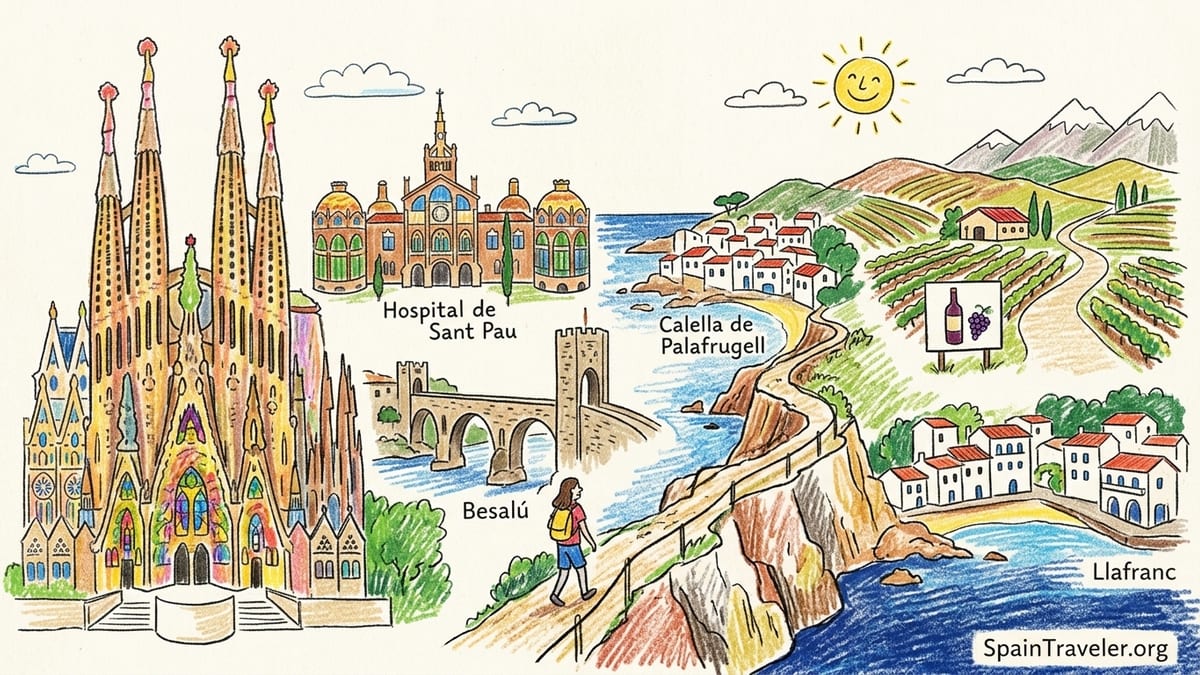
Barcelona’s Modernist landmarks dominate most Catalonia itineraries, and for good reason. But not every big-name building felt equally worthwhile once I factored in cost, crowds and how rushed the visits felt. The one I would absolutely repeat is the Sagrada Família. On my latest visit in May 2025, I booked a 10:00 guided tour ticket directly through the official website for 30 euros per adult, which included the audioguide. The standard individual ticket without guide is listed at 26 euros. I spent just under two hours inside, which felt like enough time to appreciate the forest-like columns and stained glass without fatigue. Physical effort is light, limited to walking and a few stairs, though the tower option adds more. I would strongly recommend booking at least a few days ahead and aiming for early morning or late afternoon to avoid the most intense crowds, which can be very heavy around midday.
In contrast, Casa Batlló on Passeig de Gràcia was one of my more mixed experiences. I visited on an August afternoon and bought the General Visit online a week before, paying 33 euros per adult through the official site, where prices for the basic visit start from around 29 euros depending on time and demand. The visit took about 75 to 90 minutes with the included smart audioguide. Architecturally it is stunning and I do not regret going once, but inside it felt crowded and at times more like an attraction than a house museum. We shuffled through rooms with limited time to linger, and the value-for-money felt stretched compared with Sagrada Família. Physical effort was moderate because of stairs and standing, and the crowd level was very high in peak season. I would not personally repeat it at that price, though I would still recommend it once for people who care deeply about Gaudí’s work.
Outside the big-ticket Gaudí sights, I got more satisfaction from quieter architectural visits that fit naturally into a day in the city. The Hospital de Sant Pau complex in Barcelona, reachable by metro from the center, cost 16 euros for a standard self-guided ticket when I visited in spring 2024. I stayed almost two hours wandering among pavilions and gardens with relatively light crowds. This felt like a better balance of price, space and time, especially if you already plan to visit Sagrada Família nearby. Physical effort is low apart from gentle walking. I would happily repeat this visit in cooler months, and it can be slotted into a cultural day without the stress of timed entries selling out weeks ahead.
If your time is short and you are deciding what to build a trip around, I would prioritize Sagrada Família plus one other Modernist site that matches your interest level, rather than stacking three or four expensive house museums. For design lovers, Casa Batlló or La Pedrera make sense as one-time experiences. For travelers who want architecture but also breathing room, I would structure a day around Sagrada Família and the Hospital de Sant Pau complex, then spend the rest of your cultural budget on food markets or a wine day outside Barcelona.
Coastal Walks and Beach Days: When the Path Beats the Sand
Catalonia’s coastline rewards people who like to move. After several stays on the Costa Brava, the experiences I would repeat are not the static beach days, but the coastal paths that string coves together. The standout is the Camí de Ronda, a historic coastal trail that now connects many Costa Brava towns. Over three separate trips, I have walked several sections, but the one I keep coming back to runs between Calella de Palafrugell and Llafranc, continuing on to the lighthouse at Sant Sebastià. This half-day outing costs almost nothing beyond bus fare or parking. I usually pay around 6 to 8 euros for a regional bus ticket from Girona to Palafrugell, then a short local hop to Calella. The walk itself takes two to three hours at an easy pace, with time for photos and a coffee in Llafranc.
Physical effort on this section is moderate. There are stairs carved into the cliffs and some short, steep ramps, but no technical terrain. In hot months you feel the sun, so I now aim for April, May or late September. Crowd levels vary: July and August afternoons are busy with holidaymakers walking between beaches, while early morning shoulder-season walks can feel almost tranquil. I would absolutely repeat this as a core element of a Costa Brava stay and would encourage travelers to plan at least one coastal walking day rather than spending all their time on a single crowded beach.
By contrast, my least satisfying coastal experience was an August afternoon “beach day” at Platja d’Aro. The wide sandy beach itself is pleasant, but paid loungers and umbrellas ran around 20 to 25 euros for two loungers and shade for the day when I visited in 2023, and the promenade felt intensely commercial. We stayed about three hours before moving on. Physical effort was almost zero, but crowd level was very high and the atmosphere more resort-generic than distinctly Catalan. I would not build a trip around this, especially when smaller coves like Tamariu or Sa Tuna are within reach.
To make the most of the coast, I now structure days that combine walking with selective swimming. For example, from Calella de Palafrugell I start walking the Camí de Ronda mid-morning, stop for a swim at a small cove like El Golfet, continue to Llafranc for a relaxed lunch, then decide whether to push on to the lighthouse or return by the easier promenade route. This approach spreads people out, keeps the day active, and gives you multiple scenery changes for the price of one bus ticket and a meal. If you value scenery and movement, coastal walking is worth centering a Costa Brava visit around, with beach time as the bonus rather than the main event.
Wine Tasting in Priorat and Penedès: Small Cellars, Big Payoffs
For wine-focused travel, Catalonia offers two very different but complementary regions: the sparkling-wine heartland of Penedès near Barcelona, and the steep slate vineyards of Priorat inland. I have visited both multiple times, and if I had to design a trip around wine alone, it would be a two-center stay: one day in Penedès and at least one full day in Priorat. In Penedès, I joined a small-group cava tour from Barcelona that cost 95 euros per person in autumn 2024, including return transport by minivan, two winery visits with tastings of three or four wines each, and a light snack. The day ran about eight hours door to door, with moderate physical effort in the form of cellar stairs and vineyard walks. Crowds were manageable, mostly limited to our own group at each estate, and I would repeat this as an easy, low-planning way to add wine to a city trip.
Priorat requires more intention, but the experiences feel more personal. On my last visit in 2024, I based in the village of Escaladei and booked a visit at Cellers de Scala Dei through the Priorat tourism website. The “introductory visit with four-wine tasting” was priced at 25 euros per adult for a 90 minute tour, which matched what I paid. The group was capped at about a dozen people, and we spent roughly half the time in the historic cellar and half tasting in a simple, light-filled room. Physical effort was light to moderate, with some stone steps and standing during the tasting. Crowds were minimal, and the explanation of the region’s history and terroir felt grounded rather than scripted. I would absolutely repeat this visit, especially paired with a short hike in the nearby Montsant Natural Park.
For a slightly more in-depth experience, I also visited a small family-run winery near the village of Porrera, where the standard “cellar and wines” visit was priced at 30 euros and a simpler tasting-only option at 25 euros, in line with many Priorat estates that publish similar prices. That visit ran about two hours, including a stroll through the vineyards and a tasting of four wines. Booking was by email, and the owner personally led the tour. Physical effort was moderate due to uneven ground in the vineyard, and shade was limited in summer. I would repeat this, but only in cooler seasons such as April, May or October.
If you only have time for one wine day, I would not build a whole trip around the largest “factory” style cellars, even though they are famous. The more memorable experiences came from mid-sized and small producers where I paid between 25 and 35 euros for in-depth visits with four or more wines and time for questions. When planning, I now prioritize one well-chosen Priorat visit and perhaps a second contrasting estate over trying to cram in three quick tastings. That structure leaves space to appreciate each wine and to explore the medieval villages that surround the vineyards.
Hiking and Rural Experiences: Montsant, Pyrenees and Beyond
Hiking in Catalonia ranges from gentle vineyard loops to serious mountain days, and not all of them are equally repeatable if you factor in logistics and weather. One rural experience I would absolutely repeat is a half-day hike in Montsant Natural Park, combined with wine tasting in Priorat. From the village of Escaladei, I followed a circular trail that climbed through terraced vines and scrub forest to a rocky balcony overlooking the Priorat valleys. The route, signposted locally, took about 3.5 hours including photo stops and a picnic. There is no admission fee for the park, so the only costs were transport to the village, which for me meant a rental car from Reus at around 45 euros per day, and food. Physical effort was moderate to strenuous because of sustained uphill sections and loose stones on the descent. Crowd level was very low; I met only a handful of other hikers even on a sunny Saturday in April.
For higher mountains, I have twice stayed in the Pyrenean town of Vielha in the Val d’Aran, roughly three and a half hours by bus from Barcelona. In summer, I used Vielha as a base for valley hikes and lake circuits inside the Aigüestortes i Estany de Sant Maurici National Park. One memorable day hike started from the Banhs de Tredòs area, where a local taxi service up the valley road cost around 10 to 12 euros per person each way. From there, a six-hour loop around high mountain lakes required a solid level of fitness and proper footwear. Physical effort was high, and afternoon thunderstorms are common in July and August, so an early start is important. Crowds were moderate on the main trails near parking areas but thinned out quickly beyond the first lake. I would happily repeat this as a centerpiece of a mountain-focused trip, but I would not suggest it as an add-on for travelers unused to full-day hikes at altitude.
By comparison, a rural “experience” I am not in a rush to repeat was a packaged horseback riding excursion near the Garrotxa volcanic zone that I joined on a hot August afternoon. The 90 minute ride through fields and forest cost 45 euros per person, booked the night before through a regional tourism office. Physical effort for riders was low, but the heat and flies made it uncomfortable for humans and horses alike. The group size of around a dozen riders also meant long, slow queues on narrow paths. As a result, it felt more like a box-ticking activity than a meaningful way to experience the landscape. If you are short on time in Garrotxa, I would focus instead on walking routes through beech forests and old lava flows, which are free and far more flexible around weather.
Overall, when it comes to hiking and rural experiences, I would build a Catalonia trip around Montsant and the Pyrenees if mountains matter to you. Both offer enough variety to fill several days, with minimal entry costs and the ability to tailor difficulty to your fitness. Horseback rides and other packaged rural activities can be fun with the right conditions, but I would treat them as optional extras rather than anchors for your itinerary.
Medieval Villages, Monasteries and Roman Heritage
Catalonia’s inland villages and monasteries are where I felt most removed from the crowds of Barcelona. A clear favorite is Besalú, a medieval town in the province of Girona known for its stone bridge and preserved Jewish quarter. I have visited Besalú three times, always as a day trip by car, paying about 3 to 4 euros for parking in designated lots just outside the historic center. Wandering the streets, visiting small churches and the mikveh is free or donation-based, though some specific monuments request a few euros for entry. I usually spend four to five hours in town, including a leisurely lunch. Physical effort is low to moderate thanks to cobblestones and some slopes, and crowds range from light on weekdays outside summer to moderate when tour buses arrive. I would happily repeat Besalú as a gentle cultural day anchored by atmosphere rather than a single blockbuster sight.
For monasteries, two visits stand out. The first is the Cistercian monastery of Poblet, inland from Tarragona. When I visited in autumn 2023, the standard adult ticket cost 8 euros, with a guided visit option around 12 euros depending on language and schedule. The visit lasted roughly 90 minutes and included cloisters, the church and royal tombs. Physical effort was moderate, with some stairs and uneven floors. Crowd levels were modest even on a Saturday. I would repeat Poblet as part of a broader route linking several Cistercian monasteries, especially for travelers interested in medieval history and quieter heritage sites.
The second is the Carthusian monastery of Escaladei, at the edge of Montsant Natural Park, which I have visited twice. Entry was 11 euros for adults on my latest visit, and I spent about two hours exploring reconstructed cloisters and ruins. Interpretive panels in multiple languages helped bring the site to life without needing a formal tour. Physical effort was moderate, and there was ample shade. Visitors were few, even during Easter week. I would absolutely repeat Escaladei, especially combined with a Priorat wine visit on the same day, since several wineries sit within a short drive.
For Roman heritage, Tarragona is the obvious centerpiece. On my last trip, I bought a combined ticket that covered several major sites, including the amphitheater and circus, for around 11 euros per adult. I spent a full day in the city and could easily have used more time. Physical effort is moderate with hills and stairs between sites, and summer heat is a factor. Crowd levels at the main monuments were moderate but far below what you see at Barcelona’s big attractions. I would recommend structuring at least one night in Tarragona if you are interested in Roman history, as a rushed half-day from Barcelona does not do justice to the layered old town, waterfront and museums.
If you need to choose, I would build a cultural inland day around either Besalú and another nearby village, or Tarragona and its Roman sites, rather than trying to chain too many towns in one day. Monasteries like Poblet or Escaladei can then serve as anchor points for separate excursions that balance quiet reflection with scenic driving.
Food Markets, Festivals and Everyday City Life
Some of the most repeatable experiences in Catalonia are the least structured ones: wandering food markets, catching a local festival, or simply sitting at a neighborhood bar for vermut at noon. In Barcelona, the Boqueria market off La Rambla is famous, but after several visits I now prefer Mercat de Sant Antoni and Mercat de la Concepció, where the balance of everyday shopping and prepared food stalls feels more local. At these markets I typically spend an hour or two grazing on small plates and buying fruit. A simple breakfast of coffee and a tortilla sandwich usually runs 4 to 6 euros, while a more elaborate lunch of seafood and wine at a market bar can reach 20 to 25 euros per person depending on choices. Crowds at Sant Antoni are moderate, skewing local, compared with very high tourist density in Boqueria at midday.
One experience I would happily repeat and build a city day around is a morning market visit followed by a relaxed cooking class that uses those ingredients. In 2024 I joined a small group class in Barcelona’s Eixample district that cost 85 euros per person, including a guided market shop, hands-on preparation of several Catalan dishes and a long, social lunch with wine. The total duration was about five hours. Physical effort was moderate, involving standing in the kitchen and walking to and from the market. Crowd levels were limited to our group of eight. The cost is substantial, but as a single splurge that combines food, culture and social contact, I found it worth repeating and far more memorable than many restaurant meals at the same price.
On the festival side, Catalonia’s calendar is dense, and not every celebration justifies reworking an itinerary. One that does is the Festa Major de Gràcia in Barcelona, held each August when neighborhood streets are elaborately decorated and host concerts and events. When I last attended in 2022, all the street activities were free, with costs limited to food and drinks from pop-up bars. I spent an evening and much of the following day wandering decorated streets and watching human towers and live music. Physical effort was moderate because of long hours on foot. Crowd levels were very high in the evening, with narrow streets packed shoulder-to-shoulder, which may not suit everyone. Despite the crush, I would repeat this if my dates matched, because it is one of the clearest windows into neighborhood-level culture in Barcelona.
In contrast, a smaller village festival I attended near Girona felt more opaque as an outsider. The events were clearly designed for locals, with long speeches and closed community meals. While I appreciated the authenticity, I would hesitate to build a trip around a random small-town festa unless you have local contacts or language skills. In that case, time might be better spent on universal experiences such as markets, tapas crawls or coastal walks, which do not depend on insider knowledge to enjoy.
The Takeaway
After several extended trips, the experiences I would build a Catalonia itinerary around share a few traits. They offer a mix of depth and flexibility, justify their cost with time and meaning, and leave room for spontaneity in the surrounding hours. Sagrada Família at around 26 to 30 euros is one, especially if you choose quieter time slots and allow at least two hours to absorb the space. Camí de Ronda coastal walks are another, delivering world-class scenery for the price of a bus ticket and effort on the stairs. Priorat wine visits in the 25 to 35 euro range, combined with Montsant hikes and Escaladei monastery, create days that feel rich without being crammed. Inland, Besalú, Tarragona and the Cistercian and Carthusian monasteries offer history at a humane pace and cost.
By contrast, some expensive attractions felt rushed or overly crowded once I factored in the reality of visiting in high season. Casa Batlló, horseback riding packages in summer heat, and generic resort-style beach days fall into this category for me. I do not regret trying them, but I would not design a future trip around them. Instead, I now treat them as optional extras that can be slotted in if time, budget and weather align.
If you are planning your first or second visit to Catalonia, consider starting with two or three anchor experiences that genuinely appeal to you culturally or physically, then filling in the rest of your days with markets, neighborhood wandering and shorter excursions. For a week-long trip, that might mean one Modernist highlight day in Barcelona, one coastal walking day on the Costa Brava, one wine and monastery day in Priorat, and one mountain or medieval village day, with the remaining time left open for city life and unexpected discoveries. This approach respects both your budget and your energy, while giving Catalonia’s variety space to breathe.
FAQ
Q1. Is Sagrada Família really worth the ticket price compared with other churches?
Yes. Even after visiting many European churches, I found Sagrada Família unique enough in design and light to justify its 26 to 30 euro ticket. I would strongly recommend booking directly and choosing a quieter time of day for a two-hour visit.
Q2. Which coastal walk on the Costa Brava is best for a first-timer?
For a first coastal walk, I suggest the Camí de Ronda section between Calella de Palafrugell and Llafranc, with the option to continue to the Sant Sebastià lighthouse. It takes two to three hours at a moderate pace, has plenty of stairs but no technical terrain, and can be combined with swimming and lunch.
Q3. How much should I budget for a quality wine tasting experience in Priorat?
For a substantial visit that includes a cellar tour and tasting of four or more wines, expect to pay roughly 25 to 35 euros per adult at many Priorat wineries. Smaller producers may be at the lower end and often require advance booking by email or through regional tourism sites.
Q4. Is it necessary to rent a car to visit Priorat and Montsant?
Renting a car makes visiting Priorat and Montsant much easier and more flexible, especially if you want to combine a hike, a monastery visit and a winery in one day. Public transport options exist but are limited in frequency and may not align well with tasting times, so a car is the option I would repeat.
Q5. Are Catalonia’s medieval villages suitable for travelers with limited mobility?
Many medieval villages such as Besalú have cobblestones, slopes and narrow streets that can pose challenges for those with limited mobility. However, the main squares, bridges and some viewpoints are accessible with care. It is wise to plan shorter visits, allow extra time, and check specific access details in advance.
Q6. When is the best season for coastal walks versus mountain hikes?
For coastal walks on the Costa Brava, I prefer April, May, late September and early October, when temperatures are milder and crowds lighter. For Pyrenean mountain hikes, July and August offer the most stable weather, though afternoon storms are common, while late June and early September can balance good conditions with fewer people.
Q7. Are food markets in Barcelona more for tourists or locals?
It depends on the market. La Boqueria has become heavily touristed, especially at midday, whereas markets like Sant Antoni and la Concepció still serve many local shoppers alongside visitors. I would repeat visits to the more local-feeling markets and treat Boqueria as a quick look rather than a place to eat a full meal.
Q8. How crowded are Catalan festivals, and are they worth planning around?
Major festivals such as Barcelona’s Festa Major de Gràcia can be extremely crowded, especially in the evenings, but they offer a vivid glimpse of local culture with decorated streets and performances. I would plan around a major festival if you are comfortable with dense crowds and late nights, and otherwise enjoy smaller neighborhood events if they coincide with your stay.
Q9. Is skiing in the Catalan Pyrenees worth organizing a trip around?
While I have not built a trip entirely around skiing in Catalonia, resorts in the Val d’Aran and other Pyrenean areas offer a solid experience with relatively fewer international visitors than some Alpine destinations. If skiing is a priority and you already plan to be in northern Spain in winter, it can justify a few dedicated days.
Q10. How should I split my time between Barcelona and the rest of Catalonia?
For a week-long trip, I would spend three nights in Barcelona for architecture, markets and city life, and four nights split between two contrasting areas such as the Costa Brava and Priorat or the Pyrenees and a medieval village base. That balance lets you enjoy Catalonia’s variety without feeling rushed.