


Catalonia is compact enough that you can sleep in one place and see a lot, but varied enough that choosing the wrong base can waste days in traffic or on slow trains. The official tourism board splits the region into coast, mountains, cities and rural areas, and that is the most useful way to think about where to stay. Before you book a specific hotel, it pays to decide first which city, coastal town, mountain village or wine-country valley will work as your main base.
How to Think About Bases in Catalonia
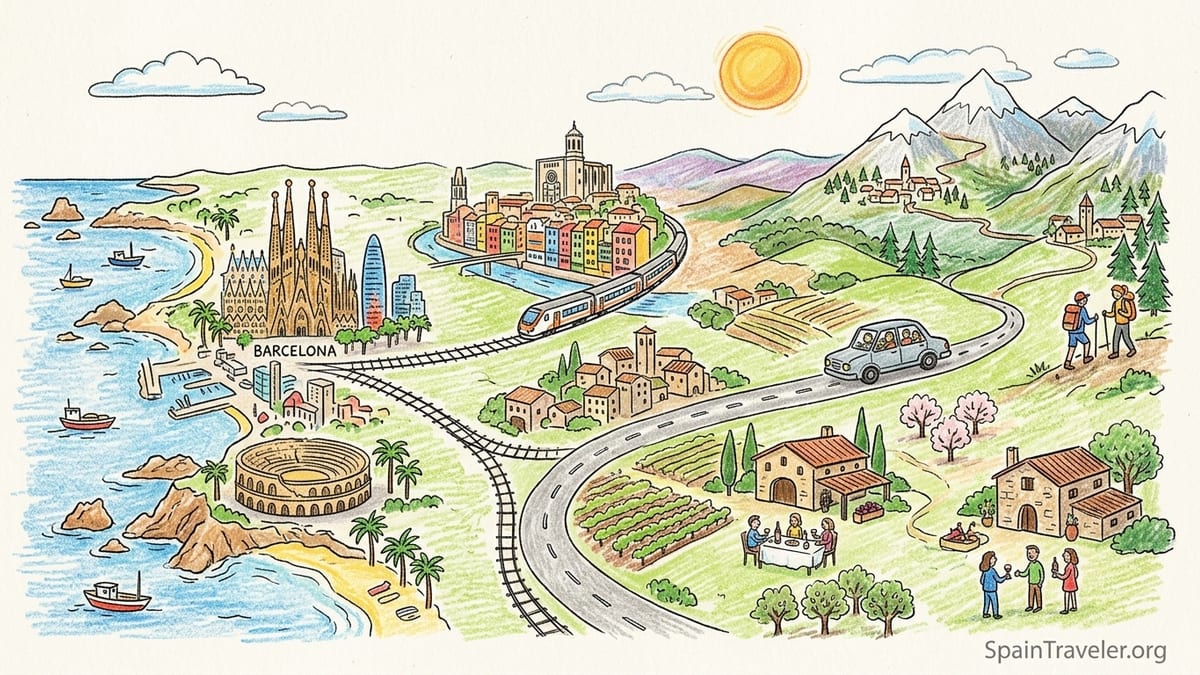
Planning a Catalonia trip starts with one decision: are you here mainly for city life, the coast, the mountains or a slower rural escape. The tourism board uses exactly these four pillars to describe the region, which stretches from the Pyrenees down to about 580 kilometres of Mediterranean coastline. Urban Catalonia is anchored by Barcelona, complemented by smaller historic cities such as Girona, Tarragona and Lleida. Coastal Catalonia runs from the coves of the Costa Brava in the north to the broad sands of the Costa Daurada around Tarragona. Inland, you find both high Pyrenees peaks and softer pre-Pyrenean hills. Between them lie wide rural areas of vineyards, stone villages and farm stays.
Transport should shape your choice. Catalonia’s integrated regional and commuter rail network, Rodalies de Catalunya, fans out from Barcelona to Girona, Tarragona, Lleida and many smaller towns, with regional lines connecting much of the coast and parts of the interior. This makes Barcelona the easiest car-free base, but also means Girona and Tarragona work well for travellers who want a smaller city with rail access to beaches and countryside. In contrast, the Pyrenees and many wine-country villages are much more practical with a rental car.
Think in day-trip radiuses rather than administrative provinces. From Barcelona you can reach Montserrat, Sitges, Girona or Tarragona in roughly one to one and a half hours on public transport, which covers a good share of the “city plus coast” and “city plus mountains” wish-lists. From Girona, the Costa Brava is within a short bus or car ride. Tarragona covers the southern coast and Roman heritage. Lleida looks west towards rural plains, river valleys and less-visited castles. Pyrenees bases like La Seu d’Urgell, Puigcerdà or Vielha in the Val d’Aran open up mountain passes, ski hills and hiking areas. Wine-country and rural areas sit between these hubs and reward slower, multi-night stays.
Finally, match your base to your travel style. Short city breaks and first-time visits work best based in Barcelona with perhaps one satellite night elsewhere. Longer itineraries of 7 to 14 days benefit from two or three distinct bases, for example Barcelona plus Girona and a Pyrenees village, or Tarragona plus a Priorat wine stay. The following sections walk through the main strategic bases so you can choose the right one before worrying about specific hotels.
Barcelona: Urban Hub and Best All-Round Base
Barcelona is Catalonia’s capital and by far the strongest base for travellers who want urban life, cultural sights and easy rail access around the region. The city’s airport, Josep Tarradellas Barcelona El Prat, is the main international gateway, with metro, bus and train links into the centre. The airport metro line L9 takes around 32 minutes to reach the city, and dedicated airport buses connect both terminals with Plaça d’Espanya and Plaça de Catalunya, where you can transfer to several metro and Rodalies lines. This means you can land, check into a hotel in Eixample, the Gothic Quarter or Gràcia and be out exploring La Sagrada Família or the waterfront without needing a car.
For regional day trips, Barcelona’s Sants, Passeig de Gràcia and Estació de França stations are the main hubs. Frequent Rodalies trains run north to Girona and Figueres on the R11 line, south to Tarragona and the Costa Daurada beaches on the R16, and inland towards Lleida via regional services that pass through cities such as Valls and Reus. On practical terms, this means you can leave Barcelona after breakfast and be walking the medieval walls of Girona, tasting vermouth in Sitges, or visiting the monastery of Montserrat by early or mid-morning, then return in time for dinner.
Barcelona’s restaurant and accommodation scene is the most varied in Catalonia. You can stay in a design hotel on Passeig de Gràcia, a mid-range boutique in El Born, or a serviced apartment in Eixample and still be close to public transport. Food ranges from simple menus del día in neighbourhood bars to multiple Michelin-starred restaurants. This density of options suits travellers who like to decide day by day whether they are in the mood for Gaudí, beach time, a wine bar in Poble-sec or a side trip out of town.
How many nights to stay in Barcelona depends on whether it is your only base. If you are using it mainly as a hub for regional day trips, three to five nights gives time for the city’s main sights and one or two excursions. If you plan to see most of Catalonia without changing hotels, a full week based in Barcelona is workable, but you will spend quite a bit of time commuting to more distant corners like the central Pyrenees or western wine regions. For itineraries longer than seven days, it usually makes sense to pair Barcelona with at least one smaller base.
Girona: Gateway to the Costa Brava and Northeastern Catalonia
Girona is the most strategic base for exploring the northeastern corner of Catalonia, especially if you are drawn to the Costa Brava and the inland counties around the French border. Fast trains from Barcelona to Girona typically take around 40 minutes on high-speed services or roughly 1 hour 20 minutes on regional trains, so Girona can serve as either a comfortable day trip from Barcelona or, better, as a quieter multi-night base with easier access to the coast. The city’s compact historic centre, with its riverside houses and medieval walls, makes it pleasant to explore mainly on foot.
Public transport from Girona to the Costa Brava is based on a network of regional buses that fan out to seaside towns such as Tossa de Mar, Lloret de Mar, Palamós, Palafrugell, L’Escala and Roses. Travel times vary, but as a general guide many of the mid-coast destinations are between 45 minutes and 1 hour 15 minutes away by bus. If you prefer not to drive, basing in Girona and using buses for day trips allows you to reach both sandy resort towns and smaller coves without worrying about coastal parking in high season.
With a car, Girona becomes an ideal launch pad for a coastal and inland loop. You can drive the scenic roads to coves near Begur, continue to whitewashed Cadaqués and the Cap de Creus Natural Park, then loop back via Figueres to visit the Dalí Theatre-Museum. Inland, routes lead to medieval villages such as Besalú and to volcanic landscapes around La Garrotxa. Parking in Girona is more relaxed than in central Barcelona, yet you keep rail access for arrival and departure and a train link back to Barcelona or even to the French border.
Girona’s accommodation leans towards mid-range and boutique hotels, guesthouses and rental apartments in and around the old town. There are enough restaurants and bars for several evenings, but the scene is less intense than Barcelona’s, making it a good match for travellers who want an atmospheric base with quieter nights. For coast-focused trips, plan at least three nights in Girona, which allows two or three day trips to different stretches of the Costa Brava plus time to enjoy the city itself. If you are pairing Girona with Barcelona, two nights can be enough to experience the city and one coastal excursion.
Tarragona: Southern Coast, Roman Heritage and Family Resorts
Tarragona sits on the southern half of Catalonia’s coast and combines two strong reasons to stay: Roman heritage and broad sandy beaches. Regional trains from Barcelona Sants take in the region of 1 hour 15 minutes to reach Tarragona, while some services continue further south along the Costa Daurada to towns like Salou, Cambrils and L’Ametlla de Mar. Because several Rodalies and regional lines pass through Tarragona, including routes that link onwards towards Lleida, the city can anchor a wider exploration of southern Catalonia without a car.
In the city itself, you are within walking distance of the Roman amphitheatre overlooking the sea, the old town with its cathedral, and an urban beach. The tourism pattern here is different from the Costa Brava: families gravitate to resort towns such as Salou and La Pineda, partly because of PortAventura World theme park just inland, while Tarragona remains more of a lived-in city with historic sites, local markets and a more understated nightlife. Using Tarragona as a base, you can spend one day with ancient ruins and sea views, another on the train to nearby beach resorts, and another day inland visiting modernist wine cellars and small villages.
If you are travelling with children and plan to visit PortAventura, consider that dedicated trains and buses run from Tarragona and nearby stations to the park area. Staying in Tarragona rather than in the resort complex itself gives you more varied dining and an evening atmosphere that includes both local restaurants and some contemporary tapas bars. Car-free travellers can reach the coast almost entirely by rail, but a car becomes useful if you want to explore less accessible coves, hilltop villages or wine regions like Priorat and Montsant, which sit roughly 45 to 90 minutes inland by road.
Accommodation in Tarragona ranges from small city hotels near the Rambla Nova to guesthouses in the old town and larger properties close to the water. This is not a place where you need a huge selection of luxury brands; instead, the attraction is walkability and a mix of historic and modern settings. As a base, two or three nights works well if you are combining it with Barcelona or Girona. If you intend to explore the wider southern coast, visit PortAventura and make a couple of forays into the nearby wine regions, plan four to five nights and consider renting a car for at least part of that time.
Lleida and Western Catalonia: Quiet Cities, Plains and River Valleys
Lleida, in western Catalonia, is often overlooked by first-time visitors yet makes sense as a base if you are interested in quieter cities, agricultural landscapes and less-touristed castles and monasteries. Regional and long-distance trains connect Barcelona and Lleida, with journey times that depend on the service you choose. High-speed trains link the two cities in well under an hour, while regional lines that pass through places such as Tarragona and Reus take longer but can be convenient if you are combining areas in a loop.
From Lleida, public transport onwards is more limited than around Barcelona or Girona, which is why many travellers who choose this base pick up a rental car. Driving, you can explore river valleys along the Segre or Noguera, visit small towns like Balaguer or Agramunt, and head towards the foothills of the Pyrenees and the Montsec range. These areas are known for stargazing spots and reservoirs where you can kayak or hike. You can also connect from Lleida towards the Val d’Aran or central Pyrenees with more driving, making it a transitional base between the plains and the mountains.
The city of Lleida itself is dominated by the hilltop Seu Vella, a former cathedral with expansive views over the plains. Accommodation tends towards straightforward business and city hotels, along with a handful of smaller properties. Restaurant options are solid rather than showy, focusing on Catalan and broader Spanish cooking with local produce. This profile suits travellers who value authenticity and lower prices over a polished tourist infrastructure.
For most visitors, Lleida works best as a one or two night base on a longer road trip that loops through Catalonia’s interior, possibly combined with Tarragona and a Pyrenees village. If you have a special interest in rural tourism, local festivals or birdwatching and stargazing around the nearby natural areas, you could comfortably stretch that to three nights, but only if you are prepared to use a car to reach the surrounding countryside.
Pyrenees Towns: Mountain Bases for Active Travel
The Catalan Pyrenees provide the clearest example of the tourism board’s “mountains” category, and here your choice of base will largely dictate the kind of trip you have. Lower valley towns such as La Seu d’Urgell, Puigcerdà or Ripoll are reachable by a combination of regional rail and bus. For instance, the R3 rail line runs from the Barcelona area towards Vic and on to Ripoll and Puigcerdà, while onward buses and roads climb to higher mountain valleys and passes. However, many of the most scenic spots, including national and natural parks, small ski stations and remote villages, are most easily reached with a car.
Choosing a mountain base requires you to be honest about how much driving and winding roads you are comfortable with. Bases such as La Molina or Vall de Núria appeal to hikers and skiers who prefer to stay right in the mountains, accepting limited restaurant choice in exchange for doorstep access to trails or slopes. Larger valleys like the Val d’Aran, with its main town Vielha, offer a broader range of hotels, from simple guesthouses to spa properties, along with more varied dining, but sit several hours by road from Barcelona. These are best for travellers committing a good share of their trip to mountain activities.
Public transport in the high Pyrenees is good enough for targeted trips but not dense enough for spontaneous exploration of multiple valleys. Seasonal bus services may connect major towns with trailheads or ski areas, and some resorts operate cable cars or rack railways. For example, mountain rail services in the region allow access to certain high-altitude areas without driving the entire way, though schedules are seasonal and linked to summer hiking and winter sports calendars. Because these services can be affected by weather, especially in winter, it is wise to check conditions and timetables a day or two before travel.
As a base, a Pyrenees town is ideal for travellers who want to slow down, repeat favourite walks or ski runs, and appreciate rural restaurants serving hearty Catalan dishes in the evenings. Plan at least three nights if you want to justify the travel time from the coast or Barcelona, with five or more nights making sense for serious hikers, cyclists or skiers. If your main interest is simply a taste of mountain scenery, consider pairing one or two nights in a lower valley town like Ripoll or La Seu d’Urgell with a longer stay in Barcelona or Girona rather than driving all the way to the highest valleys.
Wine Country and Rural Catalonia: Slower Trips between Coast and Mountains
Between the coast and the Pyrenees lies rural Catalonia, which the tourism board highlights as a destination in its own right. This includes vineyard regions such as Penedès and Priorat, the rolling landscapes of the central counties, and clusters of stone villages and farmhouses offering rural tourism stays. The key difference from city and coastal bases is pace: you come here not to tick off a list of sights, but to spend longer lunches, sample local wines and cheeses, and walk or cycle between small communities.
Penedès, roughly between Barcelona and Tarragona, is one of the most accessible wine regions. Trains on the line towards Tarragona stop at towns such as Vilafranca del Penedès and Sant Sadurní d’Anoia, both of which are surrounded by vineyards. From these bases you can visit cava producers by taxi, organised tour or, in some cases, on foot or by bike, making this one of the few rural areas where a car is not absolutely essential. However, having a car opens up smaller villages, cellar doors with limited public transport access, and country restaurants.
Priorat and neighbouring Montsant sit inland from Tarragona and have a much more rugged feel, with terraced vineyards climbing steep hillsides and winding roads leading to villages like Gratallops, Falset and Porrera. Access from Tarragona is primarily by car, though regional buses connect some of the larger towns. Here, rural guesthouses, small hotels and village bars dominate the accommodation and dining scene. Many visitors use a mix of pre-booked tastings at well-known wineries and spontaneous stops at smaller producers, building in time to simply enjoy the mountain-ringed views.
Elsewhere in rural Catalonia, you might choose a base near the volcanic landscapes of La Garrotxa, around medieval towns like Vic or Manresa in the central counties, or in farmhouse accommodation close to the pre-Pyrenean hills. In all these cases, a car is extremely useful, and you should plan multi-night stays. Two nights gives only a brief taste, effectively one full day, while three to five nights allows you to settle into a rhythm of local markets, short walks, and long meals. Compared with city stays, you will find fewer but often very characterful accommodation options, making it important to book ahead for peak seasons.
How Many Bases for 5, 7, 10 and 14 Days
Once you understand the roles of the main bases, the next step is to fit them into a realistic itinerary. For a 5-day trip focused on a first look at Catalonia, the most efficient strategy is usually to choose one main base and, at most, one short satellite. A practical option is four nights in Barcelona with one night in Girona or Tarragona. From Barcelona, you can day trip to Montserrat or Sitges and still see major city sights. Then finish with a night in Girona for a taste of the Costa Brava, or in Tarragona for the Roman amphitheatre and a different coastal feel, returning to Barcelona or flying out from there if schedules allow.
On a 7-day trip, two bases work well. One common pattern is three nights in Barcelona and four nights in Girona, letting you split time between big-city culture and coastal or rural northeast. Another option is four nights in Barcelona and three in Tarragona, combining urban highlights with the Costa Daurada beaches and, if you wish, a day at PortAventura. Travellers who come mainly for hiking and mountain landscapes might use Barcelona for two nights to adjust and sightsee, then spend five nights in a Pyrenees base such as the Val d’Aran or Cerdanya region, especially outside the hottest summer weeks.
With 10 days, you can comfortably fit three bases without too much packing and unpacking. A balanced route could be three nights Barcelona, three nights Girona and four nights in a rural or wine-country base such as Penedès or Priorat. This gives you at least one full day devoted to each of the tourism board’s categories: city, coast, mountains and rural areas, even if in practice the boundaries blur. If mountains are a priority, another 10-day strategy is to combine Barcelona, a Pyrenees town and a rural stay in central Catalonia, using a rental car for the inland segments and rail for the city legs.
For 14 days, you can slow down and deepen the experience. Four bases often work best: for example, four nights in Barcelona, three in Girona, three in a Pyrenees base and four in a wine-country or rural base. This allows for repeat visits to favourite neighbourhoods or coves, rest days with no major driving, and flexibility to adapt if weather affects mountain plans. Another 14-day pattern could focus more on the south and west, with time divided between Barcelona, Tarragona, Lleida and a Pyrenees or Montsec base. In all cases, try to group your bases to avoid backtracking: start with the main flight gateway, move in a logical loop, and finish somewhere with straightforward road or rail access back to your departure point.
The Takeaway
Choosing where to stay in Catalonia is less about pinning down a single “best” town and more about matching your base to what you most want from the region. Barcelona excels as an all-purpose hub for urban energy and day trips by train. Girona and Tarragona offer smaller-city charm with easy access to very different stretches of coast. Lleida gives you a quieter entry point to the west and the rural plains. Pyrenees towns open up mountain landscapes and active holidays, while wine-country and rural areas sit between coast and peaks, perfect for travellers who value slow days in villages and among vineyards.
By deciding first whether your trip is primarily about cities, coast, mountains, rural life or a mix, you can then choose one or more bases that make logistics simple rather than stressful. Once that structure is in place, the search for specific hotels becomes much easier because you know whether you need a city-centre room near a train station, a seafront apartment with parking, a mountain inn close to trailheads, or a farmhouse surrounded by vines. Catalonia’s diversity rewards travellers who are deliberate about where they sleep, so invest a little planning time in base selection and the rest of your itinerary will fall into place more naturally.
FAQ
Q1. Is it better to stay in Barcelona the whole time or change bases?
For trips of up to five days, using Barcelona as your only base works well and keeps logistics simple. For seven days or more, most travellers enjoy the trip more if they add at least one second base, such as Girona for the Costa Brava, Tarragona for the southern coast, a Pyrenees town for mountains, or a wine-country stay for rural life.
Q2. Can I explore Catalonia without renting a car?
Yes, if you focus on cities and the main coastal stretches. Barcelona, Girona and Tarragona are well linked by Rodalies and regional trains, and buses connect Girona and Tarragona with many nearby beaches. To reach smaller mountain villages, remote coves or rural wine regions like Priorat, a car makes the trip easier and opens up more choices.
Q3. Which base is best for the Costa Brava?
Girona is the most practical base if you want to mix city atmosphere with regular bus or car access to the Costa Brava. From there you can reach towns such as Tossa de Mar, Palamós, Begur or Roses in roughly one hour by bus or car, while still staying somewhere with good restaurants, a walkable historic centre and fast trains back to Barcelona.
Q4. Where should I stay for the Costa Daurada and PortAventura?
Tarragona is an excellent base for the southern coast, with regional trains along the shore and straightforward connections to resort towns such as Salou and Cambrils as well as to PortAventura. Staying in Tarragona gives you Roman heritage sights, a genuine city feel and more varied evening options than staying only inside the theme-park complex.
Q5. What is a good base if I want both mountains and sea?
For a short trip, the most efficient pairing is Barcelona plus Girona or Tarragona, using day trips to reach both coastline and nearby hills or low mountains such as Montserrat. On a longer itinerary, many travellers combine Barcelona or Girona with a separate base in the Pyrenees, allowing proper time in the high mountains while still enjoying days on the coast.
Q6. How many nights should I spend in a Pyrenees base?
If you go all the way to a mountain town like Puigcerdà, La Seu d’Urgell or the Val d’Aran, plan at least three nights so that the travel time is worthwhile. Five to seven nights is ideal for hikers, skiers or cyclists who want to explore several valleys, allow for a rest day and have a buffer for weather changes.
Q7. Is Girona or Tarragona better as a second base after Barcelona?
Girona suits travellers who prioritise the Costa Brava, medieval towns and a quieter, compact city feel. Tarragona is better if you prefer broad sandy beaches, Roman heritage and easier access to family resorts and PortAventura. Both connect back to Barcelona by train in around one to one and a half hours, so the choice mainly depends on which coastline appeals more.
Q8. Where should I stay for wine tasting in Catalonia?
For wine-focused trips without a car, towns such as Vilafranca del Penedès or Sant Sadurní d’Anoia on the rail line between Barcelona and Tarragona work well, since you can reach some wineries and cava houses by taxi or organised visit. With a car, consider rural bases in Priorat or Montsant, where small villages and terraced vineyards create a more remote, dramatic setting.
Q9. Is Lleida worth using as a base?
Lleida is a good base if you are interested in quieter cities, inland landscapes and a less touristed side of Catalonia. It makes particular sense on a road trip that links Barcelona or Tarragona with central and western rural areas or with the Montsec and central Pyrenees region. For most travellers it is a one or two night stop rather than a long stay.
Q10. What is the best base strategy for a 10 to 14 day trip?
For around 10 days, three bases such as Barcelona, Girona and a rural or wine-country stay give a balanced mix of city, coast and countryside. For 14 days, many travellers choose four bases, for example Barcelona, Girona, a Pyrenees town and a wine region, or Barcelona, Tarragona, Lleida and a mountain base. This keeps individual stays long enough to feel settled while limiting one-night stops.