


I arrived in Catalonia the way many first-timers do, on a cheap flight into Barcelona with a five-night hotel booking, a vague plan for “a day trip to Costa Brava,” and not much else. Over two trips that eventually added up to 17 days on the ground, I learned the hard way that Catalonia is not just Barcelona with beaches attached, but a compact country of its own, with mountain valleys where menus are in Catalan and Occitan, rice paddies full of flamingos near the Ebro Delta, quiet wine towns inland, and medieval cities like Girona and Tarragona that feel very different from the Catalan capital. I used Barcelona, Girona and Tarragona as bases, later added a rental car to get into the Pyrenees and Terres de l’Ebre, and discovered that my early assumptions about “simple” day trips, easy driving and uniform prices were mostly wrong.
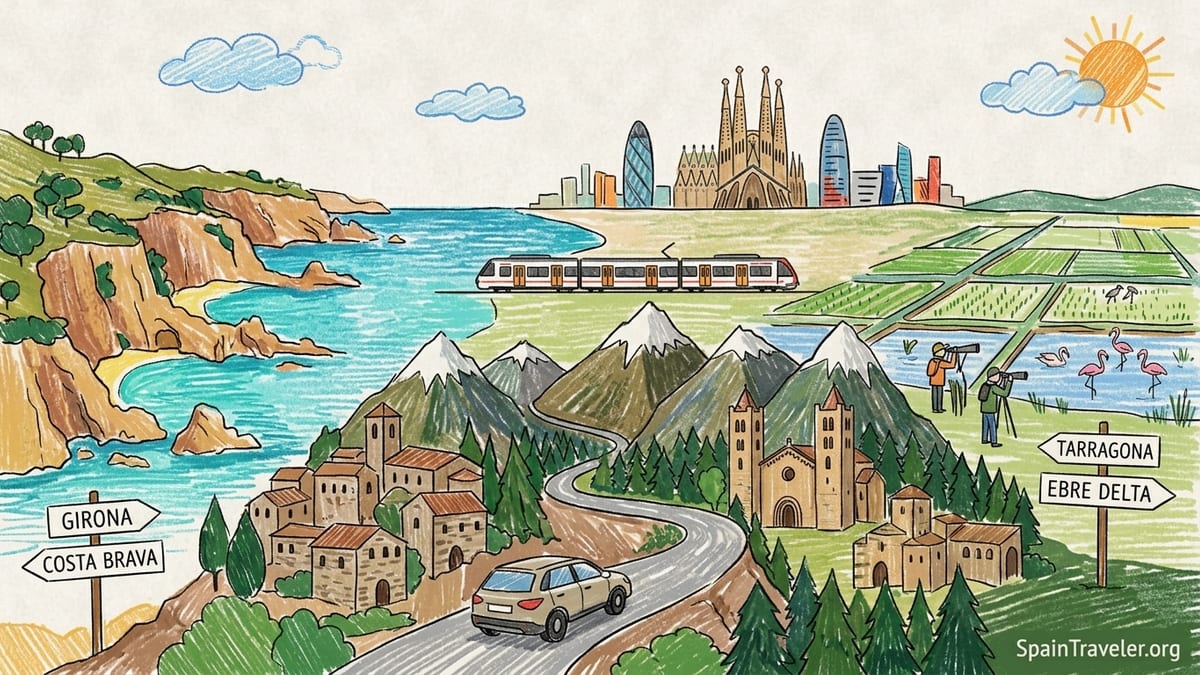
How I Actually Traveled Catalonia (And What I Got Wrong)
Across two separate journeys, I spent a total of 17 days traveling through Catalonia. On the first trip, I booked five nights in Barcelona, one rushed night in Girona and one night near the Costa Brava without a car. I relied mostly on trains and buses, using Barcelona Sants as my gateway. On the second trip, I flew back into Barcelona, stayed three nights in the city, then rented a car and spent the remaining eight days between the Pyrenees, Priorat wine country and the Ebro area, with quick returns to Tarragona and small coastal towns for comparison.
My bases looked logical on paper: Barcelona for the first five nights, Girona for one night to see the medieval old town and “some Costa Brava beach,” and finally Tarragona to explore Roman ruins and the Costa Daurada. In reality, Barcelona got too many nights, Girona and the coast got far too few and I underestimated how much time I would want in the mountains and rural inland areas. I also booked a rental car too early on my second trip, paying to keep it parked in Barcelona for two days because I did not want to drive or deal with parking restrictions in the city.
Train travel between the major cities was easier than I expected, while driving in the mountains and on small rural roads was more tiring and slower than I had planned. The Barcelona to Girona regional trains and mid-range high-speed services typically took around 40 minutes to 1 hour, and Barcelona to Tarragona took about 1 hour 15 minutes on regional trains in normal conditions, which made day trips between the cities very feasible. By contrast, my drive from the central Pyrenees near the Aigüestortes i Estany de Sant Maurici area down to the Ebro lands, which looked compact on the map, ate most of a day once you factor in winding roads, coffee stops and photo breaks.
Before these trips, I assumed that Catalonia would feel like one continuous Mediterranean strip, with Catalan and Spanish heard equally everywhere and prices only slightly lower outside Barcelona. What I actually found was a mosaic of identities and landscapes: Catalan more dominant in Girona and rural areas than in central Barcelona, hotel and dinner prices clearly dropping when I moved inland away from the main coasts, and a huge contrast between crowded August coves of the Costa Brava and quiet stone villages in the mountain foothills.
Language, Identity and Everyday Life Beyond Barcelona
In Barcelona, I heard Spanish and Catalan in roughly equal measure, with English present in the most touristy neighborhoods. Street signs and official information were consistently bilingual in Catalan and Spanish, sometimes trilingual with English. Once I took the train to Girona and later drove into the Pyrenees and Terres de Lleida, the everyday soundtrack shifted. Menus appeared first in Catalan, shopkeepers greeted me with “Bon dia” rather than “Buenos días,” and in village bars near the Pyrenees I heard almost only Catalan at neighboring tables.
Locals I spoke with often identified first as Catalan, particularly in Girona province, inland Lleida and the Ebro lands. In Barcelona, that identity was still very present, but the city’s international crowds meant I could go half a day hearing little Catalan in the most central districts. In Girona’s old town, by contrast, the souvenirs and bookstores leaned harder into Catalan history and language. When I asked a barista which language to use, she smiled and answered in English, then added that she was happy to switch between Catalan and Spanish depending on who walked in the door.
This cultural variety shows up at the table too. In Barcelona, I sampled an urban mix of tapas bars, contemporary Catalan restaurants and international food spots. In Girona, lunch menus leaned into “mar i muntanya,” the traditional combination of seafood and meat like chicken with prawns, and rice dishes that reflected the region’s position between the Pyrenees and Costa Brava. Further south in Tarragona, menus filled with grilled fish, rice dishes cooked with local seafood and simple vermut bars near the port. Inland in Priorat and Terra Alta, where vineyards climb terraced hillsides, I found hearty stews, grilled lamb and local wines taking center stage, with fewer English translations and a slower, more rural rhythm.
Daily routines also vary. In the largest cities and busy coastal towns, lunch service commonly runs from about 1:30 p.m. to 3:30 p.m., with dinner from roughly 8:30 p.m. onward, and in summer reservations are helpful in popular places. In smaller mountain and inland towns, I sometimes found restaurants that only opened for lunch during the week, especially outside peak season, and simple village bars that closed by early evening. Planning around this schedule matters more once you leave Barcelona, where there is always somewhere open.
Trains, Driving and the Surprise of Mountain Roads
On both trips I started with trains and ended with a car, and that combination worked better than any single mode. From Barcelona Sants, frequent regional and medium-distance trains connect to Girona, Figueres and the Costa Brava gateways, as well as to Tarragona, Lleida and other inland cities. Typical advance one-way fares between Barcelona and Girona or Tarragona can be modest on standard regional services, with higher prices for the fastest high-speed options. The convenience of stepping onto a train in the city and arriving in another historic center without thinking about parking or tolls was hard to beat.
The surprise was how much slower driving felt once I left the main highways. For example, while the distance between the central Pyrenees around Aigüestortes and the Ebro lands does not look great on the map, the reality involved narrow, winding roads that limited speed, occasional farm tractors, and long stretches with nowhere easy to stop. A drive I had naively plotted as “three hours” easily turned into five with breaks. The same happened on secondary roads through Priorat wine country, where road gradients are steep, hairpins are tight and views reward a slower pace.
Parking was another lesson. In Barcelona, regulated street parking zones, parking garages and tight spaces made keeping a rental car in the city feel unnecessary and expensive. On my second trip I rented directly from the airport upon arrival, thinking it would save time, but I ended up paying for two largely idle days of parking while I explored the city on foot and by metro. On reflection, I would now take the airport train or bus into the center, enjoy Barcelona car free, and only pick up a rental the morning I actually left for the countryside.
The upside of having a car outside the main cities was freedom. In the Pyrenees I could reach trailheads early and detour to small villages that buses rarely serve. Around the Ebro Delta and its rice fields, a car made it easy to stop for birdwatching, reach quiet boardwalks and visit fishing villages along the coast. Still, even with a car, I came to appreciate Catalonia’s mix of regional trains, local buses and signed walking routes that combine into the Grand Tour and other themed itineraries, which encourage travelers to move at a more local pace between mountains, coast and inland plains.
Coastlines Compared: Costa Brava, Costa Daurada and the Ebro Delta
Before my first trip I imagined “the Catalan coast” as one fairly continuous beach zone. In reality, the official tourism map divides Catalonia into distinct coastal brands that reflect very different personalities, from the rugged Costa Brava in the north to the golden Costa Daurada and the wild wetlands of Terres de l’Ebre in the south. On my initial seven-day itinerary, I made the classic mistake of treating Costa Brava as a single day trip from Barcelona, which left me with little more than a checklist glimpse of a couple of coves.
Traveling from Girona toward the Costa Brava, the landscape shifts quickly. Inland fields and low hills give way to rocky coves, fishing villages and coastal walking paths among pine trees and cliffs. In high summer, popular spots near towns like Calella de Palafrugell and Begur fill quickly by mid-morning, and parking can be tight if you arrive late. Local tourism information emphasizes both the area’s protected natural spaces and its long history as a holiday destination, so expect a mix of Spanish, Catalan, French and English on the beaches. When I squeezed this entire stretch into a single day, I ended up racing between viewpoints instead of actually swimming or relaxing.
Further south near Tarragona, the Costa Daurada feels more open and sandy. The coastline stretches in long golden arcs, backed by family-oriented resorts, campsites and the Roman city of Tarragona itself. When I stayed near Tarragona for two nights, I could combine mornings on relatively gentle beaches with afternoons exploring the UNESCO-listed Roman amphitheater, circus and old town. Coastal towns here attract large numbers of domestic visitors, and even in peak periods I found them less crowded than the most famous Costa Brava coves, although water sports and theme parks nearby add their own crowds.
The biggest surprise on the coast came when I drove into the southern Ebro lands. South of the main Costa Daurada resorts and beyond the massif of Els Ports, the landscape opens into the Ebro Delta, a vast wetland where rice paddies stretch to the horizon and the sea meets low, shifting sandbars. Here the feel is more rural and ecological, with birdwatching, cycling routes and seafood from small fishing towns defining the experience. On an August evening, I stood on a nearly empty delta beach, watching flamingos feed in the distance, and wondered why I had not allocated more time to this part of Catalonia on my first trip.
Mountains and Rural Inland Catalonia: Pyrenees, Lleida and Wine Country
Official tourism material describes Catalonia as a compact showcase of European landscapes, and nowhere is that more obvious than in the transition from the Pyrenees to the inland plains and vineyards. From Barcelona or Girona it takes only a few hours to reach valleys where peaks rise well over 2,000 meters and winters bring reliable snow. Driving into the area of Aigüestortes i Estany de Sant Maurici National Park and nearby valleys, I saw the architecture change to stone villages with steep roofs and Romanesque churches, and menus shift to hearty mountain stews, cured meats and strong local cheeses.
In summer, ski resorts in the Catalan Pyrenees transform into hiking and mountain biking hubs, with chairlifts carrying walkers to higher trails and information offices promoting outdoor activities. Temperatures can drop quickly with afternoon storms, and on two successive days in July I went from sweating in Barcelona to wearing a fleece and rain jacket on an alpine trail above 2,000 meters. That contrast made it clear why Catalonia markets itself equally on mountains and coast.
Descending toward inland Lleida, the landscape flattened into a broad central depression of fields, orchards and small towns, sometimes called the heart of rural Catalonia. Here, tourist crowds thinned, hotel prices were noticeably lower than in Barcelona, and I met more travelers from other parts of Spain than from abroad. The language environment leaned further toward Catalan in daily life, though Spanish was always understood. Overnighting in a farmhouse-style rural accommodation, I woke to the sound of tractors instead of traffic and had breakfast with local olive oil, tomatoes and rustic bread.
To the south and east, vineyard regions like Priorat and Terra Alta climb hillsides with terraced vines and winding access roads. These areas are promoted as wine landscapes, with cooperative cellars sometimes known as “wine cathedrals,” and they feel very different from the cosmopolitan atmosphere of Barcelona’s wine bars. I joined a small-group tasting at a family-run cellar where the owner apologized that their English was limited, then spent an hour explaining soils and grape varieties in a mix of Catalan, Spanish and gestures. It was one of the most personal encounters of my time in Catalonia, and it only happened because I had finally allocated days, not hours, to inland regions.
Money, Meals and Where I Felt the Biggest Price Shifts
Across both trips, the single biggest budgeting mistake I made was assuming that prices would be roughly similar across Catalonia. Barcelona, like other major European cities, has seen rising hotel rates in recent years, with national data indicating that the average price for a hotel room in Spain has climbed to well over one hundred euros per night in many destinations. In Barcelona specifically, centrally located mid-range hotels often price significantly above that national average in busy periods like spring weekends or peak summer.
Once I moved out to Girona, Tarragona and smaller inland towns, nightly rates dropped to levels that felt more in line with the broader Spanish market. In Girona, I paid less for a well-located small hotel than I had for a more basic room in Barcelona, and in a rural area of Lleida province I stayed in a simple but charming country house for roughly what one night in a Barcelona three-star hotel might cost in high season. The same pattern held for dining: dinner in central Barcelona’s fashionable neighborhoods could approach big-city Western European prices, while generous three-course set menus in inland restaurants were often more affordable and included local wine.
Restaurant schedules and reservations were another adjustment. In Barcelona and Girona, it was easy to find continuous service in tourist-heavy neighborhoods, but the best-regarded local spots usually kept strict lunch and dinner windows and appreciated advance bookings, especially on Friday and Saturday nights. On the Costa Brava and Costa Daurada, beachfront places were busy for an early lunch around 1 p.m., then saw a second wave of diners in the evening. Away from the coasts, I sometimes found myself standing outside locked village restaurant doors at 8 p.m., realizing that weekday dinner service was limited or that the only hot food option that night might be the bar at my guesthouse.
The diversity of Catalan cuisine becomes more obvious as you leave Barcelona. In the north, I found grilled fish and rice with seafood backed by wines from the Empordà appellation. In Tarragona and the Ebro lands, shellfish, eel and rice combined with local vermouth and coastal white wines. Inland, robust red wines from Priorat and Montsant accompanied dishes like pork cheeks, sobrassada and trinxat, a mountain dish of potatoes and cabbage. In almost every region, pa amb tomàquet, the simple bread rubbed with tomato and drizzled with olive oil, appeared as a default table companion, reminding me that however varied the landscapes, some Catalan staples are truly universal.
What I Would Do Differently: An Improved Catalonia Itinerary
Looking back at my two trips, the pattern of mistakes becomes obvious. I gave Barcelona too many nights on the first visit, treated Costa Brava as an afterthought squeezed into a single day, booked a rental car before I needed it, and underestimated how long it takes to move comfortably between mountain roads and southern wetlands. If I were planning a new two-week itinerary focused on variety, I would keep Barcelona important but shorter, and give more weight to Girona, the Pyrenees and the Ebro lands.
On a second visit, my ideal structure for a 14-day Catalonia journey would start with three nights in Barcelona using only public transport. I would arrive at the airport, take the train or bus to a central neighborhood, and spend those first days exploring modernist architecture, neighborhood markets and coastal promenades without the stress of driving or parking. With Barcelona as my cultural gateway rather than my entire focus, I could then move outward without fatigue.
From there, I would take the train to Girona for three nights, using one full day for the city’s old town, Jewish quarter, cathedral and riverside views, and another for a relaxed coastal day on the Costa Brava. Instead of sampling multiple coves in a rush, I would choose one or two accessible beaches or walking routes and stay put, arriving early to avoid parking pressure and afternoon crowds. This slower coastal segment would allow time for a long lunch, a swim and perhaps a short section of a coastal path rather than a frantic circuit of viewpoints.
The next stage would be four nights in the Catalan Pyrenees and surrounding mountain areas, reached by rental car picked up the morning I left Girona or Barcelona. Here I would focus on one or two valleys near Aigüestortes or the Cerdanya and Ripollès regions, balancing moderate hikes with village visits and leaving room for weather changes, since rain and storms are common in summer afternoons. After the mountains, I would head south for two or three nights divided between Priorat or another wine region and the Ebro lands, ending with a final night in or near Tarragona to visit the Roman remains and enjoy the Costa Daurada’s broad beaches.
FAQ
Q1. Is it worth leaving Barcelona if I only have a week in Catalonia?
Yes, even with seven days you can experience more than Barcelona. Many travelers spend four nights in Barcelona and then add at least two or three nights in Girona, Tarragona or a mountain area to see a different side of Catalonia without rushing.
Q2. Do I need to rent a car to explore Costa Brava and the Pyrenees?
You can reach gateway towns by train and bus, such as Girona for the Costa Brava or main towns in the Pyrenees, but a car gives you more flexibility for small coves, villages and trailheads. A good compromise is to use trains between major cities and rent a car only for the days you spend in rural or mountain areas.
Q3. How different do Girona and Tarragona feel from Barcelona?
Girona feels smaller and more intimate, with a well-preserved medieval core and a strong local identity between the Pyrenees and Costa Brava. Tarragona mixes Roman heritage with a working port and broad sandy beaches, and it is generally more relaxed and less crowded than central Barcelona while still offering good services and transport links.
Q4. Is driving in the Catalan mountains difficult for visitors?
Main highways are modern and straightforward, but secondary mountain roads can be narrow, steep and winding. If you are not used to this, plan shorter driving days, avoid setting unrealistic arrival times and be prepared for slower speeds, especially behind farm vehicles or in poor weather.
Q5. Are hotel prices really lower outside Barcelona?
In my experience, yes. Barcelona’s central hotels are among the most expensive in Spain during busy seasons. When I moved to Girona, Tarragona and rural Lleida, I consistently found lower nightly rates for comparable or better quality, particularly in family-run hotels and rural guesthouses.
Q6. How crowded are the beaches in summer?
In July and August, popular Costa Brava coves and Costa Daurada resort beaches can fill up by late morning, especially on weekends. The Ebro Delta and some less famous stretches of coast are usually quieter. Arriving early, using public transport where available and staying overnight in coastal towns rather than day-tripping from Barcelona helps manage crowds.
Q7. Can I get by in English outside Barcelona?
In major cities, tourist offices and many restaurants handle English confidently. In smaller inland towns, mountain villages and some traditional bars, English is less common. Basic Spanish phrases and a few words of Catalan are very helpful, and locals usually appreciate the effort even if you switch to Spanish afterward.
Q8. What should I expect from restaurant schedules?
Lunch is usually from about 1:30 p.m. to 3:30 p.m., and dinner often starts around 8:30 p.m. In cities and touristy coastal areas you will find some continuous service, but in rural and mountain towns many places open only for lunch, especially on weekdays. It is wise to eat on local time once you leave Barcelona.
Q9. When is the best time to visit the Pyrenees and the Ebro Delta?
For hiking in the Pyrenees, late spring through early autumn usually brings accessible trails, though snow can linger at higher elevations. The Ebro Delta is attractive most of the year, with rice fields changing color by season and good birdlife, but spring and early autumn often combine pleasant temperatures with active wildlife and fewer peak-season beach crowds.
Q10. How many bases should I plan for a two-week Catalonia trip?
A practical structure is four or five bases: Barcelona, Girona or another Costa Brava town, a Pyrenees base, an inland wine or rural area and a final stop around Tarragona or the Ebro lands. This limits packing and unpacking while still reflecting Catalonia’s mix of cities, coast, mountains and countryside.