


Catalonia rewards travelers who slow down. From serrated Pyrenees ridgelines to quiet Costa Brava coves and vineyard-draped hills, distances look short on the map but take real time on the ground. The region’s official Grand Tour route, created by the Catalan Tourist Board, runs for more than 2,000 kilometers and is designed as either a 13-day loop or five separate sections. That alone is a useful planning clue: trying to “do” Barcelona, Girona, Tarragona, the Pyrenees and the wine country as day trips from one hotel is a recipe for long commutes and shallow impressions. This guide offers a framework to build 5, 7, 10 or 14 day Catalonia itineraries that feel unhurried, with concrete examples of when to use trains, when to rent a car and how to choose realistic bases.
Understanding Catalonia’s Scale and the Grand Tour Benchmark
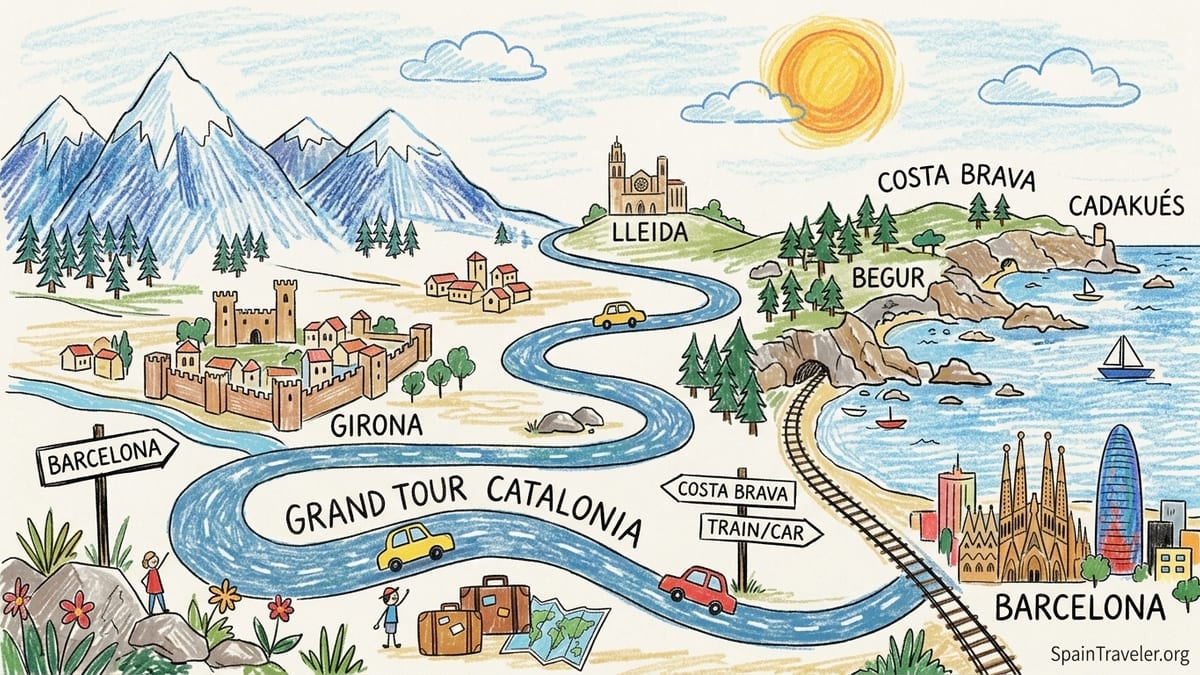
On a map, Catalonia fits neatly into Spain’s northeast corner. In practice, it is a patchwork of coast, mountains and inland plains that takes time to cross. The official Grand Tour of Catalonia, promoted by the regional tourism authority, strings together the main coastal areas, the Catalan Pyrenees, inland towns and Barcelona into one coherent journey. The route covers more than 2,000 kilometers and is presented as a 13-day road trip or as five sections of five to seven stages each. This is not a route designed for rushing between monuments. It exists specifically to encourage travelers to spread nights across multiple regions and linger.
The Grand Tour’s structure also shows how varied Catalonia is. Four of the five sections involve the Pyrenees and inland territories such as Lleida, while others trace the Mediterranean through Costa Brava and the Tarragona coast. Even the shorter versions expect you to drive several hundred kilometers over five to seven days. If regional tourism planners suggest almost two weeks to make a representative loop at road-trip pace, a first-time visitor with five to ten days is better off narrowing focus than attempting a similar sweep.
Climate reinforces this idea of scale. Coastal Catalonia, including Barcelona, Girona and much of the Costa Brava, has a Mediterranean climate with warm to hot summers and mild winters. Inland areas around Lleida are drier and more extreme, while the high Pyrenees have long, snowy winters and a hiking season that typically runs from late June to early October. That means a two-hour drive can shift you from beach weather to alpine layers. A practical itinerary has to respect both distance and altitude.
This framework uses the Grand Tour as evidence of realistic pacing, but you do not need to follow its stages. Instead, think in terms of a few strong bases linked by either efficient rail corridors or scenic driving days. Then layer in day trips that fit local geography rather than forcing every highlight into reach of Barcelona.
How Many Bases, When to Use Trains and When to Rent a Car
For most Catalonia itineraries, the sweet spot is between two and four bases, depending on trip length. With five days, staying in Barcelona and adding a second base in either Girona or the Costa Brava gives you variety without constant packing. With seven to ten days, three bases work well, for example Barcelona, a coastal town on the Costa Brava and an inland or mountain base such as the Garrotxa area or the lower Pyrenees. With a full two weeks, four bases allow you to loop through coast, mountains and wine country without more than three hotel changes.
Trains are excellent for connecting cities and some coastal towns. Regional and medium-distance services link Barcelona to Girona in roughly 40 minutes on the faster AVE or Avant services and around 1 hour 20 minutes on the slower regional trains, depending on the exact departure. Girona’s station is a short walk from the medieval center, so this is a straightforward, car-free transfer. Likewise, trains from Barcelona to Tarragona on lines such as the R16 or longer-distance services can take around one to one and a half hours under normal conditions, with the station near the Roman sites. These rail corridors make Barcelona, Girona and Tarragona logical bases without the stress of driving.
A rental car becomes more useful once you leave that spine. Public transport along the Costa Brava exists but can be slow and infrequent, especially out of summer. Getting from Girona to a small cove near Begur, for example, can easily involve a regional bus to Palafrugell and a local connection or taxi. A compact rental car picked up in Girona or Barcelona, even at a rate that often falls somewhere between 30 and 60 euros per day for a basic model outside peak August, may pay for itself in time saved and flexibility. It makes it realistic to combine inland medieval towns like Peratallada or Besalú with swim stops in coves such as Sa Tuna or Tamariu in a single, relaxed day.
In the high Pyrenees, a car is almost essential. Resort bases such as La Molina or the Vall de Núria access points are connected by trains and rack railways, but trailheads, small villages and lake-filled national parks often sit well beyond bus routes. The same applies in parts of wine country, where vineyards in Priorat, Penedès or Empordà may be many kilometers apart along small local roads. Trains are ideal for getting out of Barcelona. Cars are ideal for linking rural areas once you are there.
Why Not Everything Should Be a Day Trip from Barcelona
Barcelona is an obvious anchor. It has an international airport, fast trains, museums, Gaudí landmarks and a dense public transport network. That makes it tempting to plan a week in one apartment and treat the rest of Catalonia as a string of day trips. The problem is travel time and the different rhythms of coastal, inland and mountain areas.
Take Girona as a concrete example. Fast AVE or Avant trains connect Barcelona Sants and Girona in around 40 minutes, and regional trains generally take between 1 hour 20 minutes and 2 hours depending on stops and the line. On paper, that sounds manageable for a day trip. In practice, you need to add time to reach the station, wait for trains and navigate connections back. A day spent commuting can leave you with only a few rushed hours to walk Girona’s medieval walls, visit its cathedral and explore the Jewish quarter’s narrow lanes. Stay one or two nights instead and you can also fit in a half-day trip to nearby Banyoles lake or the volcanic landscapes around Olot.
The Costa Brava is even more illustrative. Guides often mention it as a day trip, yet reaching some of its iconic coves from Barcelona can require close to two hours each way by a mix of trains and buses, plus walks down to the sea. By the time you have reached a beach path near Calella de Palafrugell or Cadaqués, you will have traded much of your day for transit. Base yourself for three nights in a small town instead and you can walk coastal paths at sunrise and dusk, visit inland medieval villages after day trippers leave and choose swimming spots based on the day’s wind and swell, not the return bus time.
The same logic applies to Tarragona and the wine country. Tarragona’s Roman amphitheater, seafront promenade and old town are worth more than a quick run from Barcelona and back. Nearby, the Priorat and Montsant wine regions spread across terraced hills that are impractical to sample in a single day without a car and pre-booked tastings. Sleeping at least one night in a village such as Falset or Gratallops allows you to visit smaller cellars and walk among the vines before or after formal visits.
Five, Seven, Ten and Fourteen Days: A Practical Framework
With five days, it is crucial to narrow your ambition. A realistic framework is Barcelona plus one contrasting base. One option is three nights in Barcelona and two in Girona, connected by train. Spend your Barcelona time on core sights such as La Sagrada Família, the Gothic Quarter and the waterfront, leaving one evening for neighborhood life in Gràcia or Poble-sec. Move to Girona on day four, explore the city’s walls and cathedral and take a bus or taxi out to a nearby village or winery the next day. Alternatively, combine Barcelona with a Costa Brava town reachable by direct bus, such as Tossa de Mar or Palamós, so you get both urban architecture and coastal walks without needing a car.
With seven days, you can keep Barcelona as your entry and exit point while adding a more distinct region. A city and coast model could look like three nights in Barcelona and four nights in a Costa Brava base such as Begur, Calella de Palafrugell or Llafranc. Pick up a rental car when you leave Barcelona, drive around 90 minutes to two hours to the coast and return the car at the end. Use the coast days for a loose mix of swimming, walking the coastal path between neighboring coves and visiting inland stone villages such as Pals or Peratallada in the late afternoon.
Ten days allows you to connect two or three regions without rushing. One framework is three nights in Barcelona, three in the Costa Brava and four inland or in the lower Pyrenees. For example, after a few days in Barcelona, drive to the Empordà area for a base that combines vineyards and coast, then cross towards the Ripoll or La Garrotxa areas for hiking among extinct volcanoes and beech forests. Another ten-day option swaps the coast for wine and history: Barcelona, Tarragona and Priorat. Fast regional trains take you from Barcelona to Tarragona. After two or three nights exploring the Roman heritage and quieter beaches south of the city, rent a car in Tarragona and drive into the wine hills for cellar visits, village restaurants and short signposted walks.
With a full fourteen days, you can finally sketch something closer to a cross-Catalonia trip without changing hotels every night. Four logical bases might be Barcelona, a Costa Brava town, a Pyrenees base and an inland or wine-country town. You could spend three nights in Barcelona, four on the Costa Brava, three in the Pyrenees and four in Priorat or Empordà vineyards. This roughly echoes sections of the Grand Tour route, but at your own pace. The key is still to avoid one-night stops whenever possible and to accept that even with two weeks you will only sample each region, not exhaust it.
Weather, Seasons and How Coast and Mountains Affect Pacing
Weather across Catalonia is generally mild compared with much of inland Spain, but seasonal patterns have a real impact on itinerary design. Coastal Catalonia, including Barcelona and the Costa Brava, has warm to hot summers and relatively mild winters. Published averages from regional and national sources show Barcelona with moderate rainfall spread through the year and summer highs often in the upper twenties Celsius. The Costa Brava benefits from sea breezes that can temper peak heat, though mid-summer afternoons can still feel hot on exposed beaches.
The Pyrenees and higher inland areas are different. Winter brings regular snow to ski areas, creating a long season for resorts such as La Molina or Baqueira-Beret, while valley towns stay cold well into spring. Hiking routes above roughly 2,000 meters may hold snow until early summer and can see early autumn storms. That means a June road trip including both beaches and high-mountain hikes should build in spare days or lower-altitude alternatives if passes are still affected by late snow. In October, a coastal base may still offer swims on warmer days, while a mountain base demands layers, waterproofs and a flexible plan for foggy or wet conditions.
These differences shape how you pace your trip. In high summer, many travelers prefer to spend mornings and late afternoons exploring cities or hiking, and reserve midday for shaded café lunches or beach time. On the Costa Brava, that might mean walking a stretch of coastal path between coves such as Llafranc and Calella before 10 a.m., swimming, then retreating inland to a shaded medieval square in Pals for a late lunch. In the Pyrenees, it might mean starting a hike from a valley trailhead early, reaching viewpoints before clouds build and returning to a village for a slow evening meal.
In shoulder seasons such as May, June and September, when many climate and travel sources highlight milder temperatures and fewer crowds, you can afford more ambitious days. This is an ideal time to link city sightseeing in Barcelona with coastal walks or longer drives without the discomfort of peak heat. Winter visitors might design itineraries around ski bases and cozy mountain villages, accepting shorter daylight hours and limited access to some high passes. Whatever the season, building slack into your schedule matters more than crowding every day with long cross-country drives.
Planning Models: First Trip, City plus Coast, Road Trip, Family and Food or Nature Focus
For a first trip to Catalonia, a simple model is best. Think of it as “Barcelona plus one or two bases.” Spend at least three nights in Barcelona to adapt to the time zone and enjoy Gaudí architecture, local markets and the waterfront. Then choose either Girona, Tarragona or a Costa Brava town as your second base, reachable by train or bus in under two hours. For example, three nights in Barcelona followed by three in Girona gives you a compact medieval city, easy day trips to nearby villages and a taste of inland landscapes without needing a car. Finish with a final night back in Barcelona if your flight timing requires it.
A classic city and coast model uses Barcelona and the Costa Brava. One workable seven-day framework would be three nights in Barcelona followed by four in a coastal town such as Calella de Palafrugell or Llafranc. On the coast, rent a car or use local buses to explore a short stretch of shoreline in depth instead of trying to tick off every resort. You might devote one day to linking nearby coves on foot, another to inland villages and a third to a more distant town such as Cadaqués if you are comfortable with curvy roads. Returning the car before your final night in Barcelona can simplify parking and save money.
Travelers who enjoy driving can treat Catalonia as a compact road trip, inspired but not dictated by the Grand Tour. A ten or fourteen day loop could start and end in Barcelona, with overnight stops in the Costa Brava, a Pyrenees valley and a wine region. After leaving Barcelona by highway, you might exit near Girona for a night or two, continue to a coastal base, then cross inland through the Garrotxa volcanic landscapes toward a small mountain town like Ripoll or La Seu d’Urgell. From there, the route can bend south toward Lleida and back east through Priorat or Penedès vineyards before finishing in Barcelona. Daily driving distances on such a loop can stay between 150 and 250 kilometers, leaving space for walks and unplanned café stops.
Families often benefit from fewer hotel changes and more time for simple activities. A family-friendly seven-day plan might be four nights in Barcelona and three in a single Costa Brava town with a sheltered beach and playgrounds. Instead of a different excursion every day, alternate between relaxed beach time, a visit to a kid-friendly museum or aquarium in Barcelona and an easy boat trip or coastal walk suited to younger legs. Apartments with kitchens can help manage mealtimes and budgets. Trains handle the city segments, while a short-term car rental on the coast opens access to supermarkets and nearby coves without juggling bus timetables with children.
Food or nature-focused trips work especially well within Catalonia’s compact geography. A traveler interested in wine and regional cuisine might base in Barcelona for three nights and then split the rest of a ten-day trip between Empordà and Priorat or Penedès. Winery visits can be arranged through local tourism offices or directly with estates, often requiring advance reservations. A nature-focused trip could combine Barcelona’s parks and coastal promenades with several nights near the Costa Brava’s walking paths and several more in or near the Pyrenees, using local guides for more technical hikes or winter snowshoeing. In both cases, the aim is more depth in fewer regions rather than a fast circuit past every landmark.
The Takeaway
Planning Catalonia is less about plotting attractions and more about choosing a small number of bases that match your interests and the season. The region’s own Grand Tour concept treats more than 2,000 kilometers of road and thirteen days of travel as a reasonable starting point for an in-depth loop. That should give individual travelers permission to slow down. With five days, combine Barcelona with one contrasting place. With seven to ten, build in a third base such as the Costa Brava, Tarragona or a lower Pyrenees valley. With two weeks, you can finally link coast, mountains and vineyards without spending every day in the car.
Use trains to move confidently between major cities and some coastal hubs, and rent a car when you want to knit together villages, coves and mountain trailheads at your own pace. Accept that Girona, Tarragona, the Pyrenees and wine regions are worthy of overnight stays, not just long day trips from Barcelona. Above all, respect the region’s varied weather and topography, leaving room in your schedule for a quiet medieval square at dusk, an extra swim when the sea looks perfect or a detour to a viewpoint you had not marked on any map. That space, more than any checklist, is what makes a Catalonia itinerary feel unhurried.
FAQ
Q1. Is five days in Catalonia enough for a first trip?
Five days is enough for a focused first trip if you resist the urge to cover the whole region. A practical approach is to spend three nights in Barcelona and two in a second base such as Girona or a Costa Brava town. That gives you both urban and smaller-scale Catalan experiences without exhausting travel days.
Q2. Should I rent a car for my entire stay in Catalonia?
You rarely need a car while staying in central Barcelona, where parking is expensive and public transport is efficient. Many travelers rent a car only for the coastal, rural or mountain portions of their trip, picking it up when leaving Barcelona and returning it before coming back to the city. This balances flexibility with cost and reduces driving stress.
Q3. Can I visit Girona, Tarragona and the Costa Brava as day trips from Barcelona?
It is possible to visit each as a long day trip, but doing all three that way leads to a lot of time on trains and buses. Fast trains make Girona and Tarragona reasonable single-day outings, yet staying overnight in at least one of these places allows you to experience evenings and early mornings when crowds are thinner. For the Costa Brava, one or more nights on the coast is usually far more rewarding than a rushed day from Barcelona.
Q4. When is the best time of year to combine coast and mountains in Catalonia?
Late spring and early autumn are usually the most comfortable times to mix beaches and hiking. In May, June and September, coastal temperatures are warm without the most intense heat, and many mountain trails have shed winter snow. High Pyrenees routes may still hold snow patches early in the season, so it is wise to ask locally about conditions if you plan ambitious hikes.
Q5. How many bases should I plan for a two-week trip?
For a fourteen-day trip, three or four bases work well. A common pattern is to combine Barcelona, a Costa Brava town, a Pyrenees base and an inland or wine-region town. That gives you coast, mountains, city life and rural landscapes without more than three or four hotel changes, keeping travel days manageable.
Q6. Is public transport good enough to skip a car entirely?
Public transport is strong between major cities and along some coastal corridors, so you can travel between Barcelona, Girona and Tarragona without a car. However, buses and trains become less frequent in rural areas, on smaller parts of the Costa Brava and in the mountains. If you want to explore medieval hill towns, secluded coves or multiple wineries in one day, a rental car or organized tour is often the most practical option.
Q7. How does weather affect driving and sightseeing in the Pyrenees?
In the Pyrenees, winter and early spring can bring snow, icy roads and chain requirements on higher passes, which slows driving and may limit access to some areas. Summer offers long days and mostly clear roads, but afternoon storms are possible at high altitude. In shoulder seasons you should allow extra time for mountain routes and have backup plans for low-level walks or village visits if visibility or conditions are poor.
Q8. Are Catalan wine regions like Priorat or Penedès suitable as bases?
Yes, wine regions can make rewarding bases, especially for food and wine-focused trips. Villages in Priorat, Penedès or Empordà often have small hotels or guesthouses, and you can spend days visiting wineries, walking among vineyards and dining in local restaurants. A car is usually necessary in these areas given the distances between cellars and limited public transport.
Q9. What is a good Catalonia itinerary for families with young children?
Families often do best with fewer hotel changes and simple daily plans. One approach for a week is to spend four nights in Barcelona with child-friendly sights such as parks, beaches and interactive museums, then three nights in a Costa Brava town with an easy-access beach. Using trains for city transfers and a short car rental on the coast keeps logistics manageable while allowing beach time and short excursions.
Q10. How closely should I follow the official Grand Tour of Catalonia route?
The Grand Tour is a useful reference for understanding distances and regional variety rather than a strict itinerary to copy. Its thirteen stages and more than 2,000 kilometers highlight how much there is to see, but most visitors have less time. Use its structure as inspiration to choose a few regions and bases that interest you most, then adapt the route to your own pace and priorities.