


Catalonia is one of Europe’s most rewarding regions for families who love food and wine. To really enjoy it, though, you need to think beyond “Spanish tapas” and see how geography shapes the table. The same trip can include grilled fish in a Costa Brava cove, a rustic bean and sausage lunch in the Pyrenees, olive oil tasting in the Ebro lands and a sparkling-wine vineyard picnic in Penedès. This parent-level guide explains what to eat and drink across Catalonia’s main landscapes, how the official Grand Tour wine routes fit together, and where regional differences matter when you are planning with kids, teens or multi‑generational groups.
Catalan Food Culture: More Than Tapas and Paella
Catalan cooking sits at the crossroads of Mediterranean sea produce, inland farms and mountain pastures. Official tourism materials highlight olive oil, seafood stews, garden vegetables, pork sausages, legumes and rice as foundations of everyday meals, with olive oil rather than butter as the main fat. Family tables still revolve around a substantial midday meal, often a fixed‑price menú del día, and a lighter dinner later in the evening. In practice that might look like a three‑course lunch near a market for around 15 to 20 euros per adult, including bread, water or wine, and dessert or coffee.
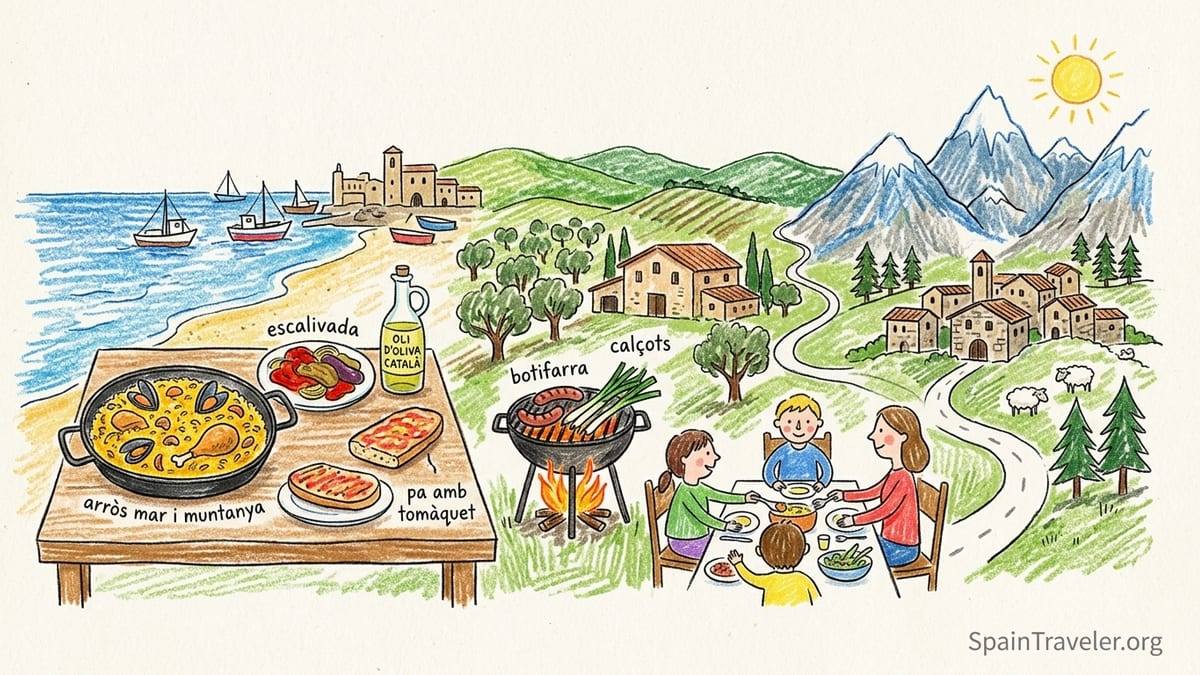
Catalonia’s geography explains the variety. The long coastline from the Costa Brava to the Ebro Delta focuses on fish, shellfish and rice. Inland plains and river valleys are dominated by cereals, pork, beans and vegetables. Mountainous areas like the Pyrenees and Pre‑Pyrenees lean toward stews, game, hearty soups and strong cheeses. Many traditional dishes are described as “mar i muntanya,” or sea and mountain, because they blend coastal seafood with inland meats in the same pot, such as chicken with lobster or meatballs with cuttlefish. That mix of influences is one of the reasons Catalonia has become a reference point for Mediterranean gastronomy.
Families will also notice that traditional restaurants and rural inns called masies take ingredients seriously. Tomatoes are served at peak ripeness, anchovies might be labeled by their specific port of origin, and even simple grilled bread is drizzled with designated Catalan olive oils. Understanding the basics of local ingredients, and which dishes belong to which landscape, will help you choose better from any menu whether you are in a Barcelona neighborhood bar or a country restaurant in the hills.
Finally, it helps to know that this guide is about regional food culture and wine. It will not list individual Barcelona restaurants or detailed self‑drive wine itineraries. Think of it as the parent guide you read first, to understand what makes Catalonia’s food and wine distinct, before you dive into separate city restaurant round‑ups or step‑by‑step wine‑road guides for Penedès, Priorat or Empordà.
The Coast: Seafood, Rice and Olive Oil at the Water’s Edge
Along the Catalan coast, from the rocky coves of the Costa Brava to the broad beaches of the Costa Daurada and the wetlands of the Ebro Delta, menus read like a survey of the Mediterranean. Fishmongers and fishermen’s guilds supply daily catches of anchovies, sardines, hake, monkfish and shellfish, which appear grilled, baked in salt, or simmered in stews. Visitors will often find suquet de peix, a traditional fishermen’s fish stew made with mixed catch, potatoes, tomatoes, garlic and generous local olive oil. Many coastal towns have their own take on it, and some hold annual suquet competitions or festivals.
Rice is the other star at the water’s edge, particularly in the Ebro Delta, where flooded paddies stretch inland from the sea. Here family restaurants serve paella‑style dry rice, black rice cooked with squid ink, and brothy rice with shellfish or crab. In a simple seaside place, a pan for two usually starts around 18 to 24 euros and is meant to be shared, often after an appetizer of clams or mussels. Unlike in some tourist zones elsewhere, locals are comfortable ordering rice at lunch in mid‑week, especially on weekends and holidays when extended families gather around large tables.
Vegetable dishes also show the coastal connection. Escalivada, a platter of slow‑roasted peppers, eggplant and onions dressed with olive oil, might accompany grilled fish. Salads of salt cod with tomatoes and olives, or bean and cod salads like empedrat, reflect the area’s history of preserving seafood before refrigeration. In beach neighborhoods of Barcelona, you will see bombas, potato croquettes with a spicy sauce, next to classic anchovies and squid on tapas counters, evidence of both fishing traditions and urban bar culture.
When traveling with children, the coast is often the easiest place to introduce Catalan flavors. Many restaurants offer simple grilled fish, fried squid rings and tomato bread, and it is common to find lunch menus that include a non‑seafood option such as grilled chicken or pork. Ice cream parlors and beach kiosks make it easy to stretch meals into relaxed seaside afternoons, especially outside the peak heat of July and August.
Inland Farming Country: Beans, Sausages, Calçots and Olive Groves
Leave the coast and cross the inland plains around Lleida, the Camp de Tarragona or inland Girona, and the plates shift from seafood to cereals, vegetables, pork and beans. Catalonia is a major producer of pork products, and sausages are central to the food identity here. Butifarra, a fresh or cured pork sausage, appears everywhere from farmhouse grills to city lunch menus. One of the most emblematic dishes, botifarra amb mongetes, pairs a grilled sausage with creamy white beans sautéed in olive oil and garlic. It is a straightforward plate that children often enjoy and that adults usually find on a lunch menu for under 15 euros including bread and a drink.
Inland farming areas are also the home of calçots, the long, sweet onions grown primarily around Valls and other parts of Tarragona province. From roughly late winter into early spring, families travel to rural restaurants and masies for a calçotada, a social meal where bundles of calçots are blackened over vine‑shoot fires, wrapped in paper to steam, then eaten by hand after peeling away the charred outer layers. They are dipped in a romesco or salvitxada sauce made from local nuts, peppers and olive oil, and are almost always followed by grilled meats, beans and rustic desserts. Many restaurants offer fixed‑price calçotada menus that include unlimited calçots, mixed grills, dessert and house wine, often in the 35 to 45 euro range per adult, depending on the setting and extras.
Olive groves cover hillsides in Tarragona, Lleida and the Ebro lands, producing some of Catalonia’s best‑known oils under protected denominations. Tasting olive oil at a cooperative or small mill can be a family‑friendly experience, similar to visiting a winery but shorter and usually without alcohol for children to navigate. Staff may offer bread, tomatoes and oil for simple tastings, and explain the difference between early‑harvest green oils used for drizzling and softer oils for cooking. Some Grand Tour of Catalonia sections explicitly highlight “cathedrals of wine,” early 20th‑century modernist cellars that also handle oil, which can be visited on guided tours.
Parents planning itineraries should see inland farming country as the place to experience big rural meals, grilled meats, and the culture of seasonal products. It is also where you are most likely to find traditional winter dishes such as escudella i carn d’olla, a rich soup and boiled meat combination, or duck with pears, snails on the grill, and hearty vegetable stews. These areas pair naturally with visits to smaller, less crowded towns and castles, and can be combined with nearby wine regions such as Costers del Segre, Montsant or Terra Alta for interested adults.
Mountain Kitchens: Stews, Cheeses and Hearty Comfort Food
In the Pyrenees and Pre‑Pyrenees, from the Val d’Aran across to the Ripollès and Berguedà regions, Catalan cooking turns more Alpine in character while keeping Mediterranean touches. Mountain cuisine described in regional gastronomy reports includes rustic soups, slow‑cooked meats, dishes based on game and offal, and a broad range of cheeses produced from cow, sheep and goat milk. Cold weather and snow seasons mean locals value filling plates that sustain long days of farming, forestry or skiing.
Families will find dishes like olla aranesa or escudella, mixed meat and vegetable soups that could easily serve as a whole meal. Stews such as fricandó, thin slices of veal braised with mushrooms, appear on daily menus when wild mushroom season peaks in autumn. Grilled pork cheeks, pig’s trotters and snails prepared a la llauna, baked in metal trays with herbs and oil, are common in traditional mountain restaurants and village festivals. Portions are usually generous, and sharing between adults and older children is normal.
Cheese is a highlight in these zones. Small dairies produce fresh cheeses like mató and recuit, often served with honey or nuts, and stronger cured cheeses that pair naturally with local red wines or mountain beers. Many farmers sell directly at weekly markets in towns like Puigcerdà or La Seu d’Urgell, where visitors can sample wedges before buying. Prices per piece are often in the 6 to 12 euro range depending on size and maturity, and these cheeses travel well if you are continuing your journey elsewhere in Spain.
Mountain regions lend themselves to slow travel. Rural guesthouses and small hotels often include breakfast and offer half‑board dinners that showcase local cooking. With children, this can simplify evenings after a day on hiking trails, ski slopes or lakes. It also lets parents sample regional wines by the glass without driving at night on winding roads. Even if wine is not your main focus, pairing a mountain stay with at least one inland or coastal wine route can give a broader sense of Catalan food culture in a single trip.
Local Produce: Olive Oil, Cured Meats, Rice and Catalan Cheeses
Beneath the big regional categories are individual products that families will see again and again in markets, tapas bars and farm shops. Olive oil is arguably the most important. Arbequina and other Catalan varieties are prized for their fruity aroma and balanced bitterness. At supermarkets you will notice Catalan extra‑virgin bottles ranging from around 6 euros for a standard 750‑milliliter bottle up to specialty single‑estate oils costing double or more. In rural shops and cooperatives, look for tasting counters where you can sample oils on bread or tomato slices before choosing.
Cured meats, particularly pork products, are another defining feature. In addition to butifarra and fuet, you will encounter llonganissa, secallona and regional hams. Towns like Vic are known for their cured sausages, which hang in long rows in charcuterie windows. A family assembling a simple picnic can easily pick up sliced fuet, local cheese, olives and bread for under 20 euros and eat in a park or at a roadside mirador. For travelers concerned about additives, many smaller producers label their sausages with clear ingredient lists and often emphasize traditional methods.
Rice, while strongly associated with the Ebro Delta and coastal zones, is omnipresent in Catalan kitchens. Packages in shops may specify varieties such as bomba or marisma, and origin labels connected to the Delta. When a restaurant features “arròs de l’Ebre” or similar wording, it often signals local sourcing. On menus, rice dishes are typically priced per person with a two‑person minimum and must be ordered for the whole table, which matters for families whose younger children may want something else. Many places are flexible if you explain that a child will share from grown‑up plates.
Local cheeses appear on dessert lists and cheese boards more often than as stand‑alone courses. Fresh mató or dripper‑molded recuit, topped with honey, offers a gentle, milky finish to a big lunch that most children enjoy. Stronger cheeses from the Pyrenees or Garrotxa region, with earthy or nutty notes, make good gifts and pair well with Catalan red wines and sweet wines. Market stalls often let you taste a bite before committing, which is especially helpful if you are new to goat and sheep cheeses.
Cava and Catalan Wines: How the Grand Tour Routes Fit Together
Catalonia is one of Spain’s most important wine areas, and its official Grand Tour now promotes nine wine routes linked to nine denominations of origin, or DOs. These include Alella, Empordà, Lleida (Costers del Segre area), Montsant, Penedès, Pla de Bages, Priorat, Tarragona, Terra Alta and a route highlighting Trepat, a native red grape. More than 300 wineries across these routes are open to visitors, offering tastings, vineyard walks and food pairings. As a parent planning a trip, you do not need to visit all nine. It is more useful to understand what each type of landscape offers and to choose one or two that fit your base and your children’s tolerance for adult activities.
Penedès is the most accessible wine country from Barcelona and the Costa Daurada. Trains connect the city with towns like Vilafranca del Penedès, and local tourism offices list dozens of wineries that accept visitors on set schedules or by reservation. This is cava country as well as still‑wine territory, and many estates produce traditional‑method sparkling wines under labels such as Cava or Corpinnat. A typical visit at a mid‑size producer might involve a short film or introduction, a guided tour of vineyards and underground cellars, and a tasting of three to five wines or cavas. Some experiences that combine breakfast or local snacks with tastings are priced around 30 to 45 euros per adult, while simpler tours can be less.
Priorat and neighboring Montsant, inland from Tarragona, are more dramatic and more remote. Vineyards cling to slatey slopes, and roads wind between tiny villages. This is where many of Catalonia’s highest‑reputation reds come from. Wineries are smaller, and appointments are often essential. A family driving here from Barcelona should plan on at least two and a half to three hours each way in normal traffic, which makes it more comfortable as an overnight or two‑night stay than as a rushed day trip, especially with younger children. The payoff is intense wines, quiet scenery and the chance to combine cellar visits with hikes or exploration of medieval hill towns.
Empordà, at the northern end of the Costa Brava, offers a compact mix of sea, mountains and vineyards. Wineries here work with local grapes like Garnatxa and Carinyena for reds and rosés, and also produce whites and sweet wines. The Grand Tour materials highlight this area as a place where you can swim in a cove in the morning and tour a seaside or hillside winery in the afternoon. Distances are shorter than to Priorat, and the region works well as a series of half‑day excursions from coastal bases such as Palamós, l’Escala or Roses. Many estates welcome families to outdoor tastings under pine trees or olive groves, where children can safely play within sight.
Pla de Bages, closer to Barcelona and the Montserrat mountain, is a smaller inland DO with a calm, rural feel. Vineyards share space with forests and old farmhouses, and producers are reviving native grapes. From Barcelona, families can combine a morning at Montserrat sanctuary with an afternoon visit to a nearby winery, limiting driving time and giving both adults and children something to look forward to. Here tasting rooms often emphasize landscape interpretation and history as much as wine styles, which can engage older children interested in geology or heritage.
What to Expect When Visiting a Catalan Winery
Although every estate has its own personality, winery visits in Catalonia follow a fairly predictable structure. Standard tours usually begin with a welcome and short explanation of the property’s history, followed by a walk through nearby vines or a visit to demonstration plots. Guides explain pruning, local grape varieties and the annual cycle of the vineyard. Families doing this in summer should bring hats, water and sunscreen, since many tours spend at least 20 to 30 minutes outdoors among the rows.
Next comes the cellar visit. In sparkling‑wine areas like Penedès, this might mean descending into underground caves or tunnels where bottles age on their lees. Guides often demonstrate riddling racks or the disgorging process with actual bottles. In places like Priorat or Empordà, you are more likely to see small barrel rooms or stainless‑steel tanks in simple stone buildings. Safety rules require children to stay close to adults in production areas, but most estates are used to family groups and adapt the pace accordingly.
Tastings usually close the visit. A basic package often includes two or three wines, poured in modest quantities, with simple accompaniments such as breadsticks, local cheese or sliced cured meats. More elaborate experiences may offer five or more wines paired with small bites, brunch or full meals. In Penedès, for example, tourism portals list options where a 32‑euro visit includes a guided tour plus tasting of five products paired with Iberian ham and cheese. Children are not served alcohol, but many farms offer grape juice, water and snacks so that the whole family can participate in the social part of the visit.
Reservations are strongly recommended, particularly on weekends and during harvest season from roughly September to October. Some wineries require a minimum number of participants or set specific tour start times, often in the late morning and late afternoon. Payment is typically taken online in advance or on arrival, by card or cash. Parking at rural estates is usually free and straightforward, but if you prefer not to drive after tastings, local transport companies and guided‑tour operators offer half‑day or full‑day excursions that include one or more wineries and a traditional restaurant stop.
Day Trips, Overnight Stays and How to Plan as a Family
Once you understand how food and wine shift between coast, inland farms, mountains and classic wine regions, itinerary planning becomes much easier. From Barcelona and its suburbs, certain areas naturally fit as day trips, while others deserve at least one night. Penedès, Alella, parts of Pla de Bages and the closer sections of Empordà can all work as day outings, especially if you focus on one winery visit plus a leisurely lunch in a nearby town. Train connections and relatively flat roads keep travel times reasonable.
Priorat, Montsant, Terra Alta and some mountain districts, on the other hand, reward overnight stays. Distances from major urban bases, smaller road networks and the appeal of slow dinners in village restaurants all make it more comfortable to sleep in the region rather than rush back the same day. With children, this allows for earlier bedtimes after a big midday meal, or for splitting activities across two days: a winery and short hike one day, a river or historic site the next. Local accommodations range from simple rural guesthouses and self‑catering apartments to design hotels with on‑site restaurants that showcase regional produce.
The official Grand Tour of Catalonia framework can help parents visualize how coastal, inland, mountain and wine landscapes connect. Sections of the tour thread together fishing ports, market towns, modernist wine cellars, olive mills and mountain lookouts, often suggesting short enogastronomic detours. You are not obliged to follow the routes in order. Instead, think of them as a menu of themed stretches that you can combine with your family’s energy levels and school‑holiday windows.
Finally, remember that this guide is meant to give you regional context, not restaurant checklists. Detailed Barcelona restaurant lists, specialized calçotada recommendations or step‑by‑step wine‑road guides come later in your planning. Once you know, for example, that your family enjoys grilled fish and rice more than long rustic lunches, you might weight your trip toward the coast and Penedès. If mountain stews and cheese appeal more, you may combine the Pyrenees with an inland DO like Pla de Bages. The key is to match landscapes, plates and travel rhythm, so that everyone at the table feels included.
FAQ
Q1. What is the main difference between Catalan coastal and inland food?
Coastal food centers on fresh fish, shellfish and rice cooked with olive oil, while inland plates rely more on pork sausages, beans, grilled meats and seasonal vegetables.
Q2. When is the best time of year to experience a traditional calçotada?
Calçotadas take place mainly from late winter into early spring, roughly from January to March, when the special onions are at their sweetest and rural restaurants offer fixed‑price menus.
Q3. Can Catalan winery visits work with young children?
Yes, many wineries welcome families, offer outdoor vineyard walks and provide grape juice or snacks for children, but alcohol is served only to adults and advance reservations are important.
Q4. Which wine regions are realistic as day trips from Barcelona?
Penedès, Alella, parts of Pla de Bages and some Empordà wineries can be visited in a day, especially if you combine one cellar tour with lunch and keep driving times modest.
Q5. Why do some Catalan dishes mix meat and seafood in the same recipe?
These “mar i muntanya” dishes reflect how coastal fishing and inland farming economies historically overlapped, especially where the sea and mountains sit close together, as on the Costa Brava.
Q6. How expensive are typical winery tours and tastings in Catalonia?
Prices vary by estate and inclusions, but many guided tours with tastings start around 15 to 25 euros per adult, while more elaborate food‑paired experiences can cost 30 to 45 euros or more.
Q7. Are vegetarian options easy to find in traditional Catalan restaurants?
They are becoming more common, particularly in cities and coastal areas where vegetable dishes, rice, escalivada and salads may be adapted, but fully vegetarian menus are still less frequent in rural grills.
Q8. What local products make good food souvenirs from Catalonia?
Popular choices include bottled Catalan extra‑virgin olive oil, cured sausages like fuet, aged mountain cheeses, local rice from the Ebro Delta and carefully packed bottles of cava or regional wines.
Q9. Do I need to speak Catalan to order traditional dishes?
No, Spanish is widely understood, and many menus in tourist areas are bilingual, but recognizing basic Catalan names such as suquet, calçots or botifarra can help you spot signature dishes.
Q10. How should parents pace meals and tastings on a food‑focused day?
For families, it works well to schedule a substantial midday meal, limit winery visits to one or two stops, and keep evenings lighter with simple plates so children do not feel overwhelmed.