


Catalonia is one of Europe’s easiest regions to traverse without a car, yet it is also a place where a small rental can unlock quiet coves, mountain valleys and wine villages far beyond the train map. Choosing between train and car is less about picking a single winner and more about matching routes and regions to the style of trip you want. This guide looks at how Catalonia’s rail and bus networks actually work on the ground, where driving really adds value, and when a hybrid plan gives you the best of both worlds.
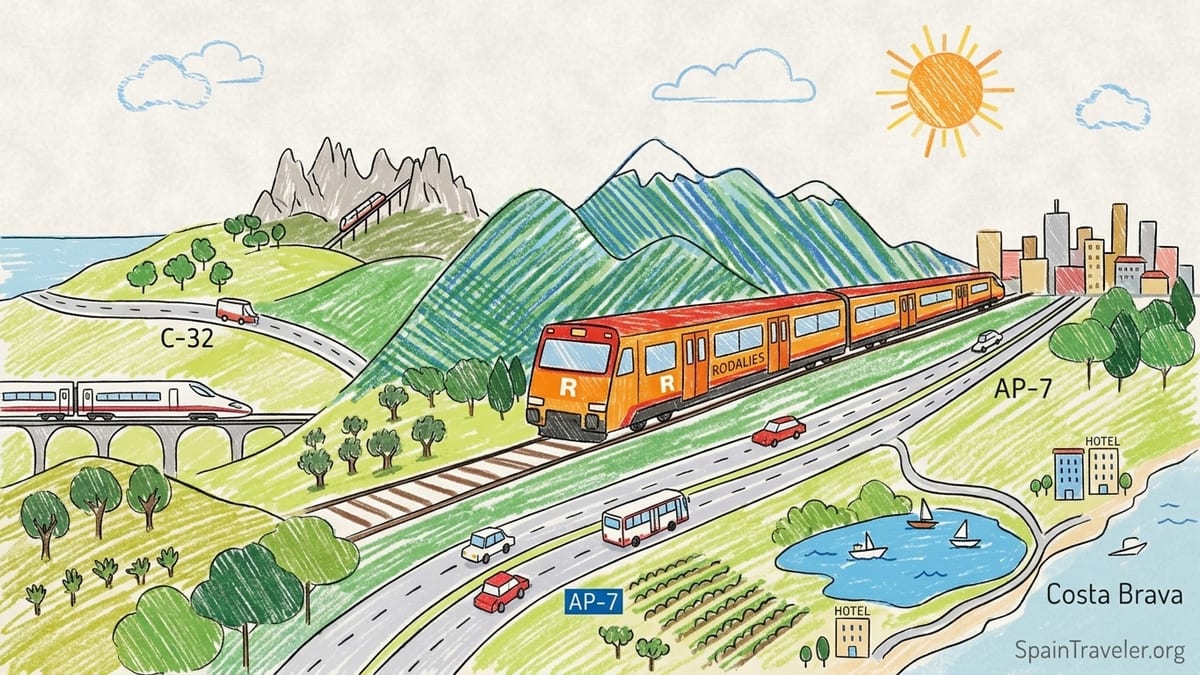
How Catalonia’s Rail and Road Networks Fit Together
Catalonia’s public transport map is denser than many visitors expect. The region is served by Rodalies de Catalunya suburban and regional trains, Renfe long-distance and high-speed services, the FGC network operated by the Catalan government, plus an extensive web of intercity and regional buses. Recent regional plans explicitly aim to make the train the backbone of public transport, with better coordination between Rodalies, regional rail, FGC and buses, especially by 2030 and beyond. In practical terms, that already shows up as reliable rail corridors linking the main cities and coastal zones, with buses plugging many of the gaps.
For drivers, Catalonia offers a modern motorway system, mountainous secondary roads and scenic coastal routes. The former toll motorway AP-7, which once carried some of Spain’s highest tolls, is now largely toll free, making long north–south journeys cheaper than they were a few years ago. Other key routes, such as the C-32 from Barcelona towards the Maresme and Costa Daurada, still charge tolls, and the regional government publishes updated tariffs and discounts each year. On peak summer weekends, traffic restrictions on certain corridors are introduced to manage congestion, something that is relevant if you plan to drive back into Barcelona on a Sunday afternoon.
Because both rail and road networks are strong in different places, most visitors are better served by thinking in corridors rather than individual routes. The Barcelona–Girona–Figueres axis is rail-rich and very car optional. Much of the Costa Brava, many wine zones and the high Pyrenees are patchy by train but reachable by bus and far more flexible by car. Your decision is less “train or car” in the abstract and more “where will I be relying mainly on rail, where on wheels, and do I actually need a private vehicle for my full stay.”
Understanding Tickets, Fares and Practicalities
One detail that surprises many visitors is that Rodalies’ regional network uses its own ticketing, separate from some integrated Barcelona transport products. Within the Barcelona metropolitan area, you can use integrated zone-based tickets issued by the local transport authority on Rodalies suburban lines, FGC, metro and tram. Once you go onto regional Rodalies routes or medium-distance trains, those integrated tickets are no longer valid, and you need specific regional tickets or passes. Official fare information emphasises that regional tickets only cover the regional network and that Barcelona integrated tickets cannot be used on Regional Exprés or medium-distance services, which matters when you plan day trips mixing city and regional travel.
On the rail side, you generally buy point-to-point tickets or multi-trip passes for Rodalies and regional services, and separate tickets for long-distance and high-speed AVE/Avlo trains. Tickets can usually be bought online or from machines at major stations such as Barcelona Sants, Girona or Tarragona, although some rural or cross-border stations have limited facilities and require purchasing on board or at staffed counters. Intercity buses use their own operators and fares, often with online advance-purchase discounts. Where the rail map thins out, coach companies step in with direct links between Barcelona and coastal resort towns or Pyrenean valleys.
For drivers, practicalities revolve around tolls, parking and low-emission rules. While the main north–south AP-7 motorway has seen many toll sections removed, other corridors still charge, notably parts of the C-32 towards Sitges and the southern Costa Daurada and the C-16 toward Montserrat and the Cadí Tunnel. The Catalan government publishes annual toll tables and discounts, and the cost for a typical private car on a single corridor segment is usually in the range of a few euros per journey, which can add up over a week of repeated trips. In Barcelona itself, the low-emission zone restricts older vehicles on many weekdays, something mostly relevant if you drive in from abroad with an older car.
Parking is the other major cost and stress factor. In central Barcelona, hotel parking can easily be in the tens of euros per night, and on-street spaces are controlled and time limited. Medium-sized cities such as Girona, Tarragona and Lleida have a mix of municipal garages and free peripheral parking, while resort towns on the Costa Brava and Costa Daurada often see informal roadside parking turn into gridlock in August. If your itinerary is city heavy, the hidden costs of a car can quickly outweigh the convenience.
City Hopping: Barcelona, Girona, Tarragona and Lleida
For a trip centered on Catalonia’s cities, trains are usually the clear choice. Barcelona, Girona, Tarragona and Lleida are all on mainline rail corridors, with a mix of Rodalies, regional and long-distance trains providing frequent daytime service. For example, Barcelona to Girona can be as fast as under 40 minutes on high-speed services or around 1 hour and 20 minutes on regional trains. Barcelona to Tarragona sits on the R16 regional line and other services, typically taking around 1 hour by regular train and substantially less on certain faster options. Lleida is linked by both conventional and high-speed lines, which makes an inland loop fully viable by rail.
Within the Barcelona area, the integrated fare system means that suburban Rodalies trains, FGC lines and metro can all be used with the same tickets across fare zones, simplifying city-based stays. Girona and Tarragona have more compact urban networks but pair well with walking and local buses. Lleida has its own suburban rail area and urban bus network, again enough to avoid a car for most central sightseeing.
Driving between these cities can be pleasant if you want to stop at small towns along the way, but traffic, one-way systems and parking quickly erode the benefit. A typical visitor itinerary that includes three nights in Barcelona, one in Girona and two in Tarragona is straightforward by train, with station-to-hotel hops usually short taxi or bus rides. In this scenario, a car mostly sits unused and accrues parking charges, so rail holds the clear advantage.
The main argument for a car on a city circuit is if you plan to stay in outlying hotels or rural guesthouses near the cities rather than in the centers, perhaps in a masia in the hills around Girona or a farmhouse south of Tarragona. Even then, you could often combine rail between cities with short local car rentals, instead of carrying a vehicle into dense urban areas where you do not actually need it.
Costa Brava and Costa Daurada: Where Trains Stop and Buses Begin
Catalonia’s two best-known holiday coasts, the Costa Brava to the north and Costa Daurada to the south, illustrate perfectly how rail and road strengths differ. The backbone of the northern corridor is the Barcelona–Girona–Figueres rail line. High-speed and regional trains connect Barcelona Sants with Girona in well under 1.5 hours and continue to Figueres, which anchors the northern Costa Brava region. From these rail hubs, you reach beach towns such as Lloret de Mar, Tossa de Mar, l’Estartit or Cadaqués not by train but by bus or car.
Interurban bus companies run frequent summer services from Barcelona and Girona to many Costa Brava resorts. For instance, Lloret de Mar and Tossa de Mar are linked to both Barcelona and Girona by direct coaches, while Figueres and Girona stations feed bus routes out to Roses, Cadaqués and other Empordà coastal villages. This setup means that a traveler who wants a week in a single resort can easily avoid driving altogether: train from Barcelona to Girona or directly by coach to the resort, walk and bus locally, then return by the same route.
The challenge comes if you want to string together multiple coastal villages or combine inland medieval towns such as Peratallada, Pals or Monells with several beaches in only a few days. Local buses exist but run less frequently outside high season and often require trips back through regional hubs. In that case, a car opens up scenic minor roads and lets you pivot spontaneously between coves without planning around bus timetables.
On the Costa Daurada, the pattern is similar but with some important differences. The R16 regional rail line runs south from Barcelona through coastal towns such as Sitges, Vilanova i la Geltrú, Sant Vicenç de Calders and on towards Tarragona and the Ebre region. Combined with other services around Tarragona, this gives good train access for city-style stays in places like Tarragona itself or in larger resorts near mainline stations. However, many low-rise family resorts and campgrounds sit a few kilometers from stations, linked instead by interurban and resort buses. Here again, staying in a single coastal base near a station works well by train and bus, but a multi-stop exploration of coves, Roman ruins and small fishing towns feels more natural with a car.
Pyrenees and Montserrat: When a Car Really Helps
Once you head up into the mountains, Catalonia’s rail network narrows to a handful of strategic lines. For the eastern Pyrenees, the Rodalies R3 line runs from the Barcelona area through Vic and Ripoll up towards Puigcerdà near the French border. This line is the main rail spine for mountain towns such as Ribes de Freser and La Molina, and at Ribes de Freser you can transfer to the rack railway that climbs to the mountain sanctuary and hiking area of Vall de Núria, operated by FGC. For travelers whose goal is to stay in one or two of these rail-served mountain spots, the train is comfortable and avoids winding roads.
West of this corridor, towards the Pallars and Vall d’Aran regions, public transport leans far more on coach services. Buses link Barcelona, Lleida and smaller cities to towns such as Vielha or Esterri d’Àneu, but frequencies can be limited, especially out of ski season. In winter, dedicated ski buses run to major resorts, and not needing to drive in snow and ice can be a strong argument for choosing them over a private car. In shoulder seasons, however, relying entirely on timetabled buses can make it hard to fit several valleys into a short trip.
Montserrat is one of the clearest examples of an area where public transport shines up to a point and then cedes to a specialist mountain system. From Barcelona you can take an FGC suburban line to either Monistrol de Montserrat, connecting with a rack railway up to the monastery, or to the cable car base station on the Llobregat River. This means a full day trip to Montserrat from Barcelona is easy without driving at all. Car access is possible via a winding mountain road with paid parking near the monastery, but many visitors prefer the train plus rack railway combination to avoid hairpin bends and parking queues.
Where a car adds significant value in the mountains is for itineraries that span multiple valleys, small villages and viewpoints in only a few days. Imagine a route that links Ribes de Freser with smaller hamlets, then crosses to the Garrotxa volcanic area and continues to Besalú or Castellfollit de la Roca. You can knit this together by bus and occasional taxi, but a car allows one continuous scenic loop and access to trailheads that may not be on any bus route. In winter, snow conditions and mountain driving experience should be factored in, but for confident drivers a compact car opens up a Pyrenean side of Catalonia that is difficult to reach otherwise.
Wine Country and Rural Catalonia: Buses vs Back Roads
Catalonia’s wine regions, from Penedès and Priorat to Terra Alta and Empordà, lie mostly outside the densest parts of the rail network. The Penedès, closest to Barcelona, is the exception. Rodalies and FGC both serve towns such as Vilafranca del Penedès and Sant Sadurní d’Anoia, home to well-known cava producers. From these stations, some wineries can be reached on foot or by short taxi rides, and a few offer shuttle services for tours. For a simple day of visiting one or two large wineries near Vilafranca or Sant Sadurní, train plus local transport is entirely adequate and has the safety advantage of letting everyone in the group taste freely.
Beyond Penedès, however, the balance tips in favour of driving. The steep slate terraces of Priorat, the windy hills of Terra Alta and the scattered vineyards of Empordà are threaded by small roads between tiny villages. Buses exist but may only run a few times a day on school schedules, and the most atmospheric cellars and viewpoints are often several kilometers from the nearest stop. For travelers serious about wine touring, a car or a private driver unlocks these areas. Another alternative is to base yourself in a rail-served city such as Tarragona, Reus or Girona and join organized day tours into surrounding wine regions, avoiding both car hire and the limitations of scheduled buses.
The same logic applies to rural interior areas rich in Romanesque churches, medieval stone villages and hiking paths. Comarques like La Segarra, Solsonès or parts of La Garrotxa have sporadic public transport at best. You might reach a county capital by regional bus or rail, but moving between small villages and country guesthouses is usually only practical by car. A hybrid approach works particularly well here: train to a regional hub such as Lleida, Girona or Tarragona, then a short 2 to 4 day rental devoted to slow rural exploration before you drop the car and continue by train.
When planning rural stays, it is prudent to check the exact location of your accommodation relative to the nearest station or bus stop before deciding on a transport mode. A charming masia “near” Girona may in reality sit 8 or 10 kilometers outside town up a country lane, which is a pleasant bike ride but challenging with luggage or in bad weather. In such cases, either coordinate taxi transfers in advance or budget for a car during just that segment of your trip.
Hybrid Strategies: Train Between Cities, Car for Strategic Days
For many visitors, the most efficient and enjoyable strategy is a hybrid: use trains for long intercity legs where rail is fast and frequent, then rent a car only for short windows devoted to rural or mountain exploration. This avoids the worst parking headaches and toll costs while still giving you flexibility where public transport is thin. Catalonia’s rail hubs such as Barcelona Sants, Girona, Tarragona and Lleida all have car rental desks either in or very close to the station, which makes station-to-steering-wheel transitions straightforward.
One common pattern is a loop that starts with several car-free days in Barcelona. From there, you might take a train to Girona, rent a car for three days to explore the Costa Brava and Empordà villages at your own pace, then return the car in Girona and continue by rail to Tarragona or Lleida. Another scenario begins with a high-speed train from Barcelona to Lleida, followed by a 4-day car rental to tour rural western Catalonia and the southern Pyrenees, before dropping the vehicle and heading back to Barcelona by train.
In these hybrid itineraries, one-way rentals can offer more freedom, for example picking up a car in Girona and dropping it in Tarragona after crossing the interior. In Catalonia, one-way drop fees between major cities are common but may be moderate, especially within the same region. The trade-off is that consolidating your driving into a focused block of days often saves more on city parking and unnecessary rental days than you spend on the drop charge. When comparing options, it is worth pricing both a continuous week-long rental and a 3-day mid-trip hire to see which aligns better with your plan and budget.
Luggage is another reason hybrid plans work well. Trains and long-distance coaches handle suitcases and backpacks reliably, and you only transfer them in and out of a car when you truly need vehicular flexibility. In contrast, driving into tight medieval centers with a trunk full of luggage can be stressful, particularly when hotels are located in restricted-traffic zones or pedestrianized old towns where you must navigate to specific access points. By timing your car rental to nights in rural or small-town lodging with on-site parking, you reduce both stress and the risk of parking fines.
Last-Mile Connections, Station Locations and Accessibility
Whether you choose train, car or both, the “last mile” can shape your experience more than the long stretch. Major Catalan cities cluster their main stations close to historic centers. Barcelona Sants is a short metro or taxi ride from the Gothic Quarter and Eixample, while Girona and Tarragona stations sit within walking distance of their old towns. Lleida’s main station is integrated into the city grid with taxis and buses available outside. Arriving by train therefore usually drops you relatively close to urban hotels, and onward taxis for luggage-heavy travelers are easy to find.
In coastal and mountain areas, station placement is more variable. Some towns grew inland while their modern beaches and resorts are a short bus ride or several kilometers away. For example, a station may sit slightly inland, with beach developments spread along the shoreline. Local buses and, in summer, tourist shuttles connect stations with waterfront promenades and campgrounds, but schedules can thin out at night or in the off season. If you expect to arrive on an evening train and walk to your accommodation, it is important to verify that your hotel is actually near the station, not only within the municipality.
Intercity and regional buses often stop closer to tourist zones than trains, particularly in resort towns where the bus station sits right behind the promenade or main square. It is quite common, for example, to arrive from Barcelona by coach directly in the heart of a beach resort, closer to many hotels than the nearest railway station. When planning your trip, look at both train and bus stop locations, not just timetables, to choose the mode that leaves you closest to where you will sleep.
Accessibility considerations also play a role. Many newer or modernized stations in Catalonia offer step-free access, lifts and level boarding, especially on main lines and in large cities. In contrast, certain rural stations and small halts may have stairs, low platforms or limited facilities. For travelers with mobility challenges, that may tilt the balance toward bus services on particular routes or toward a private car, at least for segments where station infrastructure is not yet upgraded.
Traveler Scenarios: Matching Trips to Transport
Because neither train nor car is objectively “better” for all of Catalonia, it helps to think in concrete trip scenarios. A first-time visitor with one week who wants three nights in Barcelona and four nights in a single seaside resort can easily manage without driving. They might use suburban trains and metro inside Barcelona, then either take a regional train and bus combination or a direct coach to their chosen resort, spending the rest of the week on foot and local buses.
A couple focused on culture and food, planning to split ten days among Barcelona, Girona and Tarragona with a day trip to Montserrat, will find trains extremely efficient. Fast rail links between the cities, plus FGC or combined train and rack railway for Montserrat, cover their main movements. Occasional taxis handle luggage between stations and centrally located hotels. In this scenario, a car would mainly sit unused and complicate urban days.
By contrast, a traveler who wants to photograph small Costa Brava coves at sunrise, tour tiny Empordà wine villages, and finish with two nights in a mountain village near the French border has much more to gain from at least a partial car hire. They might still use a train to Girona to avoid city driving, then rent a car there for five or six days to link beaches, villages and mountain valleys that are only lightly served by buses. If they prefer to avoid mountain roads, they could even drop the car before the highest stretches and continue by train and rack railway where those exist.
Family groups, especially with small children and bulky luggage, sit somewhere in the middle. For a family staying in a single well-served resort with a beachfront hotel, the simplicity of a direct train or coach and a week without car seats can be appealing. For an itinerary that jumps between rural houses and scattered beaches, the flexibility of controlling departure times and carrying toys and snacks in a car may outweigh the costs and parking challenges. The right answer often shifts from “no car” to “strategic car” as soon as your nights are split between three or more rural or coastal bases.
The Takeaway
Choosing between train and car in Catalonia is less a technical puzzle and more an exercise in aligning transport with the shape of your trip. The rail and bus networks excel at linking major cities, key coastal corridors and headline day-trip destinations such as Montserrat and rail-served Pyrenean valleys. In these spaces, a car adds little but cost and stress. Once you step into deeply rural comarques, patchwork wine regions and multi-valley mountain itineraries, a car can transform what is logistically possible in a short time.
For many travelers, the sweet spot is a hybrid approach: rely on Rodalies, regional trains, FGC and intercity buses for long legs and city days, and hire a car only for two to four days focused on countryside or highland routes. Pay close attention to where stations and bus stops sit in relation to your lodgings, factor in parking and toll costs, and remember that certain regional rail tickets are not integrated with Barcelona’s city passes. With that groundwork, you can treat Catalonia’s mix of trains, buses and roads not as competing systems but as tools to assemble exactly the journey you have in mind.
FAQ
Q1. Is it realistic to visit Catalonia without renting a car at all?
Yes, if you focus on Barcelona, Girona, Tarragona, Lleida and a single well-connected coastal or mountain base, the combination of trains, FGC lines, and intercity buses works very well. Once you add several rural bases or scattered wine villages to a short itinerary, a limited car rental block becomes more attractive.
Q2. Are Rodalies regional trains included in Barcelona’s integrated transport passes?
Within the Barcelona suburban area many Rodalies services are integrated with the metropolitan fare system, but the specific regional and medium-distance routes use separate tickets and passes. That means certain regional trains cannot be ridden using only T-type integrated city tickets, and you should budget for separate regional fares on longer intercity journeys.
Q3. How bad is driving and parking in central Barcelona?
Driving into central Barcelona involves busy multilane ring roads, strict one-way systems and a low-emission zone that restricts older vehicles on many weekdays. Parking in central districts is mostly in paid garages or controlled on-street zones, and nightly costs can be significant. For most visitors staying centrally, it is easier and cheaper to rely on public transport and occasional taxis.
Q4. Can I reach popular Costa Brava resorts entirely by public transport?
Yes. You can take a train from Barcelona to Girona or Figueres and connect to coastal resorts by regional bus, or in some cases take a direct coach from Barcelona. This works well if you stay in one resort, but piecing together multiple small coves and inland villages in a few days is usually smoother with a car.
Q5. What about visiting Montserrat, should I drive or take the train?
Most travelers prefer taking an FGC suburban train from Barcelona to the base of Montserrat, then connecting to the rack railway or cable car up the mountain. This combination avoids winding mountain roads and paid parking near the monastery, and is timed for day trips. Driving is useful mainly if Montserrat is one stop on a wider countryside loop.
Q6. How easy is it to rent a car at Catalan train stations?
Major hubs such as Barcelona Sants, Girona, Tarragona and Lleida have car rental desks either inside the station complex or within a short walk. This setup makes it practical to arrive by train, pick up a car for two to four days of rural or mountain driving, then return it at the same or another station before continuing your journey by rail.
Q7. Are there many toll roads left in Catalonia, and should I avoid them?
Several major toll sections have been removed in recent years, including large parts of the AP-7, but others remain, such as stretches of the C-32 and the C-16. Tolls for private cars are usually modest per trip, and in many cases the tolled roads are faster and less tiring than the alternatives. Whether to avoid them depends on your budget and how comfortable you are on slower national roads.
Q8. Is driving in the Pyrenees difficult for visitors?
Main Pyrenean roads are well maintained, but they include steep gradients, hairpin bends and, in winter, possible snow and ice. Confident drivers in good weather usually find them manageable, but those unused to mountain conditions might prefer reaching certain valleys by train and rack railway or by ski bus, especially during winter months.
Q9. Do I need a car to visit Catalan wine regions?
For the nearby Penedès region, you can reach towns such as Vilafranca del Penedès and Sant Sadurní d’Anoia by train and then use taxis, on-foot visits or organized tours. For more remote wine areas like Priorat, Terra Alta or rural parts of Empordà, a car or a private driver greatly expands your options, since village-to-village public transport is limited.
Q10. What is the best strategy if I want both city time and rural exploration?
A common approach is to start with several car-free days in Barcelona, then take a train to a hub such as Girona, Tarragona or Lleida and rent a car there for a focused block of countryside, coastal or mountain days. After returning the car, you continue by train to your final city or back to Barcelona, combining the strengths of both modes while minimizing parking and rental costs.