


Every Madrid local has opinions about the “perfect” day trip, but most roundups read like wish lists rather than what actually fits between breakfast in the capital and a late tapas crawl back in Malasaña. Over several years living in Madrid, I treated the surrounding region like an ongoing experiment, dragging visiting friends to heritage cities, hilltop villages and Sierra trails, and timing everything from front door to first coffee in the plaza. Some excursions felt like mini holidays. Others, honestly, were not worth surrendering a Madrid afternoon for. What follows is not a theoretical list but a comparison of trips I actually took, with the practical time costs, transport quirks and whether I would repeat them on a short visit.
How I Tested These Madrid Day Trips
I approached each excursion the way most visitors do: leaving from a central Madrid rental flat near Gran Vía or Malasaña, using standard public transport or a modest rental car, and aiming to be back in time for a late dinner. Door to door timing started when I closed the apartment door in Madrid and stopped when I was standing in the historic center at the destination, ready to explore. I also tracked when we realistically left again, and how much “useful” sightseeing time that translated into on the ground.
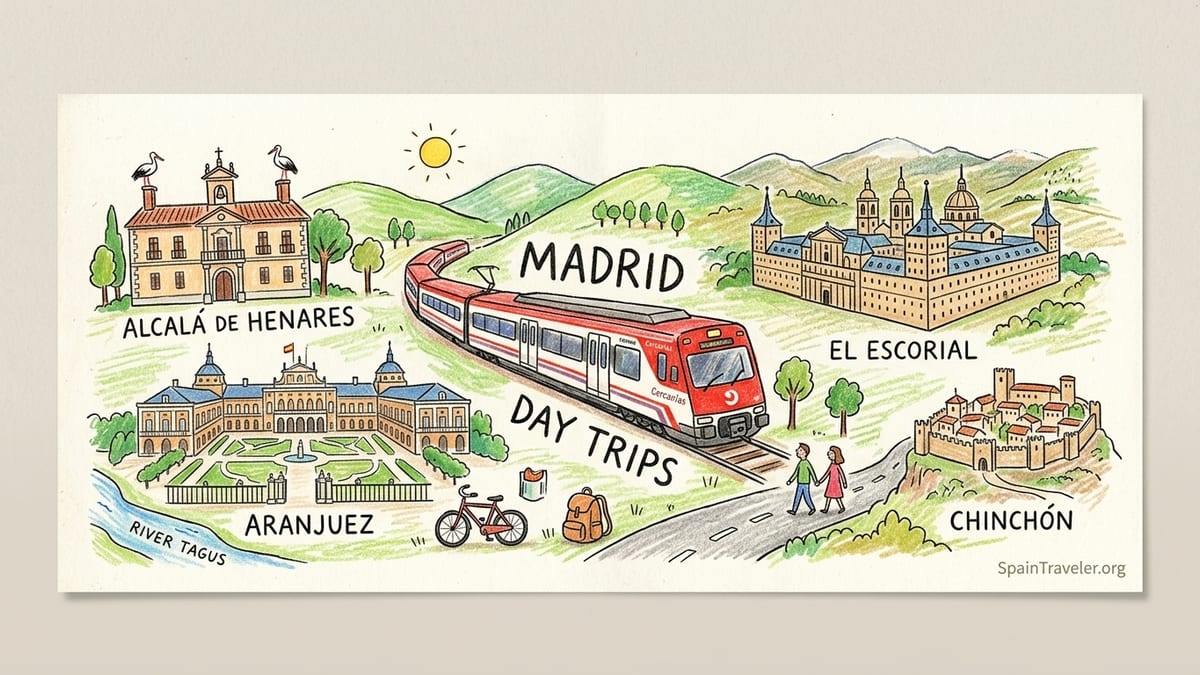
The focus here is on regional trips within the Community of Madrid and just beyond, especially those that local and regional tourism bodies now actively market as heritage excursions by train. The region highlights World Heritage cities like Alcalá de Henares, Aranjuez and San Lorenzo de El Escorial in official guides and promotes themed trains such as the Tren de Cervantes to Alcalá, the Tren de la Fresa to Aranjuez and the Tren de Felipe II to El Escorial, all designed to make them feel like natural extensions of a Madrid stay. That institutional push matches my experience: these places really are set up for straightforward visits from the capital.
Where specific ticket prices or timings are mentioned, they reflect what I could confirm in autumn 2026 through operators, official tourism pages or consolidated rail sites. Services and fares do change, so treat them as snapshots rather than guarantees and check again just before you travel, especially given ongoing works on parts of Madrid’s Cercanías commuter network.
Alcalá de Henares: Easy World Heritage, But Rushed in a Single Day
Of all the regional excursions I tested, Alcalá de Henares felt the most like stepping into a parallel, smaller university version of Madrid. It is about 30 kilometers east of the capital, and regional trains and Cercanías services connect Atocha, Recoletos and Chamartín with Alcalá in around 35 to 40 minutes of travel time according to recent timetables. Door to door from my flat near Tribunal metro, that meant about 15 minutes on the metro to Atocha, a short wait, and then the ride itself. On a typical Saturday we were standing in the historic Calle Mayor under its arcades roughly 70 to 80 minutes after locking the apartment.
I have done Alcalá in two ways. The first was the “DIY commuter” version, buying standard Cercanías tickets which cost only a few euros each way, then walking from the modern station ten to fifteen minutes into the historic core. The second time, I joined friends on the Tren de Cervantes, the heritage service that runs on selected weekends with actors and guided elements built into the ticket. That experience was atmospheric and underlined how aggressively the region now brands Alcalá as an accessible cultural day trip, but from a time standpoint it did not save us anything significant over a normal train.
On paper Alcalá is a classic day trip, yet by mid-afternoon I always felt tension between “tick the highlights” and simply enjoying the city. On my first visit we aimed to see the university’s grand courtyards, the Cervantes Birthplace Museum, the cathedral, the archaeological area of Complutum on the edge of town and still linger over a menú del día in a colonnaded plaza. With roughly seven hours of useful time between arrival and when we needed to board an evening train back, that schedule pushed us into constant motion. The detour to Complutum alone ate almost two hours once you factored in walking out, visiting, and returning.
If I repeated the experiment with a first-time visitor who already had only three or four full days in Madrid, I would treat Alcalá as a candidate for an overnight rather than a strict day trip. With a night in a simple hotel in the old town, you gain a slow evening of tapas under the arcades and a quiet morning for the museums before heading back. As a pure in-and-out excursion, Alcalá is certainly feasible, but it rewards travelers who can give it at least a day and a half. For a very short Madrid itinerary, I would prioritize other destinations that compress better into a single day.
Aranjuez: A Near-Perfect One-Day Escape
Aranjuez, to the south of Madrid, is the trip that surprised me the most in how well it worked in a single day. The historical town and royal residence sit on the Cercanías C-3 commuter line, which links central Madrid stations such as Chamartín, Sol and Atocha to Aranjuez in roughly 45 to 55 minutes of scheduled travel time. Recent information from transport guides and the local palace website still quotes about 45 to 50 minutes from Atocha, and my own experience usually fell within that window as long as there were no disruptions on the line.
Leaving from a rental in La Latina, we walked ten minutes to Sol, caught a C-3 train within about twenty minutes, and were stepping into the airy, vaguely 19th century station in Aranjuez just under one hour and fifteen minutes after leaving the apartment. From there, it was a short level walk of about ten minutes to the palace and its formal gardens. Door to palace gate, the realistic travel time was around one hour and twenty-five minutes, including modest waits.
The rich part was what came next. Because palace opening hours span the middle of the day and return trains run until late evening, we effectively had eight to nine hours of usable time on the ground. On one visit we toured the main palace rooms in the late morning, picnicked in the Jardín del Príncipe, and then rented simple bikes near the station to follow the tree-lined avenues along the Tagus. On another, we spent more time in the compact town center and its Saturday market, then wandered through the ornamental Jardín de la Isla, one of the landscaped areas now promoted as part of a World Heritage cultural landscape. In both cases, we never felt rushed to the point of sacrificing a coffee or a second walk through the gardens.
I have yet to ride the Tren de la Fresa, the heritage Strawberry Train that runs in spring and autumn between Madrid and Aranjuez with period carriages and strawberry tastings. The dates are advertised each season by Madrid tourism channels, and the train underlines how deliberately Aranjuez is pitched as a heritage outing. For me, the regular Cercanías option hits the sweet spot on cost and frequency. If I had only three full days in Madrid and wanted one day out of town, Aranjuez would be my top pick. It fits neatly between breakfast churros in Madrid and late drinks back in the city, offers an obvious focal point in the palace and gardens, and still leaves slack for delays on the commuter network.
San Lorenzo de El Escorial: Big Monument, Awkward Transport
San Lorenzo de El Escorial is another officially promoted World Heritage destination, dominated by its vast monastery and royal complex in the foothills of the Sierra de Guadarrama. On maps it looks close to Madrid, but the combination of valley topography and slightly indirect connections means the door to door trip took longer than I expected. I tried two different approaches: Cercanías train plus a short local bus, and a direct interurban bus from Moncloa.
On my first visit I rode a Cercanías service from Madrid to El Escorial station. Depending on where you board in the city, trains on what is now the C-8 line take roughly one hour from central stations to El Escorial according to recent timetables. From there, you can either climb for about thirty minutes on foot up to San Lorenzo, or take a quick local bus or taxi for the final stretch. I opted for the bus, but between waiting, boarding and a crowded ride, the transfer still took around twenty minutes. Counting the initial metro hop to the railway station in Madrid, the overall door to monastery travel time was in the ballpark of one hour and forty-five minutes.
The second time, I left from a flat near Plaza de España and took the metro to Moncloa, then boarded an interurban coach bound for San Lorenzo de El Escorial. Several companies operate under the regional transport authority, and when things go smoothly, the journey can be about one hour. In practice, morning traffic leaving Madrid and a moderate queue for the bus stretched my door to door time to roughly one hour and thirty minutes even though the drive itself is not long.
Once you do arrive, the reward is significant. The monastery complex, basilica, royal apartments and library can easily absorb three or four hours, and recent visitor information notes that access routes have been reorganized due to improvement works. Add a slow lunch in the upper town and a short stroll to viewpoints over the hills, and you hit six to seven hours in San Lorenzo without forcing the pace. That leaves an excursion length of around ten hours from Madrid and back, including transport. It is absolutely achievable in one day, but the monument’s scale means you are unlikely to see everything in satisfying depth if you also want time in the village and on the hillsides.
If I were planning again for friends who love royal history and architecture, I would still propose El Escorial as a day trip, but I would avoid visiting on days when works or disruptions affect commuter services to the northwest, and I would buy timed tickets to the complex online as early as possible. For hikers or photographers interested in the wider Sierra de Guadarrama more than the building itself, I might lean toward renting a car and combining a quick outside view of the monastery with trailheads in nearby passes. In that sense, San Lorenzo sits in a grey zone: a strong one day destination on paper, but one that can start to feel compressed unless you are efficient with early departures.
Chinchón and Buitrago del Lozoya: Characterful Towns Better by Car
Not all worthwhile trips radiate out along rail lines. Two of my favorite “deep Madrid region” days focused on Chinchón and Buitrago del Lozoya, small towns heavily featured in provincial promotional material yet much less standardized as day trips than the World Heritage trio. In both cases, I experimented with public buses and later returned by rental car, which made me far more relaxed about recommending them to time-poor visitors.
Chinchón lies to the southeast of Madrid and is famous for its irregular Plaza Mayor ringed with wooden balconies. On my first visit we used an interurban bus from Conde de Casal. The scheduled journey time was around one hour, but weekend traffic and multiple intermediate stops stretched it closer to one hour and twenty minutes. Including a short metro ride from the center to Conde de Casal and ten to fifteen minutes of waiting and boarding, we spent roughly one hour and forty minutes from apartment door to standing under the Plaza Mayor arcades.
The town itself is easy to love. We spent the morning circling the plaza, visiting the church on the hill with its views over the tile roofs, and touring the remains of the castle outside the core. After a long lunch featuring local wine and anis, we realized that with late afternoon heat we did not wish to do much else. Our return bus was delayed by about thirty minutes, and by the time we reached Madrid we had invested nearly twelve hours in total for what felt like a single concentrated experience: that plaza at different times of day. When I went back by rental car, the picture changed dramatically. Leaving from Lavapiés, we took the M-30 and a combination of radial roads and were parking on the edge of town in about fifty minutes, almost an hour faster door to door.
Buitrago del Lozoya, up the A-1 north of Madrid, told a similar story. Public coaches from Plaza de Castilla are scheduled at about one hour and fifteen minutes, but in my case weekend traffic and a missed departure meant that we did not walk through the medieval walls until almost two hours after leaving the flat. Once there, the town’s compact historic center and the river loop below the walls made for a charming three to four hour wander, including a coffee stop and time spent in the small museum. As with Chinchón, the return by bus felt longer still, and on that first visit our useful time on the ground barely exceeded our total transit time.
When I repeated Buitrago with a small rental car, departing Madrid around 8:30 in the morning, we were sipping coffee inside the walls before 9:45, and after a full circuit of the town and a walk along the river we were able to add a stop at a nearby viewpoint in the Sierra before heading back. The conclusion from both towns is clear for me. For visitors without a car and with only a few days in Madrid, I would not put Chinchón or Buitrago ahead of Aranjuez or even El Escorial. They are atmospheric, but by public transport the ratio of transit stress to payoff is not ideal. With a car, they become much easier to recommend as relaxed day trips or parts of a wider road loop.
Patones and Sierra Excursions: When Madrid’s Mountains Need an Overnight
Locals often encourage visitors to “escape to the Sierra” for a cooler day near Madrid, and official maps of the region increasingly highlight hiking areas in the Sierra de Guadarrama and northern valleys. I tried two such rural excursions that started promisingly but exposed the practical limits of squeezing mountain landscapes into a single day without your own vehicle: Patones de Arriba and a set of trails near the Puerto de Navacerrada and Cotos area.
Patones de Arriba is a tiny slate village tucked into hills north of Madrid, accessible by road and by a combination of interurban buses. On my first attempt, we took the metro to Plaza de Castilla and looked for a bus with a connection onward to the Patones area. The published journey times suggested around one hour and fifteen minutes, but in practice we spent more than two hours between waiting for infrequent services, riding out through the suburbs, and completing the short final climb to the village on foot from the stop. Once there, we had perhaps four hours of useful time before needing to reverse the sequence to avoid being stranded by the last evening buses.
Those four hours were beautiful. Patones lives up to the photographs: stone alleys, slate-roofed houses converted into rural guesthouses and restaurants, and short paths leading out into terraced hillsides with views back over the village. Over lunch we watched cars pulling in from Madrid, and by mid-afternoon we had largely exhausted what you can realistically do without a longer hike. The prospect of another two hour plus chain of buses made the day feel skewed toward logistics. When I later stayed overnight in a small rural inn there, the same scenery and village atmosphere suddenly felt proportionate to the travel effort.
The Sierra trails near Navacerrada and Cotos taught a similar lesson. On my first hiking day, we aimed for the Puerto de Navacerrada, historically reachable by a combination of Cercanías trains and mountain railway, though services have been periodically suspended in recent years. We ultimately used a coach from Moncloa that climbed to the pass in roughly one hour when traffic allowed. From a shared flat near Tirso de Molina, the metro to Moncloa, the wait and boarding, and the drive together added up to about one hour and forty minutes door to trailhead.
With that start, we still had five to six hours of walking along well-marked trails, stopping at viewpoints over pine forests and granite peaks before catching an afternoon bus back down. It was a rewarding day, but any unexpected delay on the return would have cut uncomfortably into the evening, and we had no flexibility to extend into sunset views without risking a long wait in mountain chill. When I returned later with a rented car and booked a simple guesthouse for the night, we could time our hikes around the light and weather, and a single mountain sunset suddenly justified the whole effort.
For travelers coming to Madrid primarily for culture and food who simply want a taste of the surrounding nature, I would recommend combining a lighter hill walk near El Escorial or a riverside stroll in Aranjuez with your cultural visit, rather than prioritizing Patones or the upper Sierra in a single rushed day. Those mountainous corners shine most when you give them either a car or an overnight, or ideally both.
Which Trip I Would Skip on a Short Madrid Visit
Among all the excursions I tried, the one I would personally skip if I had only a short stay in Madrid is the public transport version of Patones de Arriba. This is not a criticism of the village itself, which is objectively charming and deserves its place in regional photo campaigns. The issue is purely about time and flexibility. Without a car, our door to door travel time from central Madrid exceeded two hours each way once we accounted for metro connections, waiting at Plaza de Castilla, and the slightly unpredictable nature of rural bus schedules.
That meant we invested upward of four and a half hours in transit for a maximum of four productive hours on site, much of which we spent either at a long lunch or repeating short walks through the same alleys and viewpoints. Compared to Aranjuez, where the same travel budget gave us a palace, multiple large gardens and a riverside bike ride, or Alcalá, where a similar amount of transit unlocks a full university quarter and a dense old town, Patones felt like a poor return on time for a first trip to the region.
If Patones really appeals to you, I would either rent a car for the day or commit to an overnight in a rural inn. That way, the long journey becomes the start of a mini break rather than the price of a single lunch in a pretty hamlet. For visitors with only three or four nights in Madrid, the combination of travel complexity and limited on-site variety means I would reserve Patones for a second or third visit.
The Takeaway
After testing these trips repeatedly from a real Madrid base, some patterns became clear. Destinations that sit directly on frequent commuter rail lines and combine compact historic centers with a single dominant attraction tend to work best as true day trips. Aranjuez is the standout example: realistic door to door travel of around one hour and twenty minutes, a palace and gardens within a ten minute walk of the station, and enough depth in town and landscape to fill a relaxed eight hours before heading back.
Alcalá de Henares occupies a middle position. It is logistically simple and well served by both everyday trains and special heritage services, and it wears its university and literary history on almost every corner. Yet the density of sites, especially if you add the outlying Roman remains of Complutum, pushes it toward feeling rushed in a strict there-and-back day. If your Madrid stay extends beyond four nights or you are particularly drawn to literary Spain, consider giving Alcalá an overnight to balance the experience.
San Lorenzo de El Escorial, Chinchón, Buitrago del Lozoya, Patones and the Sierra trailheads near Navacerrada all share a different profile. They are either more complex to reach by public transport or involve longer rides with less frequent services. They reward visitors who have already seen central Madrid’s main sights and can afford the occasional longer travel day, or who are comfortable renting a car to reclaim an hour each way and layer multiple stops into a single outing.
If I were advising a first time visitor with four full days in Madrid today, I would suggest spending two and a half to three days inside the city and one day on a regional excursion, with Aranjuez at the top of the list and Alcalá as a strong second if they can stretch to an overnight. El Escorial would come next for royal history fans, while towns like Chinchón and Buitrago would move up the ranking for anyone already planning to rent a car. The sierras and Patones deserve their fans, but for a short urban break, the most “worth it” escapes are those where the scenic train ride is merely the prelude, not the main act.
FAQ
Q1. Is Aranjuez really doable as a relaxed day trip from Madrid without rushing?
Yes. With commuter trains from central Madrid taking roughly 45 to 55 minutes and the palace less than a fifteen minute walk from the station, you can comfortably enjoy the palace, gardens and a leisurely meal within an eight to nine hour window on the ground, then return to the capital for dinner.
Q2. How much time should I realistically allow for a day trip to Alcalá de Henares?
From a central neighborhood in Madrid, expect around 70 to 80 minutes door to door each way using the metro and Cercanías or regional trains. That typically leaves you with about seven hours on site if you depart in the mid-morning and return in the early evening. It is enough for the historic center and key university courtyards, but if you want to include the Roman site of Complutum and several museums, an overnight stay provides a more relaxed pace.
Q3. Is San Lorenzo de El Escorial better by train or by bus?
Both options work, but each has trade-offs. The train to El Escorial station provides predictable travel of about an hour from central Madrid, followed by a local bus or uphill walk to San Lorenzo, which adds another twenty to thirty minutes. Buses from Moncloa can drop you closer to the town center, but they are more exposed to traffic leaving the city. For a first visit, I suggest whichever option aligns best with where you are staying and the current works or disruptions on the Cercanías network.
Q4. Do I need to book the heritage trains like the Tren de la Fresa or Tren de Cervantes?
Yes. Heritage trains promoted by the regional authorities and tourism offices operate on specific spring and autumn dates and have limited capacity. If you want the themed experience to Aranjuez, Alcalá or El Escorial, you should reserve in advance as soon as dates are released for the season. For most travelers, however, the regular Cercanías services offer more flexibility, lower prices and enough frequency to build your own schedule.
Q5. Which of these trips would you recommend for families with children?
Aranjuez is particularly family friendly because the formal gardens, shaded walks and open lawns around the Tagus give children room to move, and the palace visit can be kept relatively short. Alcalá works well with older kids interested in stories about Cervantes, while El Escorial’s scale can impress younger visitors but also tire them if you try to see everything. Smaller villages like Chinchón or Patones can be charming for children, but longer bus journeys and fewer structured attractions may make them better suited to families accustomed to independent travel.
Q6. Are any of these destinations good without a car if I mainly want nature?
El Escorial and Aranjuez both offer light nature experiences without the need for a car. Around El Escorial you can take short walks into the lower slopes of the Sierra de Guadarrama, while Aranjuez has extensive riverside gardens and tree-lined paths. If your primary goal is full day hiking in high mountain landscapes near Navacerrada or Cotos, public transport can work but leaves you with tighter schedules. For serious hiking, having a car or staying overnight in the mountains makes the experience far smoother.
Q7. Is it realistic to combine two destinations, like El Escorial and a Sierra hike, in one day?
It is technically possible with a car to pair a quick look at El Escorial with a shorter hike in the nearby Sierra, but relying on public transport makes this difficult. Bus and train timetables to the monastery and separate mountain passes rarely align in a way that allows a meaningful visit to both on the same day. If you hope to combine culture and longer walks in one outing, renting a car or arranging a private transfer is the most efficient solution.
Q8. For a very short Madrid trip, which excursion would you skip first?
Based on my own door to door timings, I would skip Patones de Arriba when relying solely on public transport. The chain of metro and rural buses can take more than two hours each way, and the small village, while picturesque, offers fewer varied activities than larger heritage towns. With a car or an overnight stay it becomes more appealing, but for a three or four night Madrid stay focused on highlights, time is better spent on Aranjuez, Alcalá or El Escorial.
Q9. Is renting a car around Madrid difficult for visitors?
Renting a car is straightforward if you are comfortable driving in European cities and can navigate Madrid’s ring roads. Major rental agencies operate from the airport and central locations, and once you reach the motorways, routes to places like Chinchón, Buitrago or Patones are well signposted. The main challenges are city traffic, parking near historic centers, and observing local regulations such as low emission zones. For most travelers, a car makes sense only if you plan several rural or mountain excursions, not for a single straightforward trip like Aranjuez.
Q10. How far in advance should I plan these day trips when visiting in peak season?
In spring and early autumn, when both Madrid and its surroundings are busy, it is wise to sketch out your excursion days at least a few weeks ahead. That means checking current train or bus timetables, booking timed entry tickets for major sites like the Aranjuez palace or El Escorial monastery where available, and reserving heritage train seats or rural accommodations if you choose those options. For simple commuter rail trips outside major holidays, you can still decide a day or two before, but confirming schedules the previous evening helps avoid surprises from works on the network.