


I have spent the last few summers using Costa Dorada as a testing ground. Instead of ticking off as many beaches as possible, I kept circling back to the ones that actually worked for real days in the water, with kids in tow, laptops occasionally in my bag, and friends joining at different stages. What follows is not a glossy list of every pretty cove. It is a comparison of the specific Costa Dorada beaches where I have personally laid a towel, swum, packed up sandy toys and, in one case, left after less than an hour vowing not to return.
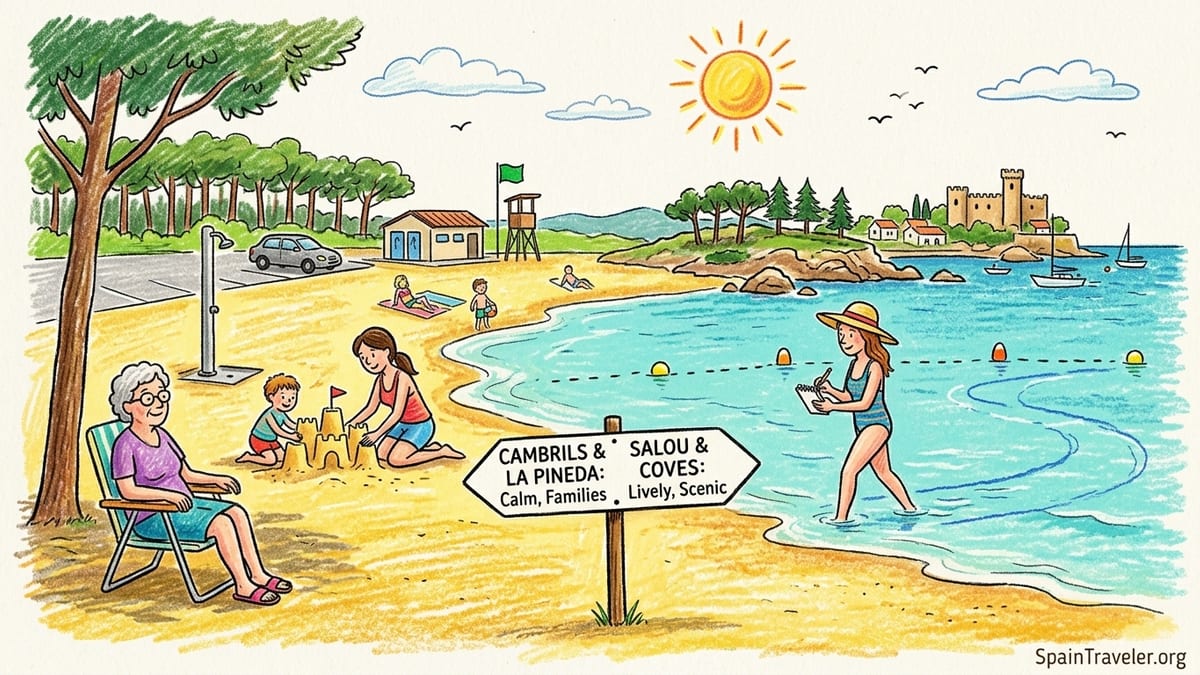
How I Tested Costa Dorada’s Beaches (And What Matters On The Ground)
Across several trips between 2023 and 2026 I based myself around Tarragona, Salou, La Pineda and Cambrils, then drove or walked to a mix of headline beaches and tucked-away coves. On some days I was solo and looking for long, uninterrupted swims. On others I had children under eight and a grandparent, so shallow water, toilets within a short walk and easy parking mattered more than dramatic scenery. Every beach in this article is one I have personally visited and swum at, usually more than once.
When I compare them, I am not judging from the promenade. I have felt the texture of the sand under bare feet, walked out until the water stopped being safe for a child to stand, and tested how easy it was to find shade at midday in August. I took notes on where the lifeguard posts actually were, how crowded the shoreline became by 11:00, and whether showers were working and usable without stepping through mud. If a beach looked beautiful but felt impractical for a real day, I have been blunt about it.
Official regional material celebrates Costa Dorada for long arcs of fine golden sand with calm, shallow Mediterranean water and strong family tourism infrastructure. That reputation is deserved, especially around Salou, La Pineda and Cambrils, where several beaches hold quality and family-friendly certifications for clean water, safety and services. At the same time, there are rocky coves, more exposed sections with noticeable waves and serious crowding at peak times. This article aims to map where that brochure promise holds up and where it frays once you are actually in the water.
To keep this guide useful, I focus on a handful of beaches that stood out after repeat visits rather than assembling a directory. Individual deep-dive guides can come later. Here I concentrate on comparisons: which beaches worked best for young children, which invited long swims, where couples will find quieter evenings and where the reality did not match the photos circulating in tourism brochures.
Platja de la Llosa, Cambrils: The Quiet All-Day Family Base
Platja de la Llosa in Cambrils is the beach I recommend first to friends with small children or anyone who wants a full, gentle beach day without drama. The sand here is soft and fine underfoot, the classic “golden” color that gives the coast its name. The shoreline shelves very gradually, which means that in summer I could walk out around 40 to 50 meters before the water reached my shoulders. For my children that translated into a huge, safe paddling and splashing zone where they could still stand even when small waves rolled in.
In terms of wave conditions, La Llosa is usually protected and calm. On windier afternoons there can be knee-high chop, but I have never seen dumpy shore-break that would knock a child over. Swimming comfort is high: once you pass the busy shallows you can trace relaxed laps parallel to the buoys without constantly dodging bodyboarders. The water here has felt consistently clear and comfortable for long swims of 20 to 30 minutes at a time, especially before 11:00 when the sea is glassy.
There is a low promenade running behind most of the beach with a separate pedestrian path and a cycle lane. Shade comes mainly from rows of pines and palms set back slightly from the sand, and in the middle part of the day I often retreated to the edge of the promenade with a stroller to stay out of the direct sun. Showers are spaced along the beach and in recent summers they have been functional, though occasionally restricted in late season to save water. Toilets are attached to nearby beach bars and cafes rather than freestanding blocks, so I usually budget for at least a drink at one of the chiringuitos.
Lifeguards are present in high season, with clear flags and a basic first aid station. Parking is a strong point: there are several free or low-cost surface lots within a short walk of the sand, and out of August I have nearly always found a space within five minutes. Accessibility is reasonable, with wooden walkways over the soft sand, though those end short of the actual waterline. Crowds build steadily from mid-morning, but La Llosa rarely feels as densely packed as the main beaches in Salou. On my longest day here, in late June, we arrived at 09:30 and did not leave until nearly 19:00 with only a short break at a nearby restaurant, which says a lot about how livable this beach is for a full family day.
Platja del Cap de Sant Pere, Between Cambrils and Vilafortuny: Best For Long Swims
Just east of central Cambrils, Platja del Cap de Sant Pere bridges the resort zones of Cambrils and Vilafortuny. It has the same golden sand as La Llosa but with a slightly firmer texture closer to the water, which makes it comfortable for walking and running. The water depth profile is still friendly, although a touch steeper. Adults can still stand far from shore, but after 30 meters or so the bottom drops enough to make proper lane-like swimming feel natural.
On my visits, wave conditions at Cap de Sant Pere have varied more with wind than at La Llosa, probably because the beach is a little less compartmentalised by breakwaters. In calm weather it is almost a natural pool, with minimal swell and excellent visibility. After a summer tramuntana or mistral breeze, you can get rolling surf up to waist height, which is fun for older children with inflatables but not ideal for toddlers at the water’s edge. For me this beach became a go-to when I specifically wanted a 30 to 40 minute uninterrupted swim. I would set off parallel to the buoy line in the morning, passing only a handful of other distance swimmers.
The promenade is continuous here, shared with the rest of the Cambrils seafront, with benches, trees and several small playgrounds just behind the beach. Shade comes from planted pines and pergolas along the promenade rather than from the sand itself, so you will likely want an umbrella if you plan to stay all day. Showers and foot-washing points are regular and reasonably well maintained, and I have used clean public toilets at intervals behind the promenade. There are several beach bars dotted along the sand, some with family-friendly menus and basic kids’ corners.
Lifeguard coverage is present in summer with watch towers spaced along the length of the beach. The main downside is parking at peak times. In July and August I have sometimes spent 20 minutes circling for a space in the streets behind the promenade, especially later than 10:30. Outside of that window, access is straightforward. The overall feel is more energetic and resort-like than La Llosa, but still moderate compared with central Salou. I usually stay three to five hours here, long enough for a proper swim, a relaxed lunch at a chiringuito and some beach time without feeling boxed in by crowds.
Platja de Llevant, Salou: Complete Infrastructure, Heavy Crowds
Platja de Llevant is Salou’s main beach and the place where Costa Dorada’s family-tourism marketing feels most literal. The sand is wide, very fine and comfortable to walk on even barefoot at midday once you get closer to the damp strip near the sea. The water here is famously shallow, and on several midsummer visits I could walk 60 meters out with water still below my chest. For small children, that means a very large, warm paddling area, particularly in the late afternoon when the sea feels almost like a shallow pool.
Swimming comfort is more mixed. On calm mornings before 10:00 the sea is flat and you can string together decent laps, but by late morning the first rows of water fill with inflatables, rental pedal boats and people on stand-up paddle boards. There are days when I felt like I spent more time adjusting my course around floating unicorns than actually swimming. Wave energy is usually low, but the density of bodies in the water can make adult-length swims slightly stressful rather than relaxing.
On land, the Passeig Jaume I promenade behind Llevant is one of the most complete on the coast: wide, lined with palms and sculptures, playgrounds every few hundred meters and a choice of cafes, ice-cream stands and restaurants. Shade is available under the trees and on benches, so even without a beach umbrella you can retreat from the sun relatively easily. Services are strong: there are multiple shower clusters, public toilets, rental loungers and umbrellas and various play structures directly on the sand.
Lifeguards are highly visible, with several towers and first aid points, and in the busiest season there are extra patrols near the children’s play zones. Accessibility is robust, with long wooden walkways reaching close to the water and in some summers amphibious chairs operated by lifeguards for bathers with reduced mobility. Parking, however, is the weak point. In August I have often left the car in a paid underground garage several blocks inland to avoid circling fruitlessly for surface spaces, which adds at least 10 to 15 euros to a full day. Crowding is intense between late June and early September, particularly in the central sections of the beach where rows of umbrellas leave only narrow corridors of free sand. The longest I have comfortably stayed here with children is about four hours, usually in the morning. After that, the noise and density start to outweigh the convenience.
La Pineda Beach, Vila-seca: Calm Water and Softer Pace for Families
La Pineda, just north of Salou, offers a different rhythm while keeping the family-friendly profile. The beach is long and consistently wide, with fine golden sand that feels slightly more compact than Llevant’s, which is helpful when pushing a stroller or beach cart. The entry into the water is even gentler than in Salou, and in my experience children could comfortably stand much further out before getting out of their depth. This aligns with the area’s reputation as one of the quieter, family-oriented resorts on the Costa Dorada.
Wave conditions at La Pineda have almost always been very calm on my visits. Even when nearby coves picked up some surf, La Pineda tended to remain a broad, placid sheet of water, which suits nervous swimmers and small kids. For serious swimming, it is less dynamic than Cap de Sant Pere or the wilder coves around Cap Salou, but I have still managed relaxed 20 minute sessions tracing easy arcs parallel to the buoys without worrying about underwater rocks or sudden drops.
The promenade behind the beach is modern and set back behind a band of low dunes and planted pines in some sections. As the name suggests, there is real shade here thanks to mature trees, and several afternoons I set up on the sand near the tree line so that by 15:00 our towels were in partial shadow without needing an umbrella. Showers are frequent, and in high season there are staffed lifeguard points at intervals along the beach. Public toilets are integrated into the promenade and in my experience have been cleaner than average for busy Spanish resort strips.
Parking has been surprisingly manageable compared with central Salou, often free or low-cost in surface lots slightly inland from the seafront. Beach bars cluster more sparsely here, with family restaurants and cafes concentrated near the central access points and around the small marina. Crowds certainly appear in July and August, but La Pineda rarely felt overwhelming. Over several stays I have often used this beach for full days, arriving mid-morning, having a long lunch under the pines and then returning for evening paddles until sunset. For families who want calm water and complete services without the non-stop bustle of Salou, this is the spot I would return to first.
Cala Crancs and Cap Salou Coves: Scenic, Rocky, Sometimes Too Tight
Cap Salou, the rocky headland between Salou and La Pineda, is where Costa Dorada starts to look more like the covey Mediterranean posters that draw many visitors to the region. Cala Crancs is the best-known cove here and one I have visited repeatedly because of its beautiful framing of ochre rocks and pines, and its softer, more enclosed ambiance. The sand at Cala Crancs is coarser than on the big resort beaches, with small shells and pebbles mixed in, so you feel more texture underfoot. The water deepens more quickly than on the open beaches, but there is still a usable shelf for children, especially on calm days.
Wave conditions vary significantly. On still mornings, Cala Crancs can resemble a swimming pool, with clear, slightly cooler water and good visibility for snorkeling along the rocks. After wind or a change in swell direction, the entrance can feel more agitated, with short, choppy waves that make it harder for smaller kids. For adults who like swimming with some scenery under the surface, this has been one of my favorite places for 15 to 20 minute circuits around the cove, weaving between rocky outcrops and patches of sea grass.
Infrastructure is more limited than on the big town beaches. There is a small seasonal beach bar set back from the sand, a couple of showers at the top of the access ramp and, in high season, a lifeguard post. Toilets are usually attached to the bar and can be basic. Shade in the early part of the day comes from the steep rock walls and pines, so it is one of the rare Costa Dorada beaches where I have comfortably sat without a parasol until almost midday before the full sun reaches the central sand.
Accessibility and parking are the main drawbacks. The approach involves a downhill path and steps that are not ideal for strollers or anyone with reduced mobility. Parking near the cove is limited to a small cluster of roadside spaces that fill fast by mid-morning, forcing latecomers to park higher up and walk down. Crowds can feel particularly intense here because the sandy area is small. On the most crowded August days I have stayed no more than two hours, swimming and enjoying the view before feeling penned in by towels packed almost edge to edge. For couples in shoulder season, however, Cala Crancs can be wonderful for quiet morning swims and lingering on the sand after lunch once the day-trippers leave.
Platja Llarga and Tamarit / Altafulla: Space, Evening Walks and Natural Backdrops
Moving north toward Tarragona, Platja Llarga is one of the few long beaches on Costa Dorada where I have consistently felt a sense of space even in high season. The sand is again fine and golden, with a gentle entry into the water similar to La Pineda but with a slightly more open feel because there are fewer buildings directly on the seafront. The water remains shallow close to the shore and then drops to a comfortable swimming depth, which is ideal for families with a mix of paddlers and competent swimmers who want to share the same area.
Wave conditions at Platja Llarga can include a bit more movement in the afternoon, enough to make jumping games fun without feeling unsafe. There are days when a steady, waist-high swell rolls in, which older children love with bodyboards. For my own long swims I appreciated the length of the bay, which allowed me to swim extended, unbroken segments without constantly turning back on myself or encountering dense clusters of bathers.
The promenade here is simpler and more fragmented than in Salou or Cambrils. Behind much of the sand there are low dunes and patches of pines rather than continuous bars and restaurants. Shade is available naturally under these trees and in picnic-like clearings where locals unroll blankets in the late afternoon. Showers are present at main access points, and I have used basic seasonal toilets in a few spots, but this is not a beach where you can assume the same level of facilities every 200 meters.
Further north, Tamarit and Altafulla share a wide bay backed by the striking profile of Tamarit Castle at one end and the low-rise village of Altafulla at the other. The sand is medium-fine and soft, and the water depth profile suits families: shallow for a decent way out, then deep enough for proper strokes. On an evening visit I walked from the Altafulla side almost to the castle and back, a round trip of about an hour at an easy pace, with the sunset reflecting on the water. Beach bars are more spaced out, and the promenade in Altafulla is modest but charming, with fewer neon signs and more residential buildings. I have used this area mostly for evening walks and shorter swimming sessions of an hour or two, often combined with dinner in the village rather than a full day on the sand.
The One I Would Skip Next Time: Platja dels Capellans, Salou
Every coastline has that beach that looks perfect in aerial photos but simply does not work on the ground once you factor in access, crowds and how it feels to be there at eye level. For me in Costa Dorada that beach is Platja dels Capellans in Salou. It is a small cove framed by rocks and apartments, with sand that is fine and pleasant underfoot and water that turns a beautiful turquoise on sunny mornings. On paper it has everything: shelter, some natural rock for snorkeling, and the services of a town beach. In reality, the combination of scale and popularity can make it feel more like a crowded hotel pool than a coastal escape.
The water becomes deep reasonably quickly here compared with Llevant or La Pineda, which is not a problem for confident swimmers but gives families less of a safety buffer in the shallows. Wave energy is usually low, but because the sandy area is so compact, everyone tends to cluster in the same few meters of shoreline. On my two peak-season visits I found it almost impossible to swim more than a few strokes without bumping into another swimmer or inflatable. The feeling is compressed and frenetic rather than relaxed.
There is a small promenade and some steps down from the street, with a couple of beach bars and nearby restaurants. Showers and a basic toilet service the cove, and in high season a lifeguard keeps watch. However, access involves stairs, which makes it awkward for strollers. Parking is difficult, since the surrounding streets are dense with hotels and apartment blocks, and spaces disappear early. On my second visit I abandoned the idea of parking nearby and ended up walking from several blocks away under the midday sun, only to find the sand already tightly packed with towels.
Most telling is how short my stays have been. The first time, I left after about 90 minutes because the noise and lack of personal space on the sand made it hard to relax. The second time, returning in the hope of a quieter early morning in late August, I still packed up after just over an hour when the cove filled rapidly from multiple access points. The water is pretty and the sand is fine, but compared with nearby alternatives that offer more breathing room for the same level of services, I would skip Platja dels Capellans on future trips in favor of Llevant for infrastructure or Cala Crancs for scenery.
Matching Beaches To Trips: Kids, Couples, Swimmers And Slow Evenings
After a series of week-long stays and shorter returns, some patterns emerged in terms of which Costa Dorada beaches suit different kinds of days. With young children who want to spend most of the time in the water, I kept defaulting to Platja de la Llosa in Cambrils and La Pineda Beach. Their combination of fine, comfortable sand, very gradual water depth, calm wave conditions and excellent access to shade, toilets and food makes them reliable choices. Add in relatively straightforward parking and you have the recipe for low-stress full days when you do not want to constantly think about logistics.
For long, uninterrupted swims, Platja del Cap de Sant Pere and Platja Llarga stood out. Both offer enough length and open water to settle into a rhythm, with clear sightlines and relatively predictable wave patterns. Cap de Sant Pere has slightly more infrastructure and nearby services, while Platja Llarga rewards swimmers and walkers who enjoy a more natural backdrop. In both places I easily clocked 30 to 40 minute sessions without needing to weave through dense crowds.
Couples and adults looking for quieter mornings or scenic evening walks will likely gravitate toward the Cap Salou coves like Cala Crancs and the Tamarit and Altafulla stretch. Cala Crancs, when visited outside the midday rush, combines clear water and rocky edges perfect for snorkeling with enough natural shade to linger. Tamarit and Altafulla give you the bonus of village life and historic architecture, along with a satisfying, manageable length for sunset walks followed by dinner. In contrast, central Salou’s Llevant is better for people who want constant activity, promenading and easy access to attractions rather than tranquility.
If you want a single base to spend an entire day with minimal movement, La Llosa and La Pineda have proven the most versatile in my own testing. I have done full ten-hour days on both, transitioning from morning swims through lazy lunches at beach bars to late afternoon sandcastle sessions and early evening walks without once feeling the urge to relocate. They each balance infrastructure with enough space to avoid feeling hemmed in, especially if you arrive early and claim a spot slightly away from the main access points.
The Takeaway
Costa Dorada earns its reputation as a coastline of long, fine golden beaches with calm, shallow water, but the reality is more varied once you step away from the broad marketing claims. After multiple trips and many hours standing in its sand, a few themes are clear. For families seeking maximum safety, easy logistics and the option to stay put all day, Platja de la Llosa in Cambrils and La Pineda Beach are the standouts I would confidently return to and recommend. For swimmers wanting space and a bit more open-water feel, Platja del Cap de Sant Pere and Platja Llarga deliver longer, cleaner lines in the sea.
The region also offers pockets of drama in the rocky coves of Cap Salou and the castle-framed bay of Tamarit and Altafulla, best enjoyed in shoulder seasons, early mornings or evenings when crowds thin. At the same time, not every photogenic curve of sand justifies your time in peak season. Platja dels Capellans, pretty as it looks from above, simply felt too cramped and busy on the ground for me to recommend over nearby alternatives with more breathing room.
If you treat Costa Dorada not as a single, generic stretch but as a series of small decisions about water depth, sand texture, shade, services and crowds, you can piece together a week that genuinely suits your group rather than the average tourist. Start with one or two reliable all-day bases, add in a couple of scenic coves or longer walking beaches for variety, and be willing to walk away from a pretty but over-subscribed spot. Having tested these beaches with kids, friends and solo swims, those are the choices I will keep making on my own returns.
FAQ
Q1. Which Costa Dorada beach is best for families with small children?
Platja de la Llosa in Cambrils and La Pineda Beach are my top choices because of their very gentle water depth, calm conditions, fine sand and easy access to shade, toilets, lifeguards and nearby cafes.
Q2. Where can I find the calmest water for nervous swimmers?
La Pineda consistently offers the calmest conditions I have experienced, with broad, shallow water and minimal swell. On still days, Cala Crancs in Cap Salou is also very placid inside the cove.
Q3. Which beach works best for long, uninterrupted swims?
Platja del Cap de Sant Pere between Cambrils and Vilafortuny and Platja Llarga near Tarragona are best for longer swims, with enough space to trace 30 to 40 minute routes without constant course changes.
Q4. Is Salou’s main beach too crowded to enjoy?
Platja de Llevant in Salou gets very crowded in high season, but early mornings and shoulder months are still enjoyable. You gain excellent services and accessibility at the cost of density later in the day.
Q5. Which beach is best for couples seeking quieter scenery?
Cala Crancs and the other Cap Salou coves are great in the early morning or outside peak months, while the Tamarit and Altafulla bay combines a wide beach with a calmer village and castle backdrop.
Q6. Are there beaches with natural shade so I do not need an umbrella?
Sections of La Pineda, Platja Llarga and Cala Crancs have pines or rock faces that provide shade for part of the day, though in midsummer I still recommend bringing at least a small parasol.
Q7. How easy is parking at these beaches in summer?
La Llosa and La Pineda usually have manageable surface parking if you arrive before late morning, while central Salou beaches and small coves like Cala Crancs and Platja dels Capellans can be difficult and sometimes require paid garages or longer walks.
Q8. Which beach would you avoid in peak season?
Platja dels Capellans in Salou is the one I would skip in high season. The cove is small, access is by stairs, and the sand and water become uncomfortably crowded very quickly.
Q9. Are lifeguards present on most Costa Dorada beaches?
On the main resort beaches like those in Salou, La Pineda and Cambrils, lifeguards are present in the core summer months. Smaller coves and shoulder seasons have more variable coverage, so always check the flags and posted information.
Q10. If I only have one day on Costa Dorada, where should I go?
If you want a full, low-stress beach day with a strong chance of calm water, I would choose La Pineda or Platja de la Llosa. If you value scenery and an evening village walk more than all-day infrastructure, pair an afternoon at Tamarit and Altafulla with dinner in the village.