


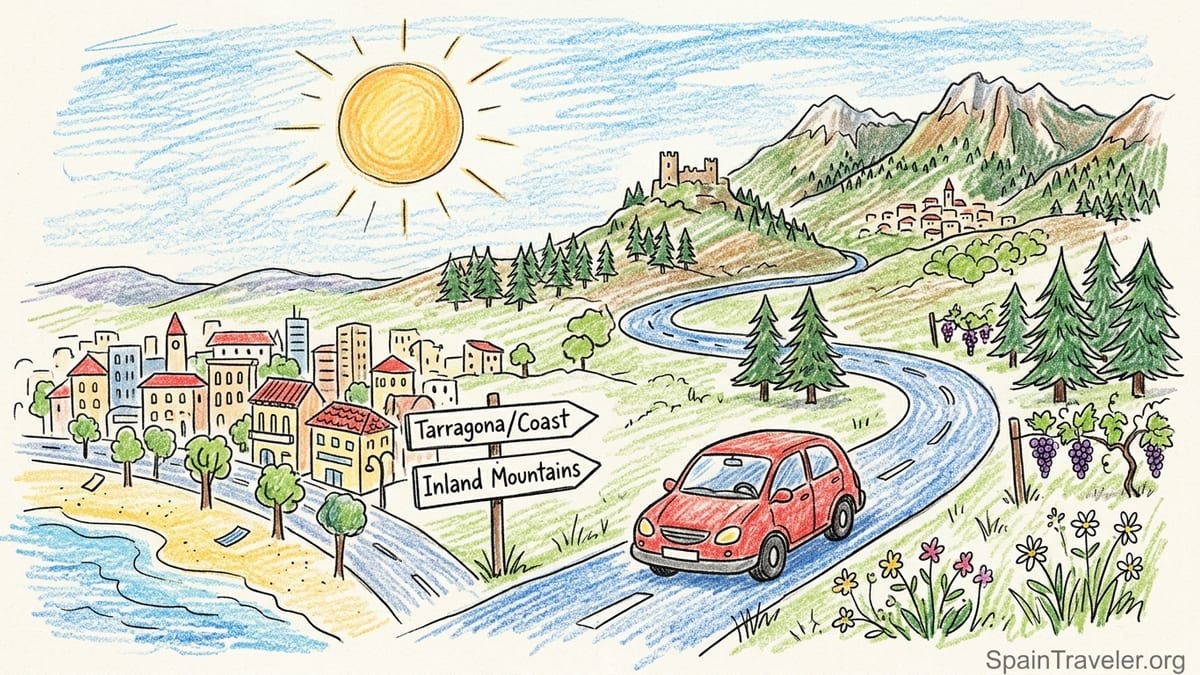
I picked up my rental car for the Costa Dorada road trip thinking mostly about freedom: the chance to hop between Tarragona, Salou, Cambrils and the inland mountains of Prades and Montsant on my own schedule. What I did not expect was how differently the car would feel in each part of the trip, from crawling through Salou’s resort traffic in August to gliding along empty vineyard roads above Cornudella de Montsant. This account is based only on roads I genuinely drove, with real journey times, parking headaches, costs and a few mistakes I would avoid next time.
Picking Up the Car and Planning the Route
I arrived in Tarragona by train and collected the car from a mainstream rental desk inside the compact Estació de Tarragona. I had prebooked an economy category, similar to a Toyota Yaris or Renault Clio, with a manual gearbox and air conditioning. For a four day summer rental in late August, the base rate was a little over 40 euros per day when booked a month ahead, plus around 25 euros per day for full collision damage waiver to reduce the excess to near zero. By the time local fees were added, the total came to just under 300 euros for the full period. The pickup process was straightforward but slow, about 30 minutes from joining the queue to driving away, largely because several travelers in front of me were debating insurance.
Before leaving the station car park, I spent a few minutes pinning actual stops in the navigation app rather than relying on broad place names. My planned loop started with a short hop to a hotel near the Tarragona seafront, then moved along the coast toward Salou and Cambrils on a mix of the A-7 and N-340 regional roads. From there I wanted to turn inland, climbing toward the Prades mountains and the Montsant wine region via the C-14 and smaller local roads such as the C-242 and T-702, before looping back to Tarragona on the same day. The idea looked elegant on a map: one base on the coast, one day dedicated to the mountains, and another left flexible for beach time or Roman ruins.
In practice, that loop turned into a good example of how route planners can underestimate coastal congestion and overestimate how much you can comfortably fit into a single day once you factor in heat, parking and narrow village streets. I kept notes on the real driving times between each stage, together with where the car was a genuine asset and where it essentially sat idle while trains and buses could have done the same job.
Driving and Parking in Tarragona: City Streets and Seafront
My first driving lesson came within ten minutes of leaving the rental garage. The hotel I had booked in Tarragona, near the Rambla Nova, did not include parking, and I assumed I would simply find a space on a side street. On a hot August afternoon around 4 pm, that assumption added a full 35 minutes of circling to an otherwise simple ten minute drive from the station. Street parking near the amphitheatre and the upper Old Town was already full, and the blue-zone spaces that did appear were limited to short stays, which was not ideal for a one night stop.
Eventually I gave up and headed to an underground municipal car park under the Rambla, where 24 hours cost a little under 20 euros. The route down involved tight ramps and columns that made me appreciate the small size of the car, but it was stress free once parked. Looking back, the mistake was booking characterful but parking-poor central accommodation when a hotel with its own underground garage just a few blocks further from the Roman remains would have saved both time and daily parking fees, even at an extra 15 to 18 euros per night.
Navigating Tarragona’s central streets is not technically difficult, but there are a few one way segments that make last minute lane changes a bad idea. The seafront roads and the axis between the station and the Rambla can feel busy around commuter times, with local traffic competing with visitors on their way to and from PortAventura and the nearby beaches. Journey planners suggested ten minutes between the station and my hotel, and that estimate was correct for pure driving time, but door to door the transfer took close to an hour including the parking hunt. Already, the car felt much less efficient than simply walking from station to hotel and using the city’s compact size to my advantage.
Along the Coast: Tarragona to Salou and Cambrils
The next morning I checked out and drove toward Salou mid morning, aiming to avoid the worst of the commuter flow. The distance between Tarragona and Salou is only around 12 to 15 kilometres depending on the route, and navigation apps typically suggest 15 to 20 minutes via the A-7 or C-31B. On a late August weekday at 10 am, my actual time from central Tarragona to the hotel zone in Salou was 35 minutes. Traffic flowed well on the dual carriageway portion of the A-7, but slowed sharply on approach to Salou’s roundabouts where resort traffic, delivery vans and buses meet.
Here I made my second key mistake of the trip: I allowed the navigation app to guide me directly into the dense resort centre near the main promenade, looking for a quick coffee before checking into a coastal apartment. That decision turned what should have been a relaxed arrival into 25 minutes of crawling behind coaches, dodging pedestrians stepping out from between parked cars and negotiating hotel drop off zones that feel more like airport forecourts than streets. Even outside of local rush hours, Salou’s core is not a pleasant place to drive in high summer. I eventually bailed out, heading back toward the perimeter and leaving the car in a paid surface car park several blocks behind the seafront for about 12 euros for the day.
Later that day I continued to Cambrils, a short hop further south. Journey planners suggested around 15 minutes along the coast road, and this time they were accurate. The link between Salou and Cambrils is well signposted and generally calmer than Salou’s centre once you move away from the densest hotel clusters. However, parking again defined the experience. The old fishing port area of Cambrils is lined with restaurants and a pleasant promenade, and as a result the waterfront parking fills extremely quickly. Arriving around 7 pm for dinner, I needed 20 minutes to find a legal spot that was not in a loading bay or residents’ zone, and ultimately parked several streets back in a mixed residential area, which felt safe but added a ten minute walk each way.
The pattern was already clear: along this stretch of Costa Dorada, the car helps you move between towns on your own timetable, but becomes a liability once you commit to driving right into the seafront cores of Salou or Cambrils. Trains and regional buses shuttle frequently along this axis in summer, and for a simple Tarragona to Salou to Cambrils day, public transport would have been both cheaper and considerably less stressful than worrying about parking and one way streets.
Turning Inland: Prades, Montsant and Vineyard Roads
The inland day was where the rental car finally earned its place. Leaving Salou just after 9 am, I joined the C-14 inland beyond Reus, then branched toward the Prades mountains on local roads that quickly became narrower and more sinuous. Map apps suggested around one hour from Salou to Prades village. With a brief service station stop for fuel and coffee near Les Borges del Camp, the real time was closer to 1 hour 20 minutes, still very manageable. Traffic fell away dramatically once I passed the last suburbs, and within 30 minutes of leaving the coast I was sharing the road mostly with local delivery vans and cyclists.
The climb toward Prades brought the first proper driving enjoyment of the trip. Here, the smaller size of the car became a clear advantage on bends and when pulling into narrow lay-bys for viewpoints. Speeds are moderate, with many stretches signed between 50 and 70 km/h, and occasional tighter curves that invite second gear. The road surface was generally in good condition, but you need to be comfortable with blind bends and the possibility of meeting an agricultural tractor just around the corner. Unlike the coastal axis, there were long moments when I did not see another vehicle ahead or behind, which made the landscape feel spacious and the pace more relaxed.
From Prades, I continued toward the Montsant area, driving through Cornudella de Montsant and down to the reservoir. The navigation suggested 25 minutes for this leg, and even with photo stops it took roughly 40. Here the car opened up opportunities that would have been cumbersome by public transport. Vineyards and viewpoints sit several kilometres apart, at elevations and trailheads that buses do not serve frequently, if at all. Being able to pull off at a cooperative winery on the roadside or detour to a shaded picnic area by the water was precisely the kind of flexibility I had hoped for when booking the car.
However, the inland day also highlighted the risk of trying to pack too much into a single circuit. I had ambitiously planned to continue from Montsant toward another historic town before looping all the way back to Cambrils by evening. While feasible in pure driving time, that plan would have meant three to four additional hours behind the wheel on top of what I had already done, much of it on winding local roads. Standing in the heat around midday near Cornudella, it became evident that slowing down, visiting one winery and a single village in depth, and returning to the coast in the late afternoon would be far more enjoyable than racing from stop to stop. I scrapped the furthest waypoint and turned back toward the C-14 by mid afternoon, reaching the coast just after 5 pm, around an hour later than the navigation estimate due to relaxed photo breaks but without any sense of hurry.
Summer Traffic, Tolls and Fuel on the Costa Dorada
One consistent factor across the whole trip was the weight of summer traffic on the main access routes. The AP-7, which runs inland as a high capacity corridor along much of the Mediterranean, has been toll free on this stretch since the concession ended, and that change, combined with restrictions on heavy vehicles on parts of the N-340, has pushed more cars and trucks onto the motorway. On peak summer weekends, local media regularly report long queues and a rising accident rate on the AP-7 in the Tarragona province, especially during return flows toward Barcelona. For this trip, that context shaped my decision to rely more on the A-7 and regional roads and to time movements to avoid late afternoon on Sundays when locals head home from the coast.
During my own drives, I did not encounter any toll booths on the routes I used. The older habit of budgeting for tolls into or out of the Costa Dorada is less relevant now, but the flip side is that you should allow more margin for potential slowdowns on the former toll motorway. For short hops such as Tarragona to Salou or Cambrils, the risk is mainly around bottlenecks at resort exits. For longer excursions, such as heading south to the Ebro delta or north toward Barcelona, checking live traffic before committing to the AP-7 is prudent, especially in July and August afternoons.
Fuel costs were a more predictable part of the budget. Filling the small petrol tank from roughly one quarter to full near Les Borges del Camp cost just under 50 euros at a standard roadside station, enough to cover the whole inland loop and subsequent return to Tarragona with some margin. Prices at service stations along the A-7 and C-14 were slightly higher than in larger supermarket forecourts on the outskirts of Tarragona and Reus, but the difference on a single fill was modest. What mattered more was planning refuelling outside the most touristed resort cores, where the narrow access and congestion make even simple stops feel like a chore.
In hindsight, the drive itself rarely felt slow on open road segments. Instead, the time lost was concentrated in three kinds of pinch points: entering and exiting resort towns at peak times, hunting for parking near beaches or old quarters, and negotiating narrow, one way residential streets in places like Tarragona when chasing an on street parking spot that might not even be available. Factoring an extra 20 to 30 minutes for these friction points on coastal days made expectations more realistic.
When the Car Helped and When Trains or Buses Would Have Been Easier
Looking back across the trip, the value of the rental car was very uneven from day to day. For the inland excursion to Prades and Montsant, having a car was a clear win. Public transport does serve some of the mountain villages, but frequencies can be limited, and connecting buses from the coast take time to wind up and down the hills. Reaching a specific winery, trailhead or reservoir viewpoint in a single day from Salou or Cambrils would have been difficult without a vehicle, and taxis for such routes, while possible, would quickly exceed the daily cost of the rental, especially when waiting time is included.
On the other hand, the car felt almost redundant for certain coastal days. Moving between Tarragona, Salou and Cambrils, the combination of regional trains and frequent buses provides a solid backbone, particularly in high season. Central stations and bus stops are close to the beach areas, and you step off without needing to think about parking restrictions or controlled access streets. On the day when I stayed entirely within Tarragona’s historic centre, the car did nothing at all; it sat in a paid garage for more than 24 hours while I walked to every site. The same would have been true on any full beach day in Salou, where once you are within walking distance of the sand and shops, a vehicle only adds the need to remember where you left it.
That experience made me reconsider the initial decision to keep the car for the entirety of the stay. A more efficient approach would have been to structure the rental as a shorter block focused on inland exploration, perhaps two consecutive days, and rely on rail or bus on the purely coastal days. Many visitors arrive via the high speed rail station at Camp de Tarragona with connecting buses to Salou and Cambrils, and staying a first night in Tarragona without a car would have been perfectly practical. Collecting the rental on the morning of the inland day, then returning it that evening or the next morning, would have significantly reduced costs and parking hassles without sacrificing mobility where it mattered.
Another lesson involved accommodation choice. Properties that include secure parking, whether underground or in a dedicated outdoor lot, change the equation. In Cambrils, I spent one night in an apartment with no parking and another in a hotel set slightly back from the seafront that offered a private lot. The difference in daily routine was obvious. With parking, arriving late from the inland loop was simple: turn in, park, and walk five minutes to the promenade. Without it, the same arrival would likely have required another 20 minutes of circling and the risk of leaving the car in a spot that might feel less secure overnight.
Mistakes, Narrow Streets and Beach Parking Lessons
Some of the most valuable insights from this Costa Dorada road trip came from straightforward mistakes. The first was underestimating how narrow and convoluted some residential streets become as you approach historic cores. In both Tarragona and parts of Cambrils, I followed navigation instructions that led into one way alleys barely wide enough for two small cars to pass. While locals handled these with ease, as a visitor in an unfamiliar vehicle, each tight squeeze between balcony posts and parked scooters added a layer of stress. The lesson was to zoom out on the map and choose routes that skirted around old quarters to reach known parking garages or lots rather than insisting on being delivered to the exact front door of accommodation.
Beach parking was another recurring challenge. In Salou, the desire to be as close as possible to the main sandy arc between the promenade and the water meant many drivers, myself included, drifted slowly along the front, hoping a space would open. In reality, by mid morning almost every unrestricted slot near the sand was taken, and cars were already circling. After one frustrating loop, I started aiming directly for streets two or three blocks back, accepting a slightly longer walk in exchange for a quicker, calmer parking process. In Cambrils, the best strategy turned out to be arriving early or later in the evening and using a mix of regulated parking zones and small lots behind the first line of buildings, which often had spaces when the waterfront lanes did not.
Overambitious daily planning was my final, predictable error. Because distances between key Costa Dorada locations look small on a map, it is tempting to stack the itinerary with multiple towns plus an inland excursion crammed into a single day. On one day I initially tried to schedule a morning walk in Tarragona, a midday swim near Salou, an afternoon drive up toward Montsant and an evening dinner in Cambrils. While technically possible in a car, that sort of overloading leaves little time to linger anywhere. Once I slowed down and accepted that a realistic day might consist of just Tarragona and one coastal town, or a single inland area plus a simple dinner back at base, the trip felt far richer and the driving more relaxed.
Revised Road Trip Structure Based on the Real Journey
If I were to repeat this Costa Dorada road trip, I would build the structure around what the car actually did well rather than a theoretical perfect loop. The starting point would still be Tarragona, arrived at by train. I would spend the first day and night entirely car free, checking into central accommodation within walking distance of the Old Town and amphitheatre, and exploring the Roman sites on foot. Public parking would not enter the picture until departure day, and there would be no temptation to drive short inner city distances.
On the morning of day two, I would collect a small rental car from near the station and head straight inland, bypassing Salou completely at first. The goal would be a focused day in the Prades and Montsant area: drive up via the C-14, stop in a single village for coffee and a short walk, continue to one or two viewpoints or vineyards, and then return to the coast by late afternoon. Overnight, I would base myself in a coastal town with its own parking, perhaps a hotel in Cambrils with an on site lot or a property on the quieter edges of Salou that explicitly guarantees a space.
Day three could then be dedicated to enjoying the coast without changing bases. With the car safely parked in the hotel’s own facility, I would either leave it there for the day and move along the promenade on foot, or use it only for a short, off peak drive to a nearby cove where parking is manageable. If I wanted to visit Tarragona again or pop into Salou’s centre, I would seriously consider leaving the car behind and using the regional train or bus for those specific hops, avoiding another spin through resort roundabouts and tight urban junctions.
Finally, on departure day, I would aim to return the car as early as practical, ideally in Tarragona or at a nearby rail hub, before continuing the journey by train. This approach would cut the rental length to perhaps two days instead of four, reduce the share of time the car spends idle in garages, and align the use of private transport with the segments where public options are weakest. It would also reduce exposure to the heaviest AP-7 or A-7 traffic flows in late afternoon on summer Sundays, since the longest inland segments would take place midweek and earlier in the day.
The Takeaway
Driving the Costa Dorada taught me that a car is both freedom and friction, depending on where you aim it. In Tarragona, Salou and Cambrils, the main challenges were not the roads themselves but the density of summer traffic, the scarcity of easy beach parking and the temptation to nudge too close to congested resort hearts instead of stopping on the fringe and walking in. Meanwhile, the roads that climb inland toward Prades and Montsant delivered exactly what road trip dreams are made of: open views, light traffic, curve after curve and the ability to reach quiet spots where buses rarely go.
Real world journey times rarely matched the most optimistic digital estimates once I factored in heat, photo stops, refuelling and parking hunts, but they felt reasonable when the day was not overloaded with ambitions. Petrol costs were straightforward, tolls were effectively a nonissue on the routes I chose, and the main hidden cost turned out to be parking fees in central Tarragona and the coastal resorts. Perhaps the most important lesson was psychological: it is entirely acceptable, even wise, to let the car sit unused for entire days on the coast, or to skip it altogether on the first and last days, if that makes the overall trip smoother.
Used thoughtfully, focusing its miles on inland vineyards and mountain curves rather than resort roundabouts, a rental car can genuinely open up the Costa Dorada beyond the standard brochures. Used uncritically, it risks becoming an expensive accessory that spends as much time trapped in underground garages and summer queues as it does on the open road. Structuring the trip around those realities, rather than around an idealised loop, is what will ultimately make the difference between a frustrating coastal crawl and a memorable journey from sea to hills and back again.
FAQ
Q1. Is it worth renting a car for a Costa Dorada trip focused on Tarragona, Salou and Cambrils?
For a trip limited to the main coastal towns, public transport usually works better. Trains and buses link Tarragona, Salou and Cambrils frequently in summer, and you avoid parking hassles and resort traffic. A car starts to add clear value once you plan to visit inland areas like Prades, Montsant or remote beaches with limited bus service.
Q2. How different is the driving experience on the coast compared with inland roads?
On the coast, expect heavy summer traffic, frequent roundabouts and crowded resort centres with scarce parking, especially in Salou. Inland, traffic thins out dramatically and roads become curvier, with more elevation changes and better views. The inland driving feels calmer and more enjoyable, provided you are comfortable with bends and occasional narrow sections through villages.
Q3. How accurate are online journey time estimates for Costa Dorada routes?
On open inland roads, estimates are often close to reality, especially outside peak hours. Between resort towns in summer, you should add at least 15 to 30 minutes for congestion and parking. For example, a 20 minute estimate between Tarragona and Salou can easily become 40 minutes once you include queueing at roundabouts and finding a legal space near the beach or hotel.
Q4. Do I still have to pay tolls driving around the Costa Dorada?
On the routes described here, there were no tolls. The main AP-7 motorway section near Tarragona no longer charges fees, and regional roads such as the A-7, C-14 and inland connectors are toll free. Even so, it is wise to check your exact route when planning, since older guidebooks may still mention former toll sections that have since changed.
Q5. How difficult is parking in Tarragona, Salou and Cambrils in summer?
Parking can be challenging and time consuming in peak season. In central Tarragona, on street spaces near the Old Town fill quickly, and you may end up using underground car parks with daily charges. In Salou and Cambrils, seafront spaces are usually taken by mid morning and again around dinner time, so be prepared to park a few blocks back or pay for managed lots.
Q6. Is an economy car sufficient for inland roads to Prades and Montsant?
An economy car is usually ideal. The roads are paved and in generally good condition, but villages and mountain sections include tight bends and narrow streets where a small footprint helps. A compact car with decent low gear pull and air conditioning is more important than power or size. There is no need for four wheel drive on the standard routes described.
Q7. How much did fuel and parking add to the overall cost?
For a four day trip with one major inland loop, a single full tank of petrol at just under 50 euros was enough, with some margin. Parking costs varied by town but added roughly 15 to 20 euros per night in central Tarragona and around 10 to 15 euros per day in Salou and Cambrils when using paid lots or garages. Over several days, parking can approach or exceed the fuel spend.
Q8. Can I comfortably visit both the inland mountains and several coastal towns in one day?
It is technically possible, but not very enjoyable. Trying to combine Tarragona, Salou, Cambrils and an inland area like Prades or Montsant in a single day leads to rushed visits and a lot of time behind the wheel. A better plan is to dedicate a full day to the inland loop and separate days to exploring one or two coastal towns at a relaxed pace.
Q9. Are there specific times of day to avoid driving on the Costa Dorada in summer?
Yes. Late afternoon and early evening on Sundays in high season see heavy return traffic toward Barcelona on the AP-7 and coastal roads. Midday can also feel slow around resort centres when beachgoers arrive or leave. Starting inland drives early in the morning and scheduling coastal moves outside peak arrival and dinner hours makes a noticeable difference.
Q10. If I only have budget for two rental days, which parts of the trip should I prioritise by car?
Prioritise the inland areas that are hardest to reach without a car. Use one or two days to explore Prades, Montsant and nearby villages, starting from a coastal base. For purely coastal movement between Tarragona, Salou and Cambrils, rely on trains, buses and walking, which are cheaper and avoid the worst parking and congestion issues.