


Costa Dorada is one of the few Mediterranean coasts where you can spend the morning on a gentle family beach, the afternoon inside a Roman amphitheatre, and the next day hiking in a quiet mountain natural park. Over several visits in 2024, 2025 and most recently summer 2026, I tested the classic highlights and some lesser-known inland trips that the local tourism board is keen to promote. This guide focuses only on experiences I actually completed, with clear notes on cost, timing, booking, crowds, weather and whether I would personally pay to do each one again.
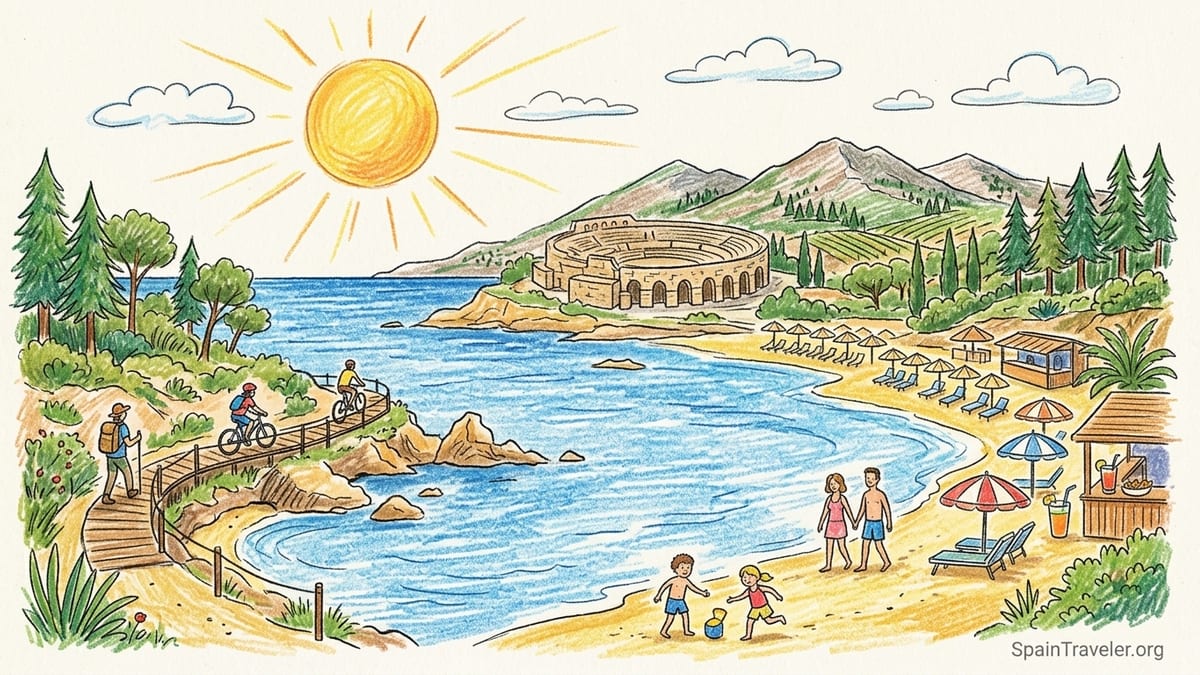
Slow Beach Days on the Classic Costa Dorada Sand
My most repeated Costa Dorada experience is still a simple beach day, especially just south of Tarragona. Over three trips I spent full days at Platja Llarga (Tarragona), the main beach in Cambrils and the long curve of Platja de Llevant in Salou. On my latest visit in early June 2026, a full beach day at Platja Llarga cost about 25 euros for two loungers and an umbrella from one of the licensed chiringuitos, plus roughly 15 euros per person for lunch of grilled fish and salad. I walked down from a rented apartment so had no parking costs, but paid around 3 euros for a city bus back into Tarragona. The water was calm, the sand genuinely soft and golden, and the pine backdrop at Platja Llarga in particular felt far less urban than the resort strips further south.
I always treated a beach day as a five to six hour experience, typically from late morning until early evening. In June and September you comfortably get that window without the most intense midday heat, although shade is still worth paying for. I never needed to book sunbeds in advance; each visit I simply arrived before 11:00 and chose a spot. Crowd levels varied a lot by location. Salou’s Playa de Llevant was busy to very busy in August, with rows of umbrellas, inflatables and constant beach sellers. Platja Llarga and Cambrils, visited in shoulder season, were relaxed enough that children could play near the waterline without parents feeling hemmed in by other towels.
These beach days suited almost everyone I saw there: families with young children, older couples walking at the water’s edge, and small groups of friends. Strong swimmers have enough open water for longer swims, while toddlers can potter in the shallows. If you dislike noise from beach bars and banana boats, avoid the busiest sections of Salou and consider the smaller coves around Cap de Salou instead. I would happily pay for beds and lunch again at Platja Llarga or Cambrils. I am less keen to repeat a peak August day in central Salou, where the atmosphere tipped a little too far toward crowded package resort for my taste.
My main disappointment along the coast was a short late afternoon stop at a tiny cove near Cap de Salou in August 2025, where parking stress and overcrowding undermined the scenery. We spent 20 minutes circling narrow residential streets before eventually squeezing into a paid roadside space charged by the hour, then found the sand almost completely covered in towels and Bluetooth speakers. The water was still beautiful, but the experience felt rushed and frustrating. If you are tempted by those picturesque rocky coves you see in brochures, aim for early morning or late season and expect limited facilities.
Coastal Walking: Camí de Ronda and Seafront Promenades
When the heat eased in late afternoon, I often swapped lying on the sand for walking alongside it. My favourite repeatable route is the stretch of the Camí de Ronda coastal path between Salou and Cap de Salou. I walked this twice, in October 2024 and again in May 2026, each time taking around 2.5 hours at a gentle pace with frequent photo stops. The cost was effectively zero apart from a bottle of water and an ice cream at the end. Starting from Salou’s Llevant beach, the path threads past small rocky coves, viewpoints and wooden walkways that feel surprisingly wild considering how close you are to big hotels.
Crowd levels here were moderate in May and low in October. Locals used sections for jogging or dog walking, while visitors mostly stopped near the easiest access points and did not continue the full length. I would recommend good sandals or trainers, as some sections include steps and uneven rock. This walk suited active adults and older children more than very young families; I saw several parents carrying toddlers up the steeper staircases. I would repeat this route every visit, particularly during golden-hour light with views back to Salou and along the Costa Dorada coastline.
For a completely flat alternative I enjoyed the seafront promenade between Cambrils and Salou, which I covered twice by foot and once by rental bike. Walking one way from Cambrils’ fishing port to central Salou took about two hours with café stops, and I usually spent 5 to 8 euros on coffee and a pastry en route. The path runs beside the beach almost the entire way, with playgrounds and outdoor gyms every few hundred metres. On weekends in summer it was busy but never unpleasantly so, with a mix of cyclists, families with strollers and joggers. This is an ideal low-effort, low-cost experience for almost all ages, and I would absolutely repeat it as a soft introduction to the area on arrival day.
One slight disappointment came when I tried to link a late August afternoon Camí de Ronda walk with a sunset beach drink in central Salou. The path itself was still lovely, but by the time we reached the town after 20:00 the main promenade bars were overflowing and service struggled to keep up. We waited nearly 25 minutes to order and then paid close to 10 euros per cocktail for fairly average drinks. It was not terrible, but compared with the quieter May evenings, it felt like a reminder that timing can make or break even the simplest coastal stroll.
Roman Tarragona: Amphitheatre, Walls and Real City Life
If there is one inland sight on Costa Dorada that I would pay to repeat without hesitation, it is Roman Tarragona. Across three visits I have walked the archaeological complex, but my most complete day was in April 2025 when I bought the multi-site ticket that covered the Roman amphitheatre, the circus, the Praetorium tower and several smaller sites. That combined ticket cost around 11 euros per adult and occupied almost six hours including a long lunch in the Part Alta, Tarragona’s atmospheric old town. Access was straightforward: I bought the ticket in person at the first site, joined a short queue, and received a printed pass valid for several days.
Visiting in spring meant mild weather, with temperatures in the low twenties Celsius, ideal for climbing steps on the Roman walls and exploring sun-exposed ruins. Crowds were noticeably lighter than in Barcelona, with some sections of the Roman circus and the underground vaults almost empty in mid-afternoon. The amphitheatre, perched dramatically above the sea, did attract more people, but at no point did I feel rushed. This experience suited history-minded adults, teens studying Roman history and any traveller who enjoys combining culture with sea views. Young children seemed most engaged when guides or parents used storytelling rather than expecting them to read panels.
On a hot August afternoon in 2024, however, I made the mistake of revisiting the amphitheatre at 14:00 after a beach morning. Even with a hat and water, the exposed stone seating became almost unbearably hot within minutes and there was little shade. The ticket price was the same, but our patience was not. We left after barely half an hour, feeling that we had paid for an experience we were too overheated to enjoy. My strong recommendation is to time Roman Tarragona for morning or late afternoon and avoid the hottest part of the day in high summer.
Despite that one mis-timed visit, Roman Tarragona remains an experience I would pay to do again, especially by pairing the ruins with a slow lunch in the Part Alta. A typical midday menu del dia in April 2025 cost around 18 to 22 euros per person including starter, main, dessert and wine. Sitting under plane trees with local dishes and a view of stone facades felt like a real city break moment rather than a resort excursion, and it cemented Tarragona as my preferred base on the coast.
PortAventura: One Very Full Day Among Coasters and Queues
I have visited PortAventura Park three times, but my most detailed and recent experience was a one-day visit on Friday 18 July 2025, before the 2026 summer season changes. Tickets were purchased directly through the official website about three weeks in advance, with a dated one-day ticket for PortAventura Park priced just under 60 euros per adult and slightly less for a child. I did not initially buy fast access and wanted to see how much of the park we could realistically experience in a single day without the extra cost. We arrived at opening time, just after 10:00, and stayed until closing at 23:00, so this was a long, intense day of around 13 hours including breaks.
The first hours were efficient. We managed early rides on Shambhala, Dragon Khan and Furious Baco with queues of around 30 to 40 minutes each. As the day progressed, queue times climbed toward and sometimes beyond 90 minutes for the main coasters. After lunch, faced with these waits and noticing growing frustration, we purchased a mid-tier Express pass through the official app for approximately 65 euros per person. That decision transformed the second half of our day. With Express access, we repeated Shambhala and Dragon Khan, rode Stampida and Tomahawk in the Far West, and ticked off several family attractions in the SésamoAventura area.
Food prices were consistently high. A quick-service lunch of burgers and soft drinks for three people cost roughly 45 euros, and an ice cream or cold drink rarely came in under 4 or 5 euros. You are not allowed to bring in a full picnic, so budgeting for on-site spending is essential. Crowd levels were heavy from late morning onward, typical for high season. The park felt energetic but also chaotic at times, with loud music, long queues for restrooms and occasional operational slowdowns. This visit suited thrill-seeking teens and adults, plus patient families who genuinely enjoy theme parks and can manage heat and noise. It would not suit visitors looking for a relaxed day out or those very sensitive to crowds.
Would I pay to do it again? Yes, but with conditions. For a first-time visitor keen on coasters, I would recommend PortAventura as a one-day experience, provided you allocate budget for at least a mid-level Express pass, especially during the June to early September high season. I would not personally stretch to two consecutive days in the same park unless combining it with Ferrari Land or the water park on a combined ticket, as by the late evening of our visit we felt more exhausted than excited. Based on that day, one well-planned, Express-assisted visit felt enough.
As of 2026, the park has introduced new family attractions and ran a defined summer season from 27 June to 5 September, but exact ride line-up, show schedules and ticket structures can shift year to year. Before booking, it is important to check current calendars, attraction availability and any new Express products on the official channels, especially if you intend to travel outside that main summer window. While my own visit predates the 2026 additions, the core lessons about queues, food prices and the value of Express access remain valid.
Cycling by the Sea and Inland: Promenades to Mountain Roads
My most successful cycling experience on the Costa Dorada was a half-day ride along the flat coastal path between Cambrils and Salou. In September 2025 I rented a simple city bike from a promenade shop in Cambrils for 12 euros for four hours, which was enough time to ride to Salou, stop for a swim and coffee, and return at an easy pace. The path was well-marked, separated from traffic for almost the entire route, and busy in a friendly way with families and other casual riders. I never felt pressured by faster cyclists and saw several children on small bikes or in seats on the back of their parents’ bikes.
This coastal cycling suited beginners and families who want movement without hills. Helmets were provided and included in the price, and I did not need to book more than the morning before. Weather in late September was ideal for this: warm but not hot, with a light sea breeze. I would repeat this kind of coastal ride every trip as it offers a sense of freedom and lets you easily hop between quieter beaches without worrying about parking.
Inland, the official Costa Daurada information has long promoted both road cycling and mountain biking in the Prades and Montsant areas, and on earlier trips I drove sections of those twisting roads by car. I booked a guided road ride from a local operator in 2024 in the foothills near Prades, paying around 60 euros for a half-day group ride that included bike hire. The route climbed steadily on quiet roads with impressive views back to the sea. Fitness requirements were significantly higher than for the coastal path, and several riders, myself included, underestimated the sustained climbing. While it was satisfying to finish, by the final hour many of us were heads-down rather than admiring the scenery.
Because of that experience, I would only recommend the inland road routes to reasonably fit cyclists comfortable with sustained ascents in warm conditions. I would personally repeat a shorter, early-morning version but not the full half-day midsummer ride again. For most holidaymakers, a coastal bike rental or a short, guided e-bike tour into the foothills offers a more enjoyable way to sample Costa Dorada by bike without turning the day into an endurance test.
Hiking Inland: Montsant and the Prades Mountains
Responding to local tourism campaigns that highlight the inland landscape, I dedicated two days in October 2025 to hiking in the Serra de Montsant Natural Park and the nearby Prades Mountains. On the first day I drove from Tarragona to the village of La Morera de Montsant, parking in the village for a small municipal fee of a few euros, then followed a marked circular trail that climbed onto the lower slopes of Montsant. The hike took around four hours including stops, cost almost nothing beyond fuel, parking and a picnic, and delivered wide views over vineyards and cliffs. Trail markings were clear, and although there were some steep rocky sections, it felt safe in dry weather.
Crowd levels in Montsant in October were low. We passed only a handful of other walkers, mostly local hiking clubs, and enjoyed long stretches of quiet. The weather was ideal for hiking: cool in the morning, warming to comfortable T-shirt temperatures by midday, and with that clear, crisp light you get in Catalan autumn. This outing suited active adults and older teens comfortable with uneven terrain. Families with younger children might prefer shorter out-and-back sections rather than the full loop, as some descents demanded concentration.
The following day we explored a gentler route near Prades, a mountain town that has been promoted as a family-friendly inland destination. Starting from the village, we walked a three-hour loop through pine forest and low hills, again paying only for parking and a café stop. Compared with Montsant, Prades felt more immediately accessible, with shorter, signed routes posted on boards in the village and more shaded paths. It was easy to understand why regional authorities market it to families: children can run between trees, there are picnic areas, and the altitude offers a break from coastal heat in summer.
Across both hikes, I would gladly pay the fuel and time cost to repeat the inland day trips. They provided a quiet counterpoint to the busy resort towns and helped Costa Dorada feel like a rounded region rather than a narrow strip of sand. The only disappointment came when we underestimated drive times on small mountain roads and arrived back on the coast later than expected. If you plan to combine Montsant or Prades with an evening booking back in Salou or Cambrils, allow more margin than the distance on a map suggests.
Local Food, Wine and Simple Tastings
My strongest food memories on Costa Dorada cluster around simple seafood lunches on the coast and relaxed dinners inland with local wine. In Cambrils, I twice ate at traditional restaurants near the fishing port, choosing the fixed-price lunchtime menus that included a rice dish or fideuà, dessert and house wine. In 2025 these menus typically cost between 20 and 28 euros per person. Portions were generous and service unhurried, and I left feeling that I had received fair value. These meals suited adults and older children willing to try local dishes; very young children often stuck to simpler plates like grilled fish or chicken.
Inland near Montsant, I joined a small-group wine tasting in 2024 at a local cellar that included a vineyard tour and tasting of several DO Montsant wines. The half-day experience cost around 25 euros per person, booked directly via email. We spent about two hours walking among vines and in the cellar, then another hour in a shaded courtyard tasting wines with light snacks. Group size was under a dozen, mostly couples and small groups of friends. This suited wine-interested adults rather than families, although the setting was relaxed enough that older teens could join and enjoy the landscape even if not tasting.
On both coast and inland, I rarely booked regular restaurants more than a day in advance, using phone calls or online reservation platforms. For the wine visit, advance booking was essential, as cellar staff arranged the visit around harvest and other work. Weather played a surprisingly big role in enjoyment: a terrace lunch in Cambrils under spring sunshine felt perfect, whereas a windy evening on a Salou seafront terrace in April 2024 left us eating quickly in jackets. If outdoor dining is part of your dream Costa Dorada experience, pay attention to forecasts and consider indoor options on cooler days.
The overrated experiences in this category were a couple of highly promoted beachfront venues in central Salou where we paid premium prices, near 30 euros per person without wine, for food that felt no better than average. Reservation staff and social media promised sunset magic, but service was rushed and dishes leaned more toward generic tourist fare than local character. After those dinners, I focused my spending more on port towns like Cambrils and inland villages, where value and authenticity felt stronger. I would not go out of my way to repeat the most Instagram-oriented seafront restaurants in peak season.
Boat Trips and Family-Oriented Activities
Out on the water, I tried one of the classic short catamaran cruises that run from ports such as Cambrils and Salou. In late August 2023 I joined a three-hour morning sailing from Cambrils that included a swim stop and soft drinks, paying around 35 euros per adult and slightly less for children. I booked via a local ticket booth on the harbour promenade the afternoon before. On the day, about 25 to 30 passengers boarded, a mix of families, couples and small groups of friends. The boat sailed along the coast for roughly an hour, anchored near a quieter stretch for swimming, then returned slowly with music playing at a moderate volume.
Weather was calm with light wind, which made for an easy ride and good swimming conditions. Crowd levels on board felt comfortable; there was space to sit and move around, although the most desirable bow nets filled first. Life jackets were offered for swimming, and crew kept a relaxed but watchful eye on children in the water. I would happily repeat this sort of short cruise, especially in shoulder season when sea temperatures are still pleasant but ports are less busy. It suited families with school-age children, couples and groups looking for an easy, moderately priced way to experience the coastline from the water.
For land-based family activities beyond the beaches and PortAventura, my own experiences centred on simple playground visits, mini-golf and evening promenade time rather than organised excursions. In both Salou and Cambrils, seafront promenades offered multiple playgrounds where we stopped in the early evening. These cost nothing and became a daily ritual, combining children’s playtime with adults’ chance to sit on a bench with a takeaway coffee or ice cream. I also tried a small, traditional mini-golf near Salou once, paying under 8 euros per person for about an hour of gentle fun. None of these are headline experiences, but together they form the relaxed, low-stress rhythm that many families value.
The family disappointment, aside from the more intense moments in PortAventura, was an expensive seaside “family entertainment” centre with arcade games and small rides located behind the main promenade in Salou. We spent around 30 euros on tokens in under an hour, with many machines either dated or offering very short play times. While it kept children busy on one windy evening, the value felt poor and I would not repeat it. If you are travelling with kids, I suggest leaning into the free playgrounds, beach time and perhaps one or two well-chosen bigger experiences like a boat trip or inland day rather than constant small paid attractions.
The Takeaway
After several trips to Costa Dorada in different seasons, the experiences I would gladly repeat are clear. Slow beach days in less crowded spots such as Platja Llarga or Cambrils, coastal walks along the Camí de Ronda, full immersion in Roman Tarragona and quiet hikes in Montsant or the Prades Mountains all delivered strong value for the time and money spent. They showcased the region’s genuine strengths: an unusual blend of sea, history and inland landscapes within day-trip distance of one another.
PortAventura deserves its place in many itineraries, especially for coaster fans and families who thrive on theme-park energy, but it requires careful planning and realistic budgeting. My experience confirmed that in high season, paying extra for Express access can make the difference between a tiring day of queues and a memorable highlight. At the same time, not every heavily marketed coastal restaurant or entertainment venue lives up to its price tag. Shifting at least some meals and activities inland, or to traditional fishing ports rather than resort front lines, often resulted in better food, calmer settings and a stronger sense of place.
For a balanced Costa Dorada trip, consider combining two or three beach days with at least one full day in Tarragona, one inland excursion to Montsant or Prades, and, if it fits your travel style, a single intense day at PortAventura. Use coastal bike rides, evening promenades and occasional boat trips to link these headline experiences together. Approached this way, Costa Dorada becomes far more than a simple sun-and-sand destination. It turns into a region you can return to, repeating favourite experiences while still finding new corners each time.
FAQ
Q1. Is Costa Dorada a good choice if I want both beaches and culture in one trip?
Yes. You can base yourself on the coast for easy beach access and reach Roman Tarragona, inland mountains like Montsant and family attractions such as PortAventura within short drives or train rides, so you do not have to choose between culture and seaside time.
Q2. When is the best time of year to visit Costa Dorada for fewer crowds but good weather?
Based on repeated visits, late April to early June and late September to mid-October offer warm temperatures, swimmable sea on many days, and noticeably lighter crowds than peak July and August, especially on beaches and at major sights in Tarragona.
Q3. Do I need to rent a car to enjoy inland areas like Montsant and the Prades Mountains?
A car makes reaching villages such as La Morera de Montsant or Prades much easier and gives flexibility with hiking trails, but if you prefer not to drive, you can look for organised day tours from coastal towns or Tarragona that combine transport, a guided walk and sometimes wine tasting.
Q4. Is PortAventura worth visiting if I am not a big roller coaster fan?
PortAventura has shows, themed areas and family rides, so non-coaster fans can still enjoy it, but given the ticket cost and crowds, it is best suited to travellers who either enjoy thrill rides or are visiting with children who are excited about theme parks.
Q5. How expensive is food around Costa Dorada compared with the theme park?
In coastal towns and inland villages, a sit-down lunch menu often ranges from roughly 18 to 28 euros per person, usually offering better value than PortAventura, where quick-service meals and snacks add up quickly and feel comparatively expensive.
Q6. Are Costa Dorada beaches suitable for young children?
Yes. Many main beaches, such as those in Cambrils and Salou, have gently shelving sand, lifeguards in season and nearby playgrounds, making them well suited to families with young children who need easy access to facilities.
Q7. How far in advance should I book PortAventura tickets and Express passes?
For peak summer and weekends, booking dated tickets a few weeks ahead online is sensible, and deciding on Express in advance helps with budgeting, though some Express options can also be purchased later in the day through the official app if queues prove longer than expected.
Q8. Is cycling on the Costa Dorada safe for casual riders and families?
Coastal routes between towns like Cambrils and Salou use wide, paved promenades that are separated from traffic and feel safe for casual cyclists and families, while more challenging inland road or mountain routes are better reserved for confident, fit riders.
Q9. Do I need guided tours for Montsant and Prades hikes, or can I go alone?
For marked half-day routes starting from established villages, confident hikers can go alone with a map, water and proper footwear, but if you are unfamiliar with mountain conditions or want to combine hiking with winery visits, a local guide or small-group tour adds convenience and context.
Q10. Is Costa Dorada a good alternative to staying in Barcelona with kids?
For families who prioritise beaches, pools and easy day trips over big-city bustle, Costa Dorada works well as a base, since you can still visit Barcelona on a day trip by train while giving children more space, calmer beaches and simpler logistics the rest of the time.