


The Costa Dorada stretches for more than 80 kilometres south of Barcelona, a run of golden sand, low-rise resorts and inland hills that together create one of Spain’s most flexible holiday regions. Before you choose a hotel, the most important decision is where to base yourself. Picking the right town or area will shape everything from how easily you reach PortAventura World to whether your evenings are about seaside promenades, wine bars in historic streets or early nights in the countryside.
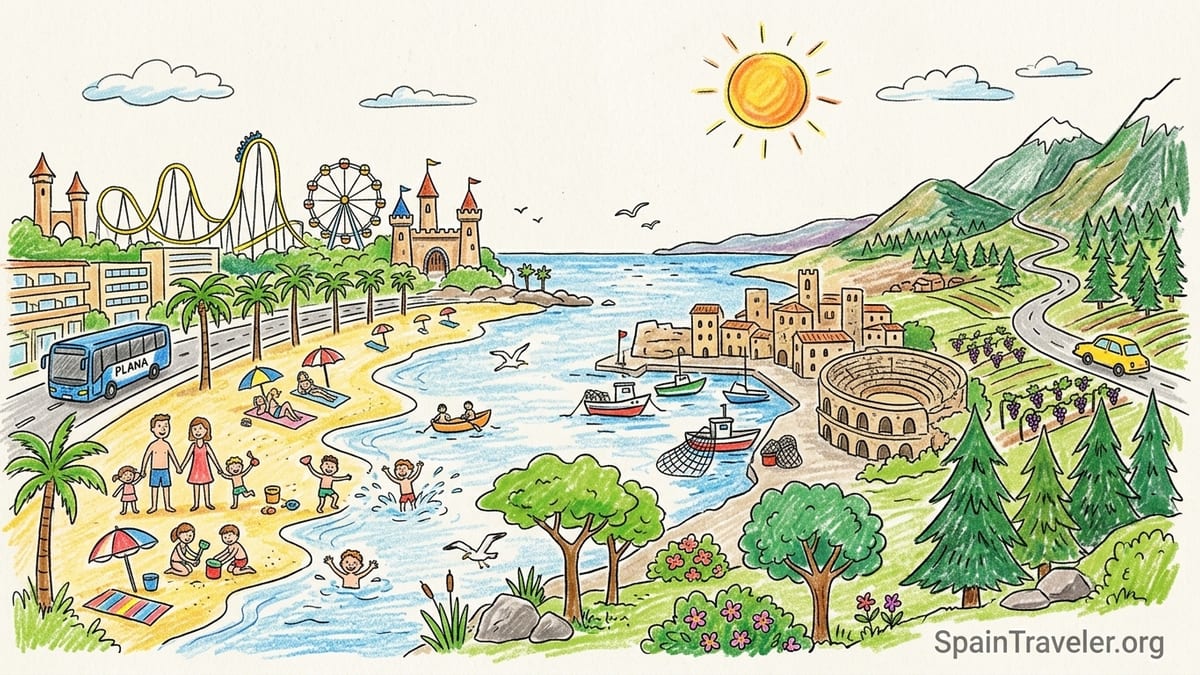
How to Think About Bases on the Costa Dorada
For trip planning, it helps to think of the Costa Dorada in a few clear categories rather than dozens of individual towns. Broadly, you have major resort hubs such as Salou, more food-focused coastal towns like Cambrils and Calafell, the small city base of Tarragona, family-oriented resorts like Vila-seca / La Pineda, quieter stretches of northern and southern coast, inland wine and nature bases in areas such as the Prades Mountains and Baix Penedès, and accommodation that orbits PortAventura World itself. Each offers a different mix of beach access, restaurants, nightlife, parking and public transport links.
Distances are relatively short. PortAventura World sits between Salou and Vila-seca, roughly 85 kilometres southwest of Barcelona and a short drive from Reus Airport. Salou, Cambrils and La Pineda form one continuous developed strip, while Tarragona lies just to the north, and Calafell and El Vendrell sit further up the coast near the Penedès wine region. Inland, the certified family tourism area of the Prades Mountains gives a completely different feel, with forests and traditional villages replacing beach bars. You can comfortably drive from one end of the core coastal strip to the other in under an hour, but where you sleep will still have a big impact on how simple your days feel.
The Catalan Tourist Board has officially certified several Costa Dorada destinations for family tourism, including Salou, Cambrils, Vila-seca / La Pineda, Calafell, El Vendrell and the Prades Mountains. This recognition focuses on kid-friendly beaches, playgrounds, stroller-friendly promenades and family services. That makes them strong starting points for many travellers, but they are not the only options. Couples, food lovers or visitors seeking quiet will often be happier in less obviously family-focused areas, even if that means driving a little farther to the theme parks.
When comparing bases, look not just at the beach in front of your accommodation but also at the wider ecosystem. Ask how many restaurants are within a five or ten minute walk, whether there is a promenade or old town to wander, if you can reach a train station or frequent bus stop on foot, and what parking looks like in high season. On the Costa Dorada, these practicalities tend to matter more than the difference between one four-star hotel and another.
Salou and the Classic Major Resort Town Base
Salou is the largest and liveliest resort on the Costa Dorada and sits almost on PortAventura’s doorstep. The main beach, Platja de Llevant, is a broad curve of soft, golden sand that shelves gently into shallow water, ideal for children who want to paddle safely. A long palm-lined promenade with fountains and play areas runs behind the sand, and smaller coves spread east towards Cap Salou for those who prefer a slightly wilder feel. Beach access is as easy as walking out of most central hotels and crossing a single road.
Restaurants and bars are concentrated in a compact core between the seafront and the old town. You can find everything from inexpensive tapas menus and pizzerias to more polished Mediterranean seafood places. In August it can feel busy and commercial, with sports bars and karaoke in certain streets, but families appreciate being able to find kid-pleasing food within a few minutes’ walk. Nightlife is the most intense on the Costa Dorada, with cocktail bars, late-opening terraces and some clubs aimed mainly at young adults, particularly around the central area near Carrer de Carles Buïgas.
Salou is also the most convenient base for PortAventura World. The park’s entrance sits roughly 2 to 3 kilometres from much of Salou’s seafront. Buses run frequently, taxis are inexpensive for the short hop, and many visitors even walk, taking around 25 to 35 minutes depending on where they start. A dedicated PortAventura railway station nearby links the resort to the regional train network. Public transport along the coast is straightforward, with Plana buses connecting Salou to Cambrils, La Pineda and Tarragona, and regional trains running north towards Barcelona and south towards the Ebro Delta.
Parking in central Salou can be tight and often paid in summer, especially near the seafront, so drivers either budget for hotel parking or choose accommodation slightly back from the main promenade where on-street spaces are easier. The accommodation stock is dominated by mid-range hotels and large apartment complexes, along with some themed four-star and five-star properties closer to PortAventura. For travellers without a car who want easy beach access, dense restaurant choices, the strongest family infrastructure and short transfers to the theme park, Salou is usually the most straightforward base, accepting that it is also the most crowded and least tranquil.
Cambrils and the Food-Focused Coastal Town Option
Immediately south of Salou, Cambrils feels like a different world despite being only a short bus or taxi ride away. The beaches are long, sandy and gently shelving, but the atmosphere is calmer and more residential, with more space between buildings and a greener seafront. Families often prefer the smaller children’s play areas spaced along the promenade and the quieter vibe, especially in the resort’s eastern districts that merge into Vila-seca and Salou. Bicycle lanes make it easy to pedal with kids along the waterfront, and the port area offers a pleasant working-harbour backdrop rather than a row of loud bars.
Cambrils is widely known on the Costa Dorada as a food destination. Around the fishing port and old town you find a concentration of seafood restaurants, rice specialists and traditional Catalan kitchens that draw diners from nearby resorts. While it has family pizzerias and ice cream stands, the overall restaurant scene skews a little more local and culinary than Salou. Evening here is more about strolling the waterfront and lingering over a paella with a glass of DO Tarragona or DO Montsant wine than about clubs.
PortAventura World lies roughly 8 to 10 kilometres from much of Cambrils. By car the drive is often around 15 minutes outside peak traffic, and local Plana buses run frequent services straight to the park. Public transport also connects Cambrils to Tarragona and other coastal towns via bus and regional trains. That makes it realistic to stay car-free, especially if you choose accommodation near the station or main promenade, though families planning multiple day trips inland will still find a car useful.
The town has a wide mix of apartments, aparthotels, classic seafront hotels and some well-known family resorts with pools and slides in the eastern zone towards Vilafortuny. Parking is generally easier than in Salou, with more residential streets and some free spaces outside the densest core. For travellers who want the beach every day, strong restaurant choice, a quieter atmosphere and still-reasonable access to PortAventura, Cambrils is a strong all-rounder. It particularly suits food-focused couples and families who prefer calmer evenings and are willing to spend slightly longer getting to the theme parks.
Vila-seca / La Pineda and the Dedicated Family Resort Feel
On the other side of PortAventura from Salou sits Vila-seca’s coastal area, La Pineda. Officially certified for family tourism, La Pineda has a long, deep sandy beach that stays shallow far from the shore, making it excellent for toddlers and early swimmers. The promenade is less crowded than Salou’s but equally stroller-friendly, with modern playgrounds and plenty of benches in the shade of pine trees, which give the resort its name. Aquopolis Costa Dorada, a major water park, sits just inland from the seafront, so children can alternate between calm sea days and slides.
La Pineda feels purpose-built for family holidays. The core of the resort clusters mid-rise hotels, apartment complexes and large family resorts with pools, splash areas and kids’ clubs within a few blocks of the beach. Restaurants lean heavily towards casual international menus, burger places and family-friendly tapas rather than fine dining. There are beach bars and some late-night venues, but overall nightlife is milder than in Salou, and the resort quietens earlier, particularly outside high summer.
PortAventura World is very close. Depending on where you stay, it is usually a short taxi ride or drive of around ten minutes to the park’s main entrance, with distances of roughly 2 to 4 kilometres. Local buses also connect La Pineda to PortAventura, Salou and Tarragona, and there are direct services from Barcelona’s airport and city provided by regional bus companies. Travelling without a car is realistic if you base yourself near the main promenade, use buses for the theme parks and day trips, and book an airport transfer or coach.
Parking in La Pineda tends to be easier than in Salou’s core, with more space around hotel complexes and residential streets. The dominant accommodation types are large resort hotels and holiday apartment blocks, many of which market themselves directly to families with facilities such as splash pools, mini clubs and entertainment programmes. For parents of younger children who want a quieter, beach-and-pool rhythm without sacrificing proximity to PortAventura and a big water park, La Pineda is often the sweet spot.
Tarragona City as a Cultural, Urban Base
Tarragona offers a very different experience to the dedicated resorts along the coast. It is a working port city and provincial capital with a UNESCO-listed Roman archaeological ensemble, including an amphitheatre overlooking the sea, city walls and the remains of a circus. The beach at Platja del Miracle sits directly in front of the city, while the larger Platja de l’Arrabassada and other coves lie a short drive or bus ride up the coast. Beach access from a central hotel is less immediate than in Salou, but many visitors like pairing morning culture with afternoon swims.
The old town and Rambla Nova concentrate restaurants, wine bars and cafes in historic streets. Here you can eat traditional dishes such as arròs negre, fideuà or grilled fish in vaulted stone dining rooms or on terraces with views down to the sea. Nightlife consists more of local bars, terraces and some late-opening spots rather than big resort clubs. Tarragona appeals to couples, friends and independent travellers who want atmosphere and history as much as beaches and theme parks.
From Tarragona, PortAventura World is usually reached by car or bus in roughly 15 to 20 minutes, since the resort sits to the south between the city and Salou. Plana buses run services linking the city and the parks, and trains from Tarragona station also connect to the PortAventura stop. As a rail hub for the region, Tarragona has frequent trains north to Barcelona and south towards Valencia, and road access via the A-7 motorway and local highways makes exploring nearby coves, wine regions and mountain areas straightforward for drivers.
Parking in the historic centre can be challenging, with narrow streets and controlled zones, though modern hotels often have underground garages and there are municipal car parks near the Rambla. Accommodation ranges from boutique hotels in refurbished historic buildings and mid-range city properties to apartments and guesthouses. Tarragona is the best base for travellers who want a city break feel wrapped around day trips to beaches, PortAventura and vineyards, and for those arriving mainly by train who prefer to rely on public transport during their stay.
Quieter Northern and Southern Coast for Low-Key Stays
Beyond the main trio of Salou, Cambrils and La Pineda, the Costa Dorada has quieter stretches that suit travellers who value calm beaches and local life over dense resort infrastructure. To the north, Calafell and El Vendrell, both officially recognised as family-friendly destinations, offer long, straight beaches backed by promenades and mid-rise apartment blocks. The atmosphere in high season is lively but less intense than Salou, with a mix of local families from Barcelona and visiting holidaymakers.
Calafell combines its seaside district with an inland historic core, including a medieval castle and archaeological sites, so it can be a good compromise between simple beach days and gentle cultural visits. El Vendrell, birthplace of cellist Pau Casals, adds a small cultural layer with a museum and music-related heritage. In both towns you find family-focused hotels, campsites on the edges, and a large number of self-catering apartments that suit longer stays. Restaurants cluster along the seafront and around local squares, with plenty of simple menus and ice cream stalls.
Distances from these northern bases to PortAventura are greater. By car, you can expect roughly 35 to 50 minutes’ drive, depending on traffic and your exact starting point. Trains and buses connect Calafell and El Vendrell to Tarragona and on to PortAventura, but day trips to the park with small children involve longer journey times and more changes. As pure beach bases, however, they work well, particularly for extended stays of one or two weeks where the priority is a relaxed seaside routine with some day trips to wine regions such as Penedès rather than repeated theme park visits.
To the south of Cambrils and the L’Hospitalet de l’Infant area, the coastline becomes even quieter, with broader natural spaces and, in places, protected dunes and coves. Here, accommodation tilts more towards campsites, bungalows and small hotels rather than high-rise resorts. Public transport is thinner, so a car is usually necessary. For travellers who want to read on relatively uncrowded beaches, explore the nearby Ebro Delta or go hiking inland and only visit PortAventura once, these southern stretches can be very appealing, though they are clearly not optimised for nightlife or dense restaurant choice.
Inland Wine, Nature and Mountain Bases
Turn your back on the sea and within a short drive you reach a very different Costa Dorada. The Prades Mountains, which are officially certified for family tourism, and neighbouring areas such as the Priorat and Baix Penedès wine regions offer cooler evenings in summer, pine forests, cliffs and terraced vineyards instead of beach umbrellas. Bases here might include rural guesthouses near villages such as Prades, Falset or small towns in the Penedès countryside, as well as campgrounds and small hotels.
Beach access from these inland bases obviously involves a drive, often of 30 to 60 minutes depending on the village and chosen beach. Families sometimes split their stays, spending several nights inland for hiking, river bathing and winery visits, then moving to the coast for the final part of the trip. Restaurants are fewer in number but often more specialised, focusing on local produce, grilled meats, mountain stews and the wines of DOQ Priorat or DO Montsant. Nightlife consists of village bars and summer festivals rather than clubs.
Public transport in these areas is more limited. Some villages have bus links to Tarragona or Reus, but frequencies tend to be low, so visitors almost always benefit from having a car. Parking, by contrast, is very easy, usually directly in front of your accommodation. PortAventura becomes a day trip goal rather than a daily option, with drives that can range from around 45 minutes to more than an hour. Many inland family-friendly accommodations respond by offering on-site pools, play areas and simple activities such as farm visits to keep children engaged without needing constant outings.
Accommodation types inland are often rural casas, agrotourism properties, small boutique hotels in historic buildings and well-equipped campgrounds. This option suits travellers who value fresh air, hiking, cycling and wine tasting more than frequent swims in the sea, or who are returning to the Costa Dorada for a second time and want a different perspective. It also works well for multi-generational trips where some members of the group prefer quiet terraces and vineyard views while others are happy to drive to the beach every few days.
PortAventura-Oriented Accommodation: Inside or Nearby
For some visitors, PortAventura World is the main reason to come to the Costa Dorada. The resort includes PortAventura Park, Ferrari Land and a large water park, and it offers its own on-site hotels clustered around themed areas. Staying inside the resort brings clear advantages for theme park fans: package deals often include multi-day park tickets, early entry to some areas and the sheer convenience of walking from your room to the gates without handling parking or buses. It is particularly attractive for short breaks of two to four nights focused on rides and shows.
However, on-site resort hotels sit slightly apart from the beach. While the Mediterranean is only a few kilometres away, you cannot walk from most PortAventura properties straight onto the sand. Taxis and buses link the resort to Salou, La Pineda and Cambrils, but families who imagine combining morning roller coasters with an easy afternoon beach stroll may find the extra logistics tiring. Food options are also more constrained in the evenings if you stay in the park, as many guests dine in hotel buffets or resort restaurants rather than wandering local streets.
An alternative is to treat PortAventura as one highlight among several and base yourself just outside. Salou, La Pineda and, to a lesser extent, Cambrils offer accommodation that keeps you within a short taxi or bus ride of the park while putting you right on or near the beach. Some hotels even sell packages that include park tickets, allowing you to balance sea days, pool days and one or two full park days. This approach usually works better for week-long summer holidays where everyone wants variety rather than three consecutive early starts at the gates.
From a transport perspective, PortAventura is easy to reach by car from the A-7 motorway and local roads, has its own train station on regional lines and is well served by buses that shuttle between the surrounding resorts. Parking at the resort is paid, so visitors staying in nearby towns frequently opt for bus services that drop them close to the entrance. When choosing a PortAventura-oriented base, think about your group’s stamina and priorities. If the trip revolves entirely around the parks, staying inside maximises convenience. If beaches, food and a sense of place matter equally, a coastal base with one or two park days often feels more balanced.
Decision Matrix: Matching Bases to Traveller Types and Trip Length
When deciding where to stay, start with the type of trip you are planning and how long you will be on the Costa Dorada. For a short break of three or four nights focused on PortAventura and simple logistics, on-site resort hotels or a central Salou base work best. You will accept busier streets in exchange for walking or short taxi rides to the park and being able to step straight onto the main beach or promenade without worrying about timetables. Travellers relying entirely on public transport also find Salou practical thanks to its dense bus routes and PortAventura’s dedicated train station.
For classic one or two-week summer holidays with children where the priority is the beach, pools and a relaxed but lively atmosphere, Salou, La Pineda and Cambrils are the main contenders. Salou has the strongest family infrastructure and nightlife, La Pineda offers the softest toddler-friendly beach and quieter evenings alongside a major water park, and Cambrils balances family-friendly facilities with a more local, food-focused feel. All three allow you to visit PortAventura once or twice without feeling that the park dominates the trip.
Couples and adults who care more about restaurants, culture and atmosphere than daily kids’ clubs generally gravitate towards Cambrils, Tarragona or the quieter northern towns such as Calafell. Tarragona works particularly well for four to six night stays where you want to explore Roman heritage, enjoy city dining and still be able to reach beaches and PortAventura by train or bus. Calafell and El Vendrell suit those planning slower beach weeks with occasional train trips to Barcelona or wine tastings in Penedès, especially outside the peak of school holidays.
For repeat visitors and travellers seeking quiet, inland bases in the Prades Mountains or wine regions, or the less developed southern coastline, are worth serious consideration. These work best for longer trips of a week or more and almost always require a car. You trade immediate beach access and dense restaurant choice for space, cooler nights, hiking trails and vineyards, and you treat PortAventura as an occasional day out rather than the centre of the holiday. Multi-stop itineraries that combine three or four nights inland with a week on the coast have become more common, giving families and couples a mix of experiences without long drives.
FAQ
Q1. What is the best base on the Costa Dorada for a first family visit with young children?
For a first family trip with younger children, Salou or La Pineda are usually the easiest bases. Both have shallow, sandy beaches, plenty of playgrounds, many family hotels and simple connections to PortAventura World. Salou offers more shops and nightlife, while La Pineda is quieter with a softer, toddler-friendly beach and quick access to a major water park.
Q2. If PortAventura is my main reason for visiting, should I stay inside the resort or in a nearby town?
If your trip is mainly about the theme parks and lasts only a few nights, staying in a PortAventura hotel maximises convenience, since tickets and early access are often included and you can walk to the gates. If you are staying a week or more and also want beach time and varied dining, basing yourself in Salou, La Pineda or Cambrils and visiting the park on one or two days usually feels more balanced.
Q3. Which coastal town is best for food-focused travellers?
Cambrils is widely regarded as the most food-focused base on the Costa Dorada, with a strong concentration of seafood and rice restaurants around its fishing port and old town. Tarragona city also offers excellent dining in its historic centre, so a split stay between Cambrils and Tarragona works well for travellers who prioritise meals and local atmosphere.
Q4. Can I visit the Costa Dorada without renting a car?
Yes, it is realistic to visit without a car if you base yourself in Salou, La Pineda, Cambrils or Tarragona. These places have frequent buses linking them to PortAventura World and to each other, and Tarragona and PortAventura both have train stations on regional lines. However, reaching quieter southern beaches, inland villages or some wine regions is much easier with a car.
Q5. How far are Calafell and El Vendrell from PortAventura World?
Calafell and El Vendrell sit on the northern section of the Costa Dorada. By car, you can usually reach PortAventura in roughly 35 to 50 minutes depending on traffic and your exact starting point. Public transport connections exist via trains and buses through Tarragona, but day trips with small children will feel longer and involve changes, so these towns work better for beach-first holidays with only occasional theme park visits.
Q6. Is Tarragona suitable for families, or is it mainly for couples?
Tarragona can work well for families who enjoy city walking, historic sites and a less resort-like feel. Children often enjoy the Roman amphitheatre, the city walls and the views from the old town. Beaches are slightly less immediate than in dedicated resorts, but local buses and short drives take you to good stretches of sand. It does not have the same density of kids’ clubs and entertainment as Salou or La Pineda, so it suits families who want culture and atmosphere as much as pools.
Q7. Where should I stay if I want quiet beaches and nature rather than nightlife?
If your priority is quiet and nature, look south of Cambrils around less developed stretches of coast or inland in the Prades Mountains and nearby wine regions. These areas have fewer bars and clubs, more campgrounds, rural guesthouses and small hotels, and easy access to hiking, vineyards and countryside views. You will almost certainly need a car and will treat PortAventura as an occasional day trip rather than a daily destination.
Q8. Which areas are officially certified as family-friendly destinations?
On the Costa Dorada, Salou, Cambrils, Vila-seca / La Pineda, Calafell, El Vendrell and the Prades Mountains have been recognised by the Catalan authorities for meeting family tourism standards. This reflects the availability of suitable accommodation, services and facilities for families, including safe beaches, playgrounds and appropriate leisure activities.
Q9. How many days should I plan for PortAventura if I am based on the coast?
If you are primarily on a beach holiday and just want to sample the parks, one full day at PortAventura Park is usually enough for many families, with a possible second day if you add Ferrari Land or the water park. From Salou, La Pineda or Cambrils, early starts by bus or taxi make it realistic to experience key attractions without rushing, and you can then return to your coastal base for rest days in between.
Q10. Is it better to stay in one place or split my stay between coast and inland areas?
For trips of a week or less, most travellers find it simpler to stay in one well-chosen base and use day trips. For ten days or more, splitting your time can work very well, for example combining several nights in Tarragona or Cambrils with a few nights in the Prades Mountains or a wine region. This gives you both beach and countryside experiences without long drives, but does involve an extra check-in and change of accommodation.