


I have done the classic Costa Dorada circuit more than once, bouncing between Tarragona, Salou, Cambrils, quieter coves to the north and south, and the inland hills around Priorat and the Prades mountains. On paper they all sound wonderful. On the ground, some places genuinely shaped the trip, while others felt like boxes ticked because guidebooks said so. This is not a 25-town checklist. It is exactly where I stayed, what each stop actually added, and where I would personally spend my time if I came back tomorrow.
Tarragona: Where I Would Anchor the Trip
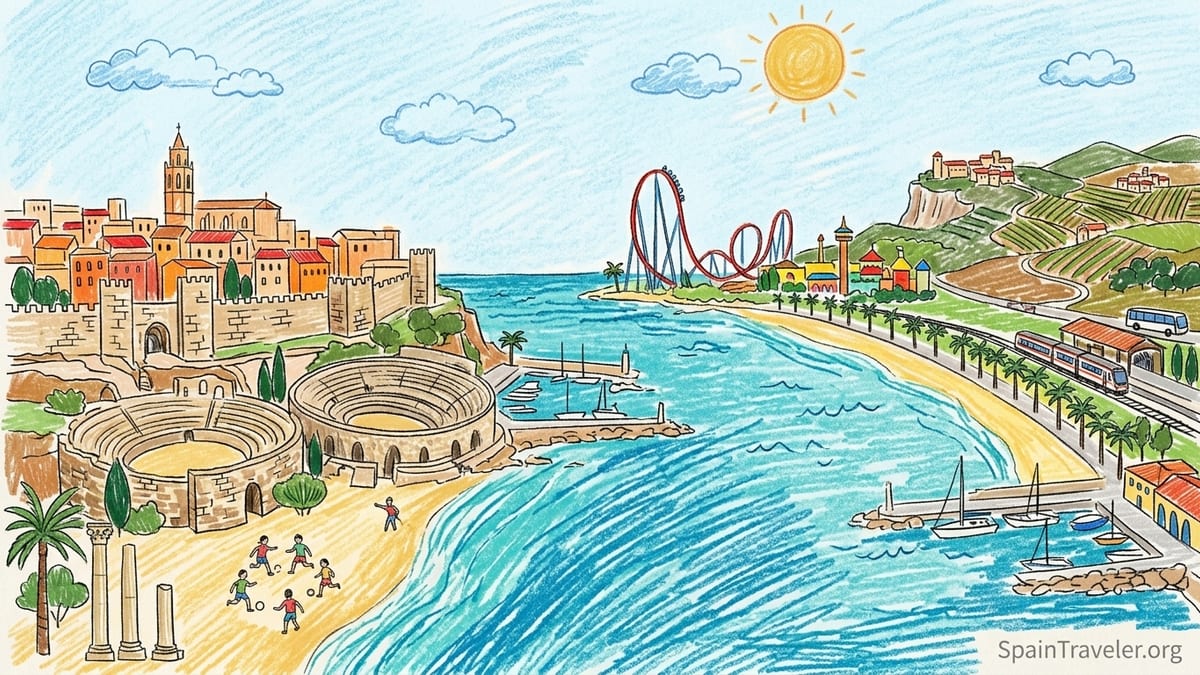
On my most recent circuit I based myself in Tarragona for four nights, and it was the part of the trip that stayed with me longest. Tarragona is much more than a day-trip backdrop to beach resorts. Its Roman archaeological ensemble, including the seaside amphitheatre and remnants of the circus and walls, holds UNESCO World Heritage status and wraps serious history around a working Catalan city. I arrived by train from Barcelona in under 90 minutes, walked straight out of the station and, ten minutes later, was watching kids play football on the sand at Platja del Miracle with Roman stonework visible up on the bluff. That kind of layering is what made Tarragona feel like the natural anchor for the region rather than an optional extra.
In terms of time, four nights felt about right if you want both history and sea. I spent one full day drifting between the Old Town, the cathedral quarter and the main Roman sites, another day built around long lunch and late swim, and two half-days on small errands and aimless evening walks. I would not have cut Tarragona shorter; if anything, I could happily have stretched to five nights and skipped a night in one of the busier resorts. The city has the rare ability to still feel alive on a Tuesday in October, with students in bars around Plaça de la Font and elderly couples promenading along the Balcó del Mediterrani.
Practically, Tarragona worked well without a car. The rail station sits on the waterfront, and I used regional trains and the Plana and other bus services to hop down the coast toward Salou and Cambrils and up to smaller towns. Within the city, I walked everywhere and never felt I needed a taxi except late at night from the newer upper districts. Parking looked more stressful, with paid underground garages around the Rambla Nova and tighter street spaces inside the old walls. Friends who drove in July told me they budgeted for garage parking near their hotels rather than chasing free curbside spaces in the heat.
For food and evenings, Tarragona punched above its weight. Around the fishing district of El Serrallo I could order a plate of arroz caldoso or grilled sardines at a simple marisqueria for a reasonable price, then stroll back along the waterfront. Up in the Part Alta, I found small wine bars pouring local Priorat and Montsant reds by the glass alongside simple tapas. The beaches are city beaches rather than remote coves, but the sand is clean, the water usually calm in summer, and the atmosphere at sunset felt low-key and local compared with the neon of Salou. If I had to choose a single place on the Costa Dorada to combine culture, decent swimming and a real evening atmosphere, Tarragona would still be my first choice.
Salou and PortAventura: Convenience and Entertainment, With Caveats
On my first Costa Dorada trip, I gave Salou three nights because every summary of the coast highlighted its beaches, nightlife and proximity to PortAventura World, the region’s headline theme park. Salou delivered exactly what it promised: big, family-oriented beaches like Platja de Llevant, a lively seafront thronging with bars and ice-cream stalls, and very easy access to PortAventura’s roller coasters and water rides. If your priority is to walk from your hotel to the sand in a few minutes and have entertainment on the doorstep, it works well.
Looking back, three nights were more than I personally needed. One full day on the main beach, an early-morning run along the coastal path past Capellans and Llarga, and a long evening paseo under the palms on the Jaume I promenade gave me a good sense of the resort. By the second evening I found myself gravitating to quieter back streets and wishing I had shifted at least one of those nights back to Tarragona or down to a smaller town. For nightlife built around karaoke bars, sports screens and cocktails in plastic glasses, Salou suits the brief. For atmosphere that feels distinctively Catalan, it added less to my trip.
From a practical point of view, Salou is structured around convenience. The resort is threaded by regular bus services along the coast, particularly the Plana buses that link it to Reus airport, Tarragona and Cambrils, which made moving around without a car straightforward. The old central train station was closed and demolished, so rail access now runs through the newer Salou-PortAventura station inland. For many visitors, that means they arrive by transfer coach instead. Parking near the seafront in August looked competitive, but accommodation out toward the edges of town often came with on-site parking or easier street options.
PortAventura World was the reason I stayed in Salou on a later visit with friends who love theme parks. The resort remains one of Spain’s major attractions, with a main park, Ferrari Land and in-season water park, and both package deals and group tariffs are structured to draw you in across at least two days. Official price lists show a single daily price for car parking and a calendar of high and low demand days for 2026, while combined hotel-and-ticket packages periodically offer discounted rates. That made it relatively simple to budget, although recent visitors report that the parking lots can be chaotic at rope-drop and close, and that many now consider the small premium for on-site hotels or walking-distance accommodation worth it for the shorter queues at the gates.
In honesty, Salou and PortAventura gave me a concentrated burst of fun rather than depth. If I returned with children or a group of friends set on coasters, I would probably book a PortAventura hotel for one or two nights and treat Salou as a way to reach the park and the long beach, then shift my base afterward. As a solo or couple traveller more interested in food, landscape and town life, I would allocate fewer nights here and more to Tarragona, Cambrils or the quieter coves further south.
Cambrils: Food, Promenade Life and a Softer Resort Rhythm
Cambrils was where the Costa Dorada finally clicked for me as a place to simply live by the sea for a while. I stayed here twice, once for three nights and once for five, and both times felt I could have comfortably added an extra night without running out of things to enjoy. The town stretches along a wide bay, with the old fishing harbour and compact historic centre at its heart and a long, smooth promenade unrolling in both directions. Compared with Salou, the energy was gentler: families biking past in the early evening, locals gathering on benches at sunset, and restaurant terraces focused more on seafood and local wine than on happy-hour cocktails.
Cambrils has a genuine reputation for food. The harbour area is lined with restaurants that highlight fresh fish, rice dishes and shellfish, and some streets back from the water hold small bistros and bars that feel aimed at residents as much as visitors. On my last visit I ate a generous menú del día near the port for a fair price, including a starter of grilled vegetables, a main of fideuà and a glass of house wine, then joined the paseo along the palm-lined seafront that runs all the way toward Vilafortuny. The combination of long, flat promenade and frequent benches meant I could wander for an hour or two without really noticing the distance.
As a base, three to five nights in Cambrils worked well. Beach quality was high along most of the central stretch, with clean, fairly fine sand and calm water suited to children. The town’s beaches felt slightly less crowded in shoulder season than Salou’s, especially toward the western end, yet I still had easy access to supermarkets, bakeries and bike-rental outfits. The evening atmosphere was sociable without tipping into loud; you hear conversation and the clink of glasses more than amplified music.
Without a car, Cambrils is reasonably functional but takes a little planning. Regional buses link it with Tarragona, Salou and Reus, but the main train station sits back from the port area, and the relocation of services has made spontaneous rail trips slightly less convenient. I was comfortable using buses and occasional taxis for excursions and would still choose Cambrils as a base without a car if my priority were food, beach time and promenade walks rather than constant touring. With a car, it becomes an excellent middle ground: easy parking in many apartment blocks or paid lots inland, and straightforward road access to both coastal coves and the inland hills.
Quieter Coasts: Altafulla to the North, L’Ametlla and L’Ampolla to the South
After the busy core of the Costa Dorada, I deliberately sought quieter stretches of coast to see whether they justified shifting nights away from the big three bases. Two trips, each of two nights, convinced me they do, especially if you value slower beach time and smaller-town rhythms.
To the north of Tarragona, I spent two nights in Altafulla. The village has a handsome old quarter climbing toward a small castle, with a separate beachfront area linked by a short walk. The sandy beach here is broad and relaxed, and because Altafulla is on the regional rail line between Tarragona and Barcelona it is easy to reach without a car. Parking near the sea was less pressured than in Salou even in high season, although I still found it easier to leave the car in accommodation parking and walk. What Altafulla added to my trip was a sense of scale: one main beach, a handful of chiringuitos and cafes, an evening stroll past low-rise houses, and then quiet. Two nights felt perfect; much longer and I would have needed a car and a list of day trips.
Further south, I split four nights between L’Ametlla de Mar and L’Ampolla. L’Ametlla felt like the point where the Costa Dorada begins to blur into something wilder. The town itself is a compact fishing port, and its municipal tourism board highlights more than a dozen sandy coves scattered along roughly 16 to 17 kilometres of coastline, many of them strung along the GR-92 coastal path. Much of this shore remains fringed with pines and has received Blue Flag recognition in recent years. I walked sections of the coastal trail and found small, almost pocket-sized coves like those near the Cala de les Ampolles area where the water was exceptionally clear and the atmosphere stayed calm even in August once I left the main urban beach. That chain of coves, some sandy and some more pebbled, gave me exactly the slower, more fragmented beach days I had hoped for.
L’Ametlla’s town beach and port have enough restaurants and bars to fill an evening, but the mood is quieter and more local than in the main resorts. I stayed for two nights and would happily extend to three on a future trip, especially now that I know how to stitch together a full day of swims by walking the GR-92 between coves. Arriving by train from Tarragona was straightforward, and I was glad to leave the car parked once I got there, because some access roads down to individual coves are narrow and parking is limited. It felt like the sort of place where you accept a ten or fifteen-minute walk in flip-flops as the price of a less crowded bay.
L’Ampolla, just south of L’Ametlla, softens things again. It is often described as the gateway to the Ebro Delta, and local tourism materials highlight a mix of small coves and more open beaches that back onto wetlands and agricultural land rather than dense resort development. The town beach near the centre was calm and family-friendly, while coves like Pinets further out provided shallower, sheltered water that worked well for young children. I stayed two nights, arriving by car, and found parking manageable near my guesthouse and around the port. What L’Ampolla added to my circuit was variety: beach time combined with short drives or bike rides into the rice fields and lagoons of the delta, where you can watch birdlife and see a very different side of Catalonia compared with the apartment blocks of Salou.
Inland Costa Dorada: Hills, Villages and Wine Country
Looking inland from the coast, I kept wondering what lay up in the red and green hills I could see from the beach. On my second extended visit I finally followed that curiosity and spent three nights between Priorat and the Prades mountains, breaking the stay between a village near Falset and a night in the hilltop village of Siurana. Those three nights fundamentally changed how I think about the Costa Dorada. It stopped being just a strip of sand and water and became a region with depth.
Priorat is one of Catalonia’s best-known wine regions, with terraced vineyards clinging to slopes and small cellars producing concentrated reds. Rather than try to tick off dozens of wineries, I booked tastings at two family-run cellars and spent the rest of my time walking the narrow streets of villages like Gratallops and Porrera and following short sections of waymarked trails between them. Local tourism sites describe networks of wine and olive-oil trails that criss-cross the countryside, and on the ground these translated into sturdy signposts and well-trodden paths through vines and old stone terraces. With a rental car, moving between villages and trailheads was simple, and parking was rarely an issue outside of the busiest harvest days.
From Priorat I drove up to the Prades mountains and stayed a night near Siurana, a dramatic village balancing on a cliff above a reservoir. The surrounding area forms part of wider hiking routes like La Ruta dels Refugis, a multi-day trail that connects the Prades range with the Montsant Natural Park and slices through emblematic landscapes of the interior. I did not attempt the full route but managed a satisfying half-day circuit from Siurana out to viewpoints over the reservoir and back. The air felt cooler and crisper than down on the coast, making it an ideal contrast to humid August afternoons by the sea.
Those three inland nights required a car and more planning for meals. Villages often have limited restaurant options and quieter midweek evenings, and I made sure to carry snacks and water on hikes rather than rely on finding a bar open at odd hours. In return, I gained a sense of the Costa Dorada as more than a beach destination: farmers working steep terraces, hermitages tucked into cliffs along forest paths, and long views toward the Mediterranean from high ridges at sunset. If I went back, I would again peel at least two nights away from the busiest beaches and spend them inland, especially outside peak summer when hiking conditions are better.
Places I Would Not Prioritize Next Time
There are names that appear on almost every list of Costa Dorada destinations, yet after visiting I would not rush back or allot them precious nights on a limited itinerary. This does not mean they are bad, only that, in the context of the whole region, other places gave me more.
In my case, La Pineda, a resort area between Salou and Tarragona, fell into this category. I spent one night there at the start of a trip because I found a last-minute hotel deal. The wide beach and family attractions, including water slides and mini-golf, were exactly what many visitors seek, and buses linked it efficiently with both Salou and Tarragona. But as I walked along the seafront in the evening, flanked by high-rise hotels and souvenir shops, I felt I could have been in almost any large Spanish resort. After a single breakfast looking at tower blocks rather than a harbour or old town, I decided that in future I would either commit to the full convenience of Salou and PortAventura or step down to the smaller scale of Cambrils or Altafulla.
Similarly, I tried squeezing in quick, surface-level visits to several other mid-sized resort strips that all offered good sand and straightforward services but blurred together in my memory afterward. With limited time, I would now rather sink into a smaller selection of distinct bases than notch up more places for the sake of it. Tarragona for urban depth, Cambrils for promenade life and food, a quiet cove base like L’Ametlla or Altafulla for slower beach days, and at least a couple of inland nights gave me a more balanced experience than trying to see every name on the map.
On paper, even PortAventura’s cluster of official hotels could have claimed more of my nights, since package offers often make them look good value when combined with park tickets. However, after a two-night stay on-site, I concluded that was my personal limit. The convenience of walking to the gates and having breakfast included was undeniable, but I missed the variety of independent restaurants and genuine town life. If your heart belongs to theme parks, by all means build a longer stay around the resort. If not, I would suggest capping it at one to two nights and investing the rest of your time elsewhere along the coast or inland.
The Takeaway: Matching Costa Dorada Bases to Travellers
After looping through the Costa Dorada several times and consciously reallocating my nights, a pattern emerged. The region works best when you accept that different places serve different moods rather than trying to find a single base that does everything. If I were planning a first or second visit now, I would build my itinerary around that idea instead of defaulting to a week in the largest resort.
For travellers who value history, local life and a sense of being in a real Catalan city, Tarragona deserves more than the token day trip it often gets. Three to five nights let you explore its UNESCO-listed Roman sites, use the train network to reach nearby towns, and still swim at city beaches in the late afternoon. For those whose priority is easy sand access and entertainment for children or teens, Salou and the PortAventura complex provide exactly that, but I would treat them as a focused segment of the trip rather than the whole story, especially if you appreciate quieter evenings.
If long, low-stress beachfront walks and good food matter most, Cambrils is where I would steer you, especially if you are travelling as a couple or family looking for a middle ground between bustle and calm. For slower, more contemplative beach days, smaller rail-linked spots like Altafulla to the north and cove-based towns like L’Ametlla de Mar and L’Ampolla to the south reward at least two or three nights each, particularly outside the very peak of summer when coastal trails and coves feel more spacious.
Finally, if you can spare them, two or three nights inland transform a standard sun-and-sea holiday into something richer. Priorat and the Prades mountains add hiking, wine, and village life that balance out days on the sand. Taken together, these pieces make the Costa Dorada a region where I now return not just for a beach break, but for a layered trip in which I am very deliberate about where I actually spend my time.
FAQ
Q1. How many nights should I spend in Tarragona on a first Costa Dorada trip?
I found three to four nights ideal, which gave me time for the main Roman sites, relaxed evenings in the old town, and a couple of beach sessions without rushing.
Q2. Is it possible to visit the Costa Dorada without renting a car?
Yes, if you focus on rail and bus-linked bases like Tarragona, Salou, Cambrils, Altafulla and L’Ampolla, you can move around by public transport and taxis, though reaching some coves and inland villages is easier with a car.
Q3. Which base works best for visiting PortAventura World?
Staying in Salou or in one of PortAventura’s official hotels makes access very easy, with walking routes or short transfers to the park, while Tarragona and Cambrils also work if you are happy to use buses or drive.
Q4. Where did you find the best food on the Costa Dorada?
Cambrils’ harbour and old town stood out for seafood and promenade-side dinners, while Tarragona’s Part Alta offered enjoyable wine bars and tapas using local Priorat and Montsant wines.
Q5. Which areas would you choose for a quieter beach holiday away from big resorts?
I would look first at Altafulla for a broad, calm beach with rail access, then at L’Ametlla de Mar and L’Ampolla for coves, pine-fringed coastline and smaller-town evenings.
Q6. How was parking in the main Costa Dorada towns you visited?
In high season parking near the seafront in Salou and Tarragona can be competitive, so I often chose underground garages or accommodation with parking, while in smaller towns and inland villages I usually found spaces more easily.
Q7. Did inland areas like Priorat and the Prades mountains justify taking nights away from the coast?
Yes, the combination of vineyard scenery, hiking routes and hilltop villages like Siurana gave the trip a different dimension that I would happily trade two or three beach nights for.
Q8. If you only had one week, how would you split your time?
For a balanced first visit, I would likely spend three or four nights in Tarragona, two nights in Cambrils or a quiet cove town, and one or two nights tied to PortAventura or inland hills depending on your interests.
Q9. Are Costa Dorada beaches suitable for families with small children?
Yes, beaches around Salou, Cambrils, Altafulla and central L’Ampolla have gentle slopes and generally calm summer water, along with nearby services and playgrounds.
Q10. Which places would you personally skip or shorten next time?
I would shorten or skip La Pineda and reduce my time in Salou, using those nights instead for longer stays in Tarragona, Cambrils, inland Priorat or the quieter coves around L’Ametlla de Mar.