


The Costa Dorada, or Costa Daurada in Catalan, is more than a string of beaches south of Barcelona. It is a compact strip of coast where resort towns, a UNESCO listed Roman city, family theme parks and inland wine country all sit within roughly an hour’s travel of each other. That density is both a blessing and a planning challenge. With only 3, 5 or 7 days, you need to be deliberate about what to include so your trip feels unhurried instead of like a checklist on rails.
Understanding the Costa Dorada Layout Before You Plan
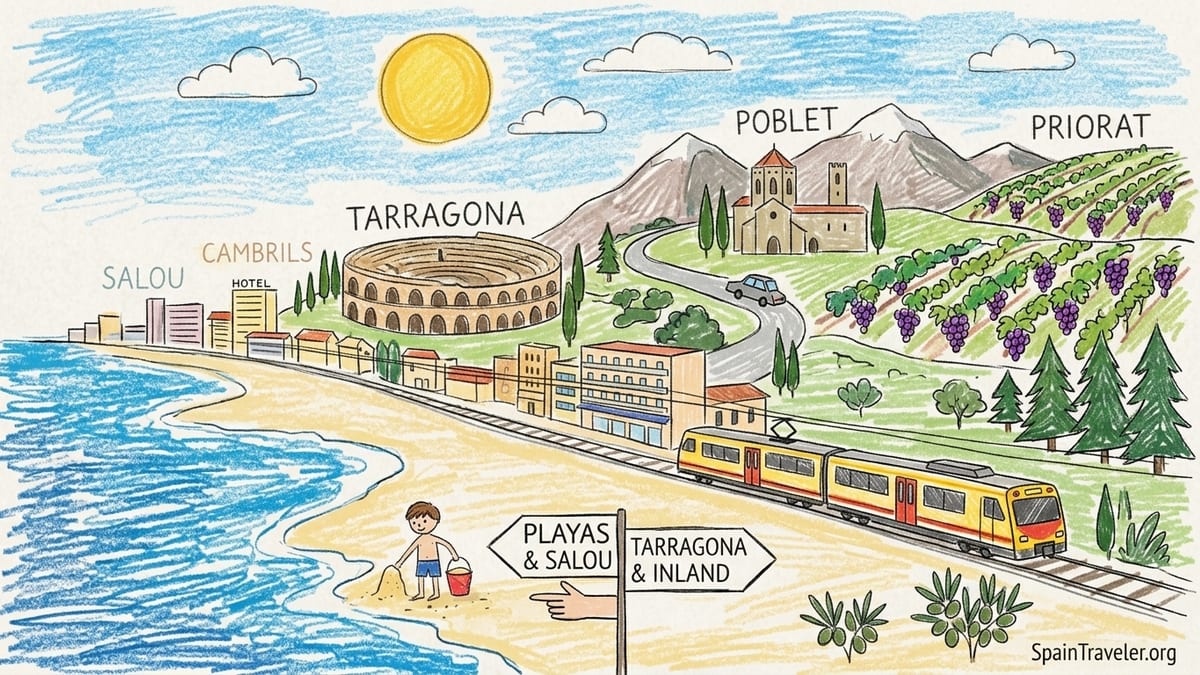
The Costa Dorada runs roughly from Cunit and Calafell in the north down past Tarragona to L’Ametlla de Mar and L’Ampolla in the south, with the main coastal concentration between Coma-ruga and Cambrils. For most visitors, the core triangle is Tarragona, Salou and Cambrils, with PortAventura World sitting just inland from Salou and regional trains and buses tying everything together along the shore. Barcelona Sants to Tarragona by regional train often takes around 1 hour 15 minutes to 1 hour 30 minutes, and on the same R16 and R17 lines you can be in Salou-PortAventura in about 1 hour 30 to 1 hour 45 minutes depending on the departure.
Tarragona deserves to be treated as more than a rainy day escape from the beach. The Archaeological Ensemble of Tarraco, which includes the amphitheatre above the Mediterranean, the circus, provincial forum, walls, aqueduct and early Christian necropolis, has been a UNESCO World Heritage site since 2000. The Catalan heritage authorities and UNESCO highlight it as one of the most important Roman ensembles in Spain by size and density of remains rather than a single marquee ruin. Recent regional initiatives, including a dedicated management plan and a new Roman heritage consortium, underline how seriously conservation and visitor experience are taken there.
Inland, official Costa Daurada tourism promotions increasingly pair the coast with the Prades Mountains, Montsant Natural Park, Poblet Monastery and the wine regions of Priorat, Montsant, Conca de Barberà and Tarragona. The regional tourism board points out that the Costa Daurada area includes seven wine designations of origin, among them DOCa Priorat and DO Montsant, and promotes winery visits and vineyard landscapes as a core part of the destination. This is important for itinerary planning: inland day trips are not an add-on to a beach holiday, but a recognized second pillar of what the region offers.
Distances are short enough that you do not need to change hotels constantly. Tarragona to Salou is about 12 kilometers, Tarragona to Reus airport about 10 kilometers, and Tarragona to the Priorat villages like Falset roughly 40 to 45 kilometers by road. In practice that means you can comfortably treat the whole central coast as a single base area and then decide whether to dedicate one night inland for atmosphere or simply dip in on a day trip by car or guided tour.
How Many Bases Make Sense for 3, 5 or 7 Days
The key strategic decision for the Costa Dorada is how many overnight bases you use. Because train and bus connections along the coast are relatively good, and because driving between main towns rarely takes more than 30 to 40 minutes, most travelers are best with one or at most two bases even for a week-long stay. This avoids packing and unpacking, which can burn the better part of a morning every time you move, especially with children.
For a 3 day trip, one base is almost always the smartest option. You either commit to a beach and resort focus based in Salou, Cambrils or La Pineda, or you stay in Tarragona to combine the Roman city with a taste of the sea. If you choose Salou or Cambrils, you might day trip up to Tarragona for one long day, but you do not want to split your nights. If you choose Tarragona, you accept that you will experience beaches mostly as urban or nearby stretches like Platja del Miracle or Platja Llarga rather than as a resort with pool complexes and kids’ clubs.
On a 5 day itinerary, one base still works well if your priorities are clear. A family coming primarily for PortAventura and beach time will probably base in Salou, within either walking distance or a short bus ride of the park, and take a half or full day trip to Tarragona by train. A couple more interested in culture and food could base in Tarragona’s historic center and do a day to PortAventura or an organized wine tour into Priorat or Montsant. Two bases only really make sense at 5 days if you deliberately want a 3 nights coast and 2 nights inland split for atmosphere, such as combining Salou with a small hotel in a Priorat village like Gratallops or Porrera.
With 7 days, you have more flexibility to use two distinct bases without rushing. A common pattern is 4 or 5 nights on the coast and 2 or 3 nights inland. For example, you might spend five nights in Cambrils at a seafront hotel, with a day in Tarragona and a day at PortAventura, then rent a car and drive to an agrotourism guesthouse near Montsant Natural Park or in the Prades Mountains for hiking, winery visits and quiet hilltop villages. Splitting this way allows you to experience both sides of what the region’s tourism boards actively promote: the “golden coast” beaches and the interior of monasteries, forests and vineyards.
Moving Around: When Trains Work and When a Car Helps
The practical framework for Costa Dorada planning hinges on how you will move between coast, Tarragona and inland. Along the shoreline, Catalonia’s Rodalies network is the backbone. Regional lines such as R16 and R17 connect Barcelona’s central stations, including Sants and Passeig de Gràcia, with Tarragona and the Salou-PortAventura area. Timetables evolve, and there have been periodic infrastructure works south of Barcelona, so it is wise to check the Rodalies official site or app shortly before you travel. As a rough orientation, standard regional tickets between Barcelona and Salou-PortAventura in recent years have typically been around the range of 8 to 10 euros one way, though final 2026 fares should be verified directly at the time of purchase.
These trains are practical for day trips between Barcelona, Tarragona and the theme park without a car. They also make coastal hopping feasible if you base in one town. For instance, staying in Tarragona, you can take a regional train in the morning to Salou-PortAventura station and be walking toward the park entrance in under 2 hours from leaving your hotel, depending on connections. Salou, Cambrils and smaller towns like Torredembarra are also linked by frequent local and interurban buses that serve beach neighborhoods not directly on the rail line.
A rental car becomes noticeably more valuable as soon as you want to explore inland. There is some public transport into Priorat and to the Cistercian Route monasteries such as Poblet, but bus frequency is limited and schedules are often geared to residents, not tourists. Many vineyard estates listed by the regional wine tourism routes expect visitors to arrive by car. Driving times are modest, but winding mountain and rural roads mean journeys take longer than their straight-line distances suggest. Tarragona to Escaladei, for example, is only about 55 kilometers but usually takes around an hour by car because of the curves and elevation changes.
For a first visit focused on coast plus Tarragona, you can manage entirely with trains and buses, especially if you are happy booking a guided day trip into wine country that includes transport. Once you extend your stay to a week and want freedom to choose small villages and hiking trails, renting a car from Tarragona, Reus airport or even Barcelona for part of your stay adds flexibility. Many travelers choose a hybrid approach: no car for the coastal and city portion to avoid parking hassles, then a 2 or 3 day car rental specifically for the inland segment.
Planning a 3 Day Costa Dorada Itinerary Without Rushing
On a 3 day Costa Dorada trip you must decide what this visit is primarily about. There is not enough time to do deep beach time, PortAventura and full Roman Tarragona without everything feeling rushed. A realistic framework is to choose between a beach and resort focus or a coast plus Tarragona city focus, accepting that the unused option can wait for another trip.
For a beach and resort focused 3 days, base yourself in Salou or Cambrils. A practical example would be checking into a midrange hotel such as a seafront property in Cambrils with direct access to the promenade. Day one can be arrival and afternoon on the local beach. Day two might be a full beach day with a relaxed lunch at one of the chiringuitos on Platja de Llevant or Platja de Ponent, followed by an evening stroll along Salou’s Passeig Jaume I. If you want a touch of variety, you could spend a half day visiting nearby Cap de Salou’s coves by local bus or tourist train, but keep the focus on decompressing rather than sightseeing marathons.
For a coast plus Tarragona 3 day framework, make Tarragona your base. Day one can center on the historic core, following part of the official Roman Route that links major sites like the amphitheatre facing the sea, the circus, and parts of the provincial forum. Entry fees to individual monuments are moderate, and the city periodically offers combined tickets or passes that cover several sites, so it is worth checking current offers at the tourist office. Day two could blend more Roman heritage with the Mediterranean, for example by walking a stretch of the city walls in the morning and spending the afternoon at Platja del Miracle or taking a short bus or taxi to Platja Llarga, a sandy arc just north of the city.
In this 3 day version, PortAventura does not fit comfortably unless you treat everything else as secondary. If your primary goal is the theme park, then consider staying in one of the PortAventura World hotels and devoting at least one full day to the park, potentially combined with a half second day. From there you might only manage a quick late afternoon or evening stroll in Tarragona to see the amphitheatre from the outside or dine in the old town, rather than a proper exploration.
Designing a Flexible 5 Day Stay with PortAventura or Inland Culture
Five days on the Costa Dorada allows you to add a major extra component such as PortAventura World or a taste of inland culture without fragmenting your itinerary into too many hotel moves. The first question is whether your priority is a high energy family theme park experience or a quieter inland and wine element paired with the coast.
For a family oriented five days anchored on PortAventura, Salou is the logical base. Many families choose packages that combine on-site hotels with park tickets, sometimes including high speed rail offers from Renfe that bundle entry to PortAventura Park with long distance train transport. While details and prices change each season, the pattern is that staying in an official PortAventura hotel can offer advantages like early park access or combined tickets to Ferrari Land. A reasonable framework would be to dedicate two full days to PortAventura and Ferrari Land, one full day to the beach and pool around Salou, and one full day to Tarragona by train or organized excursion, leaving the arrival or departure day relatively open.
Couples or adult travelers may prefer to use the five days to deepen the cultural and inland side without ignoring the sea. In this case, basing in Tarragona’s old town or in a quieter coastal town like Cambrils works well. A sample structure could allocate one day and a half to Tarragona’s Roman sites and museums, one full beach day, one full day inland to places like Poblet Monastery and the nearby vineyards of Conca de Barberà, and an optional day either at PortAventura or hiking in Montsant Natural Park. You might rent a car for only one or two days of this schedule, picking it up in Tarragona on the evening before your inland excursion and returning it the following evening.
Cost wise, five days give you space to balance splurges and savings. PortAventura tickets are a significant line item, especially for families, so you might offset that by choosing self-catering apartments in Salou or Cambrils and using supermarkets and bakeries rather than eating out for every meal. Inland, smaller guesthouses and rural hotels often offer good value compared with peak season beachfront accommodation, though exact 2026 prices vary by village and category. Checking directly with local tourism offices for seasonal offers, particularly outside of July and August, can unlock better rates and quieter experiences.
Expanding to 7 Days: Beaches, Tarragona and Inland Wine or Nature
A 7 day Costa Dorada itinerary is where the coastal resort, UNESCO Roman city and inland nature and wine landscape can all be properly represented without the feeling of sprinting from one attraction to another. With a full week, the challenge is to resist overfilling the schedule. It is often better to set a framework of four pillars beaches, Tarragona, leisure time and inland excursions and let details flex depending on weather and energy levels.
One balanced way to structure a week is to spend the first four or five nights on the coast and the final two or three inland. For example, you could base in Cambrils at a beachfront hotel with a pool and easy promenade access. Over those four or five nights, you might enjoy two largely unscheduled beach days, one dedicated day in Tarragona exploring the Roman Route sites and the cathedral area, and one or two theme park days at PortAventura if that interests you. If visiting during high season, it can be wise to book PortAventura tickets and, if needed, train or coach transport in advance, as summer days can be very busy.
For the inland portion, the official Costa Daurada promotional material frequently highlights the Montsant mountain range, the Prades Mountains and the historic Poblet Monastery as key nature and culture components. Montsant Natural Park, described as the only natural park on the Costa Daurada, offers marked trails through limestone cliffs and terraced vineyards. Nearby, the Priorat and Montsant wine regions together host dozens of wineries open to visitors, many of which request advance booking for tastings and tours. Spending two or three nights in a village like Falset, Escaladei or Siurana allows you to wake up in the landscape rather than treat it as a rushed detour.
Another way to use seven days is to stay in a single coastal base and use a car for multiple inland day trips instead of changing hotels. You might, for instance, stay in Salou all week, but dedicate one day to Montsant and Priorat, another day to the Prades Mountains and the medieval town of Montblanc combined with Poblet, and if you are especially active, a hiking day in the wooded valleys behind Prades. This approach keeps logistics simple, at the cost of some extra driving at the beginning and end of each inland day.
No matter which version you choose, build at least one completely unprogrammed day into your week, ideally in the middle of the trip. Use it to linger on a favorite beach, explore local markets in Tarragona or Cambrils, or simply rest at your accommodation. Travelers often report that these unscheduled days become the most memorable, especially for families that need downtime between intensive sightseeing or theme park visits.
Trip Styles: First Visit, Family Focus, Beach Heavy and Culture & Nature
Thinking of your Costa Dorada stay in terms of trip styles can help you select from the 3, 5 and 7 day frameworks without overcomplicating the plan. A first visit, a family trip, a beach heavy escape and a culture and nature oriented journey all use the same building blocks in different proportions.
For a first trip, especially if you are traveling from overseas and combining the Costa Dorada with Barcelona, a 5 day stay often hits the sweet spot. Basing in Tarragona or Cambrils gives you easy access to both the UNESCO listed Roman city and the beaches, while still allowing at least one day to sample inland wine country or a half day at PortAventura. It is realistic to do this without a rental car by pairing regional trains with one organized inland excursion. You will not see every corner of the region, but you will understand why local and national authorities emphasize the dual coastal and inland character of the Costa Daurada.
A family trip leans more heavily on PortAventura and child friendly beaches. For 3 days, that could mean staying at an on-site hotel and devoting almost the entire time to the theme park complex. For 5 or 7 days, you can build a rhythm of high energy and rest days, for example alternating park days with quieter beach days in Salou, La Pineda or Cambrils. Salou’s central beaches, with shallow entry and facilities like playgrounds and pedal boat rentals in season, suit younger children, while older kids and teens may appreciate water sports on nearby stretches of coast. Factor in travel fatigue: if you are arriving after a long international flight, a low key first day by the pool before tackling PortAventura often works better than rushing straight into the park queues.
If your goal is a beach heavy trip with minimal sightseeing, the framework is even simpler. Choose one coastal base that matches your taste, whether it is lively Salou with nightlife, family oriented Cambrils with its fishing port atmosphere, or quieter areas like Torredembarra or Altafulla with more local feel. For 3 days you might barely leave that immediate area, perhaps only taking a sunset walk or coastal path excursion. At 5 or 7 days you can sprinkle in an afternoon in Tarragona or a brief inland drive to a viewpoint in the Prades Mountains, but the core remains sea, sand and slow meals on terraces.
The culture and nature trip style deliberately inverts that emphasis. Here Tarragona and the inland landscapes become the backbone, with beaches as pleasant interludes. A 7 day version might start with three nights in Tarragona, focusing on the Roman Ensemble of Tarraco, the cathedral quarter and the National Archaeological Museum, which local media highlight as a key gateway to understanding the UNESCO site. You could then move inland for three or four nights divided between Priorat or Montsant and the Cistercian Route area around Poblet and Montblanc. Beaches would enter the picture as half day visits from Tarragona or as a final decompression day back on the coast after an intensive inland schedule.
FAQ
Q1. Is three days really enough time for the Costa Dorada?
Three days is enough to get a clear taste of one side of the Costa Dorada, either the beach and resort atmosphere or Tarragona plus nearby coast, but not both in depth. You should choose a single base and a single main focus to avoid spending most of your limited time in transit.
Q2. Do I need a rental car for a 5 day trip?
You can comfortably manage a 5 day stay focused on beaches, Tarragona and PortAventura using trains and buses, especially if you base in Salou, Cambrils or Tarragona. A car becomes more useful if you want to spend a full day in wine regions like Priorat or Montsant or explore hiking areas such as Montsant Natural Park or the Prades Mountains without relying on infrequent rural buses.
Q3. Where is the best base for families with young children?
Salou is the most practical base for families focused on PortAventura and easy beach access, thanks to its proximity to the theme park and family oriented infrastructure. Cambrils is another good choice if you prefer a slightly quieter port town feel while still being within a short train, bus or taxi ride of both PortAventura and Tarragona.
Q4. How much time should I allocate to Tarragona’s Roman sites?
Most visitors who care about history find that at least one full day in Tarragona is warranted, and history enthusiasts could easily spend two days exploring the amphitheatre, circus, forum areas, walls, aqueduct and early Christian necropolis. As the Archaeological Ensemble of Tarraco is a UNESCO World Heritage site with multiple components, trying to compress everything into a quick half day can feel rushed.
Q5. Can I visit wineries in Priorat or Montsant without a car?
It is possible but less convenient. There are some bus services into Priorat, and a few guided tours from the coast include transport and winery visits, which can work well if you prefer not to drive after tastings. However, many wineries ask visitors to arrive by car at pre-booked times, so having your own vehicle, even for just one or two days, opens up far more options and allows you to combine vineyard visits with viewpoints and villages that are difficult to link by public transport.
Q6. Is PortAventura worth including on a short trip?
If theme parks are a priority for you or your children, PortAventura can justify a full day even on a short visit, since it is one of Europe’s major parks with multiple themed areas and, for those interested, the adjacent Ferrari Land. If your primary interests are beaches, Roman history and inland landscapes, then on a 3 day itinerary PortAventura may crowd out other experiences and is often better saved for a longer future trip.
Q7. What months offer the best balance of weather and crowds?
Late May, June, September and early October usually offer warm sea temperatures and beach friendly weather with lighter crowds than peak July and August school holiday periods. These shoulder seasons also tend to be more comfortable for walking around Tarragona’s archaeological sites and for inland hiking or winery visits, where midsummer heat can be intense.
Q8. Can I base in Barcelona and day trip to the Costa Dorada?
Yes, many travelers use Barcelona as a base and day trip to Tarragona, Salou or PortAventura using regional trains, with journey times usually between about 1 hour 15 minutes and 1 hour 45 minutes each way. This works well for a single day highlight such as Tarragona’s Roman monuments or a PortAventura visit, but if you want relaxed beach time and multiple inland excursions it is more efficient and restful to stay on the Costa Dorada itself for several nights.
Q9. Are Costa Dorada beaches suitable for non-swimmers and small children?
Several of the main Costa Dorada beaches, including central stretches in Salou and Cambrils, have relatively gentle slopes and lifeguard presence in season, which can be reassuring for families. Conditions vary with weather and specific coves, so it is always important to follow local safety flags and advice, but in general the area is known for wide sandy beaches rather than steeply shelving or rocky shores.
Q10. How should I divide a 7 day trip between coast and inland?
A common and effective split is four or five nights on the coast, using that time for beaches, Tarragona and any PortAventura visit, followed by two or three nights inland in areas like Priorat, Montsant or around Poblet and Montblanc. This balance lets you experience the Costa Dorada’s promoted combination of seaside, UNESCO Roman heritage and rural wine and mountain landscapes without making the trip feel like a series of constant hotel changes.