


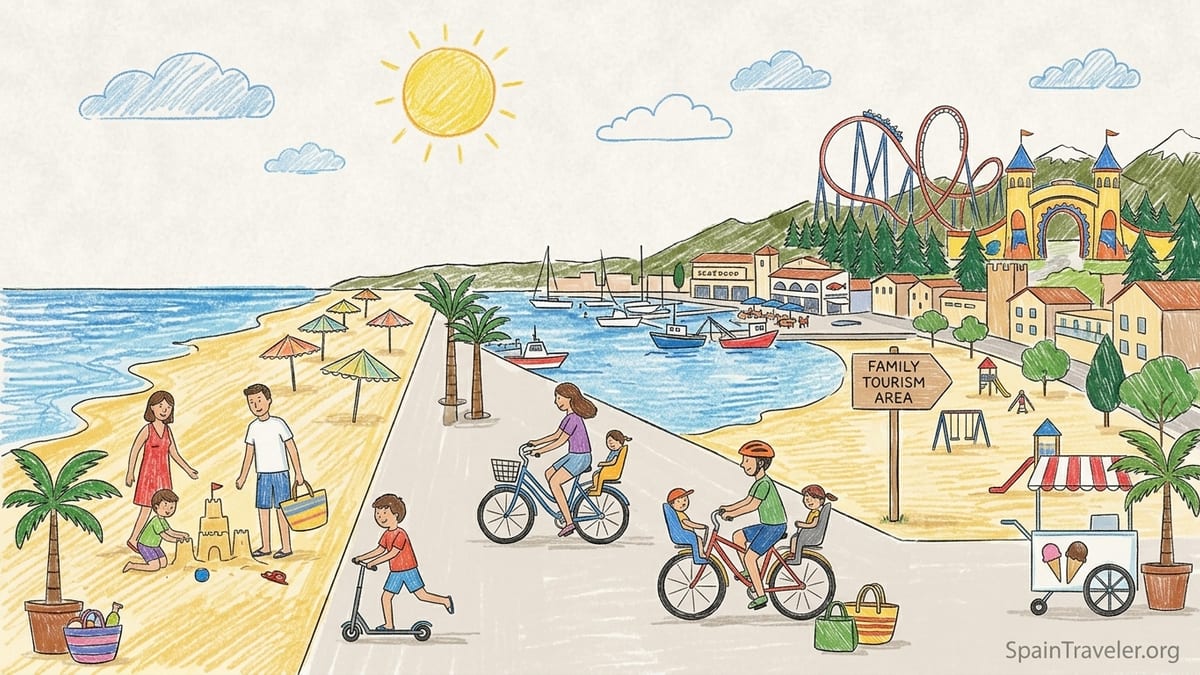
The Costa Dorada, or Costa Daurada in Catalan, stretches for more than 80 kilometres along Catalonia’s Mediterranean coast and has been carefully positioned as one of Spain’s most family-focused regions. With long arcs of fine golden sand, shallow and usually calm water, playground-studded promenades and Europe’s PortAventura World theme park on the doorstep, it works particularly well for parents who want a straightforward beach base with plenty to do in easy reach.
Why the Costa Dorada Works So Well for Families
The Costa Dorada runs along the province of Tarragona between Cunit and the Ebro Delta, its “golden coast” name coming from the colour of the sand in the sun. The official Costa Daurada tourism bodies and the Catalan government have spent years branding it as a certified family holiday area, highlighting more than 60 kilometres of beaches with fine sand and shallow water that suit children far better than many steeper Spanish coasts. Salou, Cambrils, Vila-seca/La Pineda, Calafell, El Vendrell and the Prades Mountains have all earned specific Family Tourism Destination or Family Holiday Destination seals, which signal a concentration of child-friendly facilities and services.
At beach level this translates into lifeguarded main town beaches in season, wide and mostly level seafront promenades for strollers and scooters, and a dense spread of playgrounds, mini-clubs and summer activity zones. For example, on Salou’s main Llevant Beach the town tourism board has created a free Beach Family Area and a bookable mini club with shaded play space and supervised workshops for children aged roughly four to ten, alongside showers, accessible ramps and water-sports kiosks. Similar setups appear in La Pineda, Cambrils and Calafell, so you rarely need to walk far from your sunshade to find a playground or an ice cream.
Behind the sand, the region adds variety that prevents family boredom. PortAventura World, one of southern Europe’s largest theme park complexes, sits between Salou and Vila-seca, supported by water parks, go-kart tracks and boat excursions. Inland, short drives reach vineyard country in Priorat, medieval centres like Montblanc and the cooler Prades Mountains for family hikes among pine forest. The compact size of the region keeps transfers short: from Reus Airport to Salou or Cambrils usually takes around 15 to 20 minutes by taxi, and even from Barcelona Airport you can be on the promenade in around an hour by car if traffic is normal.
Choosing the Right Resort: Salou, Cambrils, La Pineda, Calafell and Beyond
Most visiting families base themselves in or near Salou, Cambrils, Vila-seca/La Pineda, Calafell or El Vendrell, each of which has sought family certification. Salou is the busiest option and the closest base to PortAventura World, with a long central Llevant Beach, slightly quieter Ponent Beach and smaller coves at Cap Salou. It suits families who want a lively promenade with fountains, kids’ attractions and abundant apartment-style accommodation, and who are comfortable sharing space with nightlife later in the evening. In practice, many parents of toddlers report spending their days at the family-oriented end of town near the Jaume I promenade, then retreating to bed by the time bar noise picks up.
Cambrils, just to the southwest, is quieter and more village-feeling. Its long sandy beach is split into smaller sections by breakwaters that help keep the sea calm, and the traffic-calmed promenade is ideal for pushchairs and children cycling on rented bikes. Families who prioritise food often pick Cambrils, which has a reputation within Catalonia for seafood restaurants and tapas bars that still welcome kids. The walk from the marina to the more modern hotel strip is flat and manageable even with a stroller, and playgrounds punctuate the route every few hundred metres.
Vila-seca/La Pineda sits directly north of PortAventura and has a big, deep beach with very fine sand. La Pineda often appeals to families who want a large-package hotel, perhaps with a splash park, and straightforward bus links to the theme park. Calafell and El Vendrell, further north along the Costa Dorada, offer lower-rise seafronts, long bands of shallow water and a slightly more local atmosphere, which can suit families driving from France or northern Spain. For a complete contrast there are the Prades Mountains inland, which the tourism board highlights for walking, adventure parks and nature activities that you can reach as a half-day trip from the coast.
When choosing between resorts, think mainly about the age of your children and how often you intend to visit PortAventura. For example, a family with a two-year-old and a five-year-old that plans only one theme park day might prefer a quieter base in Cambrils or Calafell where playgrounds and gentle beaches dominate. By contrast, parents with a 9, 12 and 15-year-old keen on roller coasters may choose Salou or La Pineda to minimise transfer times to the parks and take advantage of evening entertainment on the promenade.
Beaches and Promenades: Matching Sand and Sea to Your Children’s Ages
The Costa Dorada’s key advantage for families is beach topography. On flagship beaches such as Salou’s Llevant and Ponent, La Pineda’s central beach and the main sands of Cambrils, the seabed slopes very gently so that the water remains under one metre deep for tens of metres from the shore in normal conditions. Local tourism information for Salou notes that the first 30 metres of water at Llevant are shallow, while descriptions of Ponent and Cambrils frequently emphasise calm, sheltered water and fine, compact sand that is comfortable for bare feet. This gives toddlers and cautious swimmers more margin for paddling, though close supervision is still essential.
For toddlers and preschool children the easiest days are usually on the largest, most serviced town beaches. A typical setup in Salou or Cambrils might include supervised play sessions at a beach mini-club in late afternoon, small slides and swings on the promenade, baby-changing facilities in a nearby cafe and shaded benches where grandparents can rest. Towns like Salou have invested heavily in making stretches of seafront accessible, with ramps, boardwalks across the sand and adapted showers for people with reduced mobility, so pushing a stroller from apartment to shoreline is normally straightforward.
Primary-school children often want a little more space and variety, so larger beaches with water-sports kiosks work well. On the Costa Dorada that might mean hiring a pedal boat with a slide from the operators on Llevant or La Pineda beaches, booking a short banana-boat ride for older children in high season, or trying a beginner stand-up paddleboard session where the water is calm and shallow. Many families adopt a rhythm of “one simple sandcastle day, one activity day,” cycling between main beaches and quieter coves such as Capellans or Llarga near Salou or the smaller coves of Cap Salou that you can reach by a short bus ride or coastal path walk.
Teenagers are usually less interested in the shallowness of the water and more drawn to beach clubs, volleyball nets and opportunities for independence. In resorts like Salou and La Pineda it is fairly common to see teens playing on the multi-sport courts behind the sand, renting electric scooters to cruise the promenade in the early evening or joining older siblings for kayaking and jet ski excursions booked from seafront kiosks. Parents can allow them a degree of freedom while still setting clear rendezvous points such as the main fountain on Passeig Jaume I in Salou or the pier in Cambrils.
Playgrounds, Cycling and Easy Activities Beyond the Sand
One of the Costa Dorada’s strengths is that you do not need to organise complicated excursions to keep children entertained. Seafront promenades across the main resorts are long, flat and lined with playgrounds and casual attractions. In Salou, for instance, several playgrounds sit directly on or beside Llevant and Ponent beaches, while the central promenade hosts fountains, trampolines in summer and small amusement rides at certain points. Cambrils offers a string of play areas every few blocks along its Passeig Marítim, so younger children can walk or scoot between swings, climbing frames and ice cream stops.
Family cycling is another low-effort activity that works from most coastal bases. You can rent standard bikes, child seats, trailers or small children’s bikes from shops in Salou, Cambrils and Calafell, often paying a modest hourly rate with discounts for a full day. Many visitors choose to cycle the almost entirely flat path between Salou and Cambrils, which hugs the coastline for several kilometres and rarely leaves sight of the sea, making it easy for children to understand where they are headed. With older kids you can turn this into a morning outing, stopping for churros or fresh orange juice mid-way.
On the water, operators along the main beaches offer short boat trips that are practical with children. These range from simple coastal cruises that glide past the coves of Cap Salou to glass-bottom boat journeys that allow children to peer at fish without needing to snorkel. Most trips last between one and three hours, which fits well between naps and avoids overstretching younger travellers. Ask locally about life jacket provision and age recommendations, particularly if you are travelling very early or late in the season when sea conditions can be cooler or choppier.
For a break from sun and sand on very hot days, families often retreat to indoor attractions and shaded parks. Salou and Cambrils both have compact municipal parks with ponds, shaded paths and play equipment, while shopping centres on the outskirts of Tarragona offer air-conditioned respite that can help during a midday heat spike in August. Simple indoor activities, from bowling alleys to small arcade centres, can salvage an afternoon when younger children are too sun-tired for another beach session.
PortAventura World With Kids: Smart, Age-Appropriate Planning
PortAventura World sits a short distance inland from the Costa Dorada’s central resorts and is one of Europe’s largest theme park complexes, combining PortAventura Park, Ferrari Land and a separate water park. The main park is divided into themed areas such as Mediterrània, Polynesia, China, México, Far West and SésamoAventura, with at least one children’s attraction without height restrictions in each zone according to the park’s ride requirement information. That makes it theoretically possible to navigate with very young children, though in practice the park feels most rewarding once children are tall enough for a good number of family and moderate rides.
Height requirements are the critical planning detail for families. Large thrill coasters such as Dragon Khan in the China area set a minimum height around 1.40 metres, while many family coasters and moderate rides require children to be at least 1.30 metres to ride alone and at least 1.00 metres to ride accompanied by an adult. At the gentler end, dedicated children’s attractions such as Área Infantil or rides within SésamoAventura have no minimum height or cater to smaller children, and some rides have maximum heights to reserve them for younger visitors. The park’s official ride requirement tool is the most reliable way to check what each child can do before buying tickets.
With toddlers under about three years old, PortAventura can still work if you manage expectations. You might focus on SésamoAventura’s gentle rides, character meet and greets and shaded playgrounds, then treat the rest of the park as a colourful place to stroll rather than a long list of rides to conquer. Families who have shared their experiences commonly report that two-year-olds enjoy the atmosphere but tire quickly, so a half-day visit, perhaps leaving around lunchtime for naps back in the resort, can be more realistic than staying open to close.
For primary-school children in the 6 to 11 age bracket, PortAventura becomes a genuine highlight. Many children in this range reach the 1.30 metre threshold during these years, unlocking several headline family rides alongside plenty of smaller ones. A common strategy is to arrive at park opening, head directly to a popular ride suited to their height before queues build, then slow the pace with shows, water rides and indoor attractions during the midday heat. Families sometimes add Express or fast-track options during peak summer dates to reduce time in line, weighing the additional cost against the benefit of keeping children out of long queues in the sun.
Teenagers can combine PortAventura Park with Ferrari Land and the water park over one or two days. Older children who meet all the height requirements can tackle the major coasters in the morning and late evening, when queues tend to be shorter, then retreat to shaded areas or indoor shows during the most intense heat. Many parents adopt a rule that teenagers explore in pairs, checking in by phone or at agreed meeting points such as the central lake at set times. Because PortAventura publishes its calendar and opening hours online and allows re-entry with a retained ticket, some families leave the park for a midday swim or nap at a nearby hotel, then return for the cooler evening session.
Age-Based Itineraries: Toddlers, Primary-School Children and Teenagers
Travelling with toddlers on the Costa Dorada is primarily about simplifying logistics and minimising overstimulation. A realistic day in Salou or Cambrils might involve a slow start, a mid-morning hour in the shallow water near the lifeguard post, playground time under a parasol and an early lunch in a seafront restaurant that opens its kitchen around 12:30 or 13:00. Many Spanish restaurants begin serving main dishes later in the afternoon and evening, but resort towns are accustomed to families and often offer children’s menus or simple grilled dishes earlier than city restaurants. After lunch, parents often push strollers along the shaded parts of the promenade while the toddler naps, then return to the pool or a small park rather than the full sun of the beach.
For primary-school children, a balanced week might include two or three simple beach days, one PortAventura day, one water-based excursion such as a boat trip or water park visit, and a short inland outing. Children aged six to eleven usually have the stamina for a full morning at the beach, a siesta or quiet time indoors, and an evening stroll with a later dinner around 20:00. Beaches like Salou’s Ponent or Cambrils, with nearby playgrounds and calm water, let them roam within agreed boundaries while still staying within easy reach of your beach umbrella.
Teenage-focused trips tend to centre more on activities. One sample three-day stretch might include a full day at PortAventura and Ferrari Land, a beach day with water sports such as paddleboarding or kayaking from La Pineda, and an inland day visiting Tarragona’s Roman amphitheatre followed by shopping and an evening back in Salou. Teenagers can handle later Spanish dining hours, so families may embrace an 21:00 or 22:00 dinner on busy promenades, using the time beforehand for volleyball on the sand or cycling along the seafront in the cooler air.
Mixed-age families need clear compromises from the outset. For instance, if you are travelling with a toddler, a nine-year-old and a fifteen-year-old, you might schedule PortAventura on a day when one adult focuses on the older two while the other keeps the youngest comfortable within the shaded areas and children’s attractions. On beach days you could choose larger beaches with both shallow paddling zones and water-sports kiosks, then agree that one parent will take the teenager out on a short jet ski or banana-boat ride while the other stays with the younger children building sandcastles.
Heat, Siestas, Meals and Naps: Practical Daily Rhythm
From late June through early September the Costa Dorada can be very hot in the middle of the day, with temperatures frequently above 30 degrees Celsius. For families this makes it important to lean into a Mediterranean rhythm: activity in the early morning and late afternoon, quiet time in the early afternoon. On the beach that means aiming to arrive by around 09:30 or 10:00, leaving for lunch and a rest by 13:00 or 13:30 and returning after 17:00 when the sun is lower and shadows lengthen. Umbrellas and shaded play areas help, but small children in particular will cope better if they are not on the sand across the hottest hours.
In theme parks such as PortAventura the same logic applies. Many families report that arriving at opening time, focusing on a handful of key rides before midday, then switching to shows, indoor attractions and shaded meals until later in the afternoon keeps everyone more comfortable. Spain’s habit of later dinners does not disappear in tourist towns, but coastal resorts are more flexible than major cities. In Salou or Cambrils you can often find seafront restaurants that serve food continuously from lunchtime into the evening, allowing families with young children to eat at 18:30 or 19:00 and still feel in sync with the holiday atmosphere.
Nap logistics are an important consideration for families with babies and toddlers. Stroller naps along the promenade are feasible thanks to the smooth, flat surfaces and general lack of steep hills in the main seafront areas. If your child sleeps better in a quiet room, it becomes worth choosing accommodation within a short, direct walk of the beach so that one parent can duck back for nap time without complicated transfers. Apartments within two or three blocks of the sand or hotels directly on the promenade simplify this routine considerably.
Hydration and sun protection require constant attention. Pack refillable water bottles and refill at your hotel, apartments or fountains along the promenade where safe. Many families choose to buy simple beach tents or pop-up shelters from local supermarkets for younger children, especially if they plan long mornings on the sand. When planning PortAventura days, consider lightweight, breathable clothing, hats that stay on during rides and a small backpack with snacks to avoid long waits in food queues just as children’s energy dips.
Where to Stay: Hotels, Apartments and What Works Best With Children
The Costa Dorada offers a mix of large resort hotels, mid-size family hotels and extensive apartment options. Deciding between an apartment and a hotel or aparthotel depends largely on your children’s ages and your tolerance for restaurant schedules. Families with babies and toddlers often find apartments or serviced aparthotels more practical because they provide a separate sleeping space, kitchen facilities for preparing simple breakfasts and early dinners, and the flexibility for parents to sit on a balcony after bedtime without hushing conversation.
In resort towns such as Salou, Cambrils, La Pineda and Calafell, entire neighbourhoods close to the sea consist of private or managed holiday apartments. Many are within a five to ten minute walk of the main beaches and promenades, which makes it easy to break up the day with naps and indoor play. When comparing apartments, look closely at whether they have lift access if you will be using a stroller, air conditioning strong enough for peak summer and washing facilities, since children tend to go through several outfit changes on beach holidays.
Larger hotels and resorts come into their own with school-age children and teenagers. Properties along the Costa Dorada frequently include children’s pools, organised mini clubs, evening entertainment and on-site sports such as mini golf and multi-sport courts. A hotel with an all-inclusive or half-board plan can simplify budgeting and ensure that there is always a buffet open when children are hungry. Families planning multiple PortAventura days sometimes choose one of the official on-site hotels, so they can walk back for naps during the day and return for evening rides when the sun is less intense.
Noise and location are worth weighing carefully. Accommodation on or very near Salou’s main nightlife strips will be more exposed to late-evening noise, which may disrupt young children, whereas blocks a little behind the promenade, in Cambrils’ residential stretches or in Calafell’s quieter streets typically offer calmer nights. When checking maps, look not only at distance to the sea but also at main roads you may need to cross with small children, the gradient of any hills and the proximity of supermarkets where you can easily buy nappies, snacks and sunscreen.
Easy Inland Excursions and Nature Breaks
While the coast will probably occupy most of your time, short inland excursions offer a welcome change of scenery and temperature. The Prades Mountains, certified as a Family Tourism Destination, sit within roughly an hour’s drive of the main resorts, rising to around 1,200 metres and bringing cooler air and pine-scented forest. In this area families can follow short waymarked walks, visit adventure parks with zip lines suitable for children and picnic in shaded clearings. The Poblet Forest near the Cistercian monastery of Poblet is recognised as a protected natural area and offers easy, stroller-friendly tracks as well as more demanding hikes for older children.
The city of Tarragona provides a compact cultural outing that works well with school-age children and teenagers. Its Roman amphitheatre and circus, which form part of a UNESCO World Heritage archaeological ensemble, sit close to the sea and can be explored in a few hours, leaving time for ice cream or a swim back on the coast. Seeing real Roman remains can give context to history lessons for primary and secondary pupils, and the elevated viewpoints over the Mediterranean appeal to photographers in the family.
For gentler inland excursions, consider small wine villages in the nearby Priorat and Penedès regions. Many wineries welcome visitors for short tours and tastings, and some offer child‑friendly outdoor spaces where children can play while adults sample local wines in moderation. Check in advance which estates are relaxed about children on site and be realistic about attention spans. Combining a brief winery stop with a walk around a hilltop village or a visit to a castle ruin can make the outing feel more like an adventure for younger family members.
If you prefer to avoid long drives, there are also micro-excursions just beyond the main resort strips. Simple options include visiting a local weekly market in towns like Cambrils or Calafell, taking a short regional train to Tarragona or smaller coastal towns, or exploring nearby coastal paths such as the Camí de Ronda around Cap Salou in short, manageable sections with older children. These small changes of scene can refresh a week of seaside routine without the need for complex planning.
FAQ
Q1. Is the Costa Dorada really suitable for toddlers and babies?
Yes, many main beaches have fine sand, shallow entries, lifeguards and nearby facilities. Choosing accommodation very close to the beach makes naps and shade breaks manageable with little ones.
Q2. Which Costa Dorada resort is best for a first visit with children?
Salou offers the widest range of activities and closest access to PortAventura, while Cambrils and Calafell provide a slightly quieter atmosphere with long, family‑friendly beaches and flat promenades.
Q3. How many days should we allow for PortAventura World with kids?
Families often plan one full day for PortAventura Park, adding a second day only if older children want Ferrari Land or the water park. With toddlers, a single half‑day visit can be enough.
Q4. Do we need a car to enjoy the Costa Dorada with children?
Not necessarily. In resorts like Salou, Cambrils and La Pineda you can walk or use local buses and taxis for most needs. A car becomes useful mainly for inland excursions and smaller villages.
Q5. When is the best time of year for a family holiday on the Costa Dorada?
Late May, June and September usually balance warm sea temperatures and open facilities with less intense heat and slightly lighter crowds than late July and August, which are hottest and busiest.
Q6. Are strollers practical on promenades and in PortAventura?
Yes, seafront promenades are generally flat and smooth, and PortAventura’s main paths are stroller-friendly. Very compact or lightweight models are easiest to manoeuvre and fold when needed.
Q7. How child‑friendly are restaurant opening times?
Resort towns know they host families, so many seafront restaurants begin serving hot food earlier than typical Spanish hours and offer children’s menus. You can usually find dinner from around 18:30 onwards.
Q8. Is the sea safe for less confident swimmers?
Main beaches usually have gradually sloping seabeds and summer lifeguards, but currents and waves can still change. Always follow local flag systems, stay within shallow water for beginners and supervise closely.
Q9. Should we choose an apartment or a hotel with kids?
Apartments suit families who value space, kitchens and separate bedrooms, especially with babies or toddlers. Hotels work well for school‑age children and teens who enjoy pools, mini clubs and evening entertainment.
Q10. Are there easy day trips away from the beach that children enjoy?
Yes. Popular options include Tarragona’s Roman sites, short hikes and adventure parks in the Prades Mountains, simple coastal boat trips and visits to local markets or nearby villages by train or car.