


Golden beaches, resort towns strung along the Mediterranean and an outstanding mix of culture and theme park thrills make the Costa Dorada one of Spain’s most appealing coastal regions. Crucially for car free travellers, this stretch of Catalan coast between Tarragona and Cambrils is also well served by buses and trains, with coordinated links from Reus Airport, Barcelona Airport and the Camp de Tarragona high speed rail station. This guide explains, using current official information, how to arrive, where to base yourself without a car and when hiring a vehicle genuinely makes sense.
Understanding the Costa Dorada Without a Car
The Costa Dorada, or Costa Daurada in Catalan, runs roughly from the town of Cunit in the north down to L’Hospitalet de l’Infant and beyond. For most visitors, the practical heart of the coast is the cluster formed by Tarragona, La Pineda, Salou, PortAventura World and Cambrils, with Reus slightly inland and connected as a transport hub. These towns sit in relatively flat terrain, with compact centres and seafront promenades that are easy to navigate on foot once you arrive. Public transport is designed around linking these population centres, so car free travellers are well catered for along the coast itself.
The key to a stress free, car free trip is to understand that long distance and regional connections usually funnel through three main arrival points. Reus Airport handles a significant share of low cost and charter traffic for the Costa Dorada. Barcelona’s Josep Tarradellas Barcelona El Prat Airport functions as the major international gateway, while Camp de Tarragona station connects the region to Spain’s high speed AVE network and to France. From each of these points, a mix of dedicated airport buses, regional buses and, in some cases, trains link onwards to the coast.
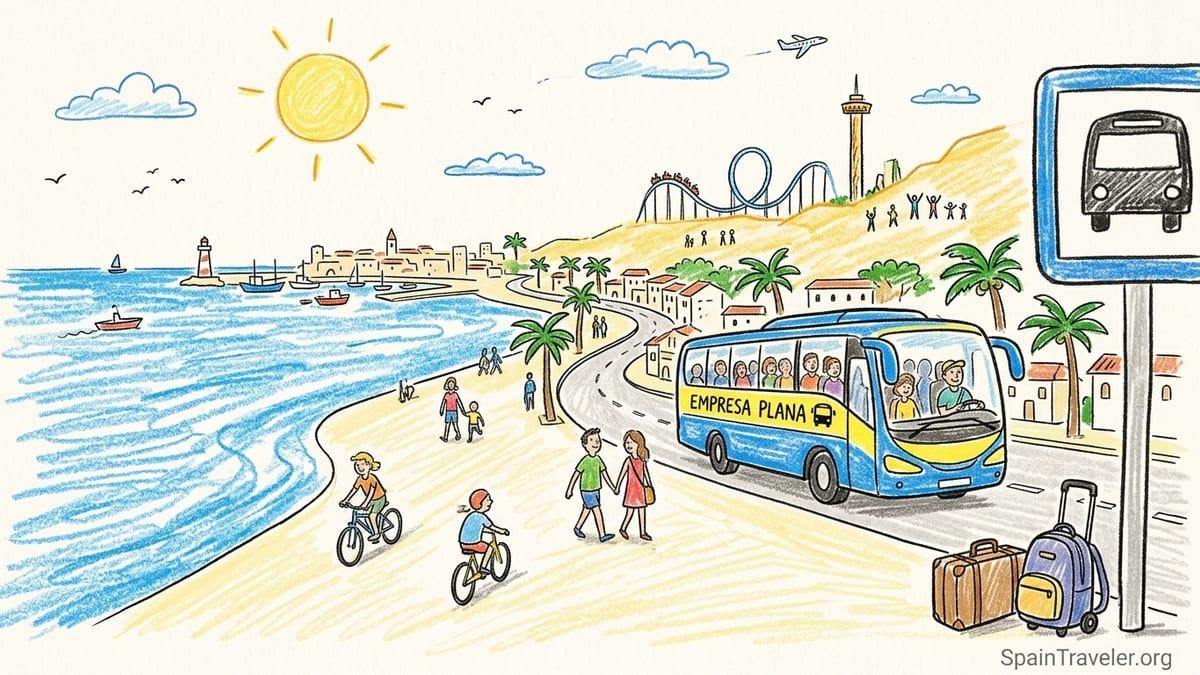
Day to day movement between resorts is then mainly by bus, supplemented by local trains along the so called Mediterranean corridor. Tariffs and timetables are coordinated within Catalonia’s integrated transport system, but several companies operate services. Autocars Plana, often branded simply as Empresa Plana, is the dominant coastal bus operator linking Reus, Tarragona, La Pineda, Salou, PortAventura and Cambrils. Other operators, including Hispano Igualadina and Alsa, provide regional and long distance services, some of which also call at these resorts.
For most travellers planning a beach break, a PortAventura holiday or a city focused stay in Tarragona, hiring a car is optional rather than essential. Buses from Reus Airport are timed to flight arrivals, there are direct buses from Barcelona Airport into the Costa Dorada, and regular services run between the main seaside towns. The main limitations appear once you try to reach more rural villages, wine regions such as Priorat or Montsant or mountain areas inland, where public transport becomes sparse and journey times much longer.
Arriving via Reus Airport
Reus Airport sits a short distance inland from the coast and is the most convenient gateway for many British, Irish and northern European leisure flights. According to Reus Airport’s official information, several bus routes connect the terminal with nearby destinations: one line into Reus city centre, another to Tarragona and others to the coastal resorts including La Pineda, Salou and Cambrils. The airport and local tourism bodies stress that bus departure times are coordinated with flight arrivals rather than running as a simple clockface timetable, so services are concentrated on days and times when flights operate.
From Reus Airport to Reus city, an urban bus service runs to Plaça de la Llibertat and the city’s bus and train stations. This is useful if you are staying in Reus itself or if you need to transfer to other regional buses or the conventional rail network. Importantly, there is currently no direct bus from the airport to Camp de Tarragona high speed station, despite older summaries suggesting a link. To reach Camp de Tarragona by public transport from the airport, you must first take the Reus urban bus into town and then connect onto an Empresa Plana bus from Reus bus station to Camp de Tarragona. This two step journey is manageable but adds a connection, so travellers with heavy luggage may prefer a pre booked taxi for this specific transfer.
For most coastal visitors, the direct airport buses are more appealing. Current official descriptions state that buses run from Reus Airport to PortAventura, Salou and Cambrils, generally via the main seafront avenues and hotel areas. In practice, in a typical summer schedule, several departures operate in each direction over the course of the day on flight days, often starting in the early morning and continuing into the evening. For example, past timetables have shown services around every one to two hours in peak season between the airport and Salou or Cambrils, but travellers should always check the latest timetable close to travel, as exact times and frequencies can shift with airline schedules.
Fares on these airport buses are usually slightly higher than on purely local services, reflecting the dedicated nature of the route, but remain modest by Northern European standards. Single tickets are typically bought directly from the driver in cash or, increasingly, by contactless card. A concrete example: travellers in recent seasons have reported paying under ten euros per person for the airport to Salou route, significantly cheaper than any taxi and competitive given the luggage carriage included. For families arriving on a charter flight, being able to walk from arrivals to the bus stop outside the terminal and board a coach style bus directly to their resort hotel area removes the need for private transfers or car hire.
Arriving via Barcelona Airport
Josep Tarradellas Barcelona El Prat Airport is the main international airport for Catalonia and lies roughly 100 kilometres northeast of the central Costa Dorada resorts. While many visitors still reach the Costa Dorada by taking the airport bus or train into Barcelona city and then changing to regional services, there are also direct bus routes from the airport to Tarragona province. This can be a major time saver for holidaymakers whose accommodation is in La Pineda, Salou, PortAventura or Cambrils.
Information from the airport operator confirms that a regional bus line operates between Barcelona, the airport and the Costa Dorada, calling at towns in Tarragona province such as Torredembarra, Tarragona, La Pineda, PortAventura, Salou, Cambrils and Reus. The route is typically operated by companies such as Empresa Plana or by contractors working within Catalonia’s regional network. On a typical high season weekday, several services leave Terminal 1 and Terminal 2 of Barcelona Airport and continue directly to these coastal stops without requiring a detour into central Barcelona.
In practice, this means a traveller landing at Barcelona Airport around midday can often board an afternoon bus that takes them straight to Salou or Cambrils in around two to two and a half hours, depending on traffic and intermediate stops. Tickets can usually be purchased online in advance through the operator or bought from the driver if seats are available, though advance purchase is recommended at peak times. From a budget perspective, this direct bus is often cheaper than a combination of airport train and regional train, particularly for families, and saves one or two changes with luggage.
Where no direct bus fits your arrival time, the fallback option remains strong. You can take the suburban R2 Nord train from the airport’s Terminal 2 station or the airport metro line to connect into Barcelona Sants, then board a regional or long distance train towards Tarragona, PortAventura or other Costa Dorada stations. However, recent infrastructure works have periodically disrupted some of these rail routes, at times replacing direct segments with rail replacement buses and lengthening travel times. For that reason, travellers who prize simplicity often prefer the direct airport to Costa Dorada bus whenever schedules align with their flight.
Arriving via Camp de Tarragona High Speed Station
Camp de Tarragona is the dedicated high speed rail station serving the Tarragona region. It lies in a semi rural area inland, roughly 10 to 15 kilometres from both Tarragona city and the coast. This location makes it excellent for fast AVE and other high speed services from Madrid, Zaragoza, Barcelona and points in France, but it is not a practical final destination without planning your onward transfer. It is essential to distinguish Camp de Tarragona from Tarragona’s central station, which is the conventional rail station right by the sea in the city centre.
Renfe operates high speed services that stop at Camp de Tarragona, including routes from Barcelona Sants that cover the distance in well under an hour, and long haul services from Madrid and intermediate cities. However, these trains do not continue to the coastal resorts. On arrival at Camp de Tarragona, you have three realistic options to reach the Costa Dorada without a car: a scheduled bus, a taxi or a pre arranged private transfer. There is no metro, and conventional local trains do not serve the high speed station directly.
Regional transport information lists dedicated bus services from Camp de Tarragona to Tarragona city, Reus and sometimes to coastal destinations such as Salou and Cambrils, operated by Empresa Plana or other contracted operators. Buses usually meet the main high speed arrivals, but they are standard public services rather than reserved shuttles. A typical pattern is for buses to run approximately hourly or aligned with AVE timetables during the day. For example, travellers have reported using a direct bus from Camp de Tarragona to Tarragona city that functions like an ordinary regional line, with tickets purchased from the driver and no reservation needed.
Taxi ranks are located immediately outside the station, and taxis are regulated with fixed meters and published supplements for station pick ups and luggage. As a rough orientation, a taxi from Camp de Tarragona to central Tarragona or Reus usually costs noticeably less than one to Salou or Cambrils, simply because of the shorter distance. For couples or small groups with heavy baggage or arriving on late evening AVE services when buses are sparse, a taxi can be a worthwhile expense, especially compared with the time and complexity of chaining multiple buses. The key is to remember that Camp de Tarragona is a separate, out of town station and to build the bus or taxi transfer into your schedule and budget.
Train and Bus Travel Along the Costa Dorada
Once you are on the Costa Dorada itself, moving between the principal towns is relatively straightforward without a car, although the balance between train and bus has shifted in recent years. Historically, a coastal railway line linked towns such as Salou and Cambrils directly, but the opening of a new inland rail corridor has led to the closure of the old seafront tracks between PortAventura and Cambrils. As a result, some local train services now terminate at Salou PortAventura station, just inland from the beach and adjacent to the theme park, while onward travel towards Cambrils or L’Hospitalet de l’Infant is handled by buses.
Renfe’s Rodalies and regional services still provide useful links along parts of the coast. Lines branded R16 and R17, for example, connect Barcelona with towns in the Tarragona region, including Tarragona city and Salou PortAventura. Connections are possible for further travel, but travellers should be aware that engineering works and service changes can temporarily alter routes and times. In peak summer, trains towards the coast can be busy, so it is wise to allow extra time and, where possible, check the latest timetable shortly before travel rather than relying on old printed summaries.
For many local journeys, buses now offer better coverage and more central stops. Empresa Plana operates frequent services linking Tarragona, La Pineda, Salou, PortAventura and Cambrils, often following the coastline and stopping near major hotels, campsites and beach access points. Timetables show daily services from early morning until late evening, with higher frequencies in summer. For instance, between Tarragona and Salou or Cambrils, you can expect departures roughly every 20 to 30 minutes in the middle of the day in high season, dropping to less frequent but still regular services outside peak months.
In practical terms, this means a traveller based in Salou can comfortably plan day trips to Tarragona’s Roman sites or to Cambrils’ harbour without needing a car. Tickets are usually bought from the driver, and regional fare integration means some multi journey cards and travel passes are accepted. In addition, several resort towns offer tourist trains or seasonal local shuttles that loop around accommodation areas, beaches and port districts. These are designed more for short hops and sightseeing than for inter town travel but can make car free life even easier within a single resort.
The Best Car Free Bases on the Costa Dorada
Not all Costa Dorada towns are equally convenient without a car. When you rely on public transport, you want a base that combines direct arrival options with good local connections. In that sense, Salou, La Pineda, Cambrils, PortAventura resort hotels, Tarragona city and Reus stand out as the strongest choices for car free travellers, each suiting a slightly different style of trip.
Salou is arguably the most versatile car free base. It has direct bus links from Reus Airport, from Barcelona Airport and from Tarragona city. Empresa Plana’s network fans out from Salou in both directions along the coast, and there is still a nearby train station at Salou PortAventura for rail day trips. The town’s seafront promenade, beaches and commercial streets are compact enough that most visitors rarely need anything more than a comfortable pair of shoes once they have arrived. For families, the ease of hopping on a short bus ride to PortAventura World or to neighbouring Cambrils adds to the appeal.
Cambrils offers a slightly quieter, more traditional seaside atmosphere while still enjoying strong bus connections to Salou, PortAventura, Tarragona and Reus Airport. Its old town and fishing port are both walkable, and most accommodation lies within reach of the beach and bus routes. La Pineda, smaller again, is attractive for those who want to be close to both Salou and Tarragona, with buses heading in both directions and direct links from Barcelona Airport on some regional routes.
Tarragona city is ideal for travellers more interested in culture and history than in being right in the heart of a resort. The central rail station on the seafront connects by train to Barcelona and other parts of Catalonia, while the city’s bus station and urban network offer frequent services to the coastal resorts and to Reus. From a car free perspective, Tarragona gives you big city amenities, a remarkable concentration of Roman remains, and access to beaches via a short local bus or a walk from some neighbourhoods. Reus itself suits visitors who want a more urban inland base with strong bus links to Tarragona and the coastal towns, combined with an attractive modernist heritage.
Sample Car Free Itineraries and When a Car Helps
To illustrate how the region works in practice without a vehicle, it helps to look at a few typical trip scenarios. A classic beach only holiday might involve flying into Reus Airport on a summer charter or low cost flight, walking from arrivals to the clearly signposted bus stop and boarding a direct airport bus to Salou. After around 30 to 40 minutes, depending on intermediate stops, you would step off near your hotel, check in and spend the rest of the week exploring Salou’s beaches, restaurants and bars on foot. Occasional day trips to neighbouring Cambrils or La Pineda would be as simple as catching an Empresa Plana bus from the main seafront avenue.
For a PortAventura focused holiday without a car, two main patterns work well. One option is to stay in one of the official PortAventura World hotels, which are within walking distance of the park entrances and the Salou PortAventura train station. You might arrive via a high speed train to Camp de Tarragona, then take a taxi directly to your hotel, or arrive via Barcelona Airport and use a direct bus that stops at “Hotels PortAventura” before continuing to Reus. Once checked in, you could spend several days in the theme parks and water park without worrying about transport at all, occasionally walking or taking a short taxi into Salou town if you want a change of scene.
A Tarragona culture trip works differently. Here you might arrive via Barcelona Airport, take a direct bus to Tarragona bus station and then walk or take a short urban bus ride to your hotel in the historic centre or near the amphitheatre. Over several days you could explore the UNESCO listed Roman ruins, the cathedral quarter and the seafront without a car. On one day you might catch a frequent bus down to Salou or La Pineda for a beach day, returning to Tarragona in the evening. Because both the bus and train stations sit relatively close to the centre, you could also slot in a rail day trip to Barcelona without difficulty.
For travellers wanting a mix of beach and inland landscapes, the limits of car free travel become more apparent. You could, for example, base yourself in Cambrils or Salou for a few days of sea and sand, then move inland to a village in the Priorat wine region or to the Montsant mountains. While it is technically possible to reach some of these inland areas by a chain of regional buses or a train plus a bus, frequencies are low, and schedules are designed for locals rather than tourists. A journey that looks short on the map can stretch to several hours with long waits for connections. In these rural zones, a rental car, even for just two or three days, gives access to scattered wineries, trailheads and viewpoints that would otherwise be impractical to reach.
Key Distinctions: Tarragona City vs Camp de Tarragona
One of the most common points of confusion for first time visitors is the difference between Tarragona’s two main rail points: Tarragona city station and Camp de Tarragona high speed station. The city station, often labelled simply “Tarragona” in booking systems, is a conventional rail station right by the seafront and within easy walking distance of the historic centre. It is served by regional and long distance trains along the Mediterranean corridor, including services from Barcelona and Valencia. If you are staying in Tarragona city or planning to use buses from Tarragona to coastal resorts, this is usually the station you want.
Camp de Tarragona, by contrast, appears in reservations as a separate station and is located well inland. It is served exclusively by high speed services, so journey times from cities like Madrid or Zaragoza are significantly shorter than into Tarragona city station. However, upon arrival you must transfer to a bus, taxi or private transfer to reach the coast or the city centre. Travellers who accidentally book trains to Camp de Tarragona when they intended to stay in the city sometimes find themselves facing an unexpected extra leg of the journey, so it is vital to double check which station your ticket lists.
From a car free planning perspective, this distinction affects your choice of route. If you prioritize speed from Madrid or northern Spain and are comfortable budgeting for a bus or taxi at the end, Camp de Tarragona is an efficient gateway. If, on the other hand, you value a simple, single seat ride that delivers you directly into the city, a slightly slower conventional train into Tarragona city station may be preferable. Similarly, if you are heading straight to Salou or Cambrils, it can be worth comparing a high speed service to Camp de Tarragona plus a taxi with a slower but direct bus from Barcelona or a regional train plus bus combination.
In all cases, making a deliberate decision about which station best suits your plans will prevent surprises. When using booking platforms, pay close attention to station names and, where possible, consult a map to see where each lies in relation to your accommodation. Booking a hotel “near Tarragona station” only to discover you are arriving at Camp de Tarragona can make an otherwise easy car free trip feel unnecessarily complicated.
The Takeaway
For a coastal holiday focused on beaches, PortAventura World and the city of Tarragona, the Costa Dorada is very manageable without a car. Reus Airport provides coordinated bus links to Reus, Tarragona and the main resorts, while Barcelona Airport offers direct buses into the heart of the Tarragona province. Camp de Tarragona connects the region to Spain’s high speed rail network, and although it requires a bus or taxi transfer, it remains a powerful option for car free travellers coming from Madrid, Zaragoza or France.
Along the coast, a dense web of Empresa Plana and other regional buses links La Pineda, Salou, PortAventura, Cambrils, Tarragona and Reus, with services frequent enough in high season to allow spontaneous day trips. Trains continue to play an important role on some routes, particularly into Tarragona city and Salou PortAventura, but buses have taken over many of the old coastal rail functions, often with the advantage of stopping closer to hotels and beaches. Choosing a base like Salou, Cambrils, Tarragona or La Pineda will put you at the heart of this network.
Where the car free model begins to strain is beyond the main urban axis. Rural wine regions such as Priorat and Montsant, mountain villages and scattered coastal coves that lack major resort development remain difficult to access by public transport alone. For travellers whose main goal is to tour vineyards, hike remote trails or stay in isolated country houses, hiring a car for at least part of the trip remains the most practical solution. Many visitors therefore mix approaches: a first week car free on the coast using buses and trains, followed by a shorter self drive segment inland.
Ultimately, the Costa Dorada rewards both types of travel. With some advance planning around airport buses, rail stations and resort connections, it is entirely feasible to enjoy a rich, varied holiday without ever touching a steering wheel. At the same time, knowing when and why a car becomes helpful will allow you to decide whether to stay fully car free or to combine public transport with a targeted period of driving.
FAQ
Q1. Is it realistic to stay on the Costa Dorada without renting a car?
Yes. If you base yourself in towns such as Salou, Cambrils, La Pineda, Tarragona or PortAventura’s resort hotels, buses and trains provide enough coverage for airport transfers, day trips and general sightseeing, especially in spring, summer and early autumn.
Q2. Which arrival option is easiest if I do not want to drive at all?
For charter and low cost holiday flights, Reus Airport combined with the coordinated resort buses is usually the simplest. For long haul or year round options, Barcelona Airport with a direct bus to Tarragona, Salou or Cambrils is the most straightforward fully public transport solution.
Q3. How far is Camp de Tarragona station from the coast?
Camp de Tarragona lies roughly 10 to 15 kilometres inland. Expect around 20 to 30 minutes by bus or taxi to reach Tarragona city and slightly longer to reach Salou or Cambrils, depending on traffic and the exact route.
Q4. Do I need to book buses from the airports in advance?
It is often possible to pay the driver on the day, but in high season and on popular weekend flights, advance tickets can be useful for peace of mind, especially on Barcelona Airport to Costa Dorada services. Always check the operator’s current advice before travel.
Q5. Are public transport services reduced outside the summer season?
Yes, frequencies on some coastal and airport routes drop in the low season when there are fewer flights and holidaymakers. Core connections still operate, but you may find gaps of an hour or more between buses where they were every 20 to 30 minutes in August.
Q6. Can I reach PortAventura World easily without a car?
Yes. There are direct buses from Reus Airport and Barcelona Airport that stop at or near PortAventura hotels, a train station named Salou PortAventura with services from Barcelona and Tarragona, and frequent local buses from Salou and La Pineda to the park area.
Q7. Is Tarragona city a good base for beach time without a car?
Tarragona works very well if you want culture first and beach second. The city has its own urban beaches reachable on foot or by short bus rides, and you can easily reach resort beaches in Salou or La Pineda for day trips by frequent regional buses.
Q8. When does it make sense to rent a car on the Costa Dorada?
A car becomes advantageous when your plans focus on rural wine regions, mountain hiking, scattered farm stays or multiple small inland villages in a short time. Public transport to places like Priorat exists but is sparse and time consuming compared with driving.
Q9. How should I choose between Tarragona city station and Camp de Tarragona when booking trains?
If your accommodation is in Tarragona city or you want an arrival point that requires no extra transport, choose Tarragona city station. If you prioritise the fastest possible journey from Madrid, Zaragoza or northern Spain and accept a bus or taxi transfer at the end, Camp de Tarragona can be better.
Q10. Are taxis easy to find if my bus or train does not line up well with my arrival?
Yes. Taxi ranks are present at Reus Airport, Barcelona Airport, Camp de Tarragona and the main bus and train stations along the coast. They provide a reliable backup if a late arrival or service change makes public transport connections inconvenient.