


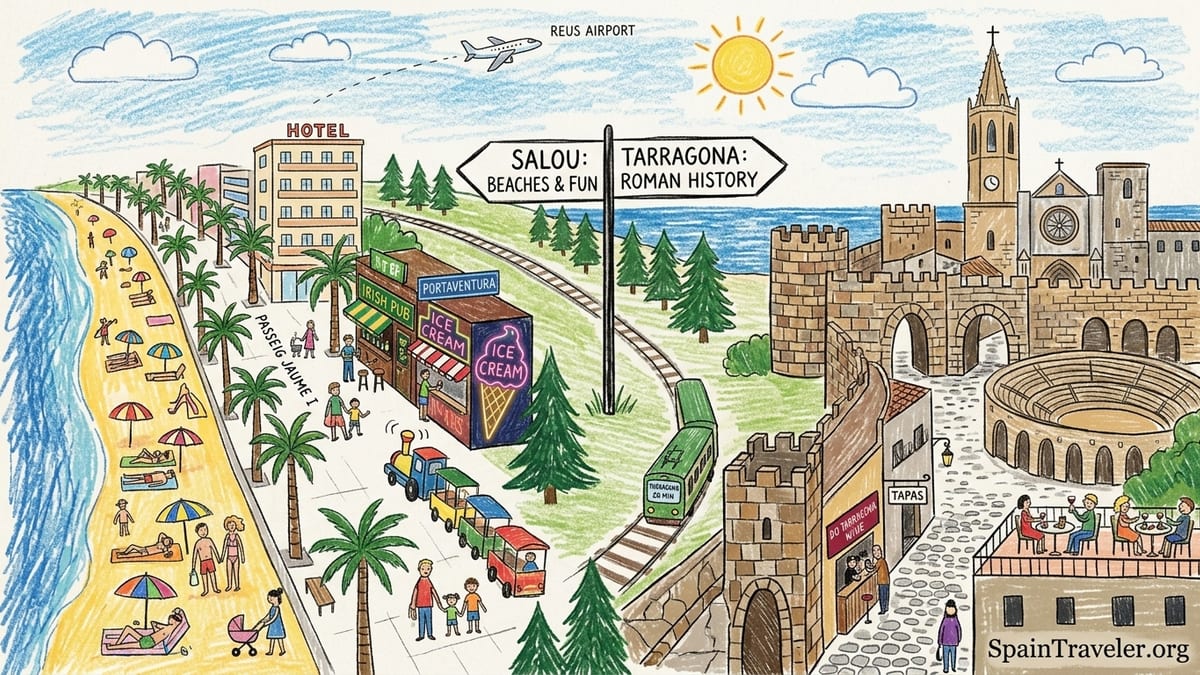
I arrived on the Costa Dorada at Reus Airport on a hot afternoon in late June, half expecting one long strip of identical beach resorts. I had booked seven nights, split between a small hotel near Salou’s main promenade and an apartment in Tarragona’s old town, assuming I would mostly stroll between bars, beach and maybe one day at PortAventura. I did rent a car for four days, thinking it would be essential, and planned a couple of easy train hops to keep things simple. What I actually found was a region that shifted every few kilometres, from neon-lit Salou and family-packed La Pineda to the working harbour of Cambrils, Roman stones in Tarragona, and vineyard roads curling inland. The more I drove and walked, the more it stopped feeling like a single “resort coast” and started to look like a small, varied slice of Catalonia tied together by sand, wine and a lot of summer heat.
First Impressions: A Week Split Between Salou and Tarragona
My base for the first four nights was a modest hotel a few blocks behind Salou’s Passeig Jaume I, the palm-lined promenade that fronts the main beach. My flight landed at Reus, the small airport that serves much of the Costa Dorada, and from there I took a shuttle into Salou before picking up a rental car near the resort. The drive from Reus Airport to Salou took around 20 minutes along busy but straightforward roads, with billboards for PortAventura and water parks making it very clear who this coastline is marketed to.
Walking down to the seafront that first evening, my initial stereotype of the Costa Dorada felt confirmed. The promenade was full of neon ice-cream signs, Irish bars shouting live sports, souvenir shops and massage offers, and a constant flow of families pushing strollers or kids wobbling on scooters. The main beach really is golden and shallow, just as the tourist brochures promise, and on a warm June evening the water felt like a bath. It was busy, but not oppressive, with lifeguard posts, showers and sunbed concessions spaced along the sand.
After four nights in Salou, I moved to Tarragona by regional train from Salou-PortAventura station, a short ride of roughly 20 minutes that cost less than what I had paid to park for a single afternoon in town. I checked into an apartment just inside the medieval walls near the cathedral. The contrast with Salou was immediate. Instead of loud pubs and hotel animation, I stepped into stone alleyways, small wine bars serving local DO Tarragona and Priorat bottles, and a view down to the Mediterranean past layers of Roman amphitheatre and modern port cranes.
My original plan had been to stay longer in Salou and treat Tarragona as a day trip, but by the second evening in the old town I realised I had misjudged it. Tarragona worked far better as a base for exploring both coast and inland, especially for anyone who wants nightlife built around tapas, wine and history rather than karaoke and 2-for-1 cocktails.
Busy Promenades vs Quiet Coves: How the Coast Really Feels
Before this trip I assumed the entire Costa Dorada, from Cunit to L’Hospitalet de l’Infant, was one long succession of beaches that looked and felt the same. The first mistake I made was treating Salou’s main beach as the template for everything else. In the resort hubs, particularly Salou and parts of La Pineda, the promenade culture is intense. You have wide pavements, constant music from bars, tourist trains ringing bells, and rows of sunbeds laid out almost down to the water line. The atmosphere is cheerful but commercial, and by the third day I started actively looking for quieter sections of sand.
A short drive or bus ride changes the picture. Heading north from Salou toward Tarragona, the coastline breaks into smaller coves backed by pine trees and low villas. At Platja Llarga and the small coves near Cap Salou, the crowds thinned, and I could actually hear cicadas rather than bar playlists. The sand was the same fine gold that gives the Costa Daurada its name, but the experience was different. There were fewer inflatable toys, more people reading or snorkelling, and beach bars that felt like simple chiringuitos instead of mini-malls.
Cambrils provided another contrast. Its long beach promenade is busy in the evenings, but the mood is less frantic than Salou. The town has a real fishing port, and walking the seafront you see locals out for a stroll, kids cycling between playgrounds and older couples on benches watching the last ferries come in. The restaurants along the harbour serve a lot of seafood tied to what comes into the auction: grilled sardines, suquet de peix and rice dishes that mention the day’s catch. It felt less like a purpose-built resort and more like a Catalan coastal town that happens to welcome plenty of tourists in summer.
My favourite discovery was the stretch around Tamarit and the protected natural area of Punta de la Mora. Here the beach backs onto pines and low dunes, with a castle perched on the headland. Parking is more limited and unpaved in places, which keeps numbers down a little, and there are sections where you walk a few minutes through the trees before the sand appears. On a late afternoon visit the light turned the water almost silver and you could look back from the shoreline and see no hotel towers at all, just forest and stone. It was hard to believe that Salou’s karaoke bars were only a short drive away.
Tarragona’s Historic Centre: More Than a Day Trip
The official tourism information bills the Costa Daurada as a mix of beach, heritage, nature, wine, family activities and sport, but many visitors never get beyond the pool and the park gates. Tarragona, which sits roughly in the middle of the coast, embodies that broader offer in a way I did not fully appreciate until I stayed in the old town. The Roman remains alone justify at least a full day. The amphitheatre drops down toward the sea, ringed by modern roads yet still remarkably atmospheric. The circus ruins cut under present-day streets, and you pop out of excavated vaults straight into plazas filled with cafe tables.
Spending nights there changed my perception of the region. Mornings began with coffee on Plaça de la Font while municipal workers set up for the day and a few tourists unfolded paper maps. In the heat of the afternoon, I would duck into the cathedral’s cool interior or explore sections of the Roman walls that circle the city. Evenings were about wandering from one small square to another, picking tapas bars with blackboards announcing local wines and daily specials. A plate of grilled calçots out of season, xató salad and a glass of chilled white from nearby DO Tarragona cost roughly what a single resort cocktail did in Salou.
What surprised me most was how lived-in Tarragona felt, despite its UNESCO-listed stones and cruise ship calls. On a Tuesday night in June the Rambla Nova was busy, but mostly with residents walking dogs, kids practising skate tricks and friends greeting each other outside ice-cream shops. It was easy to forget you were in the heart of a major tourist region. From this base you can reach beaches such as Savinosa or Arrabassada in a short bus ride or drive, and these city beaches felt distinct again, with more local families and after-work swimmers than international holidaymakers.
In hindsight, staying only three nights in Tarragona was my second big planning mistake. It deserved at least five if I wanted to combine its heritage, the surrounding beaches and some inland excursions without rushing. As a base it balanced access to the rest of the Costa Dorada with a sense of place that I did not find in the resort-strip hotels.
Driving, Trains, Inland Roads and the Reality of Getting Around
When I booked the trip, I assumed a car was essential for exploring beyond the main resorts, so I reserved one for four days. In practice, I used it heavily for inland and less connected coastal spots and realised that for certain journeys it actually made less sense than the train. From Salou I took the regional rail line up to Tarragona for a scouting day before moving bases. The ticket bought at the station cost under the price of an hour of resort parking, and the journey took about twenty minutes along the coast. Watching the traffic on the parallel highway crawl past, I realised I should have used the train earlier for visits to Tarragona and PortAventura rather than driving and hunting for spaces.
Parking is where the Costa Dorada punishes casual drivers. In June, on-street spaces in Salou’s central area were almost always full by mid-morning, and blue-zone paid parking added up quickly if you were out for a long beach day. Multistorey car parks near the seafront offered more certainty, but by the time you added the daily rate to fuel and tolls, the numbers compared poorly with the affordable Rodalies and regional train fares connecting Tarragona, Salou and the PortAventura station. My decision to drive from Salou to Tarragona for an early dinner one night instead of hopping on the train meant twenty minutes in slow traffic and another twenty looping for a half-decent spot outside the historic centre.
Inland the experience flipped. Away from the dense resort towns, the roads opened up and driving became a pleasure. Heading toward the Prades mountains and the wine areas inland from the coast, I followed secondary roads lined with vineyards and olive groves, passing through sleepy villages where the main square held a single cafe and maybe a cooperative wine cellar. Tourist information for the Costa Daurada highlights these rural routes, and they really do reveal a different face of the region, but you need a vehicle or a very patient schedule with infrequent buses to enjoy them comfortably.
If I were advising another traveller, I would say combine both: use public transport between the main coastal hubs and only rent a car once you actually plan to go beyond them. My mistake was picking up the car immediately upon arrival in Salou and then leaving it unused for two full days while I walked the promenade. On a return visit I would time the rental to begin on the day I left Tarragona to head inland, saving money and avoiding unnecessary time behind the wheel in beach-town traffic.
Summer Heat, Crowds, Evenings and the Character of Each Town
The climate of the Costa Dorada is firmly Mediterranean, with hot, dry summers and mild winters. By late June daytime temperatures in Tarragona were regularly around the high twenties to low thirties Celsius, and the sun on the open promenade in Salou felt particularly fierce in the early afternoon. I learned quickly that most activities beyond lying under a parasol were best planned either for early morning or after 6 p.m. Inland, where breezes from the sea had less impact, the heat was more intense, and village streets emptied between lunch and early evening.
The way each town handled evenings was one of the most revealing aspects of the trip. In Salou, nights revolved around the seafront and the main commercial streets behind it. Families queued for amusement rides, teenagers gathered outside fast-food chains, and light-and-music shows along the promenade fountains drew crowds with phones held high. Noise levels stayed high well past midnight near clusters of bars, and while it was lively, it sometimes felt more like an outdoor shopping centre than a Mediterranean town.
Cambrils was different. Its promenade filled with walkers and cyclists too, but much of the action shifted to restaurant terraces overlooking the harbour. There you could linger over a long seafood dinner while the sun went down, watching fishing boats as background rather than neon signage. La Pineda, a short drive in the other direction, felt like a compromise between the two, with water parks and resort complexes but also some quieter residential streets set back from the beach.
Tarragona’s evenings were my favourite. The old town’s small plazas came alive as the day cooled, with children playing around fountains while parents talked over vermut or beer. On Rambla Nova, people dressed more smartly than along the Salou strip, and the focus was as much on socialising as on consumption. I found a tiny bar pouring wines from DO Priorat and Montsant at very fair prices by the glass and ended up there two nights in a row, talking with locals about their favourite coves and inland drives. It was in those conversations that the region’s official themes of heritage, wine and local culture stopped being brochure lines and became real suggestions.
Beyond the Resort Strip: Heritage, Wine and Nature Inland
One of my biggest planning errors was assuming that inland Costa Dorada could be squeezed into a single half-day. The region’s tourism material emphasises that beyond the coast there are monasteries, vineyards and mountain landscapes, and this is not just marketing. Less than an hour’s drive from the beaches you find countryside that feels almost disconnected from the package-holiday world. I headed toward the Prades mountains and the edges of the Priorat and Conca de Barberà areas, following brown signs indicating viewpoints, hermitages and cooperatives.
In one village the cooperative wine cellar occupied a beautiful early twentieth-century building sometimes described locally as a “cathedral of wine,” with brick arches and high windows letting in filtered light. A tasting of a few local reds and whites cost little more than a coffee on the Salou seafront and came with an explanation, in simple English and Catalan, of the different designations of origin that overlap in the Costa Daurada hinterland. Driving these roads you frequently see cyclists tackling long climbs and hikers setting off on signposted trails, a reminder that sport tourism here is not limited to jet skis and beach volleyball.
Heritage inland competes strongly with that on the coast. The Cistercian monastery of Poblet and the medieval town of Montblanc, both promoted by the regional authorities as key cultural visits, lie within reach of a day trip from Tarragona or Salou. I only had time to pass through one small historic town near this route, and the brief stop convinced me that I had allocated my days poorly. A coffee in a stone square under plane trees, with not a single beach towel in sight, was a stark contrast to the bustle of the resort promenade. Locals mentioned festivals featuring human towers and medieval markets that draw visitors from across Catalonia, reinforcing how much of the Costa Daurada story happens away from the sand.
Nature reserves such as the coastal dunes and pine groves at Tamarit-Punta de la Mora or the more mountainous protected areas further inland underline how varied the landscapes are. Walking a short circular trail among pines with glimpses of sea and castle towers felt worlds away from the loudspeaker announcements of hotel pools. I left with the clear sense that anyone who limits their Costa Dorada experience to a sun lounger and a theme park queue is missing half of what the region is quietly proud of.
Hits, Misses and Where I Would Base Myself Next Time
Looking back, what I liked least were the sections of coastline that felt completely dominated by commercial strips and high-rise hotels. Parts of Salou and some corners of La Pineda fit this description, with menus identical from one block to the next and little sense of local food or culture. These areas do deliver what many families want: easy access to the beach, predictable entertainment, and the big attractions of PortAventura and nearby water parks. But for travellers seeking a more nuanced sense of place, they can feel repetitive after a couple of days.
On the positive side, I did appreciate how well the main resorts cater for children and multi-generational groups. The shallow beaches, playgrounds spaced along the promenades, and steady policing presence made the seafronts feel safe even late into the evening. I could see why the region promotes itself heavily as a family tourism destination, with theme parks, bike hire, water sports and heritage sites all within reasonable reach.
The places where I unexpectedly wanted more time were Tarragona, Cambrils and the inland wine villages. Tarragona deserved at least a full extra day simply to move at a slower pace between its Roman sites, city beaches and tapas bars. Cambrils merited a night or two rather than a rushed dinner, to sample its seafood restaurants and enjoy its more balanced mix of tourism and local life. Inland, I regretted not scheduling a full day for vineyard visits and walking, ideally with a designated driver or an organised tour so I could taste wines without worrying about the road back.
In terms of bases versus day trips, my conclusions are clear. Salou works best as a base for travellers focused on theme parks and late-night entertainment, or those who value being in the heart of the resort action. Tarragona is a stronger choice for travellers who prioritise history, local food and a more urban yet authentic atmosphere, while still having beach access. Cambrils or one of the quieter coastal towns sit nicely in the middle as bases for a lower-key seaside holiday with good eating. Inland villages and mountain areas are better approached as day trips or short overnights unless you are deliberately planning a hiking or wine-focused stay.
The Takeaway
My week on the Costa Dorada began with the expectation of a straightforward resort holiday and ended with a much more layered impression of the region. The official tourism messaging that groups together beach, heritage, nature, wine, family activities and sport is not an exaggeration, but you have to step off the main promenade to see it in practice. Salou and the neighbouring resort areas deliver exactly what many visitors are looking for. Yet only a short train ride or drive away you find Roman amphitheatres, medieval cloisters, pine-backed coves and vineyard roads that feel almost forgotten by mass tourism.
If I were planning a second trip, I would make three concrete changes. First, I would shorten my stay in Salou and lengthen my time in Tarragona, perhaps splitting the week between three nights near the old town and four nights in a quieter coastal spot like Cambrils or near Tamarit. Second, I would avoid renting a car until the days I intended to go inland, relying on trains and local buses between the main resorts and heritage centres to save money and stress. Third, I would dedicate at least a full day, preferably two, to exploring inland Costa Daurada, visiting a monastery, walking in the hills and spending unhurried time in one or two wine villages.
The Costa Dorada can absolutely be a classic sun-and-sand break, but it rewards curiosity. The difference between a week spent shuttling between hotel buffet and beach lounger, and a week that also includes Roman stones under the evening light, seafood by a working harbour, and the dusty smell of vineyards at sunset, comes down less to distance than to intention. On this first visit I made enough mistakes to know that the next one could be much richer, and that is perhaps the best reason to return.
FAQ
Q1. Is a car necessary to explore the Costa Dorada?
For the main coastal towns like Salou, Cambrils and Tarragona, trains and local buses work well, so a car is not essential. A car becomes useful if you want to explore inland monasteries, villages and wine regions, or reach more remote coves with limited public transport.
Q2. Which town is the best base for a first visit?
If you want a balance of beach, history and local life, Tarragona is a strong base. Salou suits visitors focused on theme parks and nightlife, while Cambrils offers a calmer seaside feel with excellent seafood and an active harbour.
Q3. How hot does it get in summer on the Costa Dorada?
In July and August, daytime temperatures are often around the high twenties to low thirties Celsius, especially in the afternoons. The heat is strong on exposed promenades and inland areas, so plan sightseeing for mornings or evenings and keep beach time well shaded.
Q4. Are the beaches very crowded?
Beaches in major resorts such as Salou can be very busy in school holiday periods, especially near the main promenades. Quieter experiences are possible by walking to the ends of larger beaches, seeking out pine-backed coves near Cap Salou or Tamarit, or visiting outside peak hours.
Q5. Is Tarragona worth more than a day trip from Barcelona or Salou?
Yes, staying at least one or two nights in Tarragona allows you to enjoy the Roman sites, cathedral area, local bars and evening atmosphere at a slower pace. It also makes it easier to combine city time with visits to nearby beaches and inland attractions.
Q6. How family friendly is the Costa Dorada beyond the resorts?
The whole region is very family oriented, with shallow beaches, playgrounds, theme parks and many easy walking paths. Inland villages and heritage sites such as monasteries or castles can also be engaging for children, especially when combined with short walks or picnics.
Q7. Can I visit inland wine areas without joining a tour?
It is possible to drive yourself to cooperative cellars and wineries in the hinterland, where many welcome visitors for tastings. However, you should plan carefully for opening hours and designate a driver who is not tasting, or consider an organised tour if you want to sample more wines.
Q8. Are there quieter alternatives to Salou for evenings?
Cambrils, Tarragona and smaller coastal towns provide calmer evenings focused on harbour walks, tapas and local bars rather than loud nightlife. Choosing accommodation a few streets back from the busiest promenades also helps ensure quieter nights.
Q9. When is the best time of year to avoid crowds but still enjoy the beach?
Late May, June and September usually offer warm weather suitable for swimming with fewer crowds than peak July and August. Outside school holidays you can often find more space on the beaches and easier parking.
Q10. How many days do I need for a good overview of the Costa Dorada?
A week is a comfortable length for combining resort time, Tarragona’s historic centre, one day at a theme park and at least one inland excursion. With fewer days you may prefer to choose a single base and focus on either the coastal resorts or the heritage and wine areas.