


Spanish islands are often marketed with glossy images of convertibles and winding coastal roads, but you do not need a car to have a smooth, independent holiday. If you choose the right island and, crucially, the right base within that island, buses, ferries, taxis and your own two feet can cover almost everything you want to see. This guide compares the main Spanish island groups, drills down into specific resort towns and explains where hotel location matters most for car-free travel.
How to Think About Car-Free Spanish Island Travel
Going car-free on Spanish islands comes down to three questions: how dense and frequent the public transport network is, how walkable your chosen base is, and how far your must-see sights are from that base. The good news is that on the most visited islands in the Balearics and Canaries, the combination of buses, occasional taxis and organized excursions is usually enough, provided you stay in the right town.
On islands such as Mallorca and Tenerife, the regional bus networks now connect airports with major resorts and inland towns, with fares that are often below 7 euros for the longest journeys and capped on most lines. In Mallorca, the TIB buses link Palma to almost every major resort, from Port de Sóller in the northwest to Alcúdia and Pollença in the north and Santanyí in the south, while local EMT buses cover Palma and its suburbs. In Tenerife, frequent lines connect the main southern resorts of Los Cristianos, Playa de las Américas and Costa Adeje with Tenerife South Airport and with Santa Cruz in the north.
The trade-off is that some scenic corners, such as tiny calas in northeast Mallorca or remote hamlets in La Gomera, are reachable by bus only a few times a day, if at all. That is where a strategic choice of resort town can remove the need for a rental car. If your hotel is a 5 minute walk from the main bus station on the promenade, from the ferry pier and from a beach with services, you can cover 80 to 90 percent of typical holiday activities without ever touching a steering wheel.
Finally, mindset matters. Travelers used to driving everywhere often underestimate how easy it is to combine a morning bus, an afternoon coastal walk and an occasional taxi ride of 10 to 20 euros to bridge awkward gaps. If you go in with realistic expectations, avoid last-bus-of-the-day risks, and accept that you will not reach every viewpoint, car-free travel on Spanish islands can feel liberating rather than limiting.
Mallorca: Palma, Port de Sóller and the North Coast
Mallorca is one of the easiest Spanish islands to visit without a car because its public transport network is both extensive and geared to visitors. The island’s red and yellow TIB buses radiate from Palma to nearly all major towns and resorts, including Alcúdia, Pollença, Port de Sóller, Cala Millor and Santanyí, with clear maps and capped fares so that even the longest routes stay in the single digits in euros. A separate EMT network of 30-plus lines circulates within Palma, linking the old town, port, bus station and beach suburbs, and airport buses run regularly into the city.
For many visitors, staying directly in Palma eliminates any need for a car. You can land at the airport, take the airport bus to the city in about 20 minutes, check into a hotel near the old town or Paseo Marítimo, and then rely on EMT buses to reach the cathedral, Bellver Castle, and the main beach at Playa de Palma. Bicycle rental and bike-share schemes fill the gaps along the seafront. From Palma’s intermodal station, TIB buses and the island’s SFM trains head inland toward Inca, Sa Pobla and Manacor, which is enough to explore vineyards, markets and a few traditional towns on day trips.
Port de Sóller is a particularly strong base for car-free travelers who want sea and mountains without driving. A heritage wooden train runs from Palma to Sóller town, and a tram then continues down to Port de Sóller. In addition, regular TIB buses link Palma and Port de Sóller via the mountain road, and seasonal services continue along the spectacular northwest coast toward Deià and Valldemossa. If you stay in a seafront hotel near the tram stop in Port de Sóller, you can walk to restaurants, take boats to nearby coves in summer, and join guided hikes in the Tramuntana without needing your own wheels.
In the north, Alcúdia and Port d’Alcúdia work well without a car if you choose your location carefully. Buses from Palma serve Alcúdia’s historic town and continue to Port d’Alcúdia, Platja de Muro and sometimes to Can Picafort. A hotel near the main bus stops on the beach road means you can walk to long sandy beaches, supermarkets and restaurants, and then ride buses to Pollensa, Port de Pollença or even down to Palma for a day. If you want to add more remote beaches like Formentor, you can either take restricted local buses in peak season or join a boat excursion from Port d’Alcúdia or Port de Pollença.
Tenerife: South Coast Bases and Puerto de la Cruz
Tenerife is arguably the most car-free friendly island in the Canaries thanks to its dense bus network and compact resort towns. The main southern tourist strip, formed by Los Cristianos, Playa de las Américas and Costa Adeje, is directly linked to Tenerife South Airport by regular buses, with typical one-way fares in the low single digits in euros and departures roughly every 30 minutes during the day. If you choose a hotel in these resorts within a short walk of the coastal promenade or main bus stops, you can reach beaches, shopping centers and restaurants entirely on foot.
From these southern bases, long-distance buses run to Santa Cruz, the island’s capital, to the UNESCO listed town of La Laguna and to Puerto de la Cruz in the north. Travelers report being able to see a large share of the island from a base in Costa Adeje or Los Cristianos using these buses, plus the occasional guided excursion for specific sights. For example, morning departures head up toward the Teide National Park visitor center, giving car-free visitors access to high-altitude hiking trails and the cable car base station on certain days.
Puerto de la Cruz, on the north coast, is another excellent option for visitors who prefer a more traditional town feel. Here, many mid-range hotels and guesthouses sit within a few minutes’ walk of the central bus station, the old harbor and the famous Lago Martiánez saltwater pools. Buses connect Puerto de la Cruz to La Orotava, Santa Cruz, La Laguna and the airport, while urban life remains concentrated enough that you can stroll from your hotel to cafes, black-sand beaches and supermarkets. Some travelers combine a week based in the south with a few days in Puerto de la Cruz to experience both the resort and local sides of the island without ever picking up a car.
The key in Tenerife is to map your wish list against bus routes when choosing accommodation. If your priority is nightlife, easy airport transfers and boat trips to nearby La Gomera, the southern strip around Playa de las Américas and Los Cristianos makes sense. If you care more about subtropical gardens, a local atmosphere and access to Anaga’s hiking areas via bus and guided walks, then Puerto de la Cruz or Santa Cruz are better bets. In all cases, hotels close to the main bus interchanges remove much of the friction from car-free exploration.
Gran Canaria: Maspalomas, Playa del Inglés and Puerto de Mogán
Gran Canaria combines a compact size with a well used bus system, making it manageable without renting a car, especially if you base yourself along the southern coast. Buses operated by the island’s main company link Gran Canaria Airport with major southern resorts such as Maspalomas, Playa del Inglés and Puerto de Mogán. Typical fares from the airport to Maspalomas are in the range of 4 to 6 euros, and services run from early morning into the evening, with more limited night coverage.
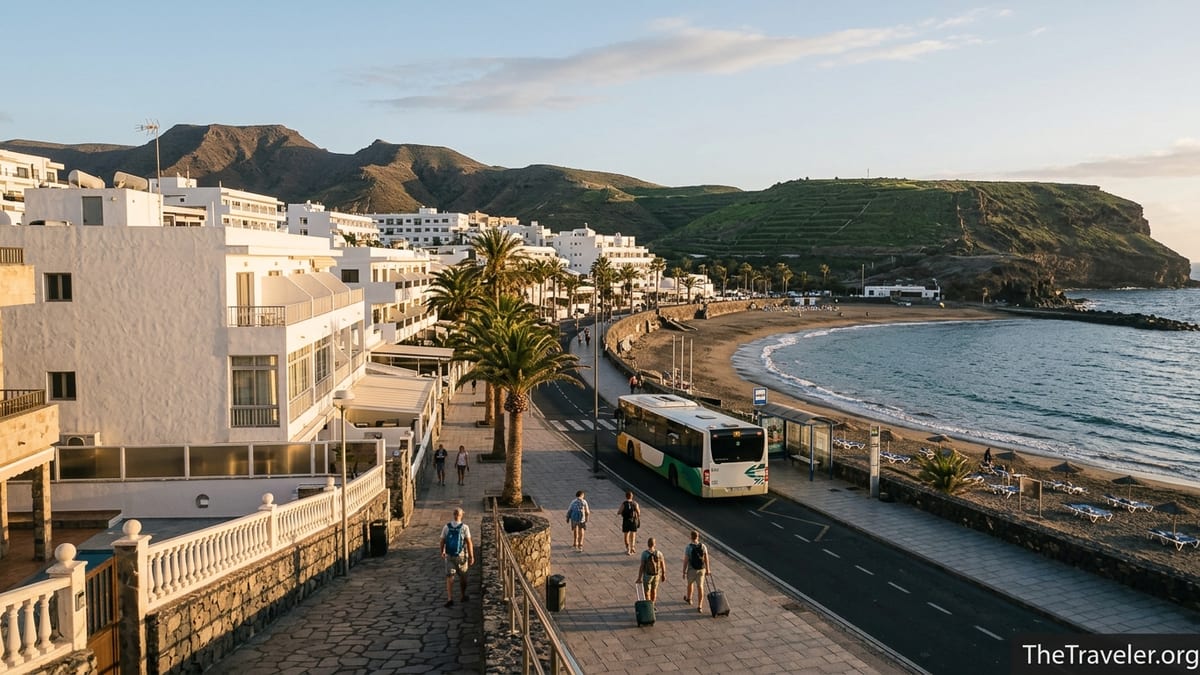
Choosing a hotel near the bus stops in Maspalomas or Playa del Inglés allows you to arrive from the airport, walk to your accommodation and then move around almost entirely on foot. The long promenade, dunes and beaches are accessible from most hotels, while local buses run frequently between Faro de Maspalomas, Playa del Inglés, San Agustín and the nearby shopping centers. If you want a quieter, more picturesque base, Puerto de Mogán at the island’s southwestern tip offers a compact marina, beach and old village within an easy stroll of each other. Buses from the airport and from Las Palmas stop within walking distance of the accommodation cluster.
From these southern resorts, express buses run north along the motorway to the capital, Las Palmas de Gran Canaria, in about an hour. That makes it realistic to spend the day in the old quarter of Vegueta, walk the urban beach of Las Canteras, and then return to your resort in the evening. Organized excursions also pick up from the main hotels to visit mountain villages like Teror or viewpoints in the interior, filling in the gaps where local buses might require awkward connections.
The main drawback of going car-free on Gran Canaria is that some of the island’s most spectacular interior driving loops are difficult to replicate using buses within a single day, especially if you want maximum flexibility for photo stops and side roads. However, for a first trip focused on sun, sea, moderate hiking and one or two cultural days, basing yourself in Maspalomas or Puerto de Mogán and combining local buses with a couple of full day tours is usually enough, and often cheaper than renting a car for a week plus parking.
Smaller Canary Islands: La Gomera, La Palma and Beyond
The smaller Canary Islands reward patient, outdoors oriented travelers and can work without a car, but expectations need to be realistic. La Gomera, for example, has a modest bus network connecting the capital San Sebastián, Valle Gran Rey on the west and a few inland towns. Some visitors choose to stay in Valle Gran Rey, a laid back resort valley with apartments close to the seafront promenade, beach and local hiking trails. From here, you can take a morning bus up toward the central plateau, then walk down on waymarked routes back to the coast, returning to your apartment on foot.
Ferries from Tenerife’s Los Cristianos make La Gomera accessible without flying, and organized hiking or nature excursions pick up passengers at the main ports and resorts. However, service frequencies on local buses are usually far lower than on Tenerife or Gran Canaria, so you need to build your plans around specific departure times. Booking accommodation within a short walk of both the bus stop and the waterfront in Valle Gran Rey or San Sebastián makes this style of travel more comfortable.
La Palma, widely known for hiking and stargazing, is also feasible without a car if you prioritize one or two regions and use local buses, taxis and guided trips. Staying in Santa Cruz de La Palma or Los Cancajos gives car free travelers immediate access to the seafront, restaurants and urban bus routes. From there, additional buses reach the Caldera de Taburiente area and key viewpoints, though frequencies and journey times mean you will see fewer places than someone with a car. The trade-off is less driving stress on winding mountain roads and no worries about parking in small villages.
Other smaller islands in the Canaries, such as El Hierro or La Graciosa, have even sparser transport, and their appeal without a car lies in staying put rather than touring widely. On La Graciosa, which is car free by regulation, people naturally walk or cycle between the whitewashed village of Caleta de Sebo and nearby beaches, and guided boat trips do the rest. If your aim is to pick one base and slow down, rather than tick off every viewpoint, these islands can be very rewarding for travelers who prefer buses and their own feet to steering wheels.
Ibiza and Menorca: Compact Islands With Strategic Bases
Outside the largest islands, Ibiza and Menorca also lend themselves to car-free holidays if you choose your base town with care. Ibiza has a functional bus network radiating from Ibiza Town and the airport to major resorts like Santa Eulària des Riu and Sant Antoni. Staying in Ibiza Town itself allows you to walk between the old walled quarter, port, beaches and nightlife, while taking buses to nearby coves or ferries across to Formentera for the day. In peak season, late evening and night buses cover key routes, which is useful if you plan to enjoy the island’s nightlife without driving.
Santa Eulària is a quieter, more family focused base with a pleasant promenade, small beach and compact center. Buses from here connect to Ibiza Town and several surrounding beaches, and the town is walkable enough that many visitors never feel the need for a rental car. If you stay in or just behind the seafront zone, supermarkets, cafes and the bus station are usually within a 10 minute stroll.
Menorca, compared with Ibiza, leans more toward low-rise developments and calm resorts. Its main bus routes link the capital Mahón, the western town of Ciutadella and several coastal areas. Travelers who base themselves in Ciutadella can easily walk the old center, harbor and nearby city beaches, then use buses to reach other parts of the coast. Similarly, staying in Mahón or in resort hubs like Cala en Bosch or Son Bou gives you reasonable access to beaches, although some of the most secluded calas still require hikes from the nearest bus stop or organized boat trips.
Because services in Ibiza and Menorca are more seasonal and less frequent than in Mallorca or Tenerife, hotel location relative to the main bus stop becomes critical. Before booking an apartment tucked into a hillside development, it is worth checking if it lies within a comfortable walking distance of the resort center and public transport, or whether you might face a 25 minute uphill walk at the end of each day. If you want absolute simplicity, look for properties on, or just off, the promenade or town square.
Choosing the Right Resort Town and Hotel Location
Across both the Balearic and Canary Islands, your choice of base and exact hotel location has more impact on car-free comfort than the abstract question of which island is “best” without a car. A hotel 300 meters from a main bus station, ferry terminal and supermarket in a mid-sized resort often provides a better car-free experience than a remote luxury villa perched on a hillside, even if both share the same island. When you evaluate options, it helps to sketch your likely weekly pattern: beach days, one or two city excursions, a couple of hikes and perhaps a boat trip.
If, for example, you plan to spend afternoons at the beach and evenings at waterfront restaurants, then basing yourself in Port de Sóller, Puerto de Mogán, Puerto de la Cruz, Santa Eulària or Ciutadella makes sense. In each of these towns, the waterfront and historic center are compact, with most hotels, bars and shops within a 10 to 15 minute walk of each other. Local or regional buses stop on the edge of the center, and small ferries connect to neighboring coves or ports during the season.
You should also consider the gradient and pavement quality. Resorts like Maspalomas, Playa del Inglés and much of the southern Tenerife strip are relatively flat with broad pavements, making them friendly for people who prefer short, level walks or who use pushchairs. In contrast, some cliffside developments in western Tenerife or parts of Ibiza involve steep streets and long staircases, which can turn a 500 meter walk into a strenuous climb. Satellite images and street-level photos can help you judge this before booking.
Finally, think about the kind of noise and nightlife you want. In Playa de las Américas, areas close to bar streets will keep you within minutes of late-night buses and entertainment but may mean more noise at night. In Costa Adeje or Puerto de la Cruz’s old town, being a few blocks back from the seafront often yields quieter nights while staying within an easy walk of the bus station and promenade. In Mallorca’s Port d’Alcúdia or Cala Millor, mid-block hotels just behind the frontline often strike a similar balance.
Practical Tips for Buses, Taxis and Ferries
Once you have picked an island and resort town, managing daily transport is mostly about understanding the local bus system and leaving a margin for delays. Regional buses typically accept contactless payment or prepaid cards, with discounts for residents that do not apply to visitors. Long journeys between airport and resort are often in the range of 3 to 7 euros one way, depending on the island and distance. Inside resort towns, short taxi rides to handle luggage or return from late dinners are commonly in the low double digits in euros, especially in the Canaries, and are regulated by meters and posted base fares.
Ferries can be either a main backbone or a pleasant extra. On routes such as Tenerife to La Gomera or Ibiza to Formentera, they effectively replace driving as the way to change islands. Tickets can usually be bought on the day except in peak periods, and terminals tend to be located close to central bus stations or within walking distance of town centers. In smaller ports like Puerto de Sóller, Puerto de Mogán or Ciutadella, seasonal boat services run to nearby coves and beaches, turning otherwise difficult-to-access stretches of coast into straightforward day trips without a car.
When planning days out, always check the last return bus time and build in flexibility. It is wise to assume that very early morning and late evening services will be less frequent, and on Sundays and public holidays, some routes operate to reduced timetables. Many islands publish network maps and current timetables through official transport websites and at bus stations. Even a quick photo of the timetable board at your local stop can prevent surprises later in the week.
For specific, one-off journeys that are poorly served by buses, combining a one-way taxi with a bus back can be efficient. For example, you might take a taxi up to a hilltop village or trailhead early in the morning, then walk or hike back toward your resort and catch a bus for the final stretch. This approach keeps costs below full-time car hire while giving you access to at least some off-the-beaten-path spots.
The Takeaway
Spanish islands are not all equal when it comes to car-free travel, but several stand out as especially easy: Mallorca with its Palma and Port de Sóller bases, Tenerife with its southern resorts and Puerto de la Cruz, and Gran Canaria’s southern coast anchored by Maspalomas and Puerto de Mogán. Ibiza, Menorca and the smaller Canary Islands also work well when you choose compact, well served towns and accept that you will explore a little less widely than drivers.
The single most important decision you will make is where to stay. A hotel or apartment within a short, mostly flat walk of the main bus stop, promenade and everyday services will make your week flow smoothly, whereas a scenic but isolated villa can turn every outing into a logistical exercise. When in doubt, choose proximity and walkability over drama and seclusion.
With realistic expectations, a modest amount of planning around bus timetables and an openness to ferries, guided excursions and the odd taxi, you can enjoy a rich island holiday in Spain without ever picking up a set of car keys. For many travelers, that trade-off brings more relaxation, more time on promenades and less time in parking lots, which is exactly what an island break should be about.
FAQ
Q1. Which Spanish island is generally easiest to visit without a car?
Tenerife and Mallorca are usually the easiest because they combine busy airports, dense bus networks and several compact, walkable resort towns that work well as bases.
Q2. If I want a simple beach holiday with buses and walking only, where should I stay?
Look at Maspalomas or Puerto de Mogán in Gran Canaria, Port d’Alcúdia or Port de Sóller in Mallorca, and Los Cristianos or Costa Adeje in Tenerife, choosing accommodation close to the promenade and main bus stops.
Q3. Are the buses from Spanish island airports reliable enough to skip a taxi or transfer?
On the major islands they are generally reliable, with regular services into main towns and southern resorts, though late night and very early morning options can be limited, so check timetables to match your flight.
Q4. How much should I budget for public transport compared with renting a car?
Most visitors on a one week trip who rely on buses, the occasional taxi and one or two excursions spend noticeably less than a full week’s car rental plus fuel and parking, but exact amounts depend on how often you move around.
Q5. Can I reach hiking areas without a car on the Spanish islands?
Yes, especially on Tenerife, Gran Canaria, Mallorca, La Gomera and La Palma, where buses, taxis and organized hiking excursions give access to many popular trails, though some remote routes remain difficult without a vehicle.
Q6. Is it realistic to visit several towns in one day using only buses?
On larger islands with frequent services it is feasible to combine two or three nearby towns in a day, but for comfort it is usually better to focus on one main destination and perhaps a short extra stop.
Q7. How important is it to stay near a bus station or main stop?
It is very important for car-free travelers, since being within a short, level walk of the main stop makes airport transfers, day trips and evening outings far easier, especially in hot weather.
Q8. Are taxis easy to find in Spanish island resorts?
In the main resorts and towns, taxis are usually easy to find at ranks near bus stations, promenades and shopping centers, and many hotels can call one for you, although in peak season there can be short waits.
Q9. What about traveling with children or luggage without a car?
Staying close to the bus stop and beach is the key; many families find that wheeled suitcases, short taxi hops for airport transfers and flat, stroller friendly promenades make car-free holidays manageable.
Q10. Will I miss out on the best hidden spots if I do not rent a car?
You may not reach some of the most remote beaches or viewpoints, but you will still experience many highlights, and for most first time visitors the easier logistics, lower cost and reduced stress of going car free are worth the trade-off.