


Southern Spain is made for road trips. Between Málaga’s palm-lined waterfront, Ronda’s soaring gorge, Cádiz’s Atlantic light, Seville’s flamenco courtyards, Córdoba’s patios and Granada’s Alhambra skyline, a car lets you link Andalusia’s greatest hits with its quietest whitewashed villages. This guide focuses on the practicalities: how to rent and drive, which roads are worth the detour, where you can realistically park, and how to shape 7, 10 and 14 day circuits that feel relaxed instead of rushed.
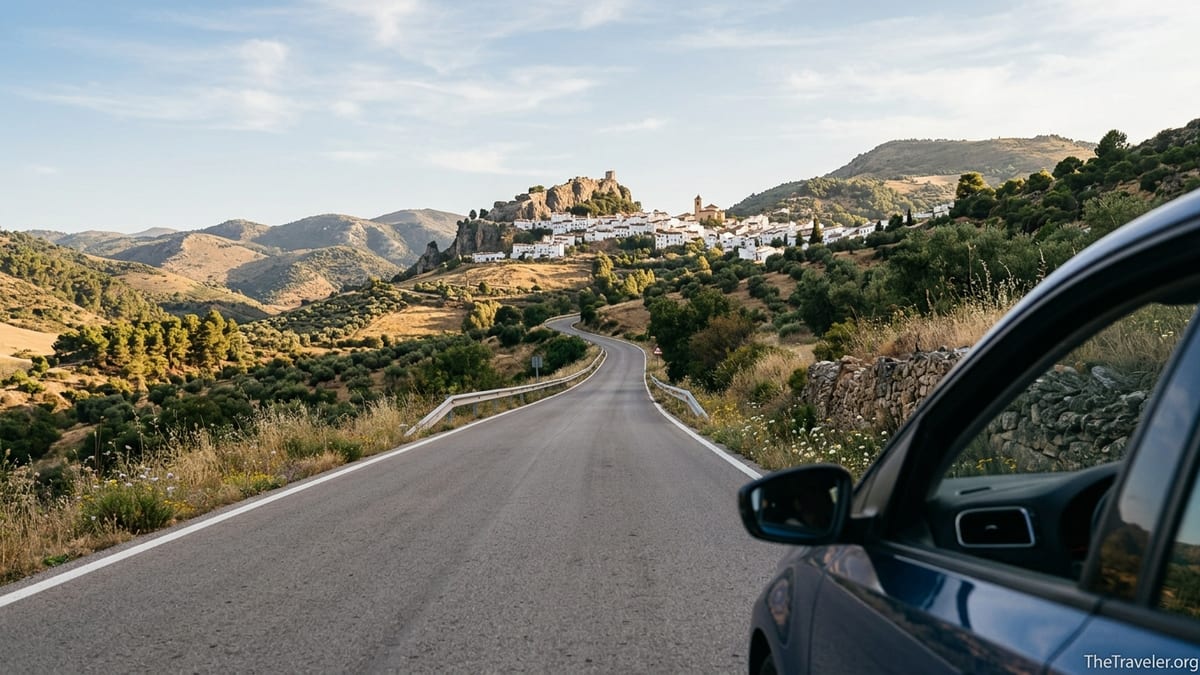
Renting a Car in Málaga and Understanding Local Driving Rules
For most travelers the easiest starting point is Málaga, which has one of Spain’s busiest airports and a dense cluster of rental desks. Major international brands sit alongside Spanish companies, so it pays to compare a few. Compact models are usually the smartest choice for Andalusia’s cities and villages; a small hatchback makes it much easier to navigate old-town streets and tight underground garages than a large SUV. Booking early for peak months such as April to June and September to October typically brings more choice and better prices than waiting until arrival.
When comparing rentals, look carefully at insurance and mileage. Many visitors opt for full coverage to avoid disputes over small scrapes from narrow village lanes or tight car parks. Fuel policies often default to full-to-full, which is straightforward: pick up the car with a full tank and return it the same way. Diesel and petrol are both widely available across Andalusia, with self-service stations along the main A-7 coastal highway and A-92 inland route. It is sensible to top up in larger towns such as Antequera, Ronda or Jerez rather than relying on remote village pumps that may keep limited hours.
Spanish roads are generally well maintained, and in this part of the country most of the main routes between the cities are free of tolls. Drivers sit on the left side of the car and drive on the right side of the road, with speed limits commonly 120 km/h on motorways, 90 or 100 km/h on secondary roads, and 30 km/h inside many town centers. Roundabouts are common; traffic already in the circle has priority, so approach slowly and signal clearly when exiting. Keep in mind that Spanish cities increasingly use low-emission or restricted-access zones, so it is rarely worth driving directly into historic centers when a ring-road car park is available.
If you are arriving in Málaga and planning to spend a couple of nights in the city, consider whether you need the car immediately. You can easily reach the center from the airport by train or taxi and pick up your rental on the day you leave for Ronda or Granada. This avoids paying for a vehicle that will sit in a garage while you explore on foot and reduces the stress of driving into a busy urban area just after a flight.
Parking and City Driving: Málaga, Seville, Córdoba and Granada
Driving into Andalusia’s historic cities can feel intimidating at first, but it becomes manageable with realistic expectations and smart planning. Old neighborhoods in Málaga, Seville, Córdoba and Granada are a tangle of one-way lanes, pedestrianized streets and concrete bollards that rise from the ground to control access. Rather than trying to park right next to your accommodation, aim for perimeter garages and walk or taxi the final stretch. It is normal, for example, to leave your car in a multistory lot outside Granada’s Albaicín and climb up through the cobbled alleys on foot.
Málaga offers several practical options near the center without driving into the tightest streets. Large underground garages sit by the port area and along the ring road, within a short walk of the cathedral and main shopping streets. These are well signposted from the coastal highways. In Seville, many drivers choose car parks near the river or at major avenues and then wander into Santa Cruz and the cathedral area. The same approach works in Córdoba, where garages close to the Guadalquivir allow you to cross by footbridge into the Mezquita quarter, avoiding medieval lanes that were never designed for modern vehicles.
Granada’s hills and steep access ramps make some private garages difficult for nervous drivers. A cautious solution is to select accommodation that either includes on-site parking with straightforward access or sits near a public garage reached by wider streets. It is worth messaging hotels and apartments in advance to ask which route your navigation should follow; many will send a recommended approach road that avoids restricted zones and camera-controlled streets that can result in fines if entered without authorization.
In all these cities, on-street parking in central districts is heavily regulated. Blue-painted bays usually indicate paid zones that work on a ticket system and limit the number of hours you can stay. These can be useful for quick stops but are rarely ideal for overnight. Underground garages, though more expensive per hour, are usually the best bet for secure, longer stays. Factor daily parking costs into your road trip budget in the same way you would allow for fuel and accommodation.
Scenic Roads and White Villages: Between Ronda, Cádiz and Málaga
The real magic of a southern Spain road trip often happens between the major cities. Nowhere is this more apparent than in the serrated hills between Ronda, Málaga and Cádiz, where the classic white villages route winds through cork oak forests and limestone peaks. From the Costa del Sol, the mountain road climbing from San Pedro de Alcántara to Ronda is a standout drive: a well surfaced, winding route that quickly swaps beach towers for sweeping vistas. Confident drivers enjoy its curves, while those prone to motion sickness may prefer to build in a photo stop or two at signed miradores along the way.
Ronda itself sits dramatically above a gorge crossed by its famous bridge, and it makes a natural base for exploring nearby villages. Within an hour’s drive you can be in Setenil de las Bodegas, where houses appear carved into a rock overhang, or in Grazalema, ringed by the mountains of a natural park that is among Spain’s wettest spots despite Andalusia’s dry reputation. Continuing west and north brings you to Zahara de la Sierra, balanced above a turquoise reservoir, and Arcos de la Frontera, perched on a sandstone ridge. Each village has its own atmosphere and parking realities, usually involving a mix of small central squares and larger car parks on the outskirts.
Most of the white village roads are standard two-lane routes, narrower than motorways but in good condition. They twist and climb, so driving times are longer than distances suggest. A 40 kilometer stretch between Ronda and Grazalema can easily take an hour with stops. Plan your days around a few key villages instead of trying to see every point on the map. It is common to combine Ronda, Zahara and Grazalema in a single loop before returning to Ronda for the night, or to travel one way from Seville to Málaga via a chain of hill towns over two relaxed days.
Parking in the white villages usually requires a short uphill or downhill walk. Many towns provide signposted car parks just below the center, allowing visitors to leave their vehicles and continue on foot through the narrowest streets. In Zahara de la Sierra, for example, it is practical to park near the lower part of the village, then stroll up past whitewashed houses toward the castle ruins. In Grazalema, a central parking area near the main square makes a convenient starting point for both village wandering and nearby hiking trails.
Designing a 7 Day Highlight Circuit
In one week you can enjoy a focused snapshot of Andalusia without spending every day behind the wheel. A logical 7 day circuit begins and ends in Málaga, looping west through the mountains and back via the coast. After a first night in Málaga to recover from the journey and explore the city center on foot, you might collect your rental car on day two and drive inland. The direct route to Ronda takes roughly two hours, but allowing extra time for coffee stops and viewpoints makes the day more enjoyable.
Spend your second and third nights in or near Ronda, using the full day between to explore at a comfortable pace. You could walk the town’s walls and viewpoints, then spend the afternoon driving a short loop through one or two nearby white villages before returning for dinner overlooking the gorge. On day four, point the car toward Seville, taking an indirect route via Arcos de la Frontera or other hilltop villages in Cádiz province. The drive to Seville, even with stops, fits easily into a single day if you leave Ronda by late morning.
Days five and six work well based in Seville, where you are likely to park the car and forget about it while visiting the cathedral, Alcázar and lively neighborhoods on foot. If you are keen to include Córdoba, one option is to leave early one morning for a full day round trip by train while the car stays safe in the garage. On day seven, drive back to Málaga using the main highways, which keeps the final leg simple and allows time to return the car and reach the airport. This 7 day outline gives you cities, countryside and white villages without trying to cover every famous site.
Travelers who prefer fewer hotel changes can compress this circuit by staying three nights each in Ronda and Seville, with Málaga limited to a final overnight near the airport. The key is to avoid the temptation to add too many detours to each driving day. Long chains of villages look appealing on a map but often turn into a blur from the driver’s seat. Choosing one or two special stops per leg keeps the week feeling like a holiday instead of a checklist.
Stretching to 10 or 14 Days: Adding Cádiz, Córdoba and Granada
With 10 days you can layer in more depth without sacrificing rest. One popular pattern is a broad clockwise loop: Málaga to Ronda, on to Cádiz, across to Seville, up to Córdoba, over to Granada and back to Málaga. From Ronda, aim for a leisurely drive toward the Atlantic, descending through Arcos de la Frontera and on to Cádiz. The transition from mountain ridges to wide ocean horizons feels dramatic, and an overnight in Cádiz delivers a dose of sea breezes and sunset walks along the old city walls.
Leaving Cádiz, the drive to Seville follows fast roads and can be as short or as long as you like depending on stops. Jerez de la Frontera, with its sherry bodegas, makes an easy and worthwhile break. Seville merits at least two or three nights in a 10 day plan, allowing for a full day in the historic center plus time to relax in parks or sample tapas districts away from the core. From there, Córdoba is roughly a two hour drive inland, mostly on straightforward highways. A single night in Córdoba is enough to see the Mezquita and stroll the Jewish quarter, though lingering longer rewards those who enjoy slower evenings in smaller cities.
Granada slots naturally onto the next leg. The drive from Córdoba to Granada crosses olive-covered hills on good roads, and it is possible to stop at smaller towns along the way if you wish. Plan to leave your car in a secure garage on arrival and treat Granada largely as a walking city, timing your visit around whichever Alhambra entry slot you secure. With two nights here you can fit the Alhambra, the Albaicín and viewpoints over the city, plus an evening in the modern center. The final drive back to Málaga is relatively short, so even in a 10 day itinerary you can move at a measured pace.
A 14 day circuit relaxes everything further and allows more white village detours. For example, you might add extra nights in Ronda or in one of the Sierra de Grazalema villages such as Grazalema or Zahara, treating them as bases for short hikes or slow mornings in local cafés. On the eastern side of the loop, a longer stay near Granada opens the door to side trips into the Alpujarras or to less visited hill towns. With two weeks you can easily schedule several off days with no driving at all, simply enjoying local markets, long lunches and evening strolls while your car remains parked.
Practical Tips for Fuel, Navigation and Seasonal Travel
Fueling up, staying oriented and timing your trip well all make a noticeable difference to how enjoyable the journey feels. Fuel prices in Spain fluctuate but are usually clearly displayed at roadside stations, with small differences between brands. It is often cheaper to fill up at larger stations near cities or along major highways than at remote village pumps. Contactless payment is widely accepted, but it is still worth carrying a physical bank card and some cash in case of technical issues at smaller outlets.
Many drivers rely on smartphone navigation, which works well across Andalusia, including most white village roads. Before each driving day, check your settings to avoid accidentally selecting the absolute shortest route, which can send you through unnecessarily narrow lanes or unpaved tracks. It is safer to favor main roads and signposted approaches to villages unless your accommodation specifically advises a scenic back way. Offline maps are a good backup in hilly areas where mobile coverage can briefly drop, especially between villages in the Sierra de Grazalema.
Season strongly shapes the road trip experience. Spring and autumn provide comfortable daytime temperatures for walking around cities and hiking in the hills, with cooler evenings and a chance of rain in the mountains. July and August can be intensely hot, especially in Seville and Córdoba, so if you travel then it is wise to book accommodations with secure parking and strong air conditioning, plan your driving for early morning or late afternoon, and schedule a mid-day siesta. Winter is quieter, and while coastal and lowland areas stay mild, mountain routes around Ronda and Grazalema can see cooler, damp conditions, so pack a warm layer.
Regardless of season, aim to arrive in each overnight destination before dark, especially when it involves mountain roads or complex urban ring roads. In white villages, daylight makes it much easier to spot parking signage and judge the width of alleys. In larger cities, late afternoon arrivals reduce the risk of encountering rush hour congestion but still give you enough light to find your chosen garage and locate your accommodation on foot. Building this buffer into your itinerary helps the trip feel like a holiday instead of a daily race.
The Takeaway
A southern Spain road trip linking Málaga, Ronda, Cádiz, Seville, Córdoba, Granada and the white villages is as much about how you travel as where you stop. Choosing a compact rental car, parking just outside historic centers and favoring scenic two-lane roads over long stretches of motorway all help you experience Andalusia at a humane pace. The route options are flexible: a 7 day highlight loop, a 10 day circuit that adds Cádiz and Córdoba, or a 14 day journey with extra nights in hill towns and along the coast.
What brings these itineraries together is the combination of practical planning and openness to small discoveries. A quiet café terrace in Grazalema after a mountain drive, an unplanned stop at a mirador between Ronda and the coast, or an evening wandering Cádiz’s sea walls can become as memorable as the headline monuments. With realistic driving days, smart use of parking and a willingness to trade a village or two for more time in your favorites, southern Spain’s roads turn from a logistical challenge into part of the pleasure.
FAQ
Q1. Is it better to start a southern Spain road trip in Málaga or Seville? Starting in Málaga works well because the airport has abundant car rentals and quick access to both coastal highways and the mountain road to Ronda, but Seville also makes a good starting point if flights there are more convenient for you.
Q2. Do I need an international driving permit to drive in Andalusia? If your license is issued within the European Union you do not usually need an international permit, while drivers from other regions are often advised to carry one alongside their home license to avoid complications if stopped or when picking up a rental.
Q3. How difficult is it to drive in the white villages around Ronda and Cádiz? The roads between villages are generally well surfaced but winding and sometimes steep, so they require attentive driving, and inside the villages themselves streets are often narrow, which is why most visitors park in signposted lots on the edge and continue on foot.
Q4. Can I visit Córdoba as a day trip without driving there? Many travelers base themselves in Seville or Málaga and visit Córdoba by train for the day, leaving their rental car parked, which avoids navigating Córdoba’s historic center and can be more relaxing than adding another driving leg.
Q5. Are there toll roads on a southern Spain road trip route? In this part of Andalusia most of the main highways between Málaga, Ronda, Cádiz, Seville, Córdoba and Granada are toll free, though you may occasionally encounter short toll stretches on coastal routes, so checking your navigation settings each day is sensible.
Q6. What kind of car is best for driving in Andalusian cities and villages? A small or mid-size hatchback is usually ideal, since compact cars are easier to maneuver through tight streets and into underground garages, and they are also more economical on fuel than larger SUVs or vans.
Q7. How many white villages should I try to see in one day? For a comfortable pace most travelers limit themselves to two or three villages in a single day, allowing time to park, walk, have a meal and enjoy viewpoints rather than spending most of the day getting in and out of the car.
Q8. Is parking safe and secure in cities like Seville and Granada?Large, established underground car parks in central areas are commonly used by locals and visitors, are generally considered secure and are usually monitored, which makes them a sensible choice for overnight parking.
Q9. What is the best season for a southern Spain road trip? Spring and autumn are often ideal, with warm days and cooler nights that suit both city sightseeing and countryside drives, while summer can be very hot inland and winter brings quieter roads but cooler, wetter conditions in the mountains.
Q10. Can I do this route using only public transport instead of driving?Trains and buses link the main cities and some larger towns, but many white villages and scenic back roads are hard to reach without a car, so public transport is excellent for an urban-focused trip but less flexible for exploring the smaller hill towns.