


Southern Spain is one of the easiest regions in Europe to explore by rail. High-speed lines stitch together Seville, Córdoba, Málaga and Granada in under three hours, while regional trains and a well-developed road network open up white villages, coastlines and mountain towns. The trick is knowing when to rely on trains, when to accept slower regional services, and when renting a car makes more sense for your itinerary and budget.
Understanding the Rail Network in Southern Spain
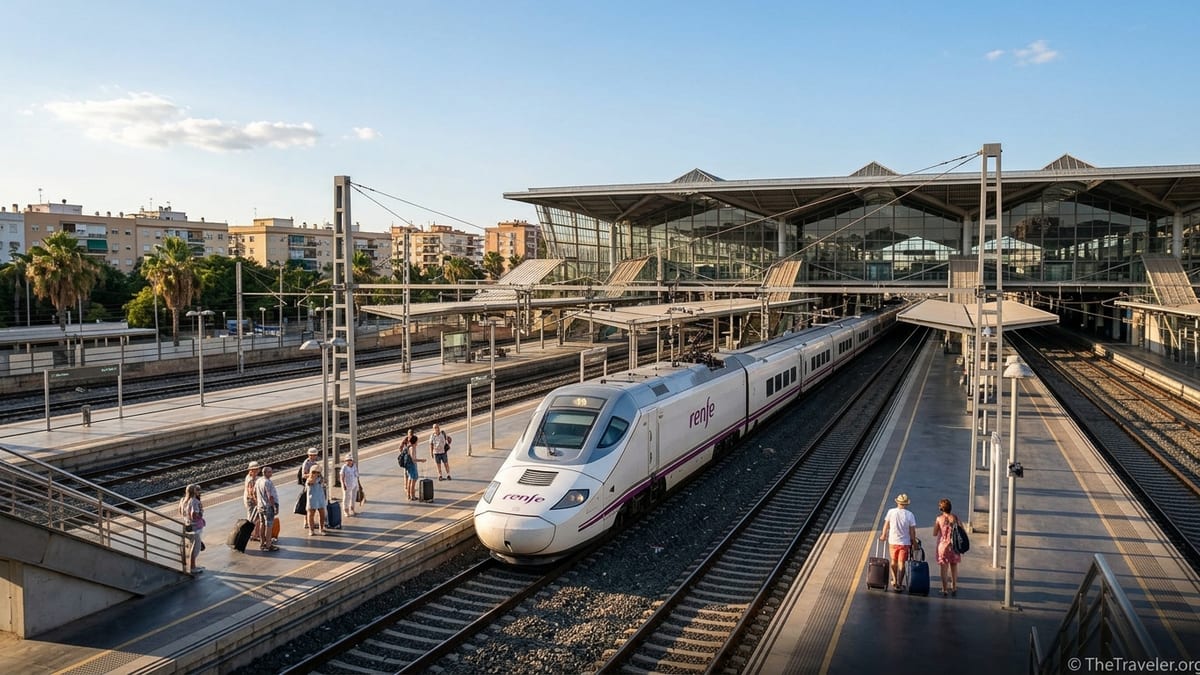
Andalusia’s four big hitters for first-time visitors are Seville, Córdoba, Málaga and Granada. All four are connected by a mix of high-speed services, branded as AVE, Avlo or Avant, and classic Renfe Media Distancia regional trains on conventional tracks. On the main high-speed spine, Córdoba is the key junction: almost any fast train between Seville, Málaga and Granada will pass through Córdoba or at least use the same high-speed corridor between Seville and Córdoba.
On the high-speed line, Seville to Córdoba takes roughly 40 to 45 minutes, Córdoba to Málaga around 50 minutes to 1 hour, and Córdoba to Granada about 1 hour 15 to 30 minutes depending on stops. In practice, that means you can travel Seville to Málaga in roughly 2 hours via Córdoba, and Seville to Granada in about 2.5 hours, usually on a through Avant service that does not require changing trains. Regional Media Distancia services between these cities exist but are significantly slower, often taking 3 hours or more between Seville and Málaga on the old line with many intermediate stops.
For visitors, the key distinction is speed, comfort and price versus flexibility. High-speed and Avant services are air-conditioned, reserved-seat trains with luggage racks and usually power sockets at the seats. Regional Media Distancia trains may be older, without assigned seating, but can be cheaper and reach smaller stations, particularly on lines radiating out of Córdoba and Málaga to smaller towns. If your trip is mainly the four major cities, you will almost always prefer high-speed or Avant services for the time savings alone.
Another important nuance is competition. On some high-speed routes, you will see multiple brands: Renfe’s AVE and Avlo, plus private operators like iryo and Ouigo on corridors that pass through Córdoba. These competing services can push prices down on popular times, but they do not necessarily cover every city pair. For example, Seville–Córdoba and Córdoba–Málaga often have several operators on the high-speed line, while Córdoba–Granada is more dominated by Renfe-operated Avant services.
Key City Stations and How They Fit Your Itinerary
In Seville, almost all long-distance and high-speed services use Santa Justa station, located roughly 10 to 15 minutes by taxi from the historic center around the cathedral. It is walkable for some travelers, about 25 to 30 minutes on foot, but most visitors with luggage opt for a taxi, rideshare, or local bus. Santa Justa is a modern through-station with ticket offices, self-service machines, cafés and luggage services, making it a practical starting or ending point for your railway journeys in southern Spain.
Córdoba’s main station, Córdoba Central, sits about a 20-minute walk or a short bus or taxi ride north-west of the Mezquita and old town. The station is more functional than charming, but its location makes it ideal for a same-day stopover. Many travelers, for example, travel Seville to Madrid and schedule a 4–6 hour break in Córdoba to visit the Mezquita and old Jewish quarter before continuing. The close proximity of the bus station next door also makes Córdoba a hub if you want to combine train and bus to reach places like Priego de Córdoba or Zuheros.
Málaga’s María Zambrano station is integrated with the local Cercanías commuter rail and a modern shopping mall. It is roughly a 15–20 minute walk from the historic center and about one stop by commuter train from Málaga’s airport. This station works especially well for travelers landing in Málaga and immediately heading inland by train to Córdoba or Seville, or for those ending a rail trip with a flight home. Luggage storage facilities are available, so you can leave bags and walk into town or take the metro to the port or beach.
Granada’s rebuilt station sits just north of the center, about 20 minutes on foot from the cathedral and a short taxi ride up to the Albayzín or the Alhambra area. Unlike Seville and Málaga, Granada does not yet have a full metro loop, so taxis, buses and walking are the main options to and from the station. If you plan a morning Alhambra visit and an afternoon train, give yourself a comfortable time buffer, as traffic on the climb down from the Alhambra hill can be slow at peak hours.
High-Speed vs Regional: Which Train Should You Choose?
Between Seville, Córdoba, Málaga and Granada, high-speed or Avant services are usually the best value when you factor in time and comfort. A typical Seville–Córdoba high-speed ticket bought in advance might start from around 15 to 25 euros in a basic fare, with flexible tickets or peak times rising into the 30–40 euro range. That is for a journey of under an hour on a modern train with reserved seating. By contrast, a slower regional train might save you a small amount, especially close to the travel date, but add 30–60 minutes to the trip with more intermediate stops.
On Seville–Málaga, high-speed trains running via Córdoba typically take about 2 hours in total. A Media Distancia service on the old route can take nearer 3 hours, weaving through towns like Osuna, Antequera and Álora. That regional route is more scenic, with glimpses of olive groves and rugged hills, and can appeal to travelers who appreciate the journey as much as the destination. However, if you have only a week in Andalusia and are trying to fit all four cities into a single itinerary, the additional hour can be decisive, especially when you add in hotel check-in and transfer times.
Granada is a helpful example of the high-speed transformation. Before the high-speed link, reaching Granada from Seville or Málaga often involved a long regional journey or a combination of bus and train. Now Avant services connect Seville–Córdoba–Granada and Málaga–Granada in roughly 1.5 to 2.5 hours, with modern rolling stock and consistent timetables. For many visitors, this makes Granada a comfortable two or three-night add-on to a Seville–Málaga trip without ever needing a car.
There are still situations where regional trains make more sense. If you are exploring smaller towns, such as traveling from Seville towards Ronda via the classic line through El Chorro and Bobadilla, regional trains are sometimes the only rail option. They can also be useful if you are booking late during a busy holiday and high-speed trains are sold out or very expensive for your desired time. In those cases, accept the slower speed as part of the experience, bring snacks, and enjoy the countryside views.
How and Where to Buy Train Tickets
The primary seller for most services is Renfe, Spain’s national rail operator, available through its website, app and station ticket machines. On major high-speed routes around Córdoba, you will also see competing operators like iryo and Ouigo selling their own tickets. For a simple Seville–Córdoba or Córdoba–Málaga trip, starting your search on Renfe’s official channels is usually enough, then comparing a couple of services on a well-known aggregator or booking app if you want to check alternative brands or times.
Buying tickets in advance is strongly recommended for high-speed and Avant trains, particularly in Easter week, spring and autumn weekends, and during summer holidays. Advance purchase can bring noticeable savings. For example, you might find a Seville–Málaga high-speed ticket a month ahead from about 25–35 euros in a basic fare, whereas buying on the day for a popular afternoon departure could be closer to 50 euros or more. Regional Media Distancia trains sometimes have fixed or less dynamic pricing, so the savings from advance booking may be smaller, but seats can still sell out on busy days.
Most foreign travelers choose e-tickets with QR codes, which can be loaded into the Renfe app or presented from an email on your phone. At stations like Santa Justa, Córdoba Central, María Zambrano and Granada, you will pass your ticket through a barcode reader before reaching the platform for high-speed trains. It is wise to arrive at least 20–30 minutes early so you have time for this process, especially if you need to collect a paper ticket from a machine, clarify a seat assignment, or purchase last-minute snacks.
If you prefer human assistance, staffed ticket counters are available in all four major stations, although queues can build up at peak times or around holidays. Station ticket machines typically have English-language menus and accept major credit and debit cards. For travelers connecting to or from an airport, such as Málaga Costa del Sol or Seville’s San Pablo, local commuter or airport bus tickets are bought separately from the long-distance ticket, so factor that into your budget and transfer time.
Luggage, Comfort and Onboard Experience
On Spanish high-speed and Avant services, luggage rules are relatively generous for regular travelers. As a broad guideline, expect to be allowed a small suitcase, a larger cabin-size or slightly larger case, and a personal item such as a backpack or handbag. There is no formal weight check for most leisure travelers, but you must be able to lift your bags yourself onto overhead racks or into luggage stacks at the ends of the carriage. On Media Distancia trains, you will also find overhead shelves and some luggage areas, though they can be tighter and fill up quickly at busy times.
Seat classes are straightforward. Standard class, often called Turista, is perfectly comfortable for trips under three hours, with reclining seats, individual tables or tray tables, and at least one plug socket per pair of seats on most modern trains. In Comfort or Preferente classes, you may get more legroom, a 2+1 seating layout and sometimes included snacks or at-seat service on longer journeys. For the short hops between Seville, Córdoba, Málaga and Granada, upgrading is nice but not essential unless you particularly value extra space.
Food options vary by service. Longer AVE trains may have a café car with hot drinks, sandwiches and light meals, while shorter Avant or Media Distancia services might restrict you to a trolley service or vending machines at the station. Because Seville, Córdoba, Málaga and Granada stations all have cafés and supermarket-style convenience shops, many travelers simply pick up water, fruit and a bocadillo before boarding. This approach is both cost-effective and more reliable than assuming the café car will be open or well-stocked at your time of travel.
For families or travelers carrying larger luggage, boarding early is particularly useful. Platforms usually open around 15–20 minutes before departure for high-speed trains, and being near the front of the boarding queue helps you find space for large suitcases. If you are traveling with sports equipment or unusually large items, check the latest size requirements on the operator’s website before you travel, as restrictions can be tighter on the busiest high-speed routes.
When Renting a Car Makes Sense
For a classic first-time itinerary focused on Seville, Córdoba, Granada and Málaga, you can comfortably rely on trains and occasional local taxis without renting a car at all. A 10-day loop might look like three nights in Seville, two in Córdoba, three in Granada and two in Málaga, all joined by high-speed or Avant trains. In this scenario, a car would be more hassle than help in the cities, where parking is expensive and old quarters are full of narrow, one-way streets and pedestrian zones.
Renting a car becomes more attractive once you want to explore smaller towns that are inconvenient by train or bus. Examples include the white villages of the province of Cádiz and Málaga, like Zahara de la Sierra or Frigiliana, or the hill towns of the Subbética region between Córdoba and Granada. Reaching Ronda, Grazalema or Arcos de la Frontera is possible by bus or a combination of regional train and bus, but having a car lets you link them into a scenic loop with spontaneous photo stops and vineyard visits.
Consider a concrete case. A couple planning five days between Málaga and Seville might spend two nights in Málaga, two in Ronda and one in an inland white village before arriving in Seville. In that case, taking the high-speed train Málaga–Seville directly would skip Ronda entirely. Renting a car in Málaga for four days, driving the mountain route to Ronda and on towards Seville, may cost in the region of 40–60 euros per day for a compact car, plus fuel and parking. For two people, this cost can be worthwhile if the goal is rural scenery and flexibility rather than strict budget savings.
Another factor is group size. For a family or group of four or five adults, multiple high-speed train tickets between several cities can add up quickly. For example, four high-speed tickets from Seville to Málaga, even at a modest 30–35 euros each, already exceed 120 euros for that leg alone. If you then plan a detour into the countryside, a single rental car might be cheaper overall while also providing door-to-door convenience to more remote accommodations such as rural guesthouses or farm stays.
However, driving in historic centers can be stressful. Many older districts in Seville, Córdoba and Granada have controlled-access zones with cameras that fine unauthorized cars. Parking garages in central areas may cost 20–30 euros per day. To get the benefits of both modes, many travelers time their rental so that they pick up a car on the way out of a city from a station-area office, then drop it at the next city’s station before diving back into pedestrian sightseeing. This station-to-station approach works especially well between Málaga, Ronda and Seville, or between Málaga and the eastern coast before ending in Granada.
Sample Rail-Based Itineraries Around Seville, Córdoba, Málaga and Granada
One straightforward rail itinerary for a week in southern Spain focuses entirely on the main cities and minimizes packing and unpacking. Start with three nights in Seville, arriving by plane or train and using local buses or taxis from Santa Justa. Take a high-speed train to Córdoba for two nights, giving you a full day to explore the Mezquita, the Roman bridge and the patios without rushing. From Córdoba, continue by Avant to Granada for two nights, timing your Alhambra visit for the morning after arrival to make the most of your energy and the softer light.
With a few more days, you can weave Málaga into the loop. After Granada, take the Avant or Media Distancia service to Málaga in roughly 1.5–2 hours, then enjoy two or three nights split between the historic center and the beach. From Málaga, catch a high-speed service back to Seville via Córdoba if you are flying out of Seville, or fly home directly from Málaga’s international airport. This rail-only loop lets you experience four distinct urban atmospheres without handling a car, while journey times between each city remain under three hours.
Travelers who prefer a mix of rail and rural exploration might flip the sequence. Start in Málaga with one night near the station, then rent a car or take a regional train into the hills towards Ronda and the white villages for three or four nights. Drop the car near Seville’s Santa Justa station or in a suburban office, then rely on trains from Seville onwards to Córdoba and Granada. This hybrid plan gives you both the ease of city-to-city high-speed travel and the joy of winding roads, hiking trails and village squares that trains do not reach.
If you only have five or six days, pick just two bases and use trains for day trips. For example, base yourself in Seville for four nights and take a high-speed morning train to Córdoba, returning in the evening to avoid moving hotels. Another option is to stay in Málaga and use the rail line to Córdoba for a long day trip, then dedicate a separate trip to Granada when you have more time. Given how frequent and relatively fast the trains are on the Seville–Córdoba–Málaga triangle, day trips by rail are usually more relaxing than attempting to drive in and out of city centers for just a few hours of sightseeing.
The Takeaway
Southern Spain is one of Europe’s best regions for combining fast, reliable trains with selective car rental. Seville, Córdoba, Málaga and Granada are all served by modern high-speed or Avant services that keep journey times under three hours and often closer to one. If your itinerary focuses on these cities, you can confidently plan a rail-only trip, using taxis, buses and your own feet to navigate compact historic centers rich in monuments and local food.
Renting a car becomes worthwhile when your plans stretch into white villages, hill towns and rural landscapes where trains do not go or only offer slow, infrequent regional services. The cost calculation depends on group size, length of stay and how much you value on-the-spot flexibility versus the simplicity of turning up at a station and boarding a train. For many travelers, the ideal compromise is to use trains between the main cities and add a short driving segment in the middle of the trip.
Whichever balance you choose, planning is easier when you understand the basic structure of Andalusia’s rail network, the differences between high-speed and regional trains, and the practicalities of stations, luggage and ticketing. With that knowledge, you can build an itinerary that feels efficient rather than rushed, with plenty of time on shaded patios and seafront promenades instead of stuck in traffic.
In the end, the best journeys in southern Spain are not defined only by the transport you choose, but by how comfortably you move between experiences: a morning in the Mezquita, an afternoon train through olive groves, and an evening of tapas in a different city. Used thoughtfully, the train network is the backbone that ties these moments together.
FAQ
Q1. Do I need to book trains between Seville, Córdoba, Málaga and Granada in advance?
For high-speed and Avant services, advance booking is strongly recommended, especially in peak seasons, to secure seats and better prices. Regional trains can sometimes be bought on the day, but busy dates still sell out.
Q2. How early should I arrive at the station before a high-speed train?
Arriving 20 to 30 minutes before departure is usually enough to clear ticket gates, find your platform and board calmly, though you may want a bit more time at unfamiliar stations.
Q3. Can I take large suitcases on Spanish high-speed trains?
Yes, large suitcases are allowed, but you must be able to lift them yourself into overhead racks or luggage stacks, and space can fill up on busy departures.
Q4. Is it realistic to visit Córdoba as a day trip by train?
Yes, many travelers make a day trip from Seville or Málaga to Córdoba, with journey times of about 45 to 60 minutes on high-speed trains, leaving several hours to explore the Mezquita and old town.
Q5. Are there direct trains from Seville to Granada?
Yes, Avant services typically run directly between Seville and Granada via Córdoba, with times around 2.5 hours, though specific timetables can vary by season and day of the week.
Q6. When is renting a car better than using trains?
Renting a car is better when you want to explore white villages, mountain towns or rural areas with limited rail and bus service, or when a group’s combined train fares would exceed the total cost of a rental.
Q7. Is driving in city centers like Seville and Granada difficult?
Driving in historic centers can be stressful due to narrow streets, one-way systems and restricted zones. Many visitors avoid driving there and instead park on the edge or rely on taxis and public transport.
Q8. Can I combine train travel with a short car rental in Andalusia?
Yes, a popular strategy is to travel by train between major cities and rent a car only for two to four days to visit rural areas, picking up and dropping off near main stations.
Q9. Are regional trains in southern Spain reliable?
Regional Media Distancia trains are generally reliable but slower, with fewer departures per day, so they require a bit more timetable planning than the frequent high-speed services.
Q10. Is first class worth it on short high-speed trips?
For journeys under three hours, standard class is usually sufficient. First or comfort class is mainly worth it if you strongly value extra space, quieter cars or added onboard services.